Showing posts with label 1915_0414. Show all posts

Monday, 20 April 2015

Poem ~ A Gadget for Every Soldier - Tuesday, 20 April 1915


Impression Sketch of two officers of the Loyal North Lancashire Regiment pose for the camera in February 1915 (the officer on the right is holding a Vest Pocket Kodak) - By Jamie Mann. An original images can be seen at: http://www.theguardian.com/books/gallery/2014/jun/13/first-world-war-soldiers-perspective-in-pictures#img-1

For more details on this WW1 gadget, equal to today's mobile cameras, see article,  'The Vest Pocket Kodak was the Soldier’s Camera': http://blog.nationalmediamuseum.org.uk/2014/03/13/the-vest-pocket-kodak-was-the-soldiers-camera/

Picture a picture of a new small gadget,
Something the size of the hand of a man.
A compact machine, shown actual size,
Under the heading 'Give him a soldier's Kodak.'

This war is different from wars before -
So is suggestion to solve a problem,
Of giving a friend or relative about
To leave for the front; a brand new pocket Kodak.

Precise as a watch, to tell the story
Of Australians - Kodak from Sydney,
NE and all states for soldier’s desire
To record memories, on a cartridge film of Kodak.

Vest pocket cameras extend to open
Ready, as shown in operation, by any
Hand - all laid out in black and white -
An ideal gift for a soldier; to the front with Kodak.

Ideal gift for any Anzac, is this vest
Pocket Kodak - small thin and flat
Slightly bigger than a cigarette case,
To fit in a tunic pocket - he's armed with a Kodak.

Light, small and strong - a VPK made
Of steel and aluminum - to take rough
Rides, strong enough to stop a bullet
As some already have done - is armor of Kodak.

A gadget that is simplicity itself -
No need to understand workings.
Usage can be learnt in 30 minutes -
No attachments; simplicity is the word of Kodak.

Always ready for action to capture 
A moment, the VPK is never in way.
Extend the front and press trigger -
A picture is made - 8 can be taken with a Kodak.

Easy to load as a revolver, with image
Size 2 1/2 long 11/4 in. wide, to enlarge
To any size - A single lens can capture
In bright sunshine; so is the advantage of Kodak.

The anastigmatic lens type is best
For the soldier - twice as fast in light
That is less than good, a 50/- model;
The film cartridge always gives quality in Kodak.

The film stays fresh for 12 months;
Ideal for the soldier faced with delays
In front line developing - or to send
Home for printing, with a good dealer of Kodak.

The proof is in the picture displays,
Made from soldiers VPK negatives.
So if you have an Anzac relative, arm
Him with Kodak - as easy to shoot as a revolver.

by Jamie Mann.

Anon.,1915. Advert: Give Him a Soldier's Kodak. The Sydney Morning Herald, [online] 14 Apr. P.7. Col.5-8. Available at: http://trove.nla.gov.au/ndp/del/page/1275186?zoomLevel=1 [Accessed: 20 April 2015].

Mann, J., 2015. 100 years Ago - Poems by Jamie Mann. [letter] (Personal communication, 20 April 2015). 


#WW1 #WW1centenary #GreatWar #WW1poem #GreatWar #WW1centenary #worldwarone #worldwaroneremembered #WW1Western front #WW1Australia #WW1Anzac

Saturday, 18 April 2015

Poem ~ Neutral Ship Sunk - Sunday, 18 April 1915


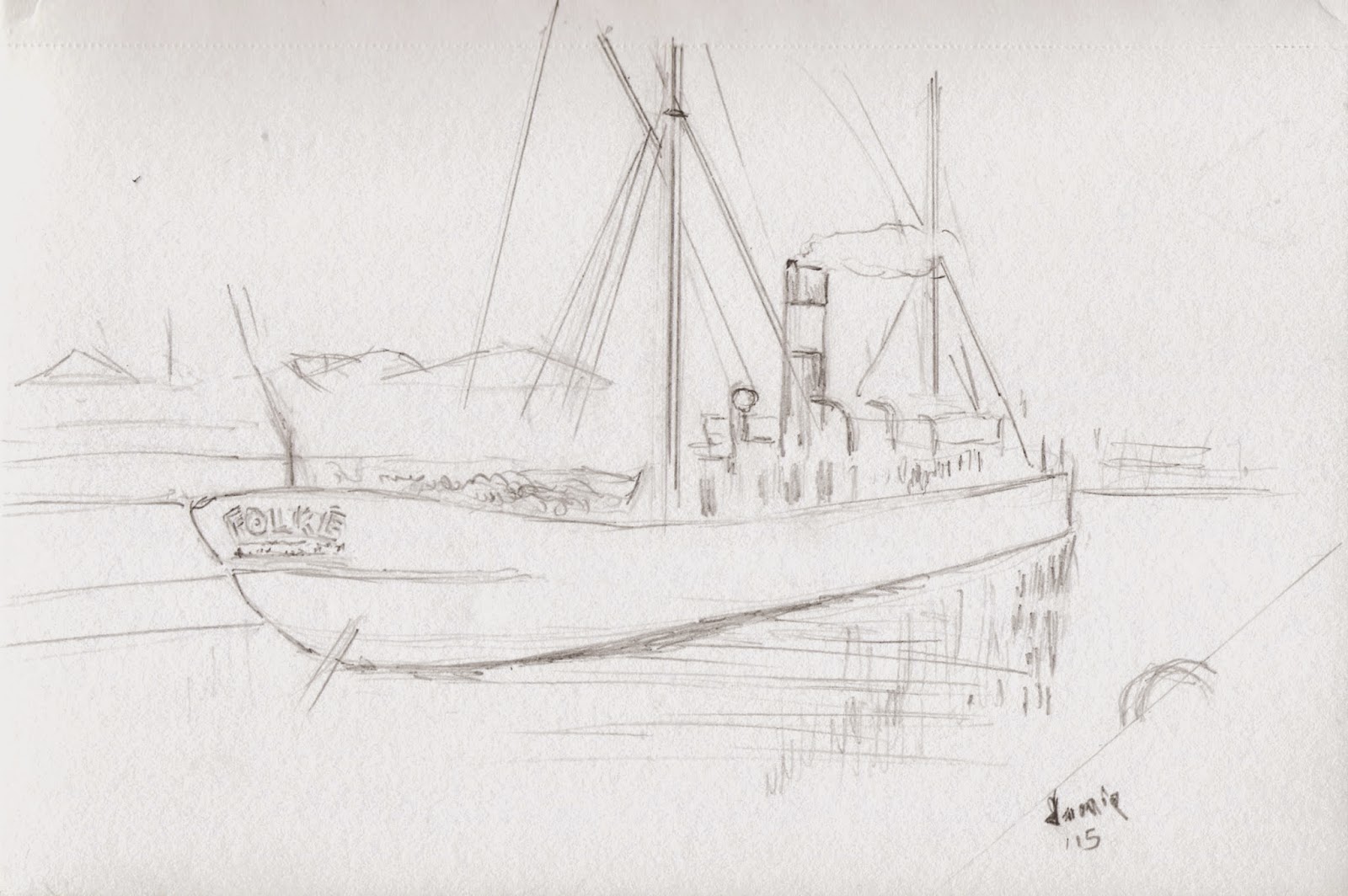
Impression Sketch of Swedish steamer Folke - By Jamie Mann. An original images can be seen at: http://www.wrecksite.eu/wreck.aspx?11198 SS Folke [+1915]

On night 14 April, off the Scottish Coast,
Some twenty miles off Peterhead, sailed
A Swedish steamer Folke –

The route of the vessel began at port
Of Stavanger, heading towards London,
With a cargo of pit props.

In the darkness of 10 p.m., on the aft
Of the vessel, was a loud explosion;
Props were blown into the air.

The suggestion was the propeller had
Exploded - as machinery began to race -
Crewmembers of seventeen, to include
Two women - took to boats.

With provisions two small boats were
Ready for launch – the steamer took two
And half hours to sink as they stayed
In the area, watching the loss.

The crew, being split between two boats,
Stayed in touch - but after a time, drifting
In darkness, moved apart.

The mate of the vessel, Mr Petersen told
They had been in the water fourteen hours;
When found by 'Fisher Prince' - the others
Picked up by 'North Cape'.

The Captain of the Folke believed the boat
Had been torpedoed - stating that he heard
Sounds of a sea craft.

With a motor sound moving away moments
Before the explosion - among the survivors
Was a man wearing only a shirt.

by Jamie Mann.

Anon.,1915. Swedish Ship Blown Up. The Daily Telegraph, [online] 17 Apr. P.11. Col.1. Available at: http://www.telegraph.co.uk/news/ww1-archive/11539851/Daily-Telegraph-April-17-1915.html [Accessed: 18 April 2015].

Mann, J., 2015. 100 years Ago - Poems by Jamie Mann. [letter] (Personal communication, 18 April 2015). 


#WW1 #WW1centenary #GreatWar #WW1poem #GreatWar #WW1centenary #worldwarone #worldwaroneremembered  #WW1Sweden 

Wednesday, 15 April 2015

Poesia ~ The Rising d'Italia - Giovedi, 15 April 1915


Impressione Sketch di Benito Mussolini - Di Jamie Mann. Le immagini originali possono essere visti sul sito: http://www.historylearningsite.co.uk/benito_mussolini.htm

Ora l'Italia ha iniziato il loro movimento in guerra.
Gli uomini dell'esercito italiano sono stati ordinati,
Per prepararsi rapidamente pronti.

Ufficiali italiani in Svizzera Canton Ticino,
Nel ricevere gli ordini sono stati dati un percorso stradale
Per preparare il loro viaggio verso incrociatori italiani.

Gli incrociatori italiani di Marsata
E Conte di Cavour erano poi al porto.
Il loro ricevimento delle bandiere di guerra tenuto pronto.

Alcuni mobilitazione civile trasferisce a preparare;
Come con il comitato di formazione di Roma per molti
Studenti e giovani ragazze di di esonero militari.

Il loro impegno è stato quello di dare assistenza del dovere,
Nelle istituzioni statali e negli ospedali - nel frattempo
Pianificazione di primo soccorso è pronta per ferito.

Questa cura, fornita da scuola Samaritano -
Mentre una pressa e di campagna chiamata indignato
Per punire un agente di polizia in una morte civile.

Il precedente Domenica in Piazza Duomo
Per dimostrare per l'Italia di intervenire in guerra
Un civile è stato colpito e ucciso da un bastone.

In risposta il comitato di presidenza del lavoro
Spinto protesta, con un sciopero di 24 ore
Treni e industria fermarono -Negozi chiusi.

Il successo dello sciopero è stato seguito
In numerosi incontri nel pomeriggio
Come sono state sollevate emozioni innalzamento.

Presto l'esercito italiano avrebbe parteggiare
Triplice Intesa; Russia, Francia e
La Gran Bretagna contro il lato Triplice Alleanza.

Italia una volta era stato sul lato d'Austria
Ungheria e la Germania in modo che quando la guerra
Broke avrebbero potuto schierati con loro.

Invece l'Italia ha giocato un gioco di attesa -
Per essere astuti - molti credevano rimanente
Neutro, che costernato i nazionalisti

Mussolini, essere contro ogni guerra, chiamando
Per mettere le braccia verso il basso e sollevare l'umanità,
La sua domanda: Italia, spettatori o combattenti?

Sciolto dal partito socialista, Mussolini,
Come altri hanno deciso di unirsi a lui, in motivazione;
Francia e Gran Bretagna avevano sperato alleanza Italia.

Una necessità di aprire un fronte meridionale ed estendere
Il fronte occidentale così indebolire il nemico -
Italia dopo aver segretamente firmato Trattato di Londra.

Leader italiani erano stati informati che avrebbero
Guadagno terre della Dalmazia, Tirolo e l'Istria -
Che sono stati poi il territorio dell'Adriatico.

da Jamie Mann.

Anon., 1915. L'Italia e la guerra - eccitazione a Milano. The Daily Telegraph, [Online] 15 aprile P.10. Col.4. Disponibile all'indirizzo: http://www.telegraph.co.uk/news/ww1-archive/11520607/Daily-Telegraph-April-15-1915.html [Accessed: 15 aprile 2015].

Mann, J., 2015. 100 anni fa - Poesie di Jamie Mann. [Lettera] (Comunicazione personale, 15 aprile 2015).

http://www.telegraph.co.uk/news/ww1-archive/11520607/Daily-Telegraph-April-15-1915.html

http://worldwaroneblogger.blogspot.co.uk/

# # WW1 WW1centenary #GreatWar # WW1poem #GreatWar # WW1centenary #worldwarone #worldwaroneremembered # WW1Italy

Poem ~ The Rising of Italy - Thursday, 15 April 1915


Impression Sketch of Benito Mussolini - By Jamie Mann. The original images can be seen at: http://www.historylearningsite.co.uk/benito_mussolini.htm

Now Italy began their move into the war.
The men of the Italian army were ordered,
To quickly prepare themselves in readiness.

Italian Officers in Swiss Canton of Ticino,
In receiving orders were given a road route
To prepare their journey to Italian cruisers.

The Italian battle cruisers of Marsata
And Conte de Cavour were then at harbour.
Their receipt of war flags held in readiness.

Some civilian mobilisation moved to prepare;
As with Rome's formation committee for many
Students and young girl's of military exemption.

Their pledge was to give assistance of duty,
In state institutions and hospitals - meanwhile
First aid planning is made ready for wounded.

This care, provided by Samaritan school -
While an indignant press and country call
To punish a police officer in a civil death.

The previous Sunday in Cathedral square,
To demonstrate for Italy to intervene in war,
A civilian was struck and killed by a baton.

In reaction, the labour bureau committee
Prompted protest, with a 24 hour strike
Trains and industry halted - shops closed.

The success of the strike was followed 
By numerous meetings in the afternoon
As heightening emotions were raised.

Soon the Italian army would side with
The triple Entente; Russia, France and
Britain against the triple alliance side.

Italy had once been on side of Austria
Hungary and Germany so that when war
Broke they might have sided with them.

Instead Italy played a waiting game -
To be astute - many believed remaining
Neutral, which dismayed the nationalists

Mussolini, being against any war, calling
To put arms down and raise humanity, until
His question: Italy, spectators or fighters?

Disbanded From the socialist party, Mussolini,
As others agreed to join him, in motivation;
France and Britain had hoped Italy’s alliance.

A need to open a southern front and extend
The western front thereby weaken the enemy -
Italy having secretly signed Treaty of London.
  
Italian leaders had been informed they would
Gain lands of Dalmatia, Tyrol and Istria  -
Which were then the territory of the Adriatic.

by Jamie Mann.

Anon.,1915. Italy and the War – Excitement in Milan. The Daily Telegraph, [online] 15 Apr. P.10. Col.4. Available at: http://www.telegraph.co.uk/news/ww1-archive/11520607/Daily-Telegraph-April-15-1915.html [Accessed: 15 April 2015].

Mann, J., 2015. 100 years Ago - Poems by Jamie Mann. [letter] (Personal communication, 15 April 2015). 


#WW1 #WW1centenary #GreatWar #WW1poem #GreatWar #WW1centenary #worldwarone #worldwaroneremembered  #WW1Italy

1915_0414

Tuesday, 14 April 2015

Poem ~ War Nurses of America, Wednesday, 14 April 1915


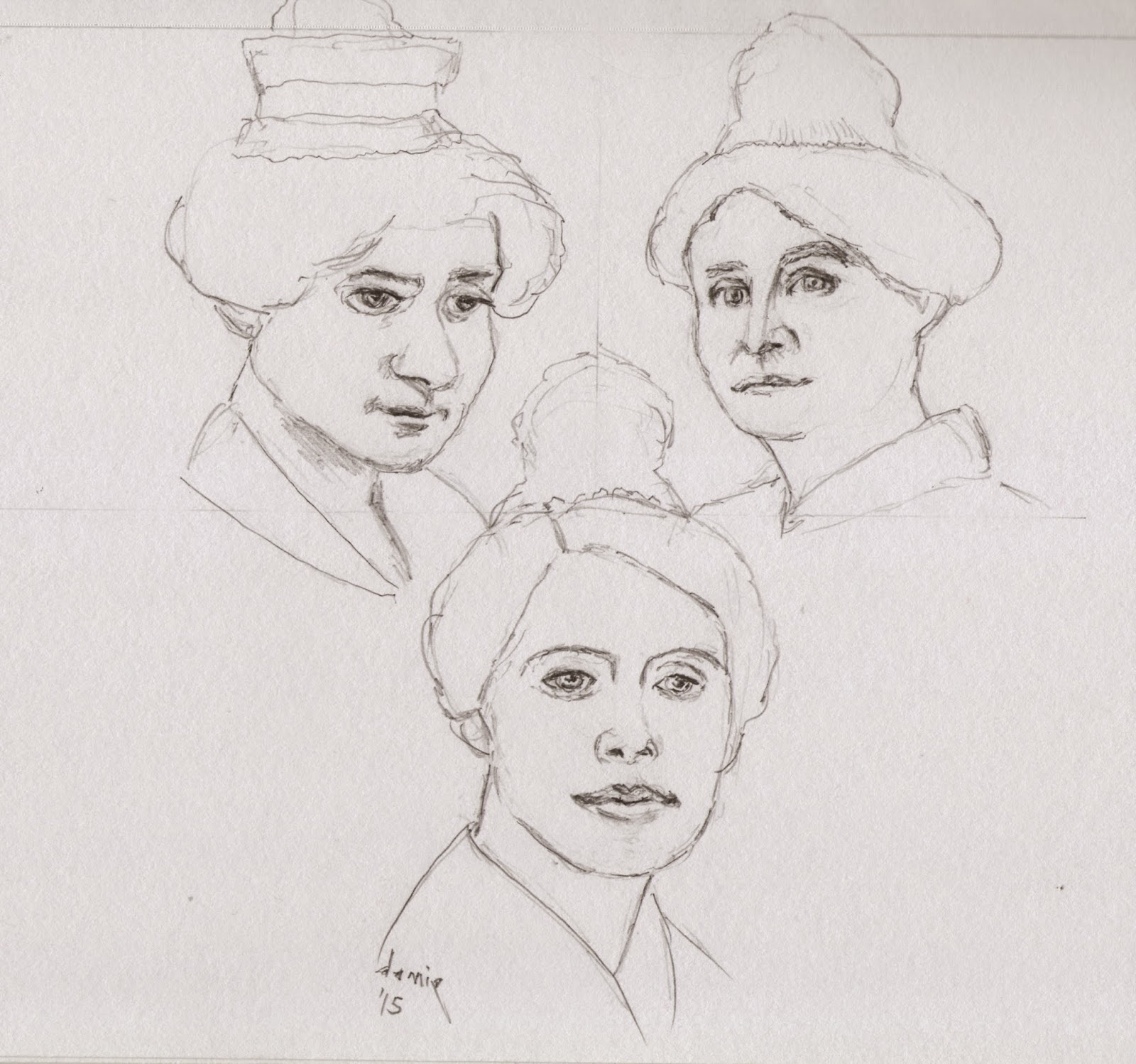
Impression Sketch of Philadelphia Nurses, (left to right) Lydia Shrope, Margaret Haggerty and Helen Barclay (below) - By Jamie Mann. The original images can be seen at: http://chroniclingamerica.loc.gov/lccn/sn83045211/1915-04-14/ed-1/seq-2/ 

From the North East of the United States,
The city of Philadelphia gave assistance,
To the war zone of Europe and Belgium.

Soon after the start of conflict, Red Cross
America called out for assistance - to send
Medical help out to their European friends.

The generic title of 'Mercy Ship' is to carry
Aid to places for humanitarian operations - 
Using converted passenger liners as bases.

With the success of their first mission, early
In the war, Red Cross America was ready
To provide more aid; giving relief to medics.

Although faced with problems of American
Neutrality, the society had gained more
Supplies and staff, willing to aid Belgium.

Philadelphia, being one such city, where
Four nurses had prepared to make leave -
To travel to New York to join others there.

At Woman’s Medical Ward Gerrard Hospital
Came Lydia Sharpe - and Miss Helen Barclay,
Assistant Night Supervisor of German Town.

From the Men’s Medical Ward of Tascarona,
Miss Margaret Haggarty and from Frankford
Hospital Lilian Wolsey, Assistant Overseer.

The Nurses were ready to leave home
For New York, to join 32 other medics on
Mercy Ship - formerly called SS Red Cross.

After a farewell party with their colleagues,
The nurses gained a train at Broad Street
Station, ready for their New York Destination.

Among them, Miss Sharpe had been chosen
Six months before, but being only 24 years
Old, had been unable to go until turning 25.

Once boarded and loaded with medical
Supplies the Mercy Ship would then leave
St Louis to head out for port of Liverpool.

Nurses and medics having been chosen
By National Red Cross Society, would
Relieve the previous team to make return.


When the Mercy Ship moves out, across
A North Atlantic Ocean, a single red stripe 
On hull would show the ship's neutrality.

by Jamie Mann.

Anon.,1915. Philadelphia Nurses start for War Today – City’s Second Contribution of four will Join Part of 32 on Mercy Ship.  Illustrated Evening Ledger, [online] 14 Apr. P.2. Col.3-4. Available at: http://chroniclingamerica.loc.gov/lccn/sn83045211/1915-04-14/ed-1/seq-1/
 [Accessed: 14 April 2015].

Mann, J., 2015. 100 years Ago - Poems by Jamie Mann. [letter] (Personal communication, 14 April 2015). 


#WW1 #WW1centenary #GreatWar #WW1poem #GreatWar #WW1centenary #worldwarone #worldwaroneremembered  #WW1Philadelphia #WW1America