Showing posts with label Armentieres. Show all posts

Friday, 20 March 2015

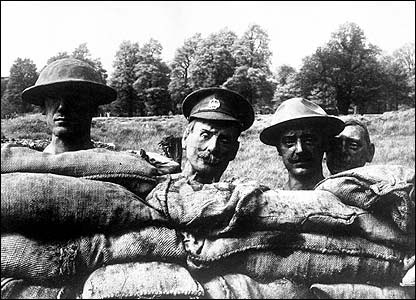
Poem ~ A Dummy Trap - Saturday, 20 March 1915


Source: File: dummy heads.jpg, 2015. Not just a German Trick, Papier-mache dummy heads were used by the French and British to trick snipers in the trenches. 20 March 1915. [online] Available at: <http://www.freerepublic.com/focus/f-news/1805449/posts/> [Accessed: 20 March 2015].

As a trooper in the Duke of Cornwall’s
Light Infantry, Private Albert Moore
Aged 39, offered himself as a volunteer.

The battalion had found themselves
Deep within the fight, about Neuve
Chapelle, late into night of 13 March.

A reconnaissance of a German trench
Was needed  - their officer stated risks
And would not order any man to go.

They were in the area of Armentieres,
As they crawled out to the barbed wire
On the German side, to see a sentry.

Trooper Moore said to the officer to stay
Still, or the sentry would raise the alarm -
Advising to lay quiet; to work way forwards.

As some minutes passed, they believed
They could take the sentry prisoner -
At eighty yards from the enemy trench,

The trooper said how he would crawl
Nearer, to stalk him from the rear -
As the Officer kept his total attention.

With a stomach crawl, Albert Moore got
To within ten yards of the very still sentry,
Slowly pulling himself up to the figure.

He signalled the officer's approach, to state
It was a dummy - to show they had no fear
The Officer said that he should push it over.

Trooper Moore put a hand to the shoulder,
A push resulted in sound like a clock's turn.
As it might explode was advice of 'head down.'

The trooper gave second shove and the figure
Exploded - both dummy and man flew up
Into the air - Moore came down in flames.

In the dummy’s body had been a substance,
Like sticky treacle, providing victim a lingering
Agony - Private Moore hit the ground in pain.

Unaware if his officer was still there, Moore
Pushed himself to a ditch of water and fell in.
In dazed awareness he jolted with a touch.

The Officer was there - as Moore said farewell
Believing that he would not live for very long -
But the Officer picked him up, to carry him.

At six yards they tumbled, Moore wracked
In pain - again the officer held him stand
And somehow walked him to an open road.

They quickly came a cross a listening patrol  -
Once in safety, Trooper Moore collapsed
Then heard officer's words, stating his bravery.

Unaware of wounds severity, had likely allowed
Moore to walk each step to safety - then blinded 
Beyond recovery, with many mutilated wounds.

Yet with his mind sound, Moore recounted
The story, on his arrival at Norwich Hospital -
To lie amid wounded, a victim of a booby trap.

by Jamie Mann.

Anon.,1915. Explosive Dummy - Victims Graphic Story. The Daily Telegraph, [online] 20 Mar. P.10. Col.4. Available at: http://www.telegraph.co.uk/news/ww1-archive/11480917/Daily-Telegraph-March-20-1915.html [Accessed: 20 March 2015].

Mann, J., 2015. 100 years Ago - Poems by Jamie Mann. [letter] (Personal communication, 20 March 2015). 


#WW1 #WW1centenary #GreatWar #WW1poem #GreatWar #WW1centenary #worldwarone #worldwaroneremembered #WW1Armentieres #WW1NeuveChapelle

Wednesday, 4 March 2015

Poem ~ Friends Reunited at Front - Thursday, 4 March 1915


Source: File: Prince.jpg, 2015. Dogged determination. World War One Great war Stories, Luton's Great War, told by its people today Submitted by Deejaya on 14 August 2014. 2 March 1915. [online] Available at: <http://www.worldwar1luton.com/blog-entry/dogged-determination> [Accessed: 4 March 2015].

i
Since the earliest months of conflict
And movements of enemy and allied
Forces that weaved through Belgium
And France, people fled their homes
In villages and towns often destroyed
Burnt to the ground –

Through such deserted places as these
English soldiers found other abandoned
Refugees – dogs of those gone or dead
Who then attached themselves to these
English troopers.

With displacement of animal's homes,
A refuge was created near Boulogne -
On the road to Wimereaux - whereby
Pets, dogs or other animals, found by
Soldiers would be looked after - until
They reclaimed by the human owners -
Their missing friends.

ii
One such story of dog and human friend
Could be recalled from the earliest days
Of an opening war starting August 1914.
A dedication and affection between man
And his closest friend to be recounted
In the month of March 1915.

In that late summer month James Brown
From his home in Hammersmith, London
Said goodbye to both his wife and Prince -
Their Irish Terrier. Private Brown called
To serve With the King's army in France
A horseman in the 1st North Staffordshire's

Some time passed and Prince pined for
James’ Company – when on September
27th his wife then noticed Prince had
Gone missing, she looked about - sadly
Unable to find him anywhere, she became
Afraid to write to her husband to explain.

iii
Two more months passed when a letter
Came for Mrs Brown from Mr Brown both
Solving and creating a mystery. Previously
Confessing that Prince was missing, a reply
Of her husband said he was sorry Prince
Not being found there, but that their terrier
Was now with him, stationed at the front line.

The story of Prince being found, had began
At Armentieres - Private Brown had returned
From a patrol and on that day as he rode
Back with other riders, amid the men was one
Standing with a dog, who walked toward him,

At first thinking the dog was very like his own
Irish Terrier, James Brown saw the man grin
To say, ‘I believe that this chap may be yours.’
In dismount James could still not believe his
Eyes until he knelt to say his name, ‘Prince?’
Who then greatly made a fuss of him.

With man and dog united as the fellow gave
Explanation how the Irish Terrier had travelled
Over to France, journeying with other troops.
Mr Brown's words to Mrs Brown explained his
Wonder; ‘Just fancy His coming and finding me.'

He added Prince, 'is quite settled Down with me.’
Then how her husband had found some old
Great coats, which he had used to make Prince
A coat to keep warm and how his faithful terrier
Was then adopted by the regiment as their pet.

by Jamie Mann.

Anon.,1915. The Soldiers Dog. The Daily Telegraph, [online] 4 Mar. p.8. Col.7. Available at: http://www.telegraph.co.uk/news/ww1-archive/11447670/Daily-Telegraph-March-4-1915.html [Accessed: 4 March  2015].

Source.,1915. The Dogged Determination Great War Stories. Submitted by Deejaya on 14 August 2014, [online] Available at: http://www.worldwar1luton.com/blog-entry/dogged-determination [Accessed: 4 March  2015].

Mann, J., 2014. 100 years Ago - Poems by Jamie Mann. [letter] (Personal communication, 4 March  2015). 

http://www.telegraph.co.uk/news/ww1-archive/11447670/Daily-Telegraph-March-4-1915.html

http://worldwaroneblogger.blogspot.co.uk/

#WW1 #WW1centenary #GreatWar #WW1poem #GreatWar #ww1centenary #worldwarone #worldwaroneremembered #WW1animals #WW1dogs

Friday, 13 February 2015

Poem ~ Fighting for Brickyards - Saturday, 13 February 1915


Source: File: British soldiers in the trenches in the La Bassee Canal Sector.jpg, 2015. 12:22, 31 July 2014 By Dailyrecord.co.uk. [online] Available at:<http://www.dailyrecord.co.uk/news/scottish-news/world-war-one-anniversary-use-3941810> [Accessed: 13 February 2015].

''Destroyed bridge at La Bassee, France, during World War I. The canal runs diagonally across the photograph with remnants of the bridge still attached on the left bank. Three men stand on this side and look down into the canal surveying the ruins. The man-made skin of the canal and the debris can be clearly seen.''

Source: File: Canal at La Bassee, showing destroyed bridge.jpg, 2015.  First World War 'Official Photographs'  British Western Front  (16) V.25. [online] Available at:<http://digital.nls.uk/first-world-war-official-photographs/pageturner.cfm?id=74545918> [Accessed: 13 February 2015].

Grounds lost on 25 January - on right
Of the British - came to be regained,
In a General Headquarters account
For French and British movements.

Attacks

Friday 5 February the day was fine,
As English Howitzers began their work,
Setting alight enemy observations -
While aircraft of both sides occupied
Blue skies - Allies making chase
Of enemy craft, high above the Lille
Neighborhoods - In close quarters
They rattled at each other, to bring
The other down - With puncture
Wounds to both, the German craft
Made a hurried descent - two miles
Short of their own aerodrome.

Below in the brickfields, situated
South Of La Bassée Canal - in close
Proximity to Cuinchy - began
A night attack on 5th - to gain
Success on German sap-heads.
Then on the 6th, this new advantage
Made for advance  - from 2 p.m.
As French and British Artillery honed
Fire on the brick stacks, of close
German defences - and beyond.

The heaviest of allied Howitzers
Rained down upon the railway's
Triangle - From 20 miles distant 
The boom and shatter of shells,
Were heard - while beneath
The speed of shells, was both
Fearful and impressive - as debris
And smoke blurred the foul air.

After that barrage of 15 minutes
The British, from three sides,
Emerged to storm forth between
Stacks of bricks, upon the strong
Enemy defence - keeping under
Cover of choking dust, to capture
With little loss, taking prisoners
By greatest surprise -
While trenches between -
Slightly north - were also taken.

Gains

With these enemy points,
Take under possession - those
Forward fighters on the canal,
Kept a continual line southwards
And reformed their positions,
Before the brickfields.
British losses seemed less
Than Germans  - who had left
Seventy dead - while a mortar
And machine gun were taken,
With unwounded prisoners -
To number nineteen, along
With other, less wounded men.

Within the early hours of the 7th,
Germans would not be seen
To accept this situation, as they
Made a strategy along the bank
Of the canal - to shout out
'Don’t shoot we are engineers.'
This novelty being old - 
These false sappers soon came
Under held fire, faced a machine
Gun to fall back - to leave thirty
Of their dead before the line.

An afternoon attempt also
Suffered failure, to get to
Close quarters  - the artillery
Kept that enemy well at bay.
The artillery’s accuracy,
Was given heavy praise,
As one heavy German Battery
Was hit, to explode - and how
At only forty yards away,
The guns blew the Germans
From their ill-sited trenches.

Afterwards

As on February 6th, most casualties
Of the enemy were due to shellfire.
The grounds about, after 15 days
Of varied fights, had left enemy
Corpses littering the area -
Before crumbling of three brick stacks,
Constructions of barbed wire
Entanglements were easily made
In daylight, without being fired upon.

Little occurred over two further days,
While it was seen how the enemy
Relied on incendiary shelling,
To create damage to besieged towns -
As on Armentieres - in creations
Of candle packed projectiles
In celluloid wax, and phosphorus -
So flammable as to ignite in the sun.

To conclude, how amid all this,
Was made an act of humanity,
During fighting of Givenchy.
Partially buried by a fallen parapet,
Lay a British Officer, found by
A German Officer, who came to aid
Him - despite bullets about, stopped
And dug him out - passing him
His flask of brandy - and was then
Killed by a straying bullet.

by Jamie Mann.

Anon.,1915. Terrible Effects of British Howitzers -Storming a Brickfield - Gallant Charges by British Infantry -Heavy German Losses. The Daily Telegraph, [online] 13 Feb. P.9. Col.6. Available at: http://www.telegraph.co.uk/news/ww1-archive/11406417/Daily-Telegraph-February-13-1915.html [Accessed: 13 February 2015].

Mann, J., 2015. 100 years Ago - Poems by Jamie Mann. [letter] (Personal communication, 13 February 2015). 


#WW1 #WW1centenary #GreatWar #WW1poem #GreatWar #ww1centenary #worldwarone #worldwaroneremembered #WW1La Bassée