Showing posts with label Battle of Neuve Chapelle. Show all posts

Friday, 20 March 2015

Poem ~ A Dummy Trap - Saturday, 20 March 1915


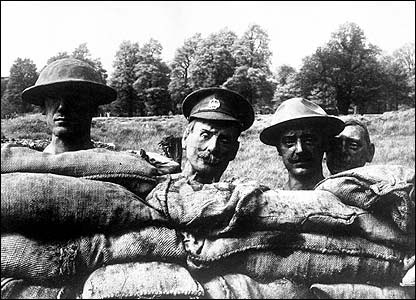
Source: File: dummy heads.jpg, 2015. Not just a German Trick, Papier-mache dummy heads were used by the French and British to trick snipers in the trenches. 20 March 1915. [online] Available at: <http://www.freerepublic.com/focus/f-news/1805449/posts/> [Accessed: 20 March 2015].

As a trooper in the Duke of Cornwall’s
Light Infantry, Private Albert Moore
Aged 39, offered himself as a volunteer.

The battalion had found themselves
Deep within the fight, about Neuve
Chapelle, late into night of 13 March.

A reconnaissance of a German trench
Was needed  - their officer stated risks
And would not order any man to go.

They were in the area of Armentieres,
As they crawled out to the barbed wire
On the German side, to see a sentry.

Trooper Moore said to the officer to stay
Still, or the sentry would raise the alarm -
Advising to lay quiet; to work way forwards.

As some minutes passed, they believed
They could take the sentry prisoner -
At eighty yards from the enemy trench,

The trooper said how he would crawl
Nearer, to stalk him from the rear -
As the Officer kept his total attention.

With a stomach crawl, Albert Moore got
To within ten yards of the very still sentry,
Slowly pulling himself up to the figure.

He signalled the officer's approach, to state
It was a dummy - to show they had no fear
The Officer said that he should push it over.

Trooper Moore put a hand to the shoulder,
A push resulted in sound like a clock's turn.
As it might explode was advice of 'head down.'

The trooper gave second shove and the figure
Exploded - both dummy and man flew up
Into the air - Moore came down in flames.

In the dummy’s body had been a substance,
Like sticky treacle, providing victim a lingering
Agony - Private Moore hit the ground in pain.

Unaware if his officer was still there, Moore
Pushed himself to a ditch of water and fell in.
In dazed awareness he jolted with a touch.

The Officer was there - as Moore said farewell
Believing that he would not live for very long -
But the Officer picked him up, to carry him.

At six yards they tumbled, Moore wracked
In pain - again the officer held him stand
And somehow walked him to an open road.

They quickly came a cross a listening patrol  -
Once in safety, Trooper Moore collapsed
Then heard officer's words, stating his bravery.

Unaware of wounds severity, had likely allowed
Moore to walk each step to safety - then blinded 
Beyond recovery, with many mutilated wounds.

Yet with his mind sound, Moore recounted
The story, on his arrival at Norwich Hospital -
To lie amid wounded, a victim of a booby trap.

by Jamie Mann.

Anon.,1915. Explosive Dummy - Victims Graphic Story. The Daily Telegraph, [online] 20 Mar. P.10. Col.4. Available at: http://www.telegraph.co.uk/news/ww1-archive/11480917/Daily-Telegraph-March-20-1915.html [Accessed: 20 March 2015].

Mann, J., 2015. 100 years Ago - Poems by Jamie Mann. [letter] (Personal communication, 20 March 2015). 


#WW1 #WW1centenary #GreatWar #WW1poem #GreatWar #WW1centenary #worldwarone #worldwaroneremembered #WW1Armentieres #WW1NeuveChapelle

Thursday, 19 March 2015

Poem ~ Prisoners of Neuve Chapelle - Friday, 19 March 1915


Source: File: Wounded from Neuve Chapelle.jpg, 2015. British,Germans and Indians The Daily Telegraph, [online] 19 Mar. P.12. Col.3-5. [online] Available at: <http://www.telegraph.co.uk/news/ww1-archive/11480912/Daily-Telegraph-March-19-1915.html > [Accessed: 1 March 2015].

Accounts came
Through, of the fight for the ruins of Neuve Chapelle.
11th March and how battered German troops were to out
To make regains.

On the following morning,
Came renewal of counter attacks about Neuve Chapelle -
Only to suffer losses, but with gains of many prisoners
Into the British hands.

Effects of exhaustion,
Led many Germans under fire to raise their hands.
At Port Arthur - south of the village Neuve Chapelle,
Lay a communication trench

From which seventy
Enemy were captured as one  - while north East, an
Enemy in British Trenches about Neuve Chapelle
Were driven out.

Germans believed weary,
The infantry stormed houses into Neuve Chapelle -
About Moulin Dupietre - to rush at them with bombs,
Catching eighty prisoners.

Then entire companies
Threw up their arms about the village Neuve Chapelle  -
Exhausted, by lack of food and in trenches full of water
Without rations on their line.

Bombardment effects
Saw German survivors crawl out in dazed conditions -
As on the 10th, in approach to lines of Neuve Chapelle -
Taken by surprise.

The village had by then
Become a ruined shambles - about all the ruined houses
Bodies were strewn, as dead occupants of Neuve Chapelle;
Became prisoners of death.

Within one night,
A patrol moved under darkness, about Neuve Chapelle,
To come across a figure before a trench - a dummy trap
To explode on contact.

Then on the 13 March,
German Counter attacks reserves behind Neuve Chapelle -
At Bois du Beiz - but guns retaliated to melt them away
From the woods.

Still more prisoners -
So by the 4th day, totaled 1,700 - during the 12th and 13th,
Pilots carried out their mission above Neuve Chapelle,
To hit railways of Douai and Don.

A quite lapse fell
By the 14 March, with enemy efforts turning to other parts
About St Eloi - leaving the village of Neuve Chapelle
Devoid of fighting.

Bombardments continued,
To turn on settlements affected away from Neuve Chapelle -
A station at Quesnoy and Aubers - where a tower hit, shot
Into the air and crumbled in dust.

An event to rankle
British troops occurred, when in a break at Neuve Chapelle,
Settled down to eat and drink rum - a hit caused evacuation.
Once regained all food was gone.

Now prisoners told,
Who had been in fight from start, that at Neuve Chapelle
A terrific attack never before witnessed - angered captured,
Stating this was total murder.

They had forgotten
Their own methods of intense concentration in field warfare,
Which the allies gave back, to cause at Neuve Chappelle
Resentment and effrontery.

Despite enemy conditions
Of exhausted troops and reports of undernourished men,
German discipline kept them clean, about Neuve Chapelle's
Filthy living conditions.

A German promise made,
Was to first finish off the Russian front within a short time  -
To turn on the British - perhaps not now at Neuve Chapelle;
Still their optimism remained.

A Spirit to match
The weary troops of the British - whose own companies
Marched back with trophies of their time in Neuve Chapelle,
With captured 'picklehauben.'

by Jamie Mann.

Anon.,1915. Battle of Neuve Chapelle - Splended Story of British Heroism - Trenches Rushed - Enemy Taken by Surprise. The Daily Telegraph, [online] 19 Mar. P.9. Col.2-3. Available at: http://www.telegraph.co.uk/news/ww1-archive/11480912/Daily-Telegraph-March-19-1915.html [Accessed: 19 March 2015].

Mann, J., 2015. 100 years Ago - Poems by Jamie Mann. [letter] (Personal communication, 19 March 2015). 


#WW1 #WW1centenary #GreatWar #WW1poem #GreatWar #ww1centenary #worldwarone #worldwaroneremembered #WW1NeuveChapelle

Saturday, 14 March 2015

Poem ~ A Hard Lesson: Neuve Chapelle - Sunday, 14 March 1915


Christ figure and soldiers, sketch by Jamie.  taken from original images of Neueve Chapelle at
http://pippopluto2.altervista.org/lettguerra/owen.htm
http://www.theatlantic.com/magazine/archive/2014/08/the-cross-at-neuve-chapelle/373454/

By close of first day's
Fight, success and failure
Came at Neuve Chapelle -
Success made by objectives
Gained - as communication
Failures made advanced delays.

Germans gained their aims
For the night into 11 March -
Working on their second lines
Of defences - hours worked
During night, completed strong
Points and connecting them
With the trench lines.

Their delayed second aim
Was for rear troops readied 
For counter attack - but they
Remained too far back - to leave
20 battalions to hold their line.

By 7 p.m. on the 10th, Haig
Sent out operational orders,
For 6.45 a.m. on the 11th -
A bombardment on Germans,
To allow IV corps and Indian
Attacking fronts - but morning
Mists hindered observations,
So shells missed trenches
Only to hit their strongpoints.

An onslaught was needed
To hit the German defences,
Sufficient enough to break
Them, yet the Corps divisions
Being bogged in the mud,
The Meerut Indian Division,
Awaited the 8th to move - but
Unable to the Indian forces
Did not move - despite other
Attempts through the day.

German firing had succeed
To cut the telephone wires
Of batteries and observers -
The day moved to evening
When General Haig, in an
Appearance, ordered that
They would only resume
The next day at 10.30 a.m.
So allowing the German
Presence, to prepare for
Their dawn counter attack.

4.30 a.m. a ready German
Artillery, ahead of game, started.
But shells fell far to the back,
To hit on the reserves troops.
A 'four pronged' German move
At 5 a.m. launched into mists
But for most part, driven back
At Moated Grange - then north
Of Neuve Chapelle and south
Where Garhwal Brigade were
Warned - ready and waiting.

The case was very similar
About Port Arthur, in holding
Back the German attacks
Yet the mist was not clearing
Sufficiently for the British
Plan - delaying their barrage  
To midday - by 12.30 p.m.
The attack would finally start.

Events then went disastrously
Wrong, with enemy guns near
Layes Bridge wired and built
Defences lay untouched by
Artillery. With machine gun
Cross fire, holding back Indian
Troops, only slow, confused
Information returned to HQ.
Misled by rumours of success
Haig gave orders for Indians
To push through, regardless.

Haig went to the Indian HQ
To learn truth - now the Indian
Force was to turn right to Boiz
Du Biez - but the plan could
Not be worked to organise this.
So by 21.00 hours the General
Gave orders went out that
All attack attempts were to stop.

Another part of front remained
In confusion - as information
And orders could not get back
Or forth - with darkness falling 
By 18.15 hours, when divisional
Officers had all been gathered,
No reconnaissance could be
Made - so commanders of 8th
Division went to gather the men.

The men's exhaustive state
Meant that they were prone
To falling asleep, only woken
By force - a great many dead
Were lying about, so time
Was lost in officers trying
To wake up the dead men.

Despite various problems
All the leading battalions
Were mustered and ready
To hit back - at 21.30 hours
They waited north of village
Of Neuve Chapelle -

As time moved to zero hour
Of 23.30, Haig at 22.40
Made communications
With Indian and Corps HQ,
To be informed that no further
Positions had been made,
So cancelled his instruction
To attempt to break through -
Across from Neuve Chapelle
Would bring no advantages.

Now the allies were to hold
Neuve Chapelle ,a defensive
Line to be secured and held.
With no further advances
To be attempted on the next
Day, the fight was ended.

Both sides claimed success.
For the British, ground had
With three objectives been
Taken, despite higher losses
Than the enemy and the fact
Of failure to breakthrough
To Lille; it could only be a bitter
Victory - The French though
Now held a higher regard
Of British army, to see how
The enemy could be breached.

Neuve Chapelle, for Germany
Was a victory, in their ability
To man second defence lines,
After their enemy's break-in.
Their policy of losing frontline
Was not serious, proving their
Theory right - any loss of control
Helped by the British slowness.

Neuve Chapelle ended in
Something a balance act -
Tipping a little in either favour -
Something of an experiment,
Yet the allied made neglect
Of results - in their ignoring
The use of surprise, after brief
Bombardment - in preference
For shell fire after shell fire.

by Jamie Mann.

BAYNES, J. Lieutenant-Colonel  (1966) Neuve Chapelle. Purnells History of the First World War. Volume 2  (Part/Month unknown). P. 741-743

Mann, J., 2015. 100 years Ago - Poems by Jamie Mann. [letter] (Personal communication, 14 March 2015). 


#WW1 #WW1centenary #GreatWar #WW1poem #GreatWar #WW1centenary #worldwarone #worldwaroneremembered  #WW1NeuveChapelle

Wednesday, 11 March 2015

Poem ~ Plan, Prepare, Attack: Neuve Chapelle - Thursday, 11 March 1915


 Neuve Chapelle: Garwhal Soldiers. Sketch by Jamie. See the original image at http://www.cwgc.org/foreverindia/military-honours/gabar-singh-negi.php

Source: File: Map.jpg, 2015. Situation 11th March 1915 at 2 p.m.
1 (circled) indicates two reserve companies advance at 2 p.m.
2-2 (circled) indicates ground seized by the two attacking platoons. [online] Available at: <http://www.worcestershireregiment.com/h_neuve_chapelle.php> [Accessed: 11 March 2015].


The Plan

By winters end
And springs beginning,
Hardships of weather
Still pounded along
The western fronts
Of France and Belgium.
Generals behind lines,
In formulating plans -
Having been waiting
For this point in time.

In the closing months
Of 1914, came rumours
Of low Russian ammunition
Supplies - to suggest
That German forces,
Might gain success
On the Eastern front -
Leading to repercussions
On the Western front -
A prompt for British military
Plans for an operation,
In early months of 1915.

A French General,
Joseph Joffre, had opinion
That the Russian position
Was over exaggerated -
But by January’s start
Joffre began to believe
Some type of offensive
Action was needed.
While allied reasons
May be different, their aims
For an outcome would
Be the same - with German
Spread over various fronts,
The allies might just win.

By 21 January, Joffre
Joined in principle,
To a combined offensive
Action  - a place where
This might commence,
Came in February,
With General Haig 's
Plans for a campaign
About Le Bassee
And Aubers Ridge -
Ultimately to capture
The ridge of Vimy,
In the area of Douai.
A draft plan was to take
Aubers Ridge - which gave
Command over Lille -
A prelude to regain
The captured French city.

To make such a step
Would shift British
From the waterlogged
Ditches to higher ground.
But the plan faltered;
Sir John French would
Be given the 46th
North Midland Division,
An inexperienced force -
Without possible assistance
Of Canadians Haig decided
On an independent operation.

Aubers Ridge
Had been held by British,
But only over three days  -
To be driven out
Under a heavy attack.
A fierce German
Presence was virtually
Everywhere - except
For a place called
Neuve Chappelle -
Here Enemy held land
That bulged into the allies.
Neuve Chapelle was
A centre of a salient -
Whose village buildings
Had been used for
Observation and housing
Snipers, that fired
Either way, into
The British held trenches.

At the salient’s northern
End was a fortified
Farm of Moated Grange,
While at southern
End was situated
A cross roads, called
'Port Arthur' - Haig
Hoped a campaign could
Coincide with French
In the southern side.
The plans approval
Came by 15 February -
Haig had to act soon
From 9 March, to form
Two phases. First was
To capture Neuve Chapelle -
Making a line east
Of the village - Then gain
Aubers Ridge, and cut
German communications
Of Lille and Le Bassee.

The Preparations

This plan would
Be the first full attack
To be launched,
From any allied trench line -
A major undertaking,
And audacious plan
With three British armies
Based in the region.
Late February found
The rapid unrolling tasks
For a reorgainsed front.
All attack preparations,
Would be within two weeks.

Neuve Chapelle village
Was to be situated centrally -
With the first army
To be on the left,
And I corps on the right -
With Indian Corps
Centralised.
Such prospects to get out
Of hollow ground,
Would boost the troops.
The campaign's secrecy
Was held by officers,
But many movements
Hinted at such plans.
So first days of March
Became rapidly taken
with training and hard
Exercise of all battalions.

In getting stores promptly
To the frontline tramlines
Were quickly devised -
Bombs and ammunition
Were packed into newly
Constructed magazines
As advanced dumps were
Placed at short intervals,
Stationed closely
To breastworks -
Heavy guns were moved
into hidden positions.
For this operation new
Methods had to be devised;
How would attack troops
Get to the assembly points?

Behind the busy
Administration of war,
Troops undertook
Wire-cutting practice
Bayonet charges,
And bombing drill -
As their officers
Considered problems
In controlling a vast size
And scale of armies -

A further issue concerned
Conveying information,
During the unfolding fight -
Messages would be passed
Through four HQ's to reach
The army - use of wireless
Restricted to divisional
HQ - with telephone line
Being the next  -
But wires could be easily cut  -
And runners could be killed.

Shortages meant orders
Were generally written in
Field Service Pocket Books,
Then passed on as carbon
Copies, out to all units -
This method, to become
Standard Battle practice,
Lacked accuracy and speed -
As found in first use
In battle for Neuve Chappel -
Another method made
By the first army,
Was devising an artillery
Timetable  - in provision
Of set tasks for each battery.

Coloured lines were drawn
On objective maps, marking
Limits of their advance,
These would then coincide
With action of artillery fire -
An English barrage would
Deluge shells on an enemy
Point, for a set time - then
The infantry set forward
With gunnery lifting, aiming
On other, advanced targets.

With ten days
To the attack, the troops
Edged their way
Into positions  -
With 5 March all guns
Took their place.
But an exception
To affect the outcome
Was the late arrival,
Of 6in howitzer Batteries -
Only getting into place
On 9 March  -
Whose accuracy
Would be affected
By lack of preparation -
340 guns finally stood
Ready and waiting.

Low-lying flat land
Added to issues
As in the lack of officer's
Vantage points,
To give direction,
In the control of guns -
Guns that might sink,
In mud had to be fixed.
With the ground troops
Maneuvering,
Royal Flying Corps pilots
Came into their own -
In undertaking Artillery
Observations their flights
Took on a grand scale -
Armed with new cameras
Being used to gain
Images of the war zone.

8 March and the troops
Finally heard about
The planned attacks  -
Rumours gave way to relief.
Then 9 March saw
More troops moved
Into place - as the day went
From afternoon into evening
The wintery weather did
Not relent - into the face
Of this the 2nd Scottish
Rifles slogged a long
Six miles from billets
In freezing conditions.
On a icy road
With mud made solid
The Scottish Rifles
Moved in silent march.

They marched into
The bitter wind - formed
In fours, moving in platoons
In company columns
And at their rear
Came bomb companies.
Shrugged in great coats
They carried
100 standard rounds
With two more bandoliers -
Each a hundred rounds -
On each man's hip
Hung rations haversack,
A rifle slung
On each man's shoulder,
As against their leg
Thumped an 18 inch
British Bayonet.

The Attack

Halfway to their objective
Scottish Rifles gladly halted
At Pont du Hem -
It was 10 March 1 a.m.
Rested and fed
By a Quartermaster's stew,
Until 2 a.m.
The march resumed -
Only for a short distance
Further, where the Scots
Left the road,
To turn East, making for
The front line trenches.

The Company had been
Met by two officers,
In their role as guides -
The day before
In the light the two had
Familiarised the route -
But in the dark,
Across featureless
And flat ground,
They led the Scots
Into alien country
Finally at 4 a.m. reaching
The 2nd Northants -
In relieving these men,
From forward trenches,
The Scots made ready
For next days attack.

In the clumsy dark
On icy mud, they took
Positions with one man
To every yard.
Ladders propped
Against mud walls -
Ahead their own wire
Cut in preparation,
And steps sliced
Into parapets  -
All was set
To go over the top.

With only hours to go
Platoon leaders,
In the weak daylight,
Looked above parapets,
Checking where gaps
In the wire were placed -
And to see general lay
Of the land - 
At 50 yards the enemy
Trench seemed too close
A potential disaster
Could happen -
If their shells fell short.

A misty morning
Was forming
With men stood
In the morning cold.
The night’s activity
Could not escape
One German officer,
Who sent back
A message, for allied
Trenches to be fired on -
Where, during night
Many British troops
Had gathered.
Only the commander
Could authorise this
Attack - and no one
Would wake him.

It was a fact that
German troops
About Neuve Chappell
Sector were lacking
In March - with only 13th
And 14th Divisions -
The order From British
HQ made note,
On 9 March,
That the allies
Had 48 battalions
Against only three
German Battalions.

Calling on reserves
The 11th Jäger Regiment
Filled the German gap
South of Moated Grange -
Their tactic being to man
Frontline trench, lightly
With fuller defences
At some 1000 yards back
On the second line.
Yet pressures
Of maintenance
Meant this second line
Only partially constructed
Their solid defences
being the strong points.

10 March 6 a.m.
And gunnery fired
Their ranging shots -
By 7.30 a.m. distances
Were fixed - heavy
Bombardment began.
Explosive clouds
Of a lyddite stench,
Began to blow back
Onto the British
Who waited - covered
In filth and grime -
Yet excited at the
Prospect that German
Defences would not
Be able to take the fire.

8.05 a.m. and barrage
Moved, to creep
Toward Neuve Chappell
The whistles called out
And men climbed
Onto a battle ground.
Indian troops,
Of the Garwhal Brigade,
Made a mistaken move.
Their two forward
Companies, took
To the right of their
Intended target -
Reaching where no
Artillery had hit -
Two more companies
Followed into the heavy fight.
Still the determined
Garwhal Brigade
Gained a enemy trench.

Others of the Garwhal
Brigade succeeded
As they sped over 200 yards
To dive into the German
Ditches - gaining five
Machine guns, to take
200 prisoners.
Yet some had slipped
Through a gap
Into vacant trenches  -
But reserves of Seaforth
Highlanders acted, to curtail
Any possibility
Of an enemy wedge.

Royal Irish and Rifle Brigade
Moved into Neuve Chappell
All By 8.50 a.m. -
But movement
Through the village
Was halted
As British artillery
Bombarded ground
Between the village
And Bois Du Biez.
On the right contact
Was made with Indian
Troops who dug down
Into poor ground.

Problems had started
To occur for the 23 Brigade
And the Scots - late
Arrival of 6in howitzers
Had failed to crush
The wire - where Germans
Were hardly affected -
They immediately started
Firing their heavy
Machine guns,
On attackers
At point blank range.

With first two waves
Cut down - from Front
And right  - the British
Waited for a further
Bombardment -
A German game
Played out  -
Yet one Scottish
Company despite
Their losses, gained
An enemy trench.

9.40 a.m. and shells
Barred down on those
Germans opposite
The waiting Middlesex's
This time making
An effective hit.
No in their advance,
The Jäger Battalion
Lifted arms in surrender
With objectives reached
And taken, faults slowly
Began to unwind.

Communications began
To falter and go awry -
Generals had to wait,
To hear by mid afternoon,
Of success and objectives
Gained  - a confusing
State had unraveled.

After some hours
On from events, new
Orders were passed -
Made along a large
Chain of commanded -
Finally 24th Brigade
Were told to progress -
It was 1800 hours When
The General advance
Was to go ahead.

With darkness falling,
Movements about mud
And ditches of earth
Became harder still -
Yet an Indian Advance
That had begun at 1700
Hours - over 300 yards -
Was done to reach
Layes Brook - unopposed.
The stream
Being 10 foot wide
With 4 foot of water
And steep slopes,
Was easily crossed
Using light bridges.

With 400 yards more
To Bois du Brez -
At the wood's border -
Lay a road and ditch.
By 1800 hours
With fall into darkness
The Indians began
To dig in.
Then reinforcements
Of Germans nearby
Changed all plans.
By 8 p.m. Indian troops
Withdrew to Layes Brook -
Avoiding any likely
Mix up in darkness
With an enemy presence.

The darkness of night
Fell on end of the first day.

by Jamie Mann.

BAYNES, J. Lieutenant-Colonel  (1966) Neuve Chappelle. Purnells History of the First World War. Volume 2  (Part/Month unknown). P. 733-741

Mann, J., 2015. 100 years Ago - Poems by Jamie Mann. [letter] (Personal communication, 11 March 2015). 


#WW1 #WW1centenary #GreatWar #WW1poem #GreatWar #ww1centenary #worldwarone #worldwaroneremembered #WW1Neuve Chappelle