Showing posts with label Flanders. Show all posts

Monday, 23 May 2016

Poem ~ Battle Plan:1916 - Tuesday, 23 May 1916 - Thursday, 25 May 1916


Source: File: Joseph Joffre, Commander in chief of French Army in 1914. [online] See an original image at: <https://en.wikipedia.org/wiki/Joseph_Joffre> [Accessed: 23 May 2016]

Source: File: Field Marshal Douglas Haig. [online] See an original an image at: <https://en.wikipedia.org/wiki/Douglas_Haig,_1st_Earl_Haig> [Accessed: 23 May 2016]

Source: File: General Foch. [online] See an original an image at: <https://en.wikipedia.org/wiki/Ferdinand_Foch> [Accessed: 23 May 2016]

After 11 months of a European struggle
Between allies and an offensive Germany,
Came the proposed need of clear strategy -
French Commander-in-Chief General Joffre
June 1915, set out ideal for the allies to unify
Their forces more effectively at Germany.

Between allied countries Britain, France,
Belgium, Russia, Serbia and Italy, formed
An Initial Inter-Allied Military Conference -
Arranged for 7 July 1915, held at Chantilly -
A need for regular meetings led to both
English and French leaders decisions.

17 November 1915, the two prime ministers
Met, to confirm requirement to organise armies
By a permanent committee - the documentation
By Joffre followed with the 'Plan Of Action' -
For coordinated forces of Russian, Italian,
British and French, due for date mid 1916.

At the military Conference 16 December
1915, Lieut-General Sir Archibald Murray
Presented a treatise on future of the war - but
Days later Robertson replaced Murray, while
Haig replaced French - as strategy confirmed
France and Flanders were centres of war.

Close cooperation would be on European
Ground - all efforts were to be for combined
Allied strength for offensive attacks around
Spring 1916. At December's end the Chantilly
Meeting Called by Joffre, formed a proposal
Before French President and ministers.

Following his appointment General Haig,
As commander of British Forces in France
And Flanders, came under French pressure
To combine their allied attack across a 60
Mile Front - the situation to be Somme -
Centred between Roye and Compiegne.

General Foch was ordered to prepare
French, from Somme River to Lassigny
In south - the idea for an offence on front
That saw stalemate over all other fronts,
And backed by British for success - Haig
Then agreed to take tenth Amy at Lens.

Modification of General Joffre’s proposal
Came by January 1916 - that by April's
End, five offences would be ready; three
South East, Oise, Champagne and Somme -
Haig would then create a seven-mile Front
North of the Somme to create damage.

This was to be in three months; 20 April.
Haig refused on three counts; to soften the
Enemy had no strategic purpose - also to be
Politically unsound - or likely seen as defeat
By their enemy; nor could forces be ready -
The proposal could only be bataille d’usure.

Along side French ideas, Haig asked
His Field Marshall's to devise parallel
Schemes - to consider available usage
Of 20 divisions over a 10 mile stretch -
And at which front to be most effective,
Alongside battle plans for frontlines.

They also had to consider Flanders;
About Houthulst, Lille area, Messines
And Wytschete Ridge, which was then
Discussed at first of what then became
Weekly Army Commanders Conference -
A finalised plan revealed 14 February.

Joffre amended his idea, to abandon
Of wearing out enemy before launch
Of a big offensive - the plan became
For minor British moves at La Bassee
And Ypres - while combined French
And British to be in area of Somme.

This major attack would be around
Date of 1 July 1916 - but then matters
Changed as German 5th Army launched
An attack of Région Fortifiée de Verdun -
Within five days Joffre knew Verdun
Would not be a short-lived conflict.

At the start of March General Haig
Was to carry on prepartions for north
Of the Somme - possibly earlier than
July - at the end of March a final plan
Was a fight at Lassigny and Hebuterne.

A change of importance was to drain
Germans away from Verdun - to alter
Initial start of 1 August to 1 July - Haig
Took over the planning of manoeuvres,
With support of General Rawlinson -
An 8 day bombardement would begin.

The plan was certain, with British army
Numbers increased by Earl Kitchener -
In August 1914 the five divisions grew
To 43 Divisions - 1 January 1916, saw
Around a million soldiers stand ground
Of France - munitions were yet to match.

At the end of January 1916 David Lloyd
George, Munitions Minster promised
By April, production would be increased -
Although no account was made of quality
Of gunnery and shells being produced -
Preparations stepped up a gear for July.

by Jamie Mann.

Source: File: Battle of the Somme - Spartacus Educational. Online. Available at: <http://spartacus-educational.com/FWWsomme.htm> Accessed 23 May 2016

Source: File: The Long, Long Trail: British tactical planning for the start of the Somme offensive, 1916. Online. Available at: <http://www.longlongtrail.co.uk/battles/battles-of-the-western-front-in-france-and-flanders/the-battles-of-the-somme-1916/british-tactical-planning-for-the-start-of-the-somme-offensive-1916/> Accessed 23 May 2016

Mann, J., 2016. 100 years Ago - Poems by Jamie Mann. [letter] (Personal
communication, 23 May 2016). 


#WW1 #WW1centenary #GreatWar #WW1poem #GreatWar #WW1centenary #worldwarone #worldwaroneremembered #WW1Somme

Tuesday, 5 April 2016

Poem ~ The Craters Of St Eloi - Wednesday, 5 April 1916 - Friday, 7 April 1916

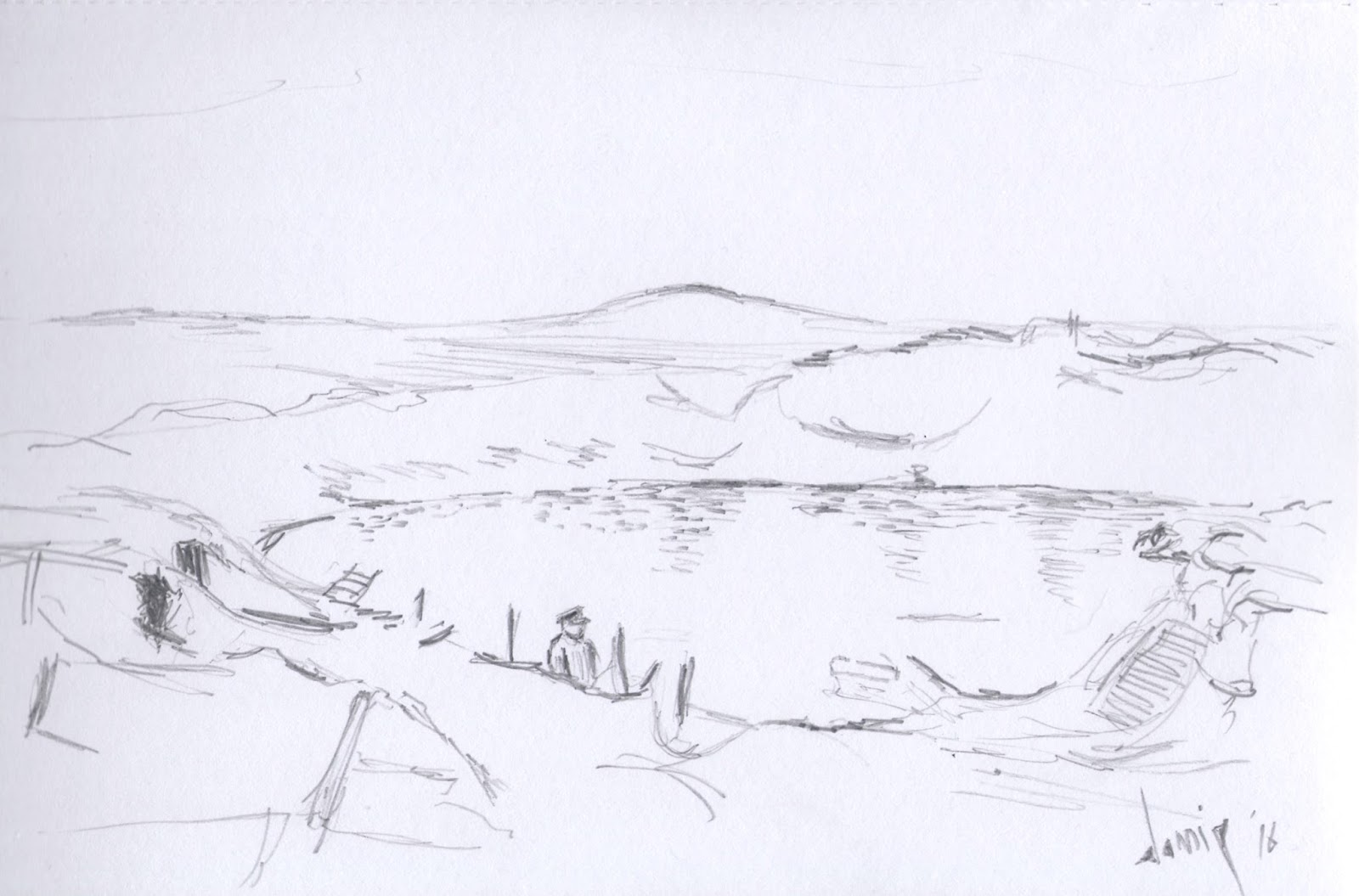
 Impression sketch of crater at St Eloi - by Jamie. From an original image that can be seen at: <http://www.militaryhistoryonline.com/forums/ViewPost.aspx?ForumID=56&ID=30517> [Accessed: 5 April 2016]

i
From days of early Flanders
The persona of Saint Eligius,
Had set on his task to convert
Pagans to Christianity religion,
With his twenty year mission -
His name dedicated to St Eloi
a village in a Flemish province.

Within a twentieth century
Mission, that same ground
Of St Eloi saw transformation
To total war, with sustained
Battles -1915 saw burrowed
Exchanges underground,
With tunneller's drafted in.

By subterranean methods,
A renewed struggle began
With six large mines, created
Beneath the German lines -
The decided plan for British
Intensions to move forward,
To capture destroyed lines.

Canadians afterwards would
Follow forwards, to secure
Captured systems - prior
To zero hour Germans had
control of ground; the land
Already battered, had mines
Prepared by sapper teams.

Into 87th leap year day
The 27th March at 4.15 a.m.
Awoke with tremendous
Gunfire - one followed by
Another of six mines, whose
Sound carried through air;
Heard on English shores.

Every man felt the earth
Shuddering, as volcanoe
Plumes of yellow smoke
Lifted skywards - debris
Rained upon pockmarked
Earth - six huge craters had
Formed in no mans land.

Amid the British forces
Lifting from sodden soil -
Khaki against blighted
Earth - Brodie clad heads
Over hunched shoulders
Came Northumberland
London's Royal Fusiliers.

With one Northumberland
Officer ready to provide
His regiment's story to
The Scotsman - the fight
the best organised to date,
Became known by name
Of Battle of St Eloi Craters.

The tunnelling companies
Had carried out operations
So secretly, the German
Presence had not guessed
What was about to happen -
A lull had till then, lasted
Across area for two days. 

A quagmire of peace could
Be seen for anyone, who
By chance could have stood
on ground, would have never
Been aware of two armies
in opposition, concealed;
Odd sniper fire interrupted.

ii
A dull drizzling morning
With possibility of heavy
Showers was observed,
Just before the ground rent
Heavenwards - the young
Officer relayed the problem
Of Northumberland’s role.

manoeuvres were acted out
Oddly, like a game - to enter
The maze of wire covering
The slope before German
Positions - slowly working 
To a pocket sized parapet,
That escaped the explosion.

A German machine gunner
Propped up on a parapet,
As they set foot among
The wire, to offer selves
Up as targets - but calmly
They worked through
By an amusing method.

A game spread amid men;
They adopted 'pick a back,'
As soldiers started to carry
Their comrades, who gave
Short reply to enemy fire -
Their aim to pick off any
Visible machine guns.

Within the gritty task,
The men took to amuse
Selves in transformation
To cavalry status - riders to
'Gee up' and chaffing each
Of their 'horse,' to criticise
Points of others mounts.

With the game of horse and
Rider making it through
The wire maze, dismount
Orders brought normality -
Back in role of foot soldiers,
They leapt down into enemy
Trenches, in warning shouts.

Their listeners though were
Just an audience of dead
And dying men - some
Lives lost within their sleep -
They came to a dug out,
Where a sentry stood
Upright, as on alert guard.

They yelled at the figure
To surrender - but he
Gave no answer - a man
With bayonet raised,
Rushed towards him -
Only to recoil in horror;
The sentry was dead.

Still on guard in death,
Looked on by those who
Would see him dead again.
With eyes described in
A look of 'the other world' -
With life severed in duty,
He was left at his post.

Moving further inwards,
Others were dazed from
An earthquake broken sleep,
Crouched or seated in pain
Of ignorance of the event -
Shocked to see strangers,
As a man in a dugout spoke.

'My God the English!' he
Found no escape, to be
Taken away with others
As prisoners - between
Them, arguing as to how
The invaders came - to
Land in massed airships?

iii
Some others suggested
They had burrowed
Up as moles - they could
Not fathom they had
Made their way across
Land of no man, that
Had been under guard.

A battle of St Eloi craters
Had begun with success -
The shattering sounds
Heard back in England,
With swarms of British
King's prisoners en mass;
Canadians made a start.

While spring had retained
Winter's wet conditions
Within the Belgium soil,
The rapid divisions arrival of
2nd Canadians in their first
Major engagement, brought
There without preparation.

Out of bitter, muddy earth
The British found success,
In hand-to-hand combat -
To win third German line -
While confusion lay amid
Enemy; mines irreparably
Altering their landscape.

Those great craters had
Been exploded, to create
A vast space over 180
Feet across and depth
Of 49 feet - with sleet
And wind, water began
To create glutinous mud.

For seven terrible days
Conditions took their toll,
With hundreds killed amid
Fighting chaos - exhausted
British gained relief from
Eager Canadian's 4 March
Arrival, in Belgium’s St Eloi.

Without blindfolds Canadians
Still had only a blinkered  
Idea of their situation and
German presence - by dates
Of 4 and 5 March, constant
Bombardment hampered
Efforts to improve defences.

With more deaths every
Minute, the 2nd Canadian
Pioneer Battalion tried
To drain their trenches -
The sight was a challenge
To the stomach of any man,
Upon the sight of that land.

'We were walking on
Dead soldiers,' Frank
 Mahout later wrote to his
Wife at home in Canada.
All about men attempted
To bandage wounds
As shells still fell around.

Soldier Private Fraser,
A Calgary bank clerk, gave
The scene at daybreak;
To see body parts protruded
Everywhere in the mud,
Marking out the yards - while
30 dead floated in crater.

Odd sights were captured
By moments of shock;
The German sentry corpse
Still on guard, or a tall, slim
English lieutenant who lay
Quite dead - his boyish face
Wearing a peaceful look.

Under nightshift fighters,
6 April at hour 3.30 a.m.
The ruins of St Eloi saw
German battalions attack,
Along the Canadian held
Main road - communication
Losses led to their retreat.

Another dawn lifted, renewed
German efforts had started
To recapture all grounds
Lost to them from battles
Start - confusion was relayed
By heavy rain, while the fight
For craters was still to end.

by Jamie Mann.

Anon.,1916. The Dead Sentry - The Story of St Eloi. The Daily Telegraph, [online] 5 April 1916. P.12. Col.3. Available at: <http://www.telegraph.co.uk/news/ww1-archive/12206739/Daily-Telegraph-April-5-1916.html>  [Accessed: 5 April 2016].

Source: File: Sint-Elooi. Online. Available at: <https://en.wikipedia.org/wiki/Sint-Elooi> Accessed 5 April 2016

Source: File: Battle of St. Eloi Craters. Online. Available at: <http://www.thecanadianencyclopedia.ca/en/article/battle-of-st-eloi-craters/> Accessed 5 April 2016

Mann, J., 2016. 100 years Ago - Poems by Jamie Mann. [letter] (Personal communication, 5 April 2016). 


#WW1 #WW1centenary #GreatWar #WW1poem #GreatWar #WW1centenary #worldwarone #worldwaroneremembered #WW1StEloi