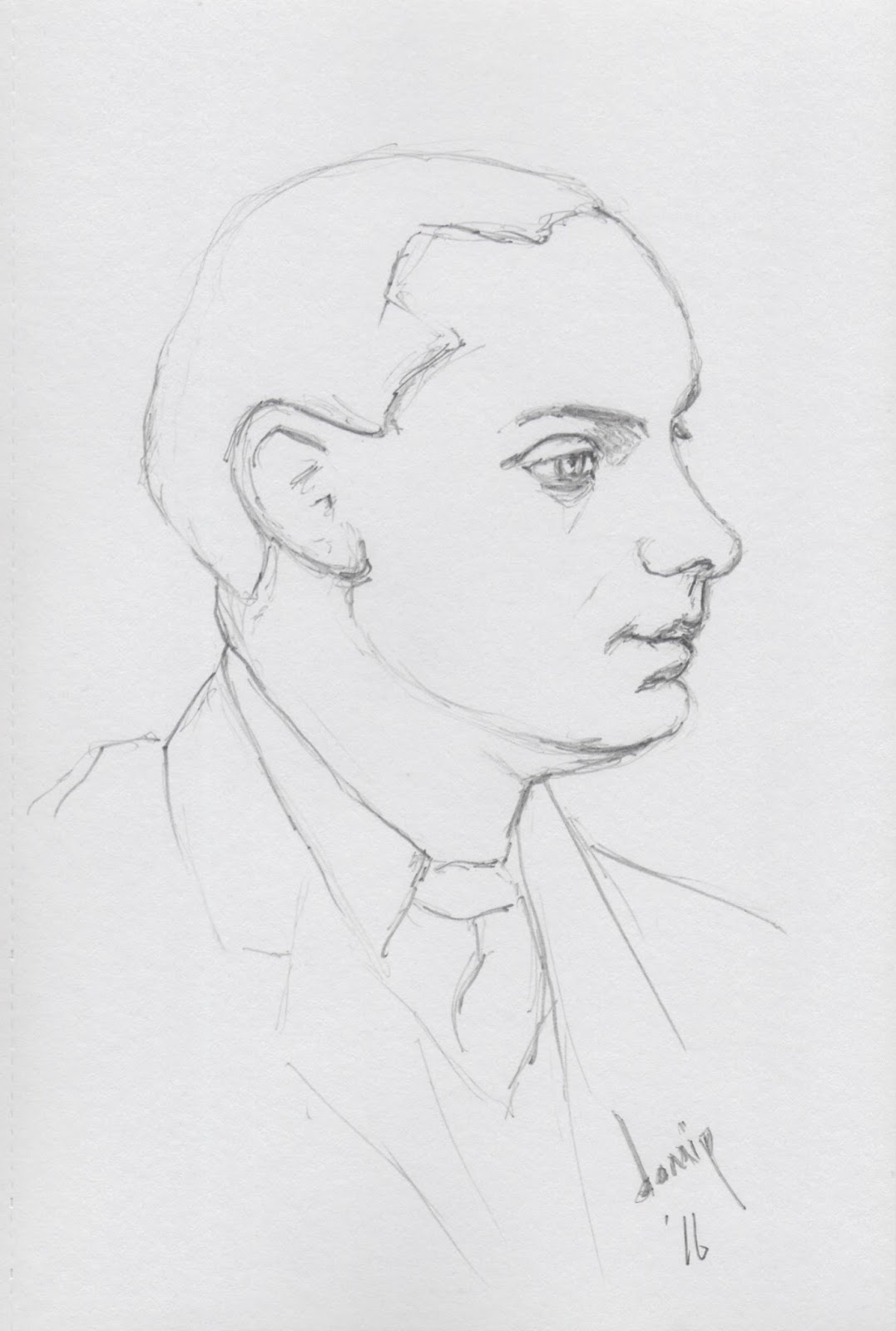
Impression sketch of James
Connolly. [online] See original image at: <http://www.anphoblacht.com/contents/23806>
[Accessed: 24 April 2016]
Impression sketch of Roger
Casement. [online] See original image at: <https://commons.wikimedia.org/wiki/File:Sir_Roger_Casement_(6188264610).jpg>
[Accessed: 24 April 2016]
Impression sketch of Patrick
Pearse. [online] See original image at: <https://commons.wikimedia.org/wiki/File:Patrick_Pearse.jpg>
[Accessed: 24 April 2016]
Monday - The Rise Of Ireland: A Resurrection
i
While war might
still continue, preparations
For public
holiday celebrations
Still go on -
with one of two annual equinox,
Month of March
sees the sun cross
The celestial equator,
when night and day
Align in hours of
light and darkness.
From the Roman to
the Julian Calendars
Reforms, to
correct the year's length
Emerged - by
instalment of the Gregorian
Timetable that
would realign day
Of Easter and the
start of Spring Equinox -
For 1916 the date
of the festival
Of Easter, was
latest of many recent years.
Easter day in 1916, would fall late to date
23 April, with
Easter Monday
24 April - the
fourth time only of Gregorian
Calendar - the next
date to fall
In year 2000 -
within Ireland, such a day
Would have equal
significance
To the Christian
resurrection of Jesus.
Home Rule Games
ii
Three years
before, prior to any definite
War, a campaign
for Ireland
Seeking
independence, seemed about
To take a
positive turn - when
British
Government formed their stamp
Of approval to a
home rule plan.
For Centuries, to
number more than
Seven, Britain had ruled over
Ireland - despite rebellion attempts
To counter this,
insurgents
Had been
oppressed - the treatment
Of Irish had seen
land wars,
With lives lost - starved by famines.
The idea of home
rule yet divided
Opinion - for protestants in
North, believed a
parliament would
Be dominated by
catholic
Presence -
against this, formed militia
Ulster Volunteer
Force.
In response, were
those Irish people
Who sought home rule -
The third bill
for self-government saw
Irish Scholar
Eoin MacNeill,
Move to assist
the formation of Irish
Volunteer’s as nationalists -
Meetings led to
launch, 25 November.
In that autumn of
1913 The Rotunda
Meeting saw
a great
Public response -
4,000 people were
Inside and 3,000
outside -
Speaker’s voices
were hardly heard;
A band
played music,
While people
clamored to be let in.
A small silken
bow could be seen
On lapels of
stewards -
With a white
centre and either side
Green and orange,
Adopted as Irish
National banner;
The atmosphere
electric.
While these two
militia forces had
Formed, Britain
did not
Make any move -
to know if turning
On one or other
or both,
The carnage
result would be terrible;
Neither side were
armed.
Germany:
Ireland's Ally
iii
The Rotunda rally
had been to defend
Home rule - this
was no ruse
To reassert any
type of rebellion - then
Within a year, home rule
Was shelved, as
war emerged with
Germany - instead
came call
For Empires troops, including Ireland.
Many men
enlisted, lowering number
Of the Irish
Volunteers -
Disenchantment
did not abate between
Nationalists - within them
A collection of
seven men gathered,
After only a
month of war.
Thomas MacDonagh,
Seán McDermott,
Joseph Plunkett,
Tom Clarke,
Éamonn Ceannt
P.H. Pearse, along with
James Connolly - all met
At Rutand square,
in the Gaelic League
Library - with others present,
Chaired by
Clarke, the meeting made results.
The discussion
centered around an idea
Of insurrection to be in Ireland.
They would take
the advantage of England
At war, to gain
Irish Independence -
Even to seek assistance from Germany;
But only to expel
the British rule.
If any German force
was to land in Ireland
They would only assist;
By this condition, Ireland would not be
Occupied by
German rule.
A plan would be
to seek their support
And secret
recruitment.
Planned action
would then take place
On the date of
Easter 1916 -
A renewed rising
to light age old torch;
For Irish people to
stand
Against British
Rule - this attack would
Take place across the land -
The source was to
be Irish Volunteers.
A stumbling block
would be leader
MacNeill - who
would
Never agree to
the volunteer force
Used in such methods.
So a decision was
made to make all
Plans without
him.
A Call
For Arms
iV
In preparation by
various methods,
Arms were needed
for the
Cause - initially, small loads of weapons
Had been smuggled
into
Ireland - to
include Austrian Mannlicher
And Austrian
Vetterli guns;
As well as
obsolete 1888 German rifles.
Many arms had been
received prior
To war - as with
two small
Boatloads of 1871
German Mauser
Rifles - then, in
secrecy,
The Irish
Republican brotherhood,
Approached a
skeptical
Germany, to
assist their Irish revolt.
The gathering of
arms, were to occur
Right up to the
last moment
Possible - on 13
April two young men,
A labourer
Patrick Doyle
And a chauffeur
Joseph Kenny, stood
Before court,
charged under
Defence of Realm
Act, for holding arms.
On 9th April the
two were travelling
By car when
stopped.
Caught by the
police, they admitted
To carrying arms
-
Found in their
possession were 8 double
Barreled shot
guns,
As well as 10
rounds of magazine rifles.
Along with 4 revolvers and ammunition
To hold homemade bayonets -
Standing as
witness, a sergeant stated
Both men had been
seen
Marching, in
company of Irish Volunteers,
In County
Wexford.
With the case
being verified, the belief
Was how the two men
Were nothing more
than messengers -
Yet aware of the
nature
Of their mission,
they were sentenced
Up to 3 months.
Rebel Leaders
V
Alongside and
outside, the organisers
Included Roger
Casement,
A British
Diplomat of Irish birth, whose
Activist of
humanitarian
And artistic
leanings, held alongside his
Irish Nationalist
ideals -
Developed a
course to change his life.
Involvement with
Irish republicanism
Grew from 1913 -
Casement
Assisted in birth
of Irish Volunteers,
To involve his
travels to US,
To raise funds
from an Irish Community.
Despite internal
politics, Casement
With John Devoy,
met
In New York
German Diplomat - Count
Bernstoff, August
1914.
The plan for
gaining German guns
Was to rebel
against
English troops,
diverted by the war.
Black-market rifles were not enough,
Military council gained
Contact with British enemy, Germany -
A transaction finally
Agreed; with German support affirmed,
The day had been
Confirmed, to rise at Easter 1916.
Within few short
weeks of opening
Warfare, a
disguised
Casement sailed
for Germany via
Norway - the
episode
Involved an outing,
along with alleged
Ideas to stop him -
Then Casement
made a negotiation.
Germany declared
a solid vow,
Not to invade
Ireland,
But to arrive as
a supporting
Nation -
furthermore
Casement sought
to gain many
Recruits from Irish war
Prisoners, to
train as rebel army.
Yet only 52 out
of 2000 made
Any voluntary nod
-
Despite the German promises
No
training was given;
The attempt came
to nothing -
Although April
1916,
German offered
some armory.
A small portion
that had been
Hoped for were
sent:
10 machine guns
along with
20,000
Mosin–Nagant
1891 rifles and a
million rounds;
Finally Casement
Learned about
Irish plan for 1916.
Setbacks and Promises
Vi
SS Libau, German boat, pretended
To be a Norwegian
vessel,
SS Castro - sailed to Ireland 9 April -
Concealed under
the
A timber cargo
was a German stash -
But
communications
Of German origin
were intercepted.
Washington sent words of attempts
To convey arms heading
For Ireland - while
precise movements
Were unknown, HMS
Bluebell
Detained the SS
Libau - the boat was
To be escorted to
Cobh,
When Captain
Spindler set off charges.
Both boat and
evidence sank, with crew
Taken prisoners -
the day
Was Good Friday;
this date being earlier
Than expected, no
volunteers
Had been at the
allotted rendezvous place;
The result had an
effect -
All loss of arms
altered Sunday's plans.
Dublin Parades
had been to take place
On Easter Sunday
-
As dawn broke on
the day, the lack
Of clarity caused
Confusion - with
given cancelations
Of all parades,
Confirmed within a
Sunday newspaper.
Communication of
orders went awry -
Organised acts
across
Ireland, were to
see a series of rebel
Attacks - as the
Sunday
Unfolded orders
followed other orders;
Volunteers mobilised
At County Tyrone
and Cresslough.
Along with County
Donegal all were
Ready, only to
disperse
Without a fight -
due to confused
Countermanding
orders.
Cork in the south
saw the muster
Of volunteers, to
last
Without effect
until Wednesday.
A Sunday call to
a meeting did
Not want to lose
Momentum - Easter
was perfect
Time to stir people
To a rising dawn
of a new Ireland.
Actions on Easter
Monday were to still go ahead.
The military
council decision
Was to merge
Volunteers and
Irish Citizen
Army - to act
As the Irish
Republic Force -
Messengers sent
To advise all
units of orders.
Monday - Emerald
Hopes
Vii
As the sun rose
over Ireland,
Monday 24 April,
The plan became unraveled
Between rebels -
Within the
capital of Dublin
Key areas were
To be taken over
by Irish rebels.
Led by Ned Daly,
250 men would
Occupy the Four
Courts -
To halt any
attacks from the west
From British
Barracks.
Across the river, D company being
12 men with
Captain
Houston, held the
Mendicity Charity.
2nd Battalion
with MacDonagh's
200, ready to
take
Jacobs Biscuit
factory south of
The centre - others
Covered road and railways, and
Boland's Bakery,
As well as
Beggars Bush Barracks.
4th Battalion of
100 men at Emerald
Square looked to
take
The workhouse, to
make defences.
From southwest -
A small number of
men mustered
At Fairview, to
move in
Direction of
General Post office.
At Liberty Hall the citizen army and
Volunteers collected,
Under Connolly and Mallin - both
Men and women,
With aim for Irish liberty; women’s
Paramilitary Irish group,
'CnamB', had formed in April 1914.
Irishwomen's
council or 'Cumann
na mBan' integrated
Into the Army of
the Irish Republic,
To stand
alongside
The men - occupying St Stephen's
Green and City
Hall
Area, where
barricades were made.
Some civilians
did not want any fight,
Pulling and attacking
These barricades
- some were shot
As others beaten away.
With everything
in place for mid day
Signal - a small
group
Were to seize Bastion Magazine Fort.
Located in Phoenix Park, the group
Disarmed British guards -
The plan to explode stores of ammo.
Despite efforts, a resulting
Explosion to signal the rising, was not
Enough to be heard across
Dublin city, over simultaneous attacks.
With son of fort's
commander gunned
Down, in trying
to raise
Alarm, a lone
police sentry at Dublin
Castle gate was
killed -
Shot by Seán Connolly
- progress was
Halted in the
guardroom,
As gates were shut
and rebels shot at.
The castle siege
was undertaken
By City Hall - despite
Being only
lightly guarded - on this
First rebel day, the
British
Military were
taken by total surprise -
With troops sent
out
To investigate -
gaining casualties.
With such events
going on around
Dublin perimeters,
The citizen army
that had gathered
At Liberty Hall set
Off marching to
General Post Office,
Set on the
main
Roadway of Dublin's
O'Connell Street.
Leaders MacDermott,
Plunkett
And Clarke led the way
Into the building,
which was taken
As their
headquarters -
Two republican
flags were hoisted,
Green, white and
orange,
Flying as Patrick
Pearse stepped out.
Before the grandeur
of the GPO,
He read aloud principle
Proclamations
that set out the
Intentions of
rising -
For Irish people
to own Ireland.
Using force to
claim
Provisional Govt.
of Irish Republic.
With seven
signatories declared,
This was the true
Start of the
rising, intended to
Alter Irish
History,
For a future of
independence -
Volunteers gave
Out copies of the
proclamation.
With occupations
made, along
With
communication
Lines cut -
except for a Morse
Code transmission,
To announce the
new existence
Of an Irish
republic -
All was set to
defy British rule.
From outposts cut
telephone
Wires hung, while
Railway stations
were taken
With lines blown
-
Nationalists
controlled bridges,
As fresh air of
new
Day hung calm, in
expectation.
Nothing might
stop ambitions -
The fight though
Was initiated
elsewhere, with
An outpost held
At campus of the
South Dublin
Workhouse - over
Fifty acres of
a hospital site.
Astonished and
frightened staff
Were overrun
By presence of
volunteer army,
Who could only
hold
Part of the vast
building complex;
As a British
response
Came from Richmond
Barracks.
These British
being themselves Irish,
Had expected a
riot
Situation, but
found themselves
In a gun battle - after
A mach to Unions
St James entrance,
Three men were
hit -
A running
hospital battle ensured.
Some Irish
regiment entered by
Rialto Gate, that
came
Under rapid fire - about buildings
And dormitories, close
Fighting occurred - in chaos one
Volunteer fell
to ground,
A nurse rushed
outside to help.
Margaret Keogh
leant over
The man, as firing
Continued - a fatal
shot cut
Down the nurse.
In the battle
the volunteers
Retreated, to the
Three storey
nurses home.
WIth the initial
fight reaching
A point with
rebels
Entrenched in the Union corner,
The Irish
regiment
Were ordered back
to barracks -
Men, already stressed
In
their return from fights in France.
by Jamie Mann.
Source: File: First
Day of the Easter Rising From Wikipedia, the free
encyclopedia. Online.
Available at: <https://en.wikipedia.org/wiki/First_Day_of_the_Easter_Rising>
[Accessed 24 April 2016]
Source: File: Easter
Rising 1916: Six days of armed struggle that changed Irish and British history.
Online. Available at: <http://www.bbc.co.uk/news/uk-northern-ireland-35873316>
[Accessed 24 April 2016]
Source: File: Easter
Rising From
Wikipedia, the free encyclopedia. Online. Available at: <https://en.wikipedia.org/wiki/Easter_Rising>
[Accessed 24 April 2016]
Source: File: Easter
Rising. Online. Available at:
<http://www.history.com/topics/british-history/easter-rising> [Accessed 24
April 2016]
Source: File: The
1916 Easter Rising. Online.
Available at: <http://www.historylearningsite.co.uk/ireland-1845-to-1922/the-1916-easter-rising/>
[Accessed 24 April 2016]
Source: File: The
Battle for the South Dublin Union 1916 by Paul O'Brien Author, Irish Military
Historian. Online. Available at: <http://www.paulobrienauthor.ie/436-2/>
[Accessed 24 April 2016]
Mann, J., 2016.
100 years Ago - Poems by Jamie Mann. [letter] (Personal communication, 24 April
2016).
#WW1 #WW1centenary #GreatWar #WW1poem #GreatWar #WW1centenary
#worldwarone #worldwaroneremembered #WW1Ireland