Showing posts with label British Miners. Show all posts

Thursday, 30 June 2016

Poem ~ Somme Mines - Friday, 30 June - 1916


Source: File: The Somme: Secret Tunnel Wars (WWI Documentary) (BBC). [online] See: <https://commons.wikimedia.org/wiki/File:British_plan_Somme_1_July_1916.png> [Accessed: 30 June 2016]

 Source: File: British infantry attack plan for 1 July 1916, the "first day on the Somme". British and French front line shown in red, German front line shown in blue. German second and third lines shown as dashed blue lines. British and French objectives on the first. [online] See an original image at: <https://commons.wikimedia.org/wiki/File:British_plan_Somme_1_July_1916.png> [Accessed: 30 June 2016]


French Companies had started
Digging under German lines for some time.
Then the British arrival at the Somme
Carried on their task - these Royal
Engineers set up their base at Bray.

Maricourt La Boisselle, Fricourt,
And Carnoy shafts came into their control -
Named the 'Glory Hole' by the British;
An area about which careful secrecy
Was maintained and defended closely.

War under foot was a different 
Dimension to the fighting above ground.
With fundamental preparations
For the Somme breakthrough,
19 dug tunnels led to mines.

While the number was less than
Intended, the undertaking was ambitious -
In a south position were nine
Smaller mines about Fricourt;
Being charges of triple Tambour.

Out of Beaumont Hamel three
Tunnels spread out - one a communication
Trench connected to jumping off
Point of Sunken Lane, the others
Made towards Hawthorn Ridge.

There at 30 yards from German
Edges, in depth of 57 feet, a deep gallery
Created was filled with ammonal.
Prepared for zero hour - a dispute
Was raised over timing the mine.

A request for ridge's detonation,
By Lieutenant-General Hunter Weston,
To be four hours earlier, allowing
Resulting crater to be taken,
For any enemy alarm to settle.

Headquarters stated 'no,' but
Lieutenant-General Hunter Weston's
Persistence led to compromise;
Ridge redoubt would be blown
Ten minutes before zero hour.

In previous battle actions of
Lieutenant-General Hunter Weston,
General Haig declared him as
Rank amateur; despite some
Successful Gallipoli tactics.

Lacking competence earned
Hunter Weston the nickname 'Hunter-
Bunter' - with ruling tendency
Towards brutality, he led VIII
Corps within Somme Sector.

Tunnelled preparations were
Readied, as at Lochnagar Street mine -
In order to make crater cover
Against exposure to enemy fire,
All readied for the Battle of Albert.

by Jamie Mann.

Source: File: Mines on the first day of the Somme Wikipedia, the free encyclopedia. Available at: <https://en.wikipedia.org/wiki/Mines_on_the_first_day_of_the_Somme> [Accessed 30 June 2016]

Source: File: Aylmer Hunter-Weston. Wikipedia, the free encyclopedia. Available at: <https://en.wikipedia.org/wiki/Aylmer_Hunter-Weston> [Accessed 30 June 2016]

Mann, J., 2016. 100 years Ago - Poems by Jamie Mann. [letter] (Personal communication, 30 June 2016). 


#WW1 #WW1centenary #GreatWar #WW1poem #GreatWar #WW1centenary #worldwarone #worldwaroneremembered #WW1Somme

Tuesday, 5 April 2016

Poem ~ The Craters Of St Eloi - Wednesday, 5 April 1916 - Friday, 7 April 1916

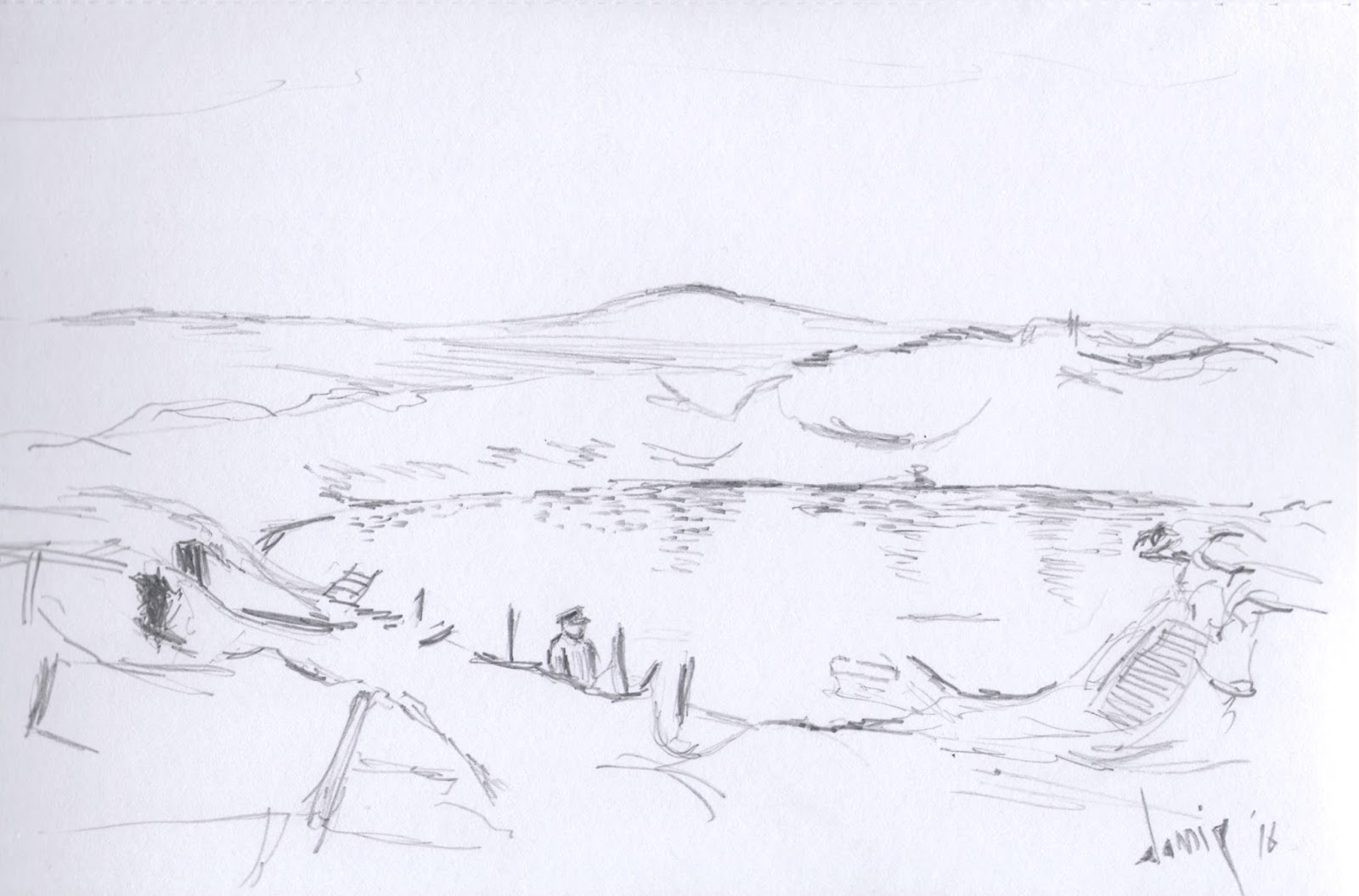
 Impression sketch of crater at St Eloi - by Jamie. From an original image that can be seen at: <http://www.militaryhistoryonline.com/forums/ViewPost.aspx?ForumID=56&ID=30517> [Accessed: 5 April 2016]

i
From days of early Flanders
The persona of Saint Eligius,
Had set on his task to convert
Pagans to Christianity religion,
With his twenty year mission -
His name dedicated to St Eloi
a village in a Flemish province.

Within a twentieth century
Mission, that same ground
Of St Eloi saw transformation
To total war, with sustained
Battles -1915 saw burrowed
Exchanges underground,
With tunneller's drafted in.

By subterranean methods,
A renewed struggle began
With six large mines, created
Beneath the German lines -
The decided plan for British
Intensions to move forward,
To capture destroyed lines.

Canadians afterwards would
Follow forwards, to secure
Captured systems - prior
To zero hour Germans had
control of ground; the land
Already battered, had mines
Prepared by sapper teams.

Into 87th leap year day
The 27th March at 4.15 a.m.
Awoke with tremendous
Gunfire - one followed by
Another of six mines, whose
Sound carried through air;
Heard on English shores.

Every man felt the earth
Shuddering, as volcanoe
Plumes of yellow smoke
Lifted skywards - debris
Rained upon pockmarked
Earth - six huge craters had
Formed in no mans land.

Amid the British forces
Lifting from sodden soil -
Khaki against blighted
Earth - Brodie clad heads
Over hunched shoulders
Came Northumberland
London's Royal Fusiliers.

With one Northumberland
Officer ready to provide
His regiment's story to
The Scotsman - the fight
the best organised to date,
Became known by name
Of Battle of St Eloi Craters.

The tunnelling companies
Had carried out operations
So secretly, the German
Presence had not guessed
What was about to happen -
A lull had till then, lasted
Across area for two days. 

A quagmire of peace could
Be seen for anyone, who
By chance could have stood
on ground, would have never
Been aware of two armies
in opposition, concealed;
Odd sniper fire interrupted.

ii
A dull drizzling morning
With possibility of heavy
Showers was observed,
Just before the ground rent
Heavenwards - the young
Officer relayed the problem
Of Northumberland’s role.

manoeuvres were acted out
Oddly, like a game - to enter
The maze of wire covering
The slope before German
Positions - slowly working 
To a pocket sized parapet,
That escaped the explosion.

A German machine gunner
Propped up on a parapet,
As they set foot among
The wire, to offer selves
Up as targets - but calmly
They worked through
By an amusing method.

A game spread amid men;
They adopted 'pick a back,'
As soldiers started to carry
Their comrades, who gave
Short reply to enemy fire -
Their aim to pick off any
Visible machine guns.

Within the gritty task,
The men took to amuse
Selves in transformation
To cavalry status - riders to
'Gee up' and chaffing each
Of their 'horse,' to criticise
Points of others mounts.

With the game of horse and
Rider making it through
The wire maze, dismount
Orders brought normality -
Back in role of foot soldiers,
They leapt down into enemy
Trenches, in warning shouts.

Their listeners though were
Just an audience of dead
And dying men - some
Lives lost within their sleep -
They came to a dug out,
Where a sentry stood
Upright, as on alert guard.

They yelled at the figure
To surrender - but he
Gave no answer - a man
With bayonet raised,
Rushed towards him -
Only to recoil in horror;
The sentry was dead.

Still on guard in death,
Looked on by those who
Would see him dead again.
With eyes described in
A look of 'the other world' -
With life severed in duty,
He was left at his post.

Moving further inwards,
Others were dazed from
An earthquake broken sleep,
Crouched or seated in pain
Of ignorance of the event -
Shocked to see strangers,
As a man in a dugout spoke.

'My God the English!' he
Found no escape, to be
Taken away with others
As prisoners - between
Them, arguing as to how
The invaders came - to
Land in massed airships?

iii
Some others suggested
They had burrowed
Up as moles - they could
Not fathom they had
Made their way across
Land of no man, that
Had been under guard.

A battle of St Eloi craters
Had begun with success -
The shattering sounds
Heard back in England,
With swarms of British
King's prisoners en mass;
Canadians made a start.

While spring had retained
Winter's wet conditions
Within the Belgium soil,
The rapid divisions arrival of
2nd Canadians in their first
Major engagement, brought
There without preparation.

Out of bitter, muddy earth
The British found success,
In hand-to-hand combat -
To win third German line -
While confusion lay amid
Enemy; mines irreparably
Altering their landscape.

Those great craters had
Been exploded, to create
A vast space over 180
Feet across and depth
Of 49 feet - with sleet
And wind, water began
To create glutinous mud.

For seven terrible days
Conditions took their toll,
With hundreds killed amid
Fighting chaos - exhausted
British gained relief from
Eager Canadian's 4 March
Arrival, in Belgium’s St Eloi.

Without blindfolds Canadians
Still had only a blinkered  
Idea of their situation and
German presence - by dates
Of 4 and 5 March, constant
Bombardment hampered
Efforts to improve defences.

With more deaths every
Minute, the 2nd Canadian
Pioneer Battalion tried
To drain their trenches -
The sight was a challenge
To the stomach of any man,
Upon the sight of that land.

'We were walking on
Dead soldiers,' Frank
 Mahout later wrote to his
Wife at home in Canada.
All about men attempted
To bandage wounds
As shells still fell around.

Soldier Private Fraser,
A Calgary bank clerk, gave
The scene at daybreak;
To see body parts protruded
Everywhere in the mud,
Marking out the yards - while
30 dead floated in crater.

Odd sights were captured
By moments of shock;
The German sentry corpse
Still on guard, or a tall, slim
English lieutenant who lay
Quite dead - his boyish face
Wearing a peaceful look.

Under nightshift fighters,
6 April at hour 3.30 a.m.
The ruins of St Eloi saw
German battalions attack,
Along the Canadian held
Main road - communication
Losses led to their retreat.

Another dawn lifted, renewed
German efforts had started
To recapture all grounds
Lost to them from battles
Start - confusion was relayed
By heavy rain, while the fight
For craters was still to end.

by Jamie Mann.

Anon.,1916. The Dead Sentry - The Story of St Eloi. The Daily Telegraph, [online] 5 April 1916. P.12. Col.3. Available at: <http://www.telegraph.co.uk/news/ww1-archive/12206739/Daily-Telegraph-April-5-1916.html>  [Accessed: 5 April 2016].

Source: File: Sint-Elooi. Online. Available at: <https://en.wikipedia.org/wiki/Sint-Elooi> Accessed 5 April 2016

Source: File: Battle of St. Eloi Craters. Online. Available at: <http://www.thecanadianencyclopedia.ca/en/article/battle-of-st-eloi-craters/> Accessed 5 April 2016

Mann, J., 2016. 100 years Ago - Poems by Jamie Mann. [letter] (Personal communication, 5 April 2016). 


#WW1 #WW1centenary #GreatWar #WW1poem #GreatWar #WW1centenary #worldwarone #worldwaroneremembered #WW1StEloi

Tuesday, 28 July 2015

Poem ~ Hooge - Wednesday, 28 July 1915


Impression sketch of Hooge Crater  - by Jamie. See the original at: http://www.ww1battlefields.co.uk/flanders/hooge.html

East of Ypres sat Hooge,
On a ridge called Bellwaerde -
Here was the home of a house
Chateau de Hooge, destined
To be in midst of a war.

From the Flemish quiet,
Of days where the chateau
Stood, erased in sad erosion -
To crumble down to dust,
Never to be rebuilt.

A decisive attack decided
To take place, about this area
In order to improve allied lines -
Construction of a mine, made
To be detonated at 7 p.m.

A Middlesex regiment lay
Opposite 126th Wurtemburge
Regiment - backed by 66th Artillery
Of German Forces – tensely
Waiting officer's signal.

Once the massive charge
Exploded, the infantry would
Rush ahead to gain occupation
Of the crater - at a distance
Platoons awaited action.

A Middlesex battalion, set
With bayonet fixed - reserve
Troops were readied in support -
The ground between them
And enemy, lay debris.

The hour shattered in
Sudden force as the earth
Flew - to throw men off their feet;
Melting German trenches
To dust, as spoilage fell.

A gaping space opened
Enemy’s neat breastwork
Out - smoke and dust emanated -
Wounded, with mainly dead
Germans lay all about.

In seconds, whistles
Blew and the Middlesex
Lifted into a smoldering inferno,
To meet stunned survivors;
With little resistance.

Bombers came after
The assault line, setting out
To progress - turned the crater
Into to allied defences, while
Bombers split into three.

Storming down three
Each trench path to drive
Back Germans that might still
Shelter; followed by soldiers,
Armed by fixed bayonets.

A gift of bombs aimed
In every dugout, only when
A traverse is made, is lobbed
Another - explosions are 
Followed by bayonets.

Such action needs
A flow of bomb supplies,
As the vulnerable bomber man,
Runs the risk of being hit,
Before he gets a target.

In an orchestra of this
Action-run-lob-halt-bayonet,
Agility is needed for progress,
Down any narrow spaces,
Of blocks and wounded.

Those bombers under
Lead of Lieutenant Erskine,
Who, taking part in operation
Came to defended dugout;
He used a pick to enter.

Hacking the roof in order
To throw a bomb, Lieutenant
Erskine had almost achived this
When a shot hit him down;
A fatal wound to his chest.

As daylight failed, action
Of bombing began to halt -
In retaliation, the minenwerfers
Woke, to toss high explosives
Into the occupied crater.

The minenwerfers named
Variously as ariel torpedoes
Gained more friendlier names;
As sausages and Rum-Jars,
In likeness to rum rations.

A night's bombardment
Continued to fade, with day
Counterattacks proving to be
Inadequate - with German
Reluctance to return.

With empathetic limits
To know the effects of loss
Of mates by a man's side - still
It seemed how the Tommy
Calmly kept to his duty.

An officer stopped, spoke
To one man at danger point
Asking how matters were going -
A reply of few aimed at them;
Unaware of any that did hit.

As replacements came,
To take over those exhausted
Troops - German shell batteries
Continued - parapets reversed,
And broken wire repositioned.

Hooge’s crater gave small
Extension to the allied front -
A stalemate was still held, as spits
Of counter attack against
Other counter attacks.

As activity settled back
Into routine, another salient,
South of Hooge, was hit by a mine
Knocked enemy’s hold - whose
Counter mine made no effect.

by Jamie Mann.

Anon.,1915. Attack at Hooge Position - Enemy Trench Mined - Daring Bomb Throwers. The Daily Telegraph, [online]  26 July. P.10. Col.6. Available at: http://www.telegraph.co.uk/news/ww1-archive/11742053/Daily-Telegraph-July-26-1915.html [Accessed: 28 July 2015].

Mann, J., 2015. 100 years Ago - Poems by Jamie Mann. [letter] (Personal communication, 28 July 2015). 


#WW1 #WW1centenary #GreatWar #WW1poem #GreatWar #WW1centenary #worldwarone #worldwaroneremembered #WW1Hooge

Friday, 28 November 2014

Poem ~ Poster Appeal - Saturday, 28 November 1914

Having joined forces of
The Territorial’s and Army,
Had been a flow of men,
Numbering 10,000 workers,
From the Lancashire mines -
With no abatement in sight.

These men were seen
As sturdy miners -
From Bolton’s Hulton
Colliery Company,
Out of 2000 workmen,
350 stepped forward,
Making their enlistment.
At Colonel Hargreave’s Pits
Burnley, 550 joined
From 3000 hardened workers.

For those miners that went
To the call, their employers
Generously gave their
Family’s allowances -
The Lancashire coal owners,
Then paid out monies,
To total some thousands.

Whitehall, Central London
And the Recruitment Depot’s
Publicity Department, -
Issued a new set of posters,
Designed to promote recruitment.

Described as attractive,
These were available
To anyone, that wished
To display a poster,
In the London County areas.

Formed in varied sizes,
These had replaced those
Out of date or soiled.
The designed posters,
Could be displayed
In Taxi cabs, motor cars,
Shop windows
And restaurants.

Invitations were soon made
To estate agents,
Who had any vacant
Properties on the main
Traffic highways,
Where placards and posters,
Were to be attractively placed.

Perfect places were Picture
Palaces - with their new
Gilded settings - these could
Entice audiences -
On seeing pictorial posters,
Would surely, swiftly swell
Recruitment numbers.

Also the call went out
To clubs, associations
And societies –
Asking secretaries to provide
Any number of branches -
Then recruitment posters
Would be quickly sent out.

One specific poster,
And handbill,
Was to appeal to both
Sports men,
And fans of football,
For show on such grounds.

In addition soldiers pay,
Detailed in pamphlet form,
Advised of allowances,
For family dependants,
Was soon issued.

Requests were addressed,
To Whitehall, in London’s
Publicity department -
So that no man in London
Might not turn, without
Seeing that posters,
Call out to his senses.

by Jamie Mann.

Anon.,1914. Men for the Army – Patriotic Colliers. The Daily Telegraph, [online] 28 Nov. P.4. Col.2. Available at: http://www.telegraph.co.uk/news/ww1-archive/11258892/Daily-Telegraph-November-28-1914.html [Accessed: 28 November 2014].

Mann, J., 2014. 100 years Ago - Poems by Jamie Mann. [letter] (Personal communication, 28 November 2014). 


#WW1 #WW1centenary #GreatWar #WW1poem #GreatWar #ww1centenary #worldwarone #worldwaroneremembered