Showing posts with label French Artillery. Show all posts

Friday, 1 April 2016

Poem ~ Verdun: Dead Man's Hill - Saturday, 1 April - Sunday, 2 April 1916

Impression sketch of French soldier killed on battlefield - by Jamie. From an original image that can be seen at: <http://wereldoorlog1418.nl/battleverdun/battleverdun33/morthomme03.jpg> [Accessed: 1 April 2016]

i
Two Forces funnelled into Verdun
By actions of a mincing machine -
Each side pushed one for resistance,
Another for success.

Renewed phase began 6 March - from
The left bank of the Meuse, German
Reserve corps edged from the right
To hit fort Vaux.

The left bank targeted Dead Man Hill,
A valued French artillery look out -
The plan to then aim for Bois Bourrus,
And French artillery.

From awareness of preparing their
Plan, lines of French defence formed
Four divisions - the less experienced
67th division being hit.

With ease the German force crossed
The Meuse, about villages of Brabant
And Champneuville - as aimed artillery
Failed the French.

Their shells sunk harmlessly into swampy
Ground - with failing defences by evening,
Found both Regneville and Forges villages
In German hands.

Hope dipped on day 7 March, as protected
Germans marched about the failing French
Efforts - Dead Man's Hill laid in their sights
To take.

A twist by morning found over confident
Germans lacking consolidation, before
More counter attacks; Bois des Corbeaux
Was French again.

Beaten back into defence, German assault
Against Dead Mans Hill was stopped until
9 March - at Bethincourt the enemy once
More halted.

Renewed forces saw Germans fight -
Despite with their huge losses regain
Bois Des Corbeaux - four days back
And forth.

The grinding down on men raised
Losses - 82,000 Germans versus
89,000 French - until the lines again
Settled down.

Hill 304 maintained French artillery -
Advantages over advance against
Dead Mans Hill - there soldiers fall,
To turn on hill 304.

On the 20th day, main German front
Moved west from villages Malancourt
And Avoncourt - to crush the French
29th division.

In disastrous defeat started rumours;
French traitors to give positions away -
3000 were taken prisoner; totals seen
To be utter disaster.

Under the crushing stalemate of death,
The fight fell to Bois Avoncourt - crossing
Every yard of ground, as heavens poured
Torrents.

Under the deluge earth turned to vile
Mud; where gunnery sunk - wounded
Drowned in dirt, as the living were
Sucked down.

Fatigue created desperation; as thirst
Forced risks by Dead Mans Hill, where
A soldier drank between green slime
Of a pond.

Within the depths a body floated, face
Down and bloated, as if he had been
Swallowing those waters for many
Days.

ii
From France came a communiqué
Telling of a quiet night East of Meuse,
While west of the river saw a very
Different matter.

During nightime hours the Germans
Made numbers of attacks en masse;
Malancourt came under their severe
Bombardment.

Three sides of the village fell under
Siege - a situation that had been held 
By French advance battalion numbers,
To last all night.

With French controlling all the exits
To the village, the troops evacuated
The ruins of Malancourt - marking 
Actions about Verdun.

The fury of fighting became divided into
Two distinct parts - close to Malancourt
Was German gain of Avoncout wood;
The date March 20.

In order to break the French presence,
The Invaders sprayed liquid fire - after
Hand to hand confrontations, the French
Returned.

Days led to day March 29; the enemy
Suffered with their counter attacks,
From French artillery in combination
With machine guns.

Their aim was the Avoncourt redoubt -
What taken ground was gained to be
Abandoned with masses of their dead,
Before entrenched French.

The German presence again evolved
To Hill 304; in determined tactics each
Side weary gave surrender, or remained
Insubordinate in trenches.

by Jamie Mann.

Anon.,1916. More Fighting Near Verdun - Village Captured. The Daily Telegraph, [online] 1 April 1916. P.9. Col.1. Available at: <http://www.telegraph.co.uk/news/ww1-archive/12206729/Daily-Telegraph-April-1-1916.html>  [Accessed: 1 April 2016].


Mann, J., 2016. 100 years Ago - Poems by Jamie Mann. [letter] (Personal communication, 1 April 2016). 


#WW1 #WW1centenary #GreatWar #WW1poem #GreatWar #WW1centenary #worldwarone #worldwaroneremembered #WW1Verdun

Wednesday, 22 July 2015

Poem ~ 'Land of the Cursed Water' - Thursday, 22 July 1915


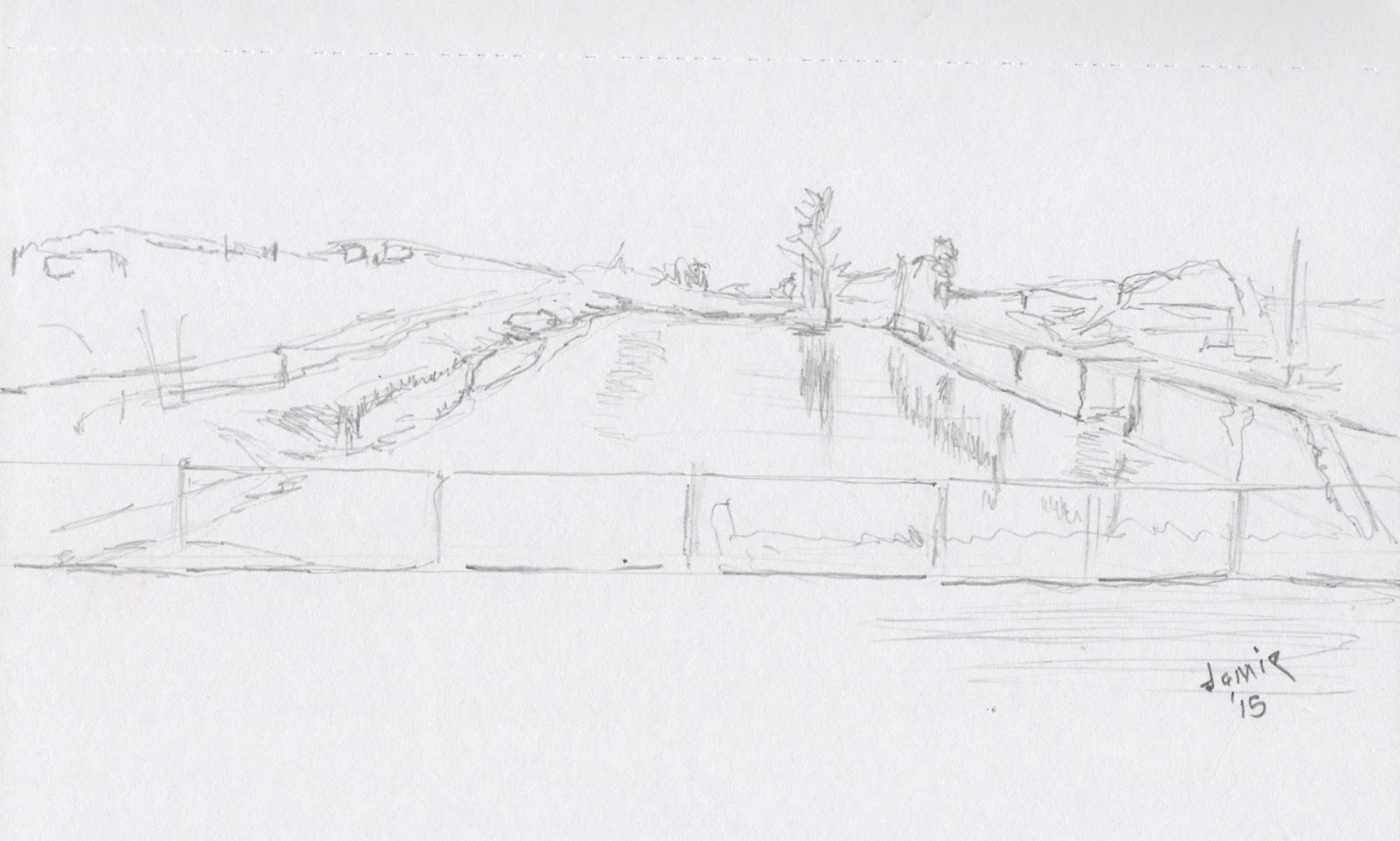
Impression sketches Canal at Boesinghe entrance to Ypres before and during war - by Jamie. See the originals at: http://www.gutenberg.org/files/36213/36213-h/36213-h.htm

An official French communication,
From 10 July 1915, gave information
Of further failed German attacks,
About the Yser canal – a wounded
French solider had provided a picture.

The German perspective of a ‘Land
Of cursed waters,' was given by one
Captured German. From their place
On right bank, here enemy made hold.

While all German caution had been
Taken, word reached French command
Of enemy preparations, for full attack -
With this information the French were
Prepared and ready for such an assault.  

9 July opened, with dawn of German
Gas bombs on the French left bank.
After the gas bombs, at 9 a.m. massed
German force provided little surprise.

An enemy formed a funnel attack over
The old stone bridge of Boesinghe -
Previously having made heavy attempt
In October 14 - chain bridges slung
Across, about the bridge of Yser canal.

Some shallow water allowed a waded
Crossing  - thus the German made
A tenuous hold on the French side -
Then confident, to be given new orders.

German troops were to take French
Second line trenches, a short distance
On - by then the bridges streaming
With German grey setting to reinforce
Their hold on the left bank of the Yser.

At a stage when a Bavarian Company
Filled the bridge, their luck halted in hit
By French 75’s - within moments bridge
Heads hit to fall into waters below,
With many Bavarians amid broken stone.

With crossing destroyed, more attempts
Of German chain bridges were hurriedly
Thrown across, amidst French counter
Attacks of Belgian and French Marines
Fixed bayonets, out to clear the left bank.

Chaos took over within German Lines -
They struggled, falling in their attempts
To assist two of their stranded battalions;
French 75's re focused on sappers work.

Under French fire they abandoned
Materials, if those soldiers were not hit
They fell to submerge in the canal depth;
Survival became nearly impossible,
'In the land of the cursed water.'

by Jamie Mann.

Anon.,1915. Fighting at Boesinghe – Germans Trap. The Daily Telegraph, [online] 22 July. P.10. Col.2. Available at: http://www.telegraph.co.uk/news/ww1-archive/11739263/Daily-Telegraph-July-22-1915.html [Accessed: 22 July 2015].

Mann, J., 2015. 100 years Ago - Poems by Jamie Mann. [letter] (Personal communication, 22 July 2015). 


#WW1 #WW1centenary #GreatWar #WW1poem #GreatWar #WW1centenary #worldwarone #worldwaroneremembered #WW1Boesinghe

Sunday, 3 May 2015

Poem ~ The Fight For St Julien - Monday, 3 May 1915


Impression sketch of St Julien, 1915 - by Jamie.an original image can be seen at http://homepage.ntlworld.com/bandl.danby/004Bn1915.html

Described in prior reports, German gas
Attacks, north of Ypres, had been made
At different times against British forces.

Around one particular section, it was
Not until 24 April, when in early hours
That enemy gas bombs were used.

One eyewitness on the lines stated
That late afternoon, on Thursday last,
French were pulling back on the west.

From a southerly direction, clouds
Of gas were drifting over ground
Driven by wind - closing in on them.

Their own position was occupied,
Being then shelled with explosives
Of high density - through until 8 p.m. 

On following day of Friday, saw some
Hours of bombardment of inclusion
Of gases - in attempt to poison them.

The German enemy infantry only lay
From about 120 yards away - to expect
An effect to put heads above parapets.

Intermittently to give accompaniment
Of rapid rifle fire - when wind dispersed
Gases - the enemy made no advance.

Thinning gas fumes made little effect -
Then on dawn of the Saturday, a sight
Of an airship appeared eastwards.

'Four red stars' fell from craft, to float
Slowly down dying out - their fixation
To observe this turned back to front.

A smoky wall had formed, blurring all
Views of enemy behind yellowish -
Green vapours, pushed by a breeze.

The invisible enemy made fire through
The wall – a prisoner said later how
They were unable to take advance -

Gas fumes had affected themselves.
12.30 a.m. on Sunday 25th were more
Repeated attacks, forcing a fall back.

Allied retreated NW of Zonnebeke,
On part of the Grafenstafel Ridge,
For a line to reform along a stream -

For a distance on the Haanebeek -
While no change had remained
Along the Yperlee Canal, until 26th.

At St Julien and east of their village,
Germans, in gathering over previous
Evening, then started their attack.

Each new assault grew more fierce
Yet with reinforcements, the witness
Stated the allied position as secured.

About Broodseinde, to the east, the line
Was cut into and Germans occupants
Settled into a section of allied trenches.

On afternoon of 26th, under a heavy
Bombardment, French and British East
Of St. Julien and Steenstraat moved.

Making a combined counter attack
Which raised right along the front -
To be described as a turning point.

A point to stop the enemy offence,
Allowing the allied to gain ground -
Giving needed relief of pressure.

In that counter attack of a narrow
Front, squeezed the guns - increased
Fire from left, came the French 75’s.

Over from the right British Batteries,
At odd times above the thundery
Noise, spewed howitzers from Ypres.

To the witnesses’ right, infantry began
A storm of enemy trenches nearby
St Julien, to capture the village edge.

Further trenches were taken from
The Bois des Cuisinirs sitting west
Of St. Julien, with more elsewhere.

The advance was made to take
700 yards  - only to fall back from
St. Julien as gas came once again.

As enemy made emplacements
With rattling machine guns in barns
And finds of other advantage spots.

French captured prisoners of 250 -
To retake Lizerne and Het Sas
Trenches and by canal's west bank.

With suffering on both sides, fights
Took place out in open daylight, as
Both sides pushed at varied points.

The Germans made close formations
Of their large numbers, in easy artillery
Targets- night fell with no occurrences.

As the 27th dawned, an organic line
Of allies held Zonnebeke north - while
Eastern edge of the ridge was to bend -

Southwest, a mile east to St. Julian,
From Haanabeek stream, in a curve
To Vamheule Farm to curve westerly -

Across Low ridges, west to east,
Onto the Ypres Langemarchk Road
To join the French section’s progress.

From the canal’s west bank Germans
Had been displaced, except at bridge
Head of Steenstraat, which they held.

In a counter attack lunch hour, progress
Between the canal and road of Ypres-
Poelcapplle; till right and centre stopped.

With the left flank also halted, the line
Remained the same as previous day.

by Jamie Mann.

Anon.,1915. Fighting at Ypres – Extensive Use of Poisonous Gas – Value in defence - Gallant Airman’s Death. The Daily Telegraph, [online] 3 May. P.10. Col.4. Available at: http://www.telegraph.co.uk/news/ww1-archive/11574527/Daily-Telegraph-May-3-1915.html [Accessed: 3 May 2015].

Mann, J., 2015. 100 years Ago - Poems by Jamie Mann. [letter] (Personal communication, 3 May 2015). 


#WW1 #WW1centenary #GreatWar #WW1poem #GreatWar #WW1centenary #worldwarone #worldwaroneremembered #WW1St.Julien