Showing posts with label Soldiers Escape. Show all posts

Monday, 7 March 2016

Poem ~ Tommy Ingenuity - Tuesday, 7 March 1916

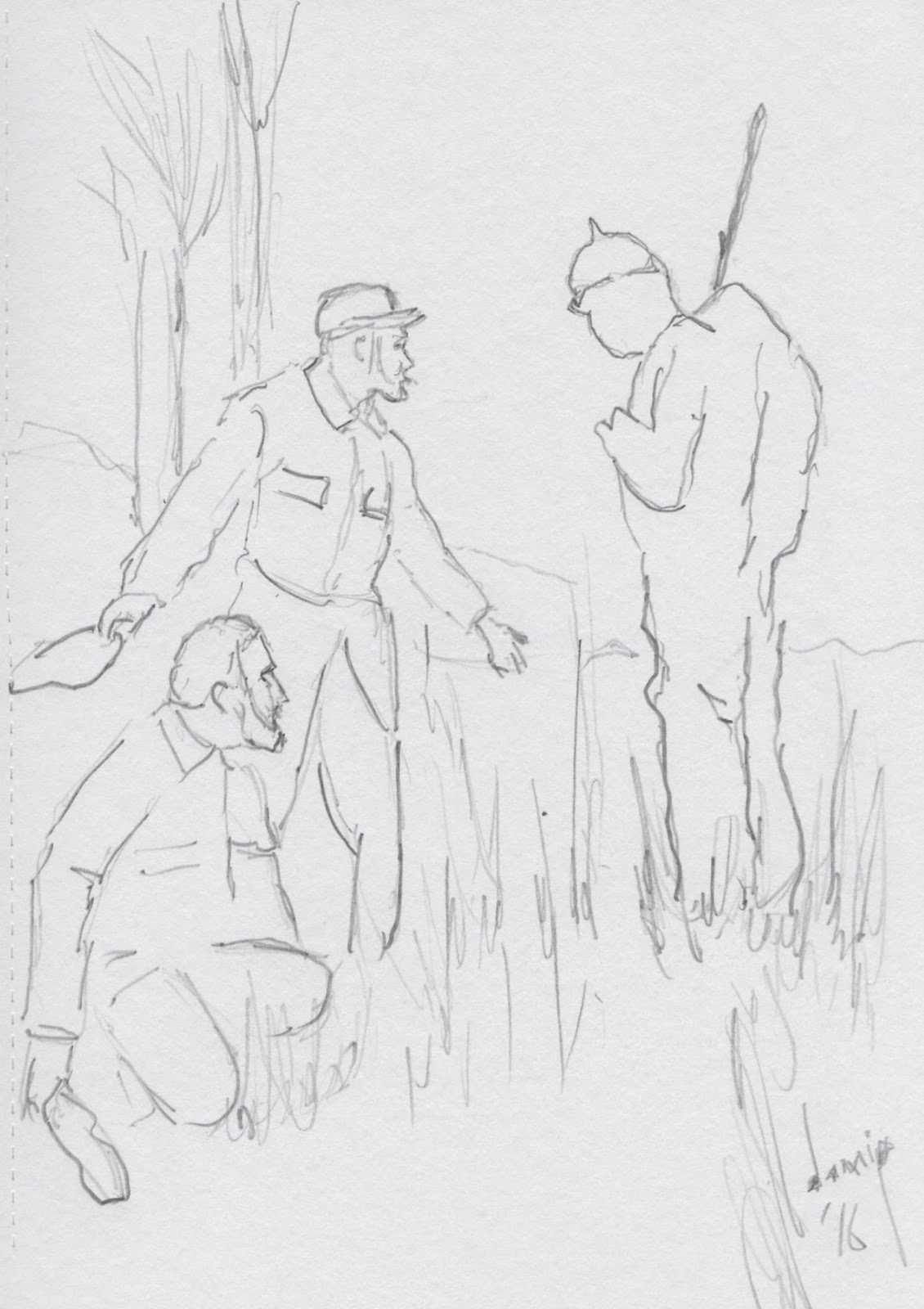
Impression sketch of Tommy knocking out sentry with grenade - by Jamie.


Somewhere on the western front,
France, two British Tommy's
Went out on patrol to encounter
By surprise, a number of Germans.

The enemy called out to them,
'Surrender!' - 'Not on your nelly!'
So the two Tommy’s quickly
Gave rifle fire to cut down a Hun.

With this, one Tommy shot away
And ran for all he was worth -
Leaving the other to fend alone.
Outnumbered, he lifted his hands.

The Tommy dropped his gun -
Deciding a live man was better
Off than a dead man - disarmed
The caught Tommy was searched.

Yet his captors had not detected
Tommy's talent for large hands,
By which he held a grenade - after
The search he put it in his pocket.

Taking on the manner of weak
Defeat, he was escorted back
To enemy lines - with the others
Gone, he was left with one guard.

Tommy, a hand in pocket, made
Grasp of grenade, to suddenly act
From subdued stance and banged
The pinned grenade to his head.

The German slumped to lose
Consciousness as Tommy took
The chance to leg it towards his
Lines, as another patrol appeared.

These Germans in their order
For his surrender came closer,
As Tommy held out his arms -
Suddenly he flicked the pin.

He threw the grenade into their
Midst with burst of explosion
The Germans cried out - Tommy
Took to his heels sprinting home.

Among his comrades Tommy
Told the story, to become pride
Of the regiment - as to how he
Used his skill in tight corner.

by Jamie Mann.

Anon.,1916. Resourceful Tommy - A Sprint To Safety. The Daily Telegraph, [online] 7 March 1916. P.7. Col.3. Available at: http://www.telegraph.co.uk/news/ww1-archive/12183671/Daily-Telegraph-March-7-1916.html [Accessed: 7 March 2016].

Mann, J., 2016. 100 years Ago - Poems by Jamie Mann. [letter] (Personal communication, 7 March 2016). 


#WW1 #WW1centenary #WW1poem #GreatWar #WW1centenary #worldwarone #worldwaroneremembered #WW1WesternFront

Saturday, 27 February 2016

Poem ~ Tree Border Guards - Sunday, 27 February 1916


Impression sketch of a German sentry carved from a tree stump - by Jamie. From an original image that can be seen at: <http://www.illustratedfirstworldwar.com/item/a-wooden-soldier-in-real-war-a-pollarded-german-guard-iln0-1916-0226-0007-001/ l> [Accessed: 27 February 2016]

As battles unfold,
By advance or retreat,
Comes luck to escape -
Or poor fortune
In capture.

In such events
Two such soldiers
Of France, found
Themselves
Prisoners.

Amid others
Transportation took
Them to Germany,
For incarceration
Of a camp.

On route these two
Men managed to get
Free - adapting
To events,
They hid.

By stealth, both
Then made their way
To reach border
Of Holland and
Germany.

After time, to feel
They would step freely
Across to Dutch soils,
Despair filled
Them both.

Just ahead they
Saw a sentry, steely
Guarding the passage
To their freedom -
What next?

They prepared
To fight and readied
To die, rather than
Give into that
Waiting sentry.

The German figure
Was on diligent guard;
With a fixed gaze,
Stared unmoved
Into Germany.

The two French
Picked up a rock, along
With a stick, readied
To strike for
Freedom.

From hiding
They rushed the guard,
Who made no move -
A striking rock
Bounced
Off him.

Heightened
By their attack, the two
Men fell, shocked
To their knees
Before the foe.

That alert German
They spied at distance,
Was nothing more
Than wood - sticks
Grew at his feet.

A stump of a tree
Had been cut and carved -
Pollarded into
Shape of a
German.

They had been
Fooled by the duplicity
Of clever crafting -
To admire
The skill.

They stepped past
The inanimate German,
To discover close
By, other such
Sentry trees.

Without any real
Soldier’s, only numbers
Of stumps stood
To resemble a
Frontier guard.

In wonder, the two
French soldiers walked
Into neutrality -
Days later back
In their regiment.

The two escapees,
In telling their story caused
Great amusement,
Regarding stumps
Of wooden sentries.

by Jamie Mann.

Anon.,1916. A Wooden Soldier In Real War: A Pollarded German 'Guard'!. The Illustrated London News, [online] 27 February 1916. 263. Available at: http://www.illustratedfirstworldwar.com/item/a-wooden-soldier-in-real-war-a-pollarded-german-guard-iln0-1916-0226-0007-001/ [Accessed: 27 February 2016].


#WW1 #WW1centenary #GreatWar #WW1poem #GreatWar #WW1centenary #worldwarone #worldwaroneremembered #WW1WesternFront

Friday, 29 January 2016

Poem ~ German Break Out At Knockaloe - Saturday, 29 January 1916

 Impression sketch of Knockaloe prison camp railway - by Jamie.  See an original image at: <http://www.independent.co.uk/news/world/world-history/history-of-the-first-world-war-in-100-moments/a-history-of-the-first-world-war-in-100-moments-britain-s-enemy-aliens-get-their-own-railway-9334403.html> Accessed: 29 January 2016].


Possibly surprising locations
For alien detainees, included
Islands about Britain - one was
The equidistant Isle of Man -
The landmass of 221 square
Miles, sitting in the Irish Sea.

To play its part, the chosen
Isle held two prison camps -
In Douglas a one time holiday
Site, held detainees - while close
To the town of Peel, Knockaloe
Was built on agricultural lands.

Constructed across a wide area,
Knockaloe was to be made
Of four compounds, to become
Like a small town - to include
Railway link - all made to house
1000's in prefabricated huts.

The camp was close to the sea,
With Peel being a fishing port -
Four detainees of Germany
Successfully existed their way
12 January 1916 from Knockaloe;
Two days later to be at Peel port.

The sailors of the German navy;
Robert Clauss, Richard Karlsen
Alexander Hoffman - the fourth
Georges Sudman, had ingenuity
To steal the yacht Genesta, from
The quay - but they were seen.

Shouts rang out at the daylight 
Theft of a local man's boat -
Close by was Constable Clague
Who quickly followed in a yawl -
With assistance of others, to make
Pursuit in a two mastered craft.

The group formed with harbour
Master and a Private Karran -
Crossing the harbour they caught
Up the yacht - the two Germans
On board lifted up their hands
To surrender, along with others.

Two more men were on a boat
Alongside - Germans and boats
Were searched, to find items;
Wire cutters, pincers, a compas,
Marlinspikes, sailmaker's thimble, 
Charts, log line and log books.

In addition; paraffin oil bottles,
Matches, along with a variety
Of food supplies, for their eager
Plan to flee - owner of Genesta
Stated how that two motorboats
In the harbour had been doctored.

A sabotage done to halt pursuit
Of the escaping German sailors -
28 January 1916, the four men
Before a military court charged
With escape and stealing - to be
Told of the men's good characters.

Along with this recommendation,
That came from two imprisoned
Officers, a court heard of Georges
Sudan's other escape at Douglas
Camp, to be held at Knockaloe - 
The military court considered.

Also in that court Franz Rignisky
Had stolen tobacco, while another,
Carl Hench had tried his luck
To escape - walking out with false
Pass - Hoffmann, Clauss, Karlsen
And Sudman all awaited verdict.

Already prisoners of Knockaloe,
What punishment might then be
Given? The final decision was
A deferred sentence, pending
The Governor's confirmation -
Very likely they were well guilty
Of building a discovered tunnel.

by Jamie Mann.

Anon.,1916. Escaped Germans On Yacht - Well Supplied With Provisions. The Daily Telegraph, [online] 29 January 1916. P.6. Col.5. Available http://www.telegraph.co.uk/news/ww1-archive/12120482/Daily-Telegraph-January-29-1916.html [Accessed: 29 January 2016].

Mann, J., 2016. 100 years Ago - Poems by Jamie Mann. [letter] (Personal communication, 29 January 2016). 


#WW1 #WW1centenary #GreatWar #WW1poem #GreatWar #WW1centenary #worldwarone #worldwaroneremembered #WW1IsleofMan

Saturday, 29 August 2015

Poem ~ Escapees Make For Orme - Sunday, 29 August 1915


Impression sketch of three German escapees, hoping to signal submarine - by Jamie. 

With almost six months passed,
From a spring escape for detainees
Of Germany - being fellows Andler
And Leben - came renewed attempts.

With Wales chosen as a place,
That might fox captured Germans,
Two more officers’ believed
They might escape Llansannan confines.

Their ambitious plan being to meet
Up with a German submarine rescue,
Off the Great Orme - a limestone
Headland on the North Welsh coast.

The prisoner's objective, where a
Serpent shape mass dips into the sea -
Close to the town of Llandudno -
At a twenty distance miles to freedom.

Amid the first interned at Dyffryn Aled,
Lieutenant-Commander Hermann Tholens -
Acting in the battle of Heligoland -
Had been caught by a British Destroyer.

Commander of the sunken cruiser
Mainz, Tholens been drifting an hour
In the cold North Sea, rescued
And taken to Chathams Naval Hospital.

During captivity in North Wales he was
Joined by Captain Heinrich von Henning;
Both schemed with their cell mate,
Captain Wolff-Dietrich Baron von Helldorf.

Long in the planning, the idea had begun
During a prisoner exchange, in December
1914 - then a message reached the
Commander in Chief of German Submarines.

The submarine was to rendezvous
Off North Wales, by the Great Orme, to meet
Helldorf, Henning and Tholens - a final
Date and confirmation made by coded letters.

Mid August saw the planned operation
happen, as the three men managed to prize
Open the bared windows - sounds
Being drowned by a prisoner's gramophone.

In steps of Andler and Leben, the three
Germans easily avoided sentries and lights,
To stroll as civilians out the front
Gates - walking through the night to Llandudno.

Soon after dawn they passed
A training field of Tommy soldiers taking drill -
Yet to be missed at morning
Roll call, hungry escapees purchased a cafe meal.

At sea, submarine U38, under
Command of Max Valentiner, had left base,
Wilhelmshaven on 4 August -
To reach west coast of Scotland and Ireland.

On way Targeting merchant ships
In the Irish Seas, before silently reaching
Point 50 miles off the Orme -
On 13 August 1915, in the cool evening air.

Having hidden for the day
Of 14 August the Germans at dusk,
Emerged, to reach Ormes
Lighthouse and edge a way down cliffs.

The U38 edged closer
Into land, to expect a signal - but
Unable to reach the beach,
The escapees failed in their task.

The plan was still possible,
As the arrangements were for three
Nights - when submarine
Would approach the allotted position.

Back in the hide of brambles,
The three German officers sought
To sleep for the day - until
Another dusk attempt made success.

At the foot of the Orme,
They used a torch in a circular
Continual wave - but no
Reply came from the dark waters.

In a final attempt, in gathering
Driftwood, the men built a fire - waving
A burning log to make signals
In darkness; yet still no submarine came.

Disappointed, the three
Believed that the vessel would not
Then come - in reality
The submarine lay at a short distance.

A limestone buttress had
Blocked their views of each other -
Now the officers decided
Not to wait, instead to leave Llandudno.

The three escapees split
Up to make seperate ways to London -
Walking off alone, Tholens
Bought cigarettes finding rest in a cafe.

After coffee and cake,
Tholens walked onto Tudno Hotel,
To be seen by a police
Constable, who asked for his identity.

For reasons of dejection
And hunger, maybe, he declared
Himself as a German
Escapee, requesting he be arrested.

Then Llandudno went
Into lock-down, as a search was taken
To find the other two -
Believing them to be at the railway station.

Their descriptions did
Not match any man at the station -
Next at Colwyn Bay,
Was decision to halt the London train.

The searched train
Gave no result  - in fact the two
Were still in Llandudno,
trying to gain a car at Silver Motors.

The idea quickly failed
As the staff attempted to engage
In conversations -
The men left, still in Llandudno.

The day faded into rainy
Evening when a cab driver, on way
To get a fare, stopped by
Two soaking men on North Parade.

Alfred Davies asked them
If they needed a cab - on climbing in
They asked in broken
English, to be taken to 'the colonel.'

Obligingly, he drove them
To Gloddaeth Street and headquarters
Of the London Welsh
Battalion - where they were arrested.

27 August saw the three
Escapees in Military Court, Chester Castle.
Captain Tholens in guilty
Plea, stating indignity of being handcuffed.

More suited to dangerous
Criminals, this degraded an officer of war -
Additionally Captain Henning,
Who had also surrendered, admitted guilt.

Henning told that his being
Guarded against escape, by an officer
In company of three soldiers
With fixed bayonets was quite enough.

He shared belief that
Also being cuffed, should not be done
To an army or navy officer;
That rules of English army were wrong.

Lastly Officer Helldorff,
In his plea of guilt, also had decided
To give himself up, knowing
The impossibility to escape England.

All three shared complaints
Of being transported in handcuffs -
To reinforce fact that they,
As officers, had duty to try an escape.

by Jamie Mann.

Anon.,1915. Trial of German Officers - Escape from Prisoners' Camp. The Daily Telegraph, [online] 28 August. P.8. Col 6. Available at: http://www.telegraph.co.uk/news/ww1-archive/11812558/Daily-Telegraph-August-28-1915.html [Accessed: 29 August 2015].

Source: File: The Home Front Museum. The Great (Orme) Escape! [online] Available at: <https://homefrontmuseum.wordpress.com/tag/ww1/> [Accessed: 29 August 2015].

Mann, J., 2015. 100 years Ago - Poems by Jamie Mann. [letter] (Personal communication, 29 August 2015). 


#WW1 #WW1centenary #GreatWar #WW1poem #GreatWar #WW1centenary #worldwarone #worldwaroneremembered #WW1Wales

Monday, 1 December 2014

Poem ~ French Boy Saves British Soldiers - Tuesday, 1 December 1914


Living for a number of weeks in Roye,
A boy returned to Paris.
His story is that he saved,
Ten British Soldiers -
From German capture.

Staying with his aunt at Roye,
The boy of 16 witnessed
A bombardment there,
Lasted up to ten days.

With no time for fear
He helped to attend,
To wounded British men,
He had hidden in the house.
Nine men and one officer.
Having been made
Prisoners by the Germans,
Made for a lucky escaped.
Finding their way to Roye.

The boy explained,
How they could not move,
Outside as the enemy,
Surrounded the area.
They would have only
Been recaptured –
With his aunt, they hid them,
In a concealed loft,
As comfortably
As they possibly could.

A knocking suddenly
Came to the house.
The boy unlocked the door,
To a German officer.
With an answer
To every question,
He gave the officer various
Information –
Along with an offer,
To look after German wounded,
Lodged in a chapel -
The officer left satisfied.
With no idea,
Of the ten English soldiers
Present over his head.

by Jamie Mann.

Anon.,1914. Britishers in a Loft – Saved by a French Boy. The Daily Telegraph, [online] 1 Dec. p.5. Col.4. http://www.telegraph.co.uk/news/ww1-archive/11261358/Daily-Telegraph-December-1-1914.html [Accessed: 1 December 2014].

Mann, J., 2014. 100 years Ago - Poems by Jamie Mann. [letter] (Personal communication, 1 December 2014). 


#WW1 #WW1centenary #GreatWar #WW1poem #GreatWar #ww1centenary #worldwarone #worldwaroneremembered #WWParis

Sunday, 7 September 2014

Poem ~ Escape from Mons – Monday, 7 September 1914


An unnamed Private and a Sergeant Smith,
Both being of the Somerset Light infantry,
On arrival, soon experienced the fighting
Outside Mons - the men bustled from train
Being sent charging into the fray, before
Even before knowing where they were.

Some hours later after a big fight,
The Germans were moving about,
To take ground between many men
And their regiments. Effectively cut off,
The private and Sergeant hid,
Alongside many other soldiers
Waiting silently until darkness fell.

Then throwing rifles aside
They crawled Slowly on knees
And elbows, through German pickets.
The Private and Sergeant Smith
Finally got through and looking
For others, found themselves
At the homes of simple peasants.

Taking some brief respite,
They were given civilian clothes.
Disguised in the hope to return
And rejoin their fighting force,
Quickly proved quite Impossible,
As their regiment
Had retired too far back.

So together they made a plan.
Making their way along the coast,
In various incidents on route. 
Being stopped many times,
Not just by French soldiers,
But cyclists riding about,
On lookout for any German spies.

On success in reaching Boulogne
They saw the consul and acquired
A pass to sail back to England,
Where they re-joined their depot -
Still in clothes given them,
By helpful French people.

They could only assume,
Other men that had stayed,
Had been taken prisoner.
While some other soldiers,
Escaping that situation,
Cut off from their regiment,
Did the same as them.

But unable to speak French
Soldiers may have been taken
As German spies and possibly shot.

by Jamie Mann

Anon., 1914. Battle Stories - Cut Off At Mons - Rifles Thrown Away. The Daily Telegraph, [online] 7 Sept. p.3. Col.1. Available at: http://www.telegraph.co.uk/news/ww1-archive/11073408/Daily-Telegraph-September-7-1914.html [Accessed: 7th September 2014].

Mann, J., 2014. 100 years Ago - Poems by Jamie Mann. [letter] (Personal communication, 7 September 2014). 


#WW1centenary #GreatWar #WW1 #WW1poem #GreatWar #ww1centenary #worldwarone #worldwaroneremembered #Mons