Showing posts with label British Government. Show all posts

Wednesday, 7 December 2016

Poem ~ Fall Of A Government - Thursday, 7 December 1916 - Friday 8 December 1916

 Source: File: Herbert Henry Asquith. See an original image at: <https://en.wikipedia.org/wiki/H._H._Asquith> [Accessed 07 December 2016]


Source: File: David Lloyd George. See an original image at: <https://commons.wikimedia.org/wiki/File:David_Lloyd_George_1915.jpg> [Accessed 07 December 2016]

After the initial months of conflicts, tensions had raised
In the running of British government - the munitions
Shortages prompted a change for important decisions -
A Coalition rule formed as a way forward for war.

May 1915 marked the date when Liberal prime minister
Asquith formed this situation, from out of the belief
That war could be managed in business as usual;
Though lack of unionist support left government weak.

The coalition then consisted of one labour member
Along with nine conservatives - though the liberals
Still held the most important positions - to dissatisfy
The conservative party and their leader Bonar Law.

Continual failures did not bring war to any conclusion;
The Dardanelles campaign had ended without success,
The Somme Offensive had not brought the hoped
For outcome - by December Roumania lay defeated.

Such variety of threads had all been woven into place,
To cause a likely unavoidable chain reaction - another
Factor was the Lansdowne Memorandum published
13 November seeking a Central Powers settlement.

20 November 1916 saw a meeting set by Max Aitken,
Canadian entrepreneur and friend to leader Bonar Law,
To be attended by Lloyd George and Edward Carson
Irish politician and unionist - to agree need for change.

In making conclusion the current government was
Not functioning, they formulated an agreed plan for
A War Council led by Lloyd George - they all agreed
Asquith would remain prime minster and overseer.

Yet divisions remained amid politicians over Asquith
Staying on as prime minster. The newspaper Magnate
Lord Northcliffe emerged, playing a pivotal role in the
Outcome, taking many meetings with Lloyd George.

The proposal was then presented to Asquith over
Establishing this War Council, of more than five
Members, although Asquith would keep 'supreme
Control’; Asquith stated that he would be chairman.

With the plan tentatively taken Lloyd George could
Not accept Asquith's wish - he wrote to Bonar Law
2 December to say he had to make 'resolute action' -
The press bubbled as conservative leaders met.

By twists and turns of unconfirmed plots raised
Debates over Asquith's future position - a resolution
From conservatives came; Asquith would need
To tender resignation of the current government.

If he did not conservative members would then
Resign - Bonar Law relayed this to prime minister
But without raising the resolution, after they met
Asquith sought to compromise with Lloyd George.

In a return to basics with 1st December proposal,
Was amendment that the prime minister would
Instead have right of daily oversight and allowed
To veto - Asquith, George and Law met again.

3 December 5 p.m. they decided over a bulletin
To be released to state the Government was
To undergo modifications - 4 December saw
Release, to attract great hostile press reactions.

Critics said how Asquith would be prime minister
In name only - suspicions lay on Lloyd George
As the source to a press editor - Asquith reacted;
He could not go on if claims were uncorrected.

4 December saw various quick fire meetings and
Led to Asquith and supporters standing firm, in
Order to fight into evening's meltdown - Asquith
Reacted in rejecting the idea of a war council.

With further debates too and fro on 5 December,
Ministers showed their true colours; that without
Bona Law and Lloyd George in post they could not
Work in the Government - instability had been set.

Into evening's darkness 5 December Asquith made
His way to Buckingham Palace, for an audience
With the king - next mornings newspaper reports
Told In a grave act Asquith had given his resignation.

Later that same evening Bonar Law had followed
The same path, in order to accept the King's offer
In royal commission - battle lines between Asquith
And George led to problems egged on by press.

While making acceptance of king's Commission
Bonar Law called at No 10 Downing Street to ask
If Asquith would still serve with him - but with his
Refusal Bonar Law rejected the royal commission.

Finally 6 December Lloyd George was requested
To form a government - He acted within 24 hours
To establish not a war council, but a war cabinet -

By 7 December date George was prime minister.

by Jamie Mann.

Anon.,1916. Mr Asquith's Resignation. The Daily Telegraph, [online] 6 December 1916. P.8. Col.5. Available at: <http://www.telegraph.co.uk/news/ww1-archive/12213939/Daily-Telegraph-December-6-1916.html> [Accessed: 7 December 2016].

Source: File: H. H. Asquith. Wikipedia. Available at: <https://en.wikipedia.org/wiki/H._H._Asquith> [Accessed 7 December 2016]

Source: File: David Lloyd George. Wikipedia. Available at: <https://en.wikipedia.org/wiki/David_Lloyd_George> [Accessed 7 December 2016]

Mann, J., 2016. 100 years Ago - Poems by Jamie Mann. [letter] (Personal communication, 7 December 2016). 


#WW1 #WW1centenary #GreatWar #WW1poem #GreatWar #WW1centenary #worldwarone #worldwaroneremembered #WW1Britain

Sunday, 6 November 2016

Poem ~ Tunnel Ambitions - Monday, 6 November 1916 - Wednesday, 8 November 1916


Source: File: plan to build a double Channel tunnel. See an original image at: <http://www.railwaywondersoftheworld.com/channel-tunnel.html> [Accessed 06 November 2016]

Prior press releases had well discussed
The likelihood of a tunnel being built;
From the English coast of chalky downs,
To pass beneath the sea and rise again
On French soil - emerging between Calais
Or Boulogne - all to help the war efforts.

The leader of these plans for a channel
Tunnel given to Sir Frances Fox - totally
Confident of ambitious plans feasibility -
Just to consider the existence of tubes
Beneath London, or the 1903 railroad
Simpson tunnel in Pennsylvania, USA.

Alongside technicalities of construction
Came argumentation over safeguarding
The tunnel's completion - Although
The channel tunnel's existence was little
More than paper blueprints, came evolving
Discussion on the idea of its destruction.

The debate of a report carried forward
By Telegraph's engineer correspondent.
Historically, there had been a long desire
For the creation of linking together Britain
And France - prior opposition had been
Raised by Field Marshal Wolseley.

While Wolseley had died a year prior to 
1914 world war, Garnet Wolseley put out
His theory that any such passage link,
Would be quite 'calamitous' for England -
He suggested an ever-present peril from
A continental army, seizing the tunnel.

At that time Edward Watkin had dreamed
The ideal of a rail line Manchester to Paris,
That began in 1880 - but big opposition
From figures like Wolseley and the Queen
Caused the ideas cancellation, for purposes
Of national security; arguments resumed.

Times changed, as came in a reminder
That in Wolseley's peak how poison gas
Was not known, or uses of high calibre
Explosives - electricity was then in its
Infancy; while no one could then have
Imagined armoured tanks carrying guns.

The new prospect had taken on a solid
Formation by Channel Tunnel committee,
Created within the House of Commons -
British Prime Minster Asquith had called
For a review in the light of experiences
Due to the war, from the war committee.

Supporter of the tunnel, Arthur Fell MP;
A figure that had previously produced
A paper for the tunnel in 1913 - in 1916
Led a delegation of MPs before Asquith,
Advising that many military oppositions
Had 'practically disappeared' off scene.

Governmental military advisers were
Well satisfied such a tunnel could not
Be used in any armed invasion against
Britain. A discussion then centered
On how the tunnel might be rendered
Unusable, for purposes against invaders.

The simplest of ideas would be to flood
The entrance over a short length - close
To the English coast there would be
A 'V' shaped dip, into which water could
Be filled by electric sluice gates - operated
Not just by Dover forts but from London.

Even a rat would not be able to pass,
And this would stop complete damage.
Their first plan had been to blow tunnel
Roof, to let water flood the whole length -
Originally a viaduct entry would be built,
Leading from the cliffs into the tunnel.

In emergency British war ships could
Blow this construction, in order to halt
Any enemy using the tunnel - yet since
The submarine came into service this
Idea was dropped - as any submarine
Could easily destroy such a viaduct.

A further consideration from such
Submarines was an attack actually
On the seabed, by laying of mines.
A hole might be blown, allowing the
Channel waters to flood the tunnel;
Likely thwarted by 100 feet of chalk.

Due to water pressure at that depth
Any explosion would be less effective
Than if on land - an additional plan
Of engineers focused on the French
Coastline where the tunnel opened;
Though positioned 4 miles inland.

The jurisdiction of protection would
Still be guarded by gunnery of British
Fleet - with consideration by engineers
To French side, regarding inland attacks;
to recall how first months had been threats
On Calais, targeted by German invaders.

New plans suggested making the land
Around the tunnel access into some
Type of fortress as a last stand -
To aid English side to put into action
All preventative measures - in addition
A French power station would assist.

Being able to supply electricity part
Way into the tunnel - they could
Halt any rogue trains trying to enter
The route by a switch; while a British
Power station would be out of range
Of enemy, being 20 miles inland.

Engineer Sir Frances Fox believed
That within 6 years the tunnel would
Be completed; a straightforward build,
To total £8,000,000 for English share.
With a ventilation system simpler than
London tubes, travel was 30 minutes.

The underlying suggestion seemed
To indicate that war with Germany
Would likely last, well beyond when
The tunnel would be operational; into
At least six more years of war. To add
France had no fears from the tunnel.

In the commons the discussions
Of the proposition in connecting
England to the continent came via
A reminder by Mr Fell to Asquith -
That peace with France had lasted
100 years, to be so for much longer.

To note rate of scientific progression,
By fifty or 100 more years to 2016,
No one could make any prophecy
As to what in future needs might be,
In protection from threats above, or
Below the sea or even from the air.

by Jamie Mann.

Anon.,1916. Channel Tunnel - Invasion Risks - Engineering Safeguards. The Daily Telegraph, [online] 06 November 1916. P.4. Col.3. Available at: <http://www.telegraph.co.uk/news/ww1-archive/12213599/Daily-Telegraph-November-6-1916.html> [Accessed: 06 November 2016].

Source: File: Edward Watkin. Available at: <https://en.wikipedia.org/wiki/Edward_Watkin> [Accessed 06 November 2016]

Source: File: Garnet Wolseley, 1st Viscount Wolseley. Available at: <https://en.wikipedia.org/wiki/Garnet_Wolseley,_1st_Viscount_Wolseley> [Accessed 06 November 2016]

Mann, J., 2016. 100 years Ago - Poems by Jamie Mann. [letter] (Personal communication, 06 November 2016). 


#WW1 #WW1centenary #GreatWar #WW1poem #GreatWar #WW1centenary #worldwarone #worldwaroneremembered #WW1Britain

Saturday, 9 July 2016

Poem ~ Boots Are Made For Marching - Sunday, 9 July 1916

Source: File: Three Russian Soldiers. See an original image at: <https://www.flickr.com/photos/sunnybrook100/3377341300/in/album-72157615683192081/> [Accessed 9 July 2016]

Source: File: Russian Army in World War I - Mad Monarchist, [online] <https://www.youtube.com/watch?v=R4wg04_ZqEg&feature=youtu.be> [Accessed: 09 July 2016]

In necessity of an army's day-to-day
Living, frequent marching, running,
Fighting across varieties of rough
Terrain - not to forget days of training,
An allied army required sturdy boots.

Manufacturers of this footwear created
Their own trade references - heavy
Leather was needed to create army
Boots - tanned hide parts prefered
Over butts, shoulders and the cheeks.

Released details of the Army Council's
Intentions to take possession of 'all
Bends of 10lb upwards' - making
Claim to all named parts mentioned;
Would likely push up all leather prices.

Yet the fact was not particularly new -
The Boot and Shoe Manufacturers' 
Secretary stated, on 7th July,
Government's order already done
This - to believe effects as not serious.

Furthermore, an enormous Russian
Order for infantry and ankle boots
Of 3000,000 that would likely
Double - with 3000,000 Cossack
Boots - could push up high demands.

Price rise rumours by such orders
May have added some effect,
Along with reasons, such as
Scarce male labour, to include
Insufficient war bonus from 1915.

More grant applications were under  
Way, while a bubbling crisis came
From obtaining enough leather
To complete big contracts - to find
Sources in time created pressures.

A month had been given to find
All sources for leather uppers
Of tallest boots - for future
Needs, in a current shortage
Of quality, was to import the hide.

The government’s restrictions from
Taking their claim for leathers
Suitable for army boots,
Had resulted in there being
Limited resources of good quality.

by Jamie Mann.

Anon.,1916. 1916. Army Boots - Russia's Enormous Orders. The Daily Telegraph, [online] 8 July 1916. P.6. Col.2. Available at: <http://www.telegraph.co.uk/news/ww1-archive/12211872/Daily-Telegraph-July-8-1916.html>[Accessed: 9 July 2016].

Mann, J., 2016. 100 years Ago - Poems by Jamie Mann. [letter] (Personal communication, 9 July 2016). 


#WW1 #WW1centenary #GreatWar #WW1poem #GreatWar #WW1centenary #worldwarone #worldwaroneremembered #WW1Uniforms

Thursday, 5 May 2016

Poem ~ A Bill for Saving Daylight - Friday, 5 May - Saturday, 6 May 1916


Source: File: Allegorical illustration depicting the introduction of daylight saving time from 1916. Daylight Saving Time: What is it and why do we have it? by Jess Staufenberg   Thursday 3 March 2016. [online] See an original image at: <http://www.independent.co.uk/news/uk/home-news/daylight-saving-time-what-is-it-and-why-do-we-have-it-a6907621.html> [Accessed: 6 May 2016]

For further study see:

http://hansard.millbanksystems.com/bills/daylight-saving-bill

After much debates for and against,
Was a decision made by Parliament.
This proposal was to last for wars
Duration - the daylight saving Bill.

The idea to alter times of clocks
Had been around for some time -
The waking hours alterations, had
Taken place in the ancient world.

Then a Benjamin Franklin satire
Rekindled the thought, to suggest
That a practice of waking earlier,
Would allow people to use daylight.

One such figure that had risen
To ride his horse in Petts Wood
Noted how many blinds were
Still down despite a summer's day.

William Willett was a builder,
Whose occupation probably
Made him think, how wise
It was to use all possible daylight.

By his own funds in 1907, Willett
Petitioned Parliament with his
Pamphlet - how for half the year
The sun shines while people sleep.

Determined to show all benefits
to Businesses and Town Councils,
He found support in Robert Pearce
MP, who tried to get it passed into law.

While this failed, other minor support
Came from Churchill, with another
Consideration in 1909 - still nought
Came of this until war's outbreak.

Willets thoughts were to improve
Well-being of people, that bring
Clocks forward over four Sundays
In April, to reverse them in September.

To be 20 minutes over each day -
Germany was already using such
A scheme, when 3 May 1916
Announced Daylight saving Bill.

Declared as unexpected the act
Was prompted by several MPs
Being in favour of a trial - only
For the length of the current war.

Advantages would actually give
The saving of coal in producing
Artificial light - the instance
Of advancing would occur in May.

The Daylight Saving Bill, while
Not aimed at peoples health,
Would act as wartime production
Boost, under Defence of realm Act.

by Jamie Mann.

Anon.,1916. Daylight Saving. The Daily Telegraph, [online] 5 May 1916. P.6. Col.6. Available at: <http://www.telegraph.co.uk/news/ww1-archive/12209706/Daily-Telegraph-May-5-1916.html>  [Accessed: 5 May 2016].

Mann, J., 2016. 100 years Ago - Poems by Jamie Mann. [letter] (Personal communication, 5 May 2016). 


#WW1 #WW1centenary #GreatWar #WW1poem #GreatWar #WW1centenary #worldwarone #worldwaroneremembered #WW1IEngland

Monday, 11 April 2016

Poem ~ Nurse Training Scheme - Tuesday, 11 April 1916

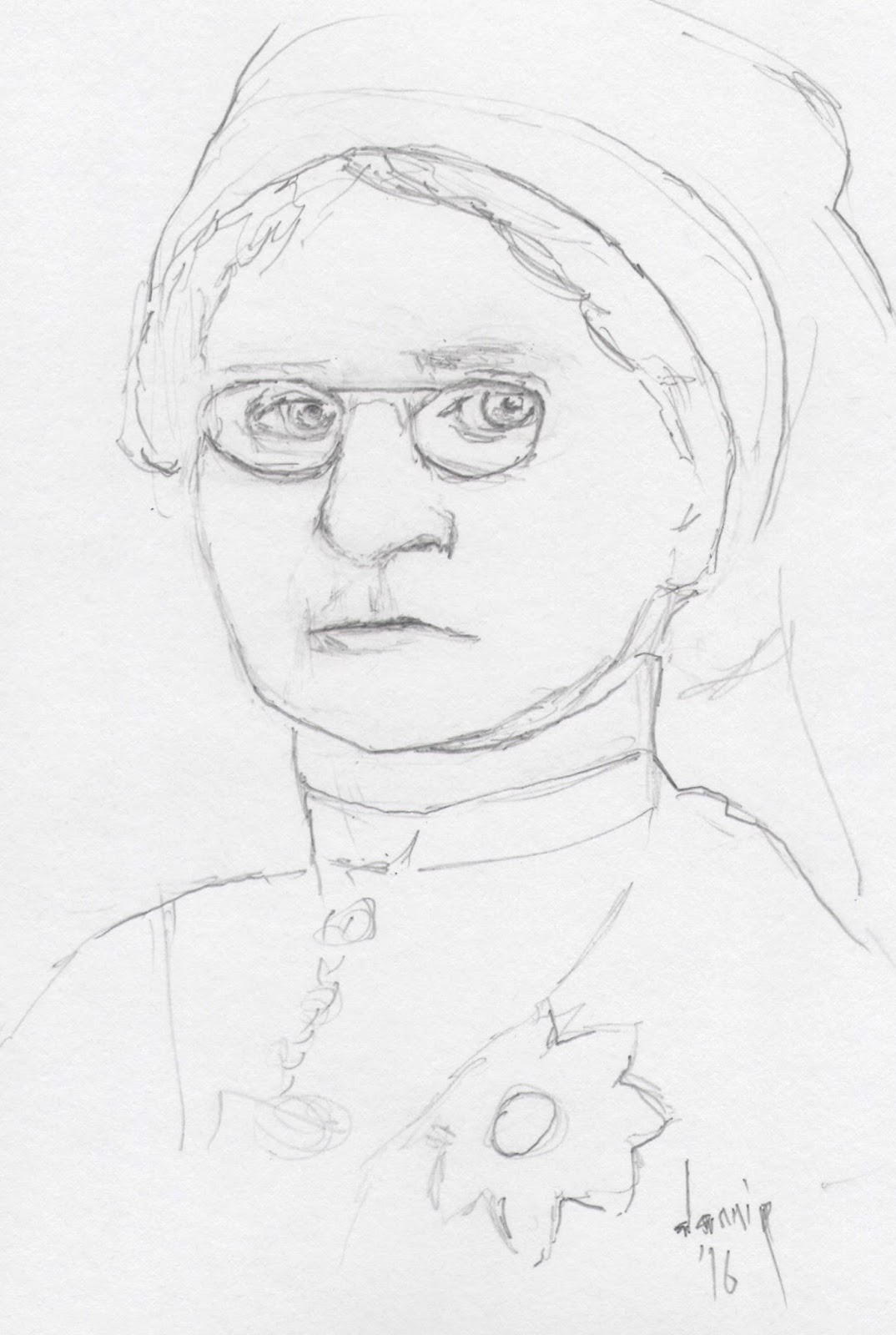
Impression sketch of Sir Arthur Stanley and Sarah Swift - by Jamie. From original images that can be seen at: <https://commons.wikimedia.org/wiki/File:Sir_Arthur_Stanley.jpg> and <https://www.rcn.org.uk/centenary> [Accessed: 11 April 2016]

With ongoing war without
Any sign of ending, a great
Need continued for nurses
To care for wounded soldiers.

As early as 1886 had been
Call for state registration
Of nurses but the proposal
Had been suspended in 1914.

An obvious growing need
For structured nurse training,
Was taken on by Red Cross'
Sarah Swift and MP A. Stanley.

Support of Arthur Stanley
Came from his volunteer
Work of health and disability;
As Chairman of the Red Cross.

Nurse training so far, had varied
Between programs in volunteer
Hospitals over 3 years - or hasty
Training in mental hospitals.

Two institutions they looked to
Were medical royal colleges;
Together, these models drew
A proposal for future meetings.

Despite various objections, an
Initial meetings success meant
No others were needed - diplomat
Stanley overcame all challenges.

Came significant date, 27 March
1916, to consolidate the college
Of Nursing Ltd - a meeting sat
At St Thomas Hospital London.

Objective, to discuss constitution
Of newly formed nursing college;
To bring hospital governing bodies
And matrons from across the country.

With Chairman Arthur Stanley
MP, announcing scheme, came
From needs of standardisation
For qualifications in the profession.

Matron Sarah Swift, of Joint war
Committee, with Stanley as their
Chairman - looked to already well
Established bodies of medical training.

Alongside the Royal College of
Physicians and Surgeons, time
Had come for College of Nurses -
Which, in time, may gain a royal title.

At its heart were three principles;
State recognition, uniformed
Curriculum of training alongside an
Established standard entrance exams.

Mr Stanley advised there would
Be no finance issues - a public
Keen to help soldiers and sailors,
Would not fail this nursing profession.

Regarding state registration
Of nurses Bill, Mr Stanley felt
Not to wait till wars end, when
Public interest would move away.

Nursing needs were current
In public's minds; after conflicts
End nurses, with their knowledge,
Would return with a power to harness.

by Jamie Mann.

Anon.,1916. A College Of Nursing. The Daily Telegraph, [online] 8 April 1916. P.12. Col.5. Available at: <http://www.telegraph.co.uk/news/ww1-archive/12208608/Daily-Telegraph-April-8-1916.html>  [Accessed: 10 April 2016].

Mann, J., 2016. 100 years Ago - Poems by Jamie Mann. [letter] (Personal communication, 10 April 2016). 


#WW1 #WW1centenary #GreatWar #WW1poem #GreatWar #WW1centenary #worldwarone #worldwaroneremembered #WW1London