Showing posts with label Army Training. Show all posts

Sunday, 1 January 2017

Poem ~ Owen: An Officer In France - Monday, 1 January 1917 - Friday 5 January 1917


Source: File: Second Lieutenant Wilfred Owen. See an original image at: <http://www.wilfredowen.org.uk/Biography> [Accessed 01 January 2017]

By December's despondent mood,
Second Lieutenant Wilfred Owen
Stayed in temporary residence; the
Queens Hotel Southport, Merseyside
Held little comfort for 1916's end.

A place poised on North Sea's edge
To funnel a cold northwest draft, did
Nothing to uplift Owen's mood - daily
Challenged by Major Melville's ways
Of continual dissatisfied manners.

Still on home duty Owen was fit and
Ready - while many resident officers
Wandering there wore gold stripes
On sleeves, to show there wounded
Status; frustrations pummelled Owen.

His application to join draft for Egypt
Had fallen through - once more Owen
Thought to join Royal Flying Corps,
But Colonel Ridge only humored him,
Not wanting to lose such an officer.

Yet sometimes what is really desired
Comes about, as papers evidenced.
To fade in years were adjutant typed
Notes; 11 December 1916, orders
Stated Wilfred Owen to go overseas.

Five days leave led him to Mahim -
Giving a chance to stay for Christmas.
With packed valise and preparations
Finished, Owen learned his company
Would be the Lancashire Fusiliers.

Another hotel - this time in Folkstone,
To be vaster and grander than the poky
Cold Queens hotel - though the journey
There involved a fright - from London
In the guards van Owen had dozed.

A goods wagon passing by suddenly
Lost part of it load, a timber rolled and
Smashed the roof of the guards van
Over Owen, like some omen - luckily
Safe, relief came by a Hotel's company.

The end of 1916 was spent in travel.
Finally Second Lieutenant Wilfred
Owen set foot on French ground - date
29 December at port of Calais - amid
The great machinery of British army.

France was no stranger to Owen,
Though he returned in a different
Guise from his days as a boy's tutor.
A train carried him along the coast
To the vast base camp of Etaples.

A transitory stop on way to trench
Line front that held German troops
At bay; Etaples camp, a last ditch
Intensified training for troops, which 
Initially Owen saw as a hotel camp.

Comforts of a helpful servant and
A tent of his own, Wilfred Owen
Experienced transition from 1916
To 1917 under canvas - as echoes
Of Scots celebrated their hogmanay.

Away from such celebrations other
Men about wore dogged expressions,
Like a cap badge - this was no place
For giving up - a cold dawn arose
On New Year's day's training routines.

Out in the field among the troopers,
Lieutenant Owen took part in acts
Of realism, to include throwing
Bombs - when a splinter from one
Cut his thumb; later he wrote home.

For the first time he wrote 1 January
1917, to tell of the wounded thumb
To spout blood - alas only a tiny drop.
Then to tell of a change from prior
Orders to join 2nd Manchester’s.

Owen admitted to be singled out,
Possibly a promising officer; to 
Be pleased to be among 'real-old'
Officers, his mood heightened -
He felt a swell of heroic emotions.

New Years day boosted Owen's
Excitement, which had always
Gave him sense of wellbeing -
Etaples possibly to assist that
Anticipation, like a train station.

The maximum stay he told his
Mother was three days, as he
Signed off to pack his valise,
Ready to travel to Manchester's
Base; little more than forty miles.

Wilfred Salter Owen had already
Travelled far from the teacher
And lost preacher ambitions -
As an army officer came new
Sets of rules and experiences.

By Jamie Mann.

Hibberd, D., 2002. Wilfred Owen – A New Biography. London. Weidenfeld & Nicolson. Ch 11.

Mann, J., 2016. 100 years Ago - Poems by Jamie Mann. [letter] (Personal communication, 01 January 2017). 


#WW1 #WW1centenary #GreatWar #WW1poem #GreatWar #WW1centenary #worldwarone #worldwaroneremembered #WW1WilfredOwen

Wednesday, 27 July 2016

Poem ~ Owen: The Image Of An Officer - Thursday, 27 July 1916


Source: File: Wilfred Owen 1916.  See an original image at: <http://www.borrowers.uga.edu/782958/show> [Accessed 27 July 2016]

Seven months, a long time through war,
As battles fought, lose with minimal gain;
With front line loss of numbers others
Are in manufacture of war, prepared.

With fingers stained from hated rifle oil,
One cadet Private Wilfred Owen made
Months of training as a trooper - days
Of barking drills punctuated by walks.

Escapism came by way of London, with
Monk-like fixation to good books and
Poetry - ambition always simmered, from
Ideas of poetry to release a creative mind.

Word experiments and the body always
Remained as some metaphor, aiming
At something higher than sensuality,
In preference for critics by friend Monro.

Through phases Wilfred Owen made
Reinventions of self; as a pale parish
Assistant to French dandy, to become
A disciplined soldier, as fit as his equals.

Change once again came, this time
June 1916 - discharged from Artists
Rifles to take an officers commission -
A second Lieutenant with Manchester’s.

Moving up ranks involved another
Rung, as he reported for duty - Witley
Camp in Surry was beautifully vast,
A culture shock with odd conventions.

The 3/5th Manchester’s were solid,
Earthy northern men - a lot of miners
Formed out of three unified units
Of mixed ages, Owen gained a platoon.

Consisting of four sections of ten men
Each led by corporal along with his
Servant scouts and a sergeant, Owen's
Role to train them for varied duties.

Working as a team, the four sections
Leant to attack and defend - to become
Proficient in rifle and bomb and
Lewis gun, as instructed by their officer.

Obsessed by three 'ings'; marching, 
Digging and killing - he saw these men
As ugly, hard, coarse Lancashire Saxons
Who would remain reliable under fire.

For majority leaving Witley camp was
Only possible with permission, except
Officers who had privileges - Lieutenant
Owen made his escape on a bicycle.

Away from camp and his role Owen
Very likely became more his old
Self - admirer of beauty of locality,
Lingering in shops of tea and books.

Sunday 2 July, leaning against his
Bike in survey of green countryside,  
He listened to mutterings in France;
Mutual guns battering their enemy.

Manchester’s had taken part within
The biggest push and Montauban
In the South had been captured by
Them - but the North had suffered.

As news of the Somme crept over,
Owen attended a course travelling
To Aldershot, showing an ability with
Rifle - yet he was to carry a revolver.

Acknowledgement of self-confirmation
As soldier in the Aldershot barracks,
Owen visited old ground of Dunsden -
His Pope and Bradley uniform noted.

In leave at Alpenrose Wilfred Owen
Became the subject of his Uncle John.
To pose in a camera studio full and half
Face, with and without his officer’s cap.

By natural light john Gunston chatted
To his nephew, whose image reflected
On the glass - 'that’s it my boy, slightly
More right, look towards me, sideways.'

A living form poised, colour of face
Hair and uniform captured with a click
Into tones of grey - 'another one please.'
Owen stood still, to enjoy the thought.

Unaware though how they would convey
Him into eternity. He changed position
Slightly under instruction, used to orders,
Taking a blink before the shutter took him.

Cool eyes under heavy lids, looked
Calmly askant and out to the watcher -
This was confirmation of ambition -
Owen was now a gentleman and officer.

By Jamie Mann.

Hibberd, D., 2002. Wilfred Owen – A New Biography. London. Weidenfeld & Nicolson. Ch 11.

Mann, J., 2016. 100 years Ago - Poems by Jamie Mann. [letter] (Personal communication, 27 July 2016). 


#WW1 #WW1centenary #GreatWar #WW1poem #GreatWar #WW1centenary #worldwarone #worldwaroneremembered #WW1WilfredOwen

Thursday, 9 July 2015

Poem ~ Botanic Rifles - Friday, 9 July 1915


Source: File: The Approved Volunteer Training Corps uniforms, published in February 1915.jpg, The Original can be seen at: https://en.wikipedia.org/wiki/Volunteer_Training_Corps_%28World_War_I%29 
[Accessed:  9 July 2015]

A pleasant setting for army
Training, arranged about Regents
Park and within the Royal
Botanic Gardens.

Advertised requests for
Recruits for men, unable to join
Regular army  - for what
Reason is not said.

Such volunteers would be
Called The Royal Botanic Society
Training Corps - will have
Own rifle range

At the headquarters. these
Botanic soldiers would be trained
As marksmen of expertise,
For home defences.

Anyone wishing to join
Botanic Training Corps, was asked
To apply to the quartermaster
At Regents Park.

by Jamie Mann.

Anon., 1915. No title. The Daily Telegraph, [online] 9 July. P.3. Col.4. Available at: http://www.telegraph.co.uk/news/ww1-archive/11721649/Daily-Telegraph-July-9-1915.html [Accessed: 9 July 2015].

Mann, J., 2015. 100 years Ago - Poems by Jamie Mann. [letter] (Personal communication, 9 July 2015). 

http://www.telegraph.co.uk/news/ww1-archive/11721649/Daily-Telegraph-July-9-1915.html


#WW1 #WW1centenary #GreatWar #WW1poem #GreatWar #WW1centenary #worldwarone #worldwaroneremembered #WW1London

Sunday, 31 May 2015

Poem ~ School for Marksmen - Monday, 31 May 1915


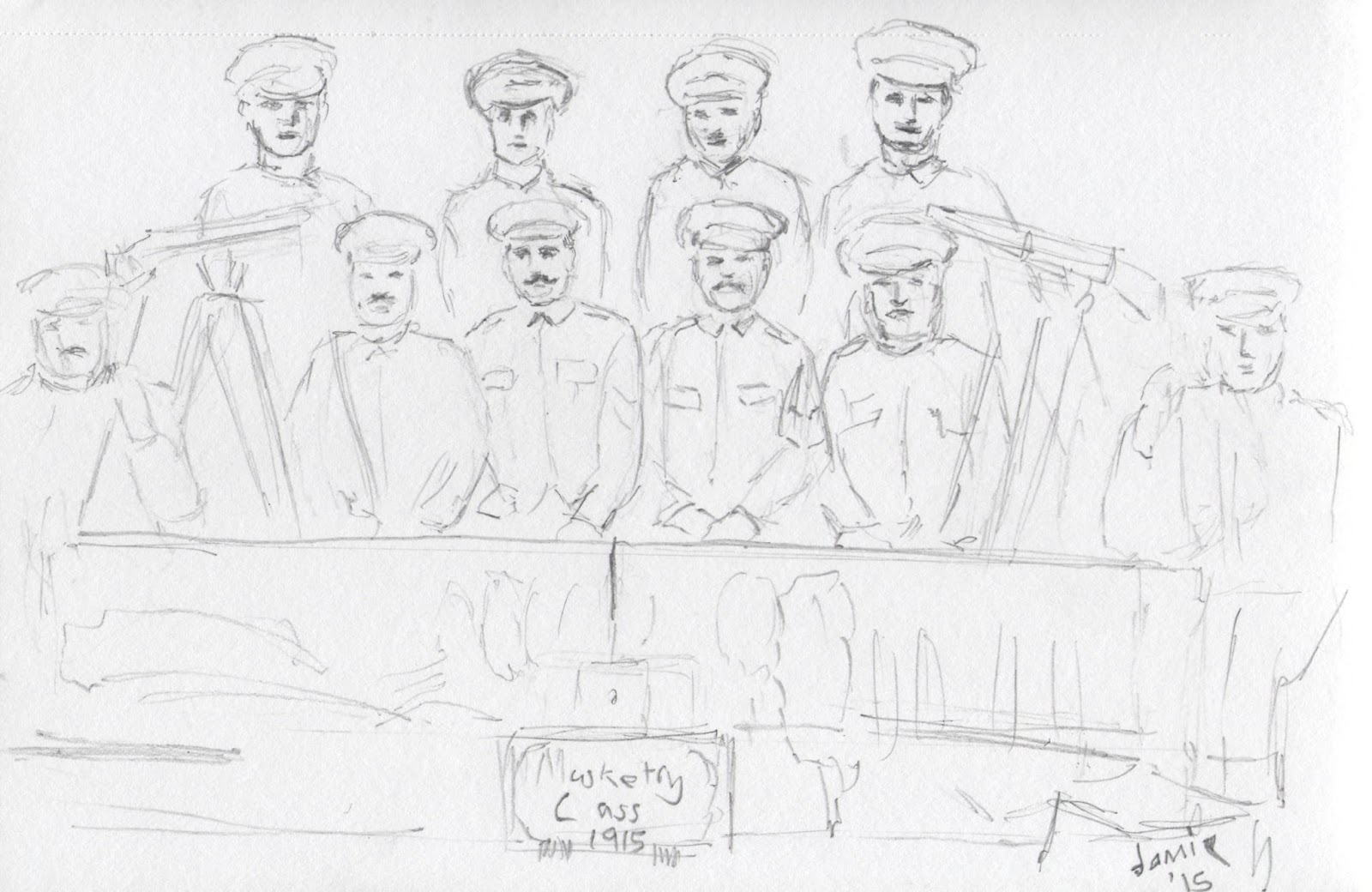
Impression sketch Musketry Class 1915 - by Jamie. taken from an original image which can be seen at: http://www.rifleman.org.uk/Landscape_Targetry.htm 


1915 Saturday 27 May, Pall Mall
London saw a spring meeting,
For National Rifle Association – 
In the chair Lord Cheylesmore
Spoke, how the meeting should
Discuss July’s competitions -
Yet many members were away
Using skills on frontline; now
There would be no programmes.

With domination of war, Bisley
Had only seen one musketry
Course, run with assistance from
Captain Summers and Major
Richardson, men and officers
Had gained Bisley certificates.

Raised at a previous meeting,
Lord Cheylesmore had requested
Telescopea - with an offer coming
From a lady for one on a mahogany
Stand - to be met with laughter  -
Current telescopic sights available
Were German - although approval
Had been given to a British scope
Designed by Major Lattey  - one
Of which was passed around.

Between laughter and cheers,
The meeting went on to say how
Machine Gun course was being
Attended, by over a 1000 men –
How professional and amateur
Men worked together, which could
Only benefit the war office -
The association being a best friend.

Bisley School's Chief Instructor,
Major Richardson told how well
The school worked - How 1,191
Men had been passed - 384
Instructors were now employed
In the New Army – one instructing
Musketry to 1000 men - to total
A million and quarter men.

by Jamie Mann.

Anon.,1915. National Rifle Association  - training Marksmen. The Daily Telegraph, [online] 31 May. p.3. Col.6. Available at: http://www.telegraph.co.uk/news/ww1-archive/11633912/Daily-Telegraph-May-31.html  [Accessed: 31 May  2015].

Mann, J., 2014. 100 years Ago - Poems by Jamie Mann. [letter] (Personal communication, 31 June  2015). 


#WW1 #WW1centenary #GreatWar #WW1poem #GreatWar #WW1centenary #worldwarone #worldwaroneremembered #WW1London

Friday, 1 May 2015

Poem ~ Deaths in Essex Training - Saturday, 1 May 1915


A party of sappers based in Colchester
In the county of Essex, on 30 April, went
To recover equipment beneath a trench.

In taking part of their training, a mine
Had been set off - in the routine of work
Sapper Williams of his section, climbed

Down the 12 ft passage, shortly to return.
He complained, feeling very dizzy to say
Not to enter - the space was dangerous.

Yet ten minutes later Sapper Williams
Went back underground - with no sign
Of him, another Sapper went after him.

In pitch-blackness he could not see him
But heard his groans – set to get him out,
With Sappers Bullock, Scott and Simpson.

The descended but then they succumbed
To the lingering fumes – another Sapper,
Along with Corporal Blyth got them out.

Williams still remained somewhere inside.
Word was sent to Lieutenant Darton, who
Came by cycle, breathless he went down

Into the mine – but did not then reappear.
After a time several sappers went after
Him - both men, Lieutenant and Williams

Were recovered, but both remained quite
Unconscious - although given oxygen
The men died, Bullock was hospitalised.

by Jamie Mann.

Anon.,1915. Colchester Tragedy – Soldiers Asphyxiated. The Daily Telegraph, [online] 1 May. P.10. Col.7. Available at: http://www.telegraph.co.uk/news/ww1-archive/11574498/Daily-Telegraph-May-1-1915.html [Accessed: 1 May 2015].

Mann, J., 2015. 100 years Ago - Poems by Jamie Mann. [letter] (Personal communication, 1 May 2015). 


#WW1 #WW1centenary #GreatWar #WW1poem #GreatWar #WW1centenary #worldwarone #worldwaroneremembered #WW1Essex

Friday, 20 February 2015

Poem ~ Field Exercise Disaster - Saturday, 20 February 1915


Source: File: Pond near Morton, Lincolnshire .jpg, 2015. In 1914 more than 4,000 Yorkshire soldiers were sent to Lincolnshire for training before heading off to the battlefields of northern France. Photograph: Berliner Verlag/Archiv/dpa/Corbis. [online] Available at:<http://www.wakefieldexpress.co.uk/news/local-news/seven-soldiers-who-died-on-home-soil-100-years-ago-to-be-remembered-1-7030544> [Accessed: 20 February 2015].

From the corners of Yorkshire
Seven men - along with 4000
Others  -were sent to Lincolnshire.
In preparation to fight in France
They embarked on training exercises.

A mile out of Gainsborough town,
The soldiers of the 3rd West Riding
Territorial Brigade, were stationed
In a small village of Morton -
About this place of the country
Were lakes and ponds and open
Fields, chosen for army training.

In spite of the choice of a shallow
Lake Captain Harold Hirst still
Followed orders  - despite
Local legends that the ponds
About were bottomless
And other warnings of depths
Of water from regimental officers.

Early in the morning -
On Friday the 19 February,
1915, Captain Harold Hirst
Of Dewsbury - a town linked
To the men of 4th Battalion
Kings Own Light Infantry - led
Two platoons of D Battalion
Out to the training fields.

Part of their plan in France
And Belgium, was to cross
Canals safely - with ability
To build light pontoons,
When necessary - the Captain
Would train them in this
Process, ready for deployment,
Within short weeks.

The place, a short distance
From the river Trent, where
They stood about a bottomless
Pit - a depth of 32 feet - while
Within nearby fields about
Were the sights and sounds
Of soldiers on drier exercises.

Between 20 to 40 soldiers
Were to be given instruction -
Seven of these Yorkshire men
In the group, came from civilian
Trades, such as Fred Cooke
A plate-layer of East Ardsley
Being an older man of 33.

While among the younger,
Sharing a few jokes, was
Ernest Cockell aged 20,
From Wakefield  - leaving
His job on Westgate station
Maybe finding a mate
In William Dent, from Morley
A young mill worker of 21.

At the back, Edmund Battye
Of Batley - a miner at 20,
Stamped his feet in the cold,
Being one of three brothers
To answer the King's call.
Private Alfred Bruce, among
Them all listened to instruction.
A Harrogate man at 22, from
His job as a clerk - but whose
Real skills were in football.

Not quite as young, stood
Smart John Myers, just 24 - had
Worked as a chauffeur - now
Away from his home of Dewsbury.
While somewhere to his side,
Was Private William Atheron,
Lighthearted man of Wakefield,
Who was to be happily married,
Within two weeks time.

Captain Hirst, as their leader,
Gave instruction to their purpose.
Indicating the basic materials
To build their raft - this was not
A ship or boat of permanence, but
Makeshift, in order to get across
Water and get into the fight with
Their enemy. Therefore time
Was limited, working under fire.

With a smart order to begin
The men jumped too - mostly
Eager, as did a 19 year old -
Another miner from Batley,
Private Creighton - to comment
That this was abit of a lark.
Although his mate felt they
Were overdressed for the part.

Two waterproof tarpaulins
Were unfolded and stretched out
And tied - then the fun part -
Conveying a pile of hay and straw
Into the belly of the craft.
The men moved as the Captain
Gave orders - allowing some
Lighthearted time, the men
Crawled in between, amid dusty
Straw, that was thrown inside
Upon them - yet with a keen
Voice to keep them in check.

With such a crowd construction
Was quick, to form a structure
Of urethane and straw - three foot
In depth and six-foot square.
The men stood back, at ease
Looking upon their creation.
In order to maintain some
Urgency, Captain Hirst, gave
His instruction for the launch.

Some fifty yards away,
Occupied in a field with
Their dull section drill, others
Noted the building of a pontoon,
By jolly men - with a little envy
To do other than what they
Were doing - among these dry
Landed men was Private Ewart
Whiteley Mann of Batley Carr,
And another man of Batley -
Lance Corporal George Sykes.
Sergeant Charles Hemmingway
Kept his charge of men busy
Including Walter Gatenby.

The intention was to test the craft,
Just a short way out on the water.
Little more than six foot from shore,
The raft was pushed out,
To float successfully - held in place
By a man on shore with a boat hook.

First aboard was Captain Hirst,
Himself, watched closely by those
Who had never before built a float,
This first experience of their army life.
One experienced man, was given
Charge of the fourteen foot
Punting pole - although the water
Was twice that depth - the Captain
Gave orders for them to board.

With their leader stood in a corner
Each man took their first steps
Onto the cushion of straw -
Wearing equipment and packs.
Some said forty stood on top
It was most likely twenty were on
When matters started to go wrong.

At the corner, with the raft
Six foot, from shore the last
Two were allowed on board,
When the weight shifted  -
The Captain first saw water
Come about his feet.
Hirst then ordered the men
To stand still  - but still water
Rushed on as their load still
Shifted, - the inexperienced
Soldiers reacted, as the craft
Tipped  - throwing most men
Down into the deep water.

Fred Cooke felt the bitter
Tinge of water, while beside
Him William Dent saw himself
Submerge, with the weight
Of boots and pack, dragging
Him down  - as did John Myers.

Ernest Cockell tried to hold
Onto the canvas, yet the angle
Was too much. Edmund Battye
Flew, feeling the force of water
Hit him hard, as Alfred Bruce
Kicked at the dark forbidding
Water trying to lose his boots.
William Atheron already in
Tried to swim without experience.

With a commotion raised, those
On drill sped over to the pond.
Private Mann suddenly ran
With Lance Corporal Sykes -
Throwing off pack and coat
They dived into the pond.

Each diver swam to the first
Man flaying in the water.
As Captain Hirst touched
The bank, a form of a sergeant
flew over him, whilst other
Swimmers went to assistance.

Lance Corporal Chorely
Pulled one to his safety,
Going out to another.
While those on the banks,
Used poles, reaching out
Hands with Private Barber.
As Lance Corporal Chapelle
Taking urgent action
To stop the men drowning.

Then, within a short time
As Chorley now almost
Exhausted, saw how some
Now lay still in the water.
Others could not be seen.

Within the depth a presence
Felt himself sink - a strange
Calm for William Atheron
Who looked up to see
Watery sky - where figures
Arms and legs kicked about.
He thought them as angels,
High over him - as he took
The strain to hold his breath.
Along side him another man
Was twisting in mid water,
Pulling at straps of his pack.

John Myers was not
A swimmer, as he pulled
Off the sodden weight
That dragged him down.
He had only ever been
In service - as chauffer
To a Doctor and a Captain.

He was just twenty-four,
As he thought about
His forty-eight hour leave
For a wedding - John saw
His four sisters and five
Brothers’ call to him -
Lighter without his pack,
He drifted skywards
His relief cut by sharpness
Of held breath - he slumped,
Only able to breathe water.

Fallen on the ponds side
Private Creighton lay still
Devoid of breath - 'he’s gone,'
Said one. 'No he's not,' said
Another, and worked on him,
Until his breathing returned.

Then the surface of the pond
Was still again, with a half sunk
Pontoon of straw - with a single,
Unused lifebuoy, drifting away -
Passing between shapes
Of lost men - the five of them
Pulled slowly ashore - a roll call
Of the two platoons, found
Two still missing - their recovery
Was made some hours later
By useage of boat and drags.

by Jamie Mann.

Anon.,1915. Pontoon Accident To Territorials - Seven Men Drown. The Daily Telegraph, [online] 20 Feb. P.10. Col.7. Available at: http://www.telegraph.co.uk/news/ww1-archive/11420995/Daily-Telegraph-February-20-1915.html [Accessed: 20 February 2015].

Source: File: PONTOON OVERTURNED. Cymru 1914 - Friday 26th of February, 1915. [online] Available at: <http://cymru1914.org/en/view/newspaper/4098610/6 Monday 22nd of February, 1915> [Accessed: 20 February 2015].

Source: File: Nostalgia with Margaret Watson: Tragedy on British shores. 19 February 2015. Dewsbury Reporter. [online] Available at: <http://www.dewsburyreporter.co.uk/news/nostalgia/nostalgia-with-margaret-watson-tragedy-on-british-shores-1-7115409> [Accessed: 20 February 2015].

Source: File: Centenary tribute to drowned soldiers. Friday 13th February 2015 [online] Available at: <http://www.thepressnews.co.uk/press-news/centenary-tribute-drowned-soldiers/> [Accessed: 20 February 2015].

Source: File: Seven soldiers who died on home soil 100 years ago to be remembered. 04 January 2015. [online] Available at: <http://www.wakefieldexpress.co.uk/news/local-news/seven-soldiers-who-died-on-home-soil-100-years-ago

Mann, J., 2015. 100 years Ago - Poems by Jamie Mann. [letter] (Personal communication, 20 February 2015). 


#WW1 #WW1centenary #GreatWar #WW1poem #GreatWar #ww1centenary #worldwarone #worldwaroneremembered #WW1Lincolnshire