Showing posts with label French. Show all posts

Tuesday, 1 August 2017

Poem ~ A Battle Opens - Wednesday, 1 August 1917

Source: File: German prisoners and British wounded crossing a duck board bridge over the Yser Canal. Near Boesinghe, 31 July 1917. See an original image at: <https://commons.wikimedia.org/wiki/File:The_Battle_of_Passchendaele,_July-november_1917_Q5726.jpg> [Accessed 01 August 2017]

One day had started - 'the day of battle
The world had waited for began.'
Such were words of war correspondent
Philip Gibbs - formed in acts of battle
Tactics; did that world include Germany?

Over land between Boesinghe to River
Lys, shoulder-to-shoulder French
And allied troopers began the fight - after
Intensity of bombardment and offence
Opened to soften the German side.

Along a 15-mile front French made their
Approaches over allied left shoulder.
Despite poor weather, the sector of Ypres
Neighbour villages fell from German
Hands - Steenstraete soon succumbed.

The Poilu had made great advances
In protection of the allied left flank -
Taking objectives within first few hours,
Two miles into enemy occupation
Another objective formed, Bixschoote.

In south easterly directions the mass
Of Poilu's advanced into Kortekeer,
Cabaret village - with other communes
Soon to follow - short hours later
German counter attacks were halted. 

From their centralised push the British
Made gain of two miles - objectives
Of Steebeek river crossings were taken.
With formation of two assurgent
Systems, assaults opened on targets.

St Julien, Frezenberg, Pikem along
With Verlorenhoek - strongholds
Of woods and farms reformed under
Hands of British - on the south
Flank first objectives were also gained.

Sanctuary Wood and Hooge village -
while Westhoek village witnessed
A vicious struggle - a mile reportedly
Taken. All about counter attacks
Were faced and held on: stalemate.

Success upon success - all within
Initial hours of fight to suggest
Great gains. Reports promised battle
Wins the world had awaited -
This might just be the breakthrough.

by Jamie Mann.

Anon.,1917. Great Battle Of Flanders. The Daily Telegraph, [online] 01 August 1917. P.5. Col.4. Available at: http://www.telegraph.co.uk/news/ww1-archive/12214747/Daily-Telegraph-August-1-1917.html [Accessed: 01 August 2017].

Mann, J., 2016. 100 years Ago - Poems by Jamie Mann. [letter] (Personal communication, 01 August 2017). 


#WW1 #WW1centenary #GreatWar #WW1poem #GreatWar #WW1centenary #worldwarone #worldwaroneremembered #WW1Belgium

Tuesday, 18 April 2017

Poem ~ Villages Devastated - Friday, 20 April 1917

Source: File: The destruction of the church in Moÿ-de-l'Aisne, February 1917. Available at: <http://02610.moy.free.fr/Moydelaisne/02610.moy/Infos/Municipalite/Moyquand/N23/Lanciers.html> 
[Accessed 18 April 2017]

With the western front in France,
Reaching its 35th week in 3rd
Year of war, devastation of lives
Of the population had no conclusion.

Between the invasion of Germany
Taking over ground of Aisne
And reunification of that area,
Came reports of great annihilation.

Making a visitation of the retaken
Region, Chairman of the Aisne
Refugee Committee D.Camp,
Learned of systematic destruction.

Eleven French towns and villages
Were wiped off the map -
The occupiers had used
Variations of means in process.

Battering rams had been built
To destroy ancient town
Walls; dynamite, petrol tar
All employed to take down houses.

Exteriors of churches still stood
But all contents taken,
Graveyards lay broken -
Opened vaults emptied to bury own.

Some 25 miles from Laon town,
Lay Ugny le Gay - little
More than a hamlet
Of 234 people, lay in persecution.

Germans made tax of exactions.
First demanded monies
February 1915; £140.00 -
The same demand again in August.

September 1915 saw how the Mayor
Of Ugny le Gay and others
Were imprisoned, until
Payment of £500.00 were handed over.

October 1915, £200 fee equivalent
In francs was demanded -
12 months later, October
1916, another extortion sum of £1500.

When finally the Germans were forced
From the area, the people
Found their possessions
Had been seized, pillaged and abused.

Young girls of the village were taken
Away - villagers disinterred as
Germans set homes on fire
Destroying machinery and fruit trees.

Any French people who returned to their
Villages, would have struggled
To see where their homes had
Once stood; to see crushed stone piles.

by Jamie Mann.

Anon.,1917. Devastated France. The Daily Telegraph, [online] 9 April March 1917. P.6. Col.5. Available at: <http://www.telegraph.co.uk/news/ww1-archive/12214440/Daily-Telegraph-April-9-1917.html> [Accessed: 20 April 2017].

Mann, J., 2016. 100 years Ago - Poems by Jamie Mann. [letter] (Personal communication, 20 April 2017). 


#WW1 #WW1centenary #GreatWar #WW1poem #GreatWar #WW1centenary #worldwarone #worldwaroneremembered #WW1France

Wednesday, 5 April 2017

Poem ~ Fishing Boat Versus U-boat - Thursday, 5 April 1917 - Friday, 6 April 1917


Impression sketch of French fishing boat Hyacinth Yvonne, sinking a German submarine by Jamie. See an original image at: <http://www.fotolibra.com/gallery/1307670/wwi-u-boat-sunk-by-a-french-fishing-boat/> [Accessed 5 April 2017]

By contradictory respect
For those who sailed the seas,
Wartime orders of U-boat
Commanders were to sink
Allied vessels.

Self-protection was advised
In wariness for all those at sea.
Campaigns of submarines
Of Germany centred about
British isles.

U-boat missions were to cut
Trade routes - German intentions
Were once again renewed;
Breaking Sussex pledge
To distress the US.

Any boat large or small
Might become a U-boat victim,
As was the intention
In an encounter with
One fishing crew.

A six-man crew of a French
Fishing boat found themselves
Confronted, in the shape
Of a surfaced German
U-boat.

The two crews regarded
Each other, separated by yards
Of waves that carried
Them in a union of
Sea currents.

The German commander
Called out to the French captain
Orders to abandon their
Fishing vessel, but the
Men refused.

From under a cover,
The French revealed their single
Small gun, which they
Then aimed and fired
On the U-boat.

A Furious commander
Ordered his crew to sink them
And their boat - for
Over twenty minutes
Two sides fought.

Despite the fishing vessel
Hit various times, was refusal
To give in - the French
Crew kept up fire
On U-boat's skin.

A journal report via
Paris, told the story how that
Six French fishermen
Made a decisive hit
To sink enemy.

Yet a mystery would
Centre around the claim - were
Such fishermen actually
A decoy vessel, called
A Q-ship?

Such boats sailed
With intent to lure submarines
To the sea's surface -
Hyacinthe Yvonne
Being one.

Part of the French
Navy the story of Hyacinthe
Yvonne was in fact
An armed patrol
Vessel; a Q-Ship.

by Jamie Mann.

Anon.,1917. U-boat Sunk By Fishermen. The Daily Telegraph, [online] 4 April March 1917. P.4. Col.6. Available at: <http://www.telegraph.co.uk/news/ww1-archive/12214428/Daily-Telegraph-April-4-1917.html> [Accessed: 05 April 2017].

Source: File: List of Shipwrecks in March 1917. Available at: <https://en.wikipedia.org/wiki/List_of_shipwrecks_in_March_1917> [Accessed 05 April 2017]

Mann, J., 2016. 100 years Ago - Poems by Jamie Mann. [letter] (Personal communication, 05 April 2017). 


#WW1 #WW1centenary #GreatWar #WW1poem #GreatWar #WW1centenary #worldwarone #worldwaroneremembered #WW1submarines

Thursday, 30 June 2016

Poem ~ Somme Mines - Friday, 30 June - 1916


Source: File: The Somme: Secret Tunnel Wars (WWI Documentary) (BBC). [online] See: <https://commons.wikimedia.org/wiki/File:British_plan_Somme_1_July_1916.png> [Accessed: 30 June 2016]

 Source: File: British infantry attack plan for 1 July 1916, the "first day on the Somme". British and French front line shown in red, German front line shown in blue. German second and third lines shown as dashed blue lines. British and French objectives on the first. [online] See an original image at: <https://commons.wikimedia.org/wiki/File:British_plan_Somme_1_July_1916.png> [Accessed: 30 June 2016]


French Companies had started
Digging under German lines for some time.
Then the British arrival at the Somme
Carried on their task - these Royal
Engineers set up their base at Bray.

Maricourt La Boisselle, Fricourt,
And Carnoy shafts came into their control -
Named the 'Glory Hole' by the British;
An area about which careful secrecy
Was maintained and defended closely.

War under foot was a different 
Dimension to the fighting above ground.
With fundamental preparations
For the Somme breakthrough,
19 dug tunnels led to mines.

While the number was less than
Intended, the undertaking was ambitious -
In a south position were nine
Smaller mines about Fricourt;
Being charges of triple Tambour.

Out of Beaumont Hamel three
Tunnels spread out - one a communication
Trench connected to jumping off
Point of Sunken Lane, the others
Made towards Hawthorn Ridge.

There at 30 yards from German
Edges, in depth of 57 feet, a deep gallery
Created was filled with ammonal.
Prepared for zero hour - a dispute
Was raised over timing the mine.

A request for ridge's detonation,
By Lieutenant-General Hunter Weston,
To be four hours earlier, allowing
Resulting crater to be taken,
For any enemy alarm to settle.

Headquarters stated 'no,' but
Lieutenant-General Hunter Weston's
Persistence led to compromise;
Ridge redoubt would be blown
Ten minutes before zero hour.

In previous battle actions of
Lieutenant-General Hunter Weston,
General Haig declared him as
Rank amateur; despite some
Successful Gallipoli tactics.

Lacking competence earned
Hunter Weston the nickname 'Hunter-
Bunter' - with ruling tendency
Towards brutality, he led VIII
Corps within Somme Sector.

Tunnelled preparations were
Readied, as at Lochnagar Street mine -
In order to make crater cover
Against exposure to enemy fire,
All readied for the Battle of Albert.

by Jamie Mann.

Source: File: Mines on the first day of the Somme Wikipedia, the free encyclopedia. Available at: <https://en.wikipedia.org/wiki/Mines_on_the_first_day_of_the_Somme> [Accessed 30 June 2016]

Source: File: Aylmer Hunter-Weston. Wikipedia, the free encyclopedia. Available at: <https://en.wikipedia.org/wiki/Aylmer_Hunter-Weston> [Accessed 30 June 2016]

Mann, J., 2016. 100 years Ago - Poems by Jamie Mann. [letter] (Personal communication, 30 June 2016). 


#WW1 #WW1centenary #GreatWar #WW1poem #GreatWar #WW1centenary #worldwarone #worldwaroneremembered #WW1Somme

Wednesday, 23 March 2016

Poem ~ British Brodie Versus French Adrian - Thursday, 23 March 1916


Impression sketch of Brodie versus Adrian - by Jamie. Original images can be seen at:  <http://thebrodiehelmet.weebly.com/war-office-pattern.html> <https://www.worldwarsupply.com/cart/French-Adrian-Helmet> [Accessed: 23 March 2016]

Learning by experience of wearers
From the French casque, designers
Of the British Brodie then perfected
Their final design to be distributed.

Taking over from the War Office,
Ministry of Munitions made articles -
Final idea combining various designs,
Within weeks from different origins.

By compacted time a scientific evolution
Was described, in design of effective
Headpieces formed from hardest steel,
To have circumference of a narrow lip.

A fault detected from the French casque
Was the higher dome, allowing cool air
To collect at the top - the fit being tighter
So the metal pressed on wearer’s head.

Therefore the Brodie was constructed
With a lower pitch than French, made
To make a lower target - smooth steel
Without projections or any weak flutings.

Made at Armaments House, developed
A comfortable fit - rubber studs in dome
Absorbed any shock, with a double lining
Of felt and wadding against wearers head.

The wadding would act to absorb blood
With some antiseptic, should a bullet
Cut through metal to cause scalp wound -
While a chinstrap held helmet to the head.

by Jamie Mann.

Anon.,1916. The British Helmet. The Daily Telegraph, [online] 23 March 1916. P.9. Col.6. Available at: http://www.telegraph.co.uk/news/ww1-archive/12200314/Daily-Telegraph-March-23-1916.html [Accessed: 23 March 2016].

Mann, J., 2016. 100 years Ago - Poems by Jamie Mann. [letter] (Personal communication, 23 March 2016). 


#WW1 #WW1centenary #WW1poem #GreatWar #WW1centenary #worldwarone #worldwaroneremembered #WW1uniforms

Sunday, 28 February 2016

Poem ~ Mother's War Ultimatum - Monday, 28 February 1916

Impression sketch : Mother's War Ultimatum - by Jamie.

From the letter of an Englishman
Came a story of New York.
A French acquaintance had recently
Travelled back from America -
During his time there he had dined
In a New York restaurant.

When ordering his meal he found
The waiter to be French.
Developing a conversation, he asked
The young man of Europe
Why he was not fighting for France -
A reason was forthcoming.

The French waiter told how he would
Soon make his way to fight.
He handed the traveller a letter just
Received from his mother -
The correspondence informed her son
He had lost both brothers.

Her words spelled out her patriotism;
As she declared, while
Being her only remaining son, unless
He did not come back
To France in fighting for their country,
He need never return to her.

by Jamie Mann.

Anon.,1916. French Mothers Patriotism. The Daily Telegraph, [online] 28 February 1916. P.7. Col.3. Available at: http://www.telegraph.co.uk/news/ww1-archive/12175151/Daily-Telegraph-February-28-1916.html [Accessed: 28 February 2016].


#WW1 #WW1centenary #GreatWar #WW1poem #GreatWar #WW1centenary #worldwarone #worldwaroneremembered #WW1France

Saturday, 27 February 2016

Poem ~ Tree Border Guards - Sunday, 27 February 1916


Impression sketch of a German sentry carved from a tree stump - by Jamie. From an original image that can be seen at: <http://www.illustratedfirstworldwar.com/item/a-wooden-soldier-in-real-war-a-pollarded-german-guard-iln0-1916-0226-0007-001/ l> [Accessed: 27 February 2016]

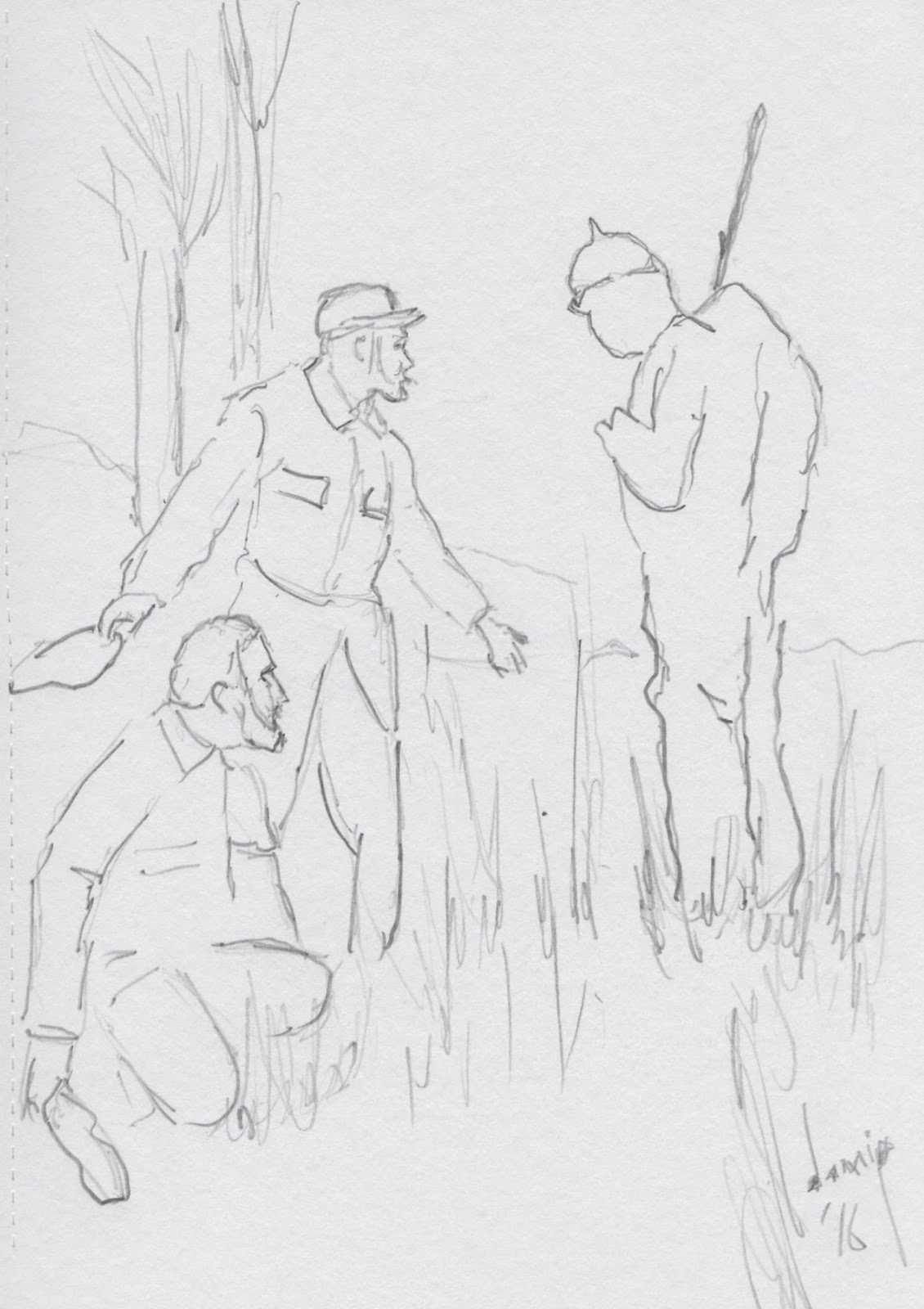
As battles unfold,
By advance or retreat,
Comes luck to escape -
Or poor fortune
In capture.

In such events
Two such soldiers
Of France, found
Themselves
Prisoners.

Amid others
Transportation took
Them to Germany,
For incarceration
Of a camp.

On route these two
Men managed to get
Free - adapting
To events,
They hid.

By stealth, both
Then made their way
To reach border
Of Holland and
Germany.

After time, to feel
They would step freely
Across to Dutch soils,
Despair filled
Them both.

Just ahead they
Saw a sentry, steely
Guarding the passage
To their freedom -
What next?

They prepared
To fight and readied
To die, rather than
Give into that
Waiting sentry.

The German figure
Was on diligent guard;
With a fixed gaze,
Stared unmoved
Into Germany.

The two French
Picked up a rock, along
With a stick, readied
To strike for
Freedom.

From hiding
They rushed the guard,
Who made no move -
A striking rock
Bounced
Off him.

Heightened
By their attack, the two
Men fell, shocked
To their knees
Before the foe.

That alert German
They spied at distance,
Was nothing more
Than wood - sticks
Grew at his feet.

A stump of a tree
Had been cut and carved -
Pollarded into
Shape of a
German.

They had been
Fooled by the duplicity
Of clever crafting -
To admire
The skill.

They stepped past
The inanimate German,
To discover close
By, other such
Sentry trees.

Without any real
Soldier’s, only numbers
Of stumps stood
To resemble a
Frontier guard.

In wonder, the two
French soldiers walked
Into neutrality -
Days later back
In their regiment.

The two escapees,
In telling their story caused
Great amusement,
Regarding stumps
Of wooden sentries.

by Jamie Mann.

Anon.,1916. A Wooden Soldier In Real War: A Pollarded German 'Guard'!. The Illustrated London News, [online] 27 February 1916. 263. Available at: http://www.illustratedfirstworldwar.com/item/a-wooden-soldier-in-real-war-a-pollarded-german-guard-iln0-1916-0226-0007-001/ [Accessed: 27 February 2016].


#WW1 #WW1centenary #GreatWar #WW1poem #GreatWar #WW1centenary #worldwarone #worldwaroneremembered #WW1WesternFront

Sunday, 13 December 2015

Poem ~ French Flag Recaptured - Monday, 13 December 1915

Image of the French flag

Amid those from all walks of life,
Came men of education - one master
Of Eton, Walter George Fletcher,
Joined the Royal Welch Fusiliers.

In the rank of Second Lieutenant,
His career had seen him as Captain
Of his school - to win Jelf Verse Prize
And as a rower in the Eton eight.

From appointment of Assistant
Master in 1913, to be Lieutenant
By 1915 - at the front a mission
Of danger took him into the night.

The Eton master aged 27, crawled
Out into the dark - moving forward
Between the lights of bright flares,
Where he climbed an enemy tree.

Within the branches the Germans
Had hung a trophy of a captured
Flag of France - with this trophy
In his hands, he returned to cheers.

Already mentioned in dispatches,
From 18 February, his brave actions
Led to another recommendation
Of distinction at the flag's recapture.

Only a short time later Lieutenant
Fletcher, was in the trenches when
A shot direct to the head killed him;
The flag was sent to his Eton School.

by Jamie Mann.

Anon.,1915. French Flag at Eton. The Daily Telegraph, [online] 13 December. P.5. Col.2. Available at: http://www.telegraph.co.uk/news/ww1-archive/12037754/Daily-Telegraph-December-13-1915.html [Accessed: 13 December 2015].

Mann, J., 2015. 100 years Ago - Poems by Jamie Mann. [letter] (Personal communication, 13 December 2015). 


#WW1 #WW1centenary #GreatWar #WW1poem #GreatWar #WW1centenary #worldwarone #worldwaroneremembered #WW1France