Showing posts with label 1915_0806. Show all posts

Friday, 28 October 2016

Poem ~ Corporal Leo Clarke VC - Saturday, 28 October - Sunday, 29 October 1916


Source: File: Private (Acting Corporal) Leo Clarke. See an original image at Governor General's Foot Guards: <http://footguards.ca/victoria-cross/private-acting-corporal-leo-clarke/> [Accessed 28 October 2016]

To view Leo Clarke's War Records go to:<http://www.bac-lac.gc.ca/eng/discover/military-heritage/first-world-war/100-stories/Pages/clarke-leo.aspx>

Amid citations of latest fifteen VCs were
To number four privates; Clarke, Jones
Hughes and Kerr as advised in a London
Gazette supplement - a private from
The Connaught Rangers, two with Canadian
Infantry and another from a Cheshire Regt.

From Hamilton Ontario Lionel, Leo, Clarke
Gave his attestation within six months
Of war - 25 February 1915 from where
He then lived; 785 Pine Street Winnipeg
Manitoba, a Canadian Prairie Province;
Clarke worked as a construction engineer.

Known as Leo, he joined with the Canadian
Infantry 27th Battalion - they sailed from
Quebec on S.S. Carpathia 17th May 1915.
By 6 August Private Clarke was to become
An acting Corporal - whose purpose was
To groom likely candidates to promotion.

In France by September, Clarke moved
To the 2 Battalion by October - to gain
A wound during December - but back
To duty short days later aged 23; by then
Of average height 5ft 7 1/2, grey green
Eyes and dark brown hair, weight 156 lbs.

Acting Corporal (Private) Leo Clarke
No. 73132, advanced into the line close
To Pozieres - Saturday 9 September
1916, the move of 1, 2 and 3 companies
Were covered by a bombardment
Of artillery shelling Germans; 16:45 p.m.

The bombardment lacked any effective
Result and Germans easily took back
Every lost position - German gunnery
Retaliated - focusing fire on advancing
Canadians companies - 1 and 3 were
Pinned down, as no 2 gained objective.

In the trapped centre, company action
By Lt. Pringle charged a machine gun -
Following him the company pushed out
Into fierce close fighting of bombs and
Bayonets - Sgt. Nicholls with bombers
Shot forward across to German trenches.

In starting to build a block, using wood
And barbed wire rolls, the small number
Went to clear the Germans out - taking
Action they made good destruction, until
A counter attack of two officers leading
20 Germans, leaving many casualties.

Seeing what was happening Cpl. Clarke
Assisted by Private Soppitt held them,
As Clarke began to make a barricade -
Now the Germans rushed him - Clarke
Emptied a revolver at them to quickly
Refill - still they came - he fired again.

With fate of Soppitt unknown, the first
German to reach Clarke then sliced
His leg with a bayonet, to be shot dead
By him - the Germans then turned about
Starting to retreat - Clarke had gained
A German rifle and another, firing at them.

Roused into fury and forgetting any
Feelings of his wound, Cpl. Leo Clarke
Shot dead another four fleeing figures -
As fifth one tumbled he pulled him up,
Leading him back as prisoner - finally  
Ordered to go to a dressing station.

Despite this Leo was back the next
Day - Clarke settled down into daily
Routine, but with his exploit known,
Acting Corporal Leo Clarke 73132
Was recommended a Victoria Cross
For bravery - awarded posthumously.

In his action of defence Clarke had
Killed nineteen of the Germans
That charged - just a month later
He was again in trenches, involved
In Thiepval fighting - the battalions
Orders to secure capture of Regina.

Regina trench stretched from Le Sars
Village to Stuff Redoubt - Leo Clarke
Taking shelter in a funk hole at rear
Of a trench, with heavy shelling raking
The ground - one shell hit close by
Him, causing the trench to collapse.

In same battalion his brother, Charles 
Clarke, hurried over to Leo's rescue
And worked to dig him out - with help
He was taken to No 1 General Hospital.
The extent of his injuries quickly became
Apparent - Leo Clarke was paralysed.

At Etretat he was diagnosed paraplegia;
The weight of the earth having crushed
His back, damaging his spine - on the day
18 October the notes of Major Nicholson
Stated how Leo Clarke arrived there,
11 p.m. transported their by No. 22 train.

All his lower limbs were paralysed, to add
How Leo answered their questions with
Difficulty - 'restless, weak and groaning.'
Yet into the early hours of 19 October
He slept for a time, talking and restless.
By morning he was tinged by cyanosis.

In the light of day symptoms provided
Evidence from his deterioration, he had
Only hours - Corporal Leo Clarke died
At 11 a.m. a report described enlarged
Spleen, his lungs dark and congealed;
Finally, he lay at rest by Etretat church.

by Jamie Mann.

Anon.,1916. Fifteen New V.C's. The Daily Telegraph, [online] 27 October 1916. P.8. Col.7. Available at: <http://www.telegraph.co.uk/news/ww1-archive/12213502/Daily-Telegraph-October-27-1916.html> [Accessed: 28 October 2016].

Source: File: Leo Clarke. Available at: <https://en.wikipedia.org/wiki/Leo_Clarke> [Accessed 28 October 2016]

Mann, J., 2016. 100 years Ago - Poems by Jamie Mann. [letter] (Personal communication, 28 October 2016). 


#WW1 #WW1centenary #GreatWar #WW1poem #GreatWar #WW1centenary #worldwarone #worldwaroneremembered #WW1medal

Sunday, 30 August 2015

Poem ~ Ministers Son Blinded - Monday, 30 August 1915


Portrait of MacKenzie in Cairo. MacKenzie, Clutha. Scrapbooks, 1917 - 1947. [online] Auckland War Memorial Museum Library.  Available at: <http://www.aucklandmuseum.com/war-memorial/online-cenotaph/record/C49530> [Accessed 31 August  2015]

To Note: Clutha Mackenzie, who became activist for blind, was also the author of a novel The Tale of a Trooper Novel (1921) is a first-hand account in novel form of World War I.  Available as an ebook from: http://www.gutenberg.org/ebooks/26548

A true New Zealander born in Balclutha,
The seventh youngest son
Of Thomas Mackenzie and Ida Nantes -
The boy given name of his
Birthplace - Clutha Nantes Mackenzie.

A lover of the outdoor life, his education
Was made at Otago
And Waitaki Boys High Schools - days
Of youth spent about
The Southern waters of New Zealand.

In a hankering to join navy, Clutha
Had spent time
On a defence ship, Lady Roberts,
And another vessel -
The lighthouse steamer Hinemoa.

Clutha though took another route,
As an agricultural cadet;
On a Experimental Farm of Weraroa -
To move to the Ruakura
Farm of Instruction, Waikato region.

Life seemed to be set in working
On farms - with time
As labourer loading the ships
In Wellington, over
Ten weeks during a waterfront strike.

The following year Clutha worked
On a sheep farm -
When outbreak of war saw an eager
Clutha to sign into
Wellington Mounted Rifles Regiment.

At the age of 17, in 1912, Clutha
had seen his father, 
Thomas Mackenzie, Scottish born
Move from politician,
To be prime minister of New Zealand.

While no one realised his identity,
As son of the eighteen
Prime minster of New Zealand,
Clutha was posted out
To Egypt, with the Rifles Regiment.

Trooper Mackenzie in Gallipoli,
Took part in final
Attempts to take the peninsula,
In August offensive -
Which was known as Sari Bair.

A dominating ridge of ground,
On peninsula heights -
Formation was drawn up of a plan;
With landings on 6 August
At Suvla Bay, alongside attacks.

Land progress in the north would
Take the high ground,
To join up with the other troops -
At Suvla Bay Trooper
Clutha Mackenzie took his place.

It was at this stage when fate
Took a blow - a British
Shell fell short to burst too close.
The act of concussion,
Forced out both Cluthe's eyes.

Ten days after the campaign's
Start, young Mackenzie
Arrived in Alexandria's Victoria
College Hospital, amid
A ward of many injured men.

The soldier made no attempt
To give his identity,
Until a High Commissioner
Cable arrived, to ask
About well being of C.Mackenzie.

The realisation was then made -
He was the son
Of New Zealand’s representative
In London - Soon
Arrangements sent him to England.

by Jamie Mann.

Anon.,1915. High Commissioner's Son - Blinded at the Dardanelles. The Daily Telegraph, [online] 28 August. P.7. Col 6. Available at: http://www.telegraph.co.uk/news/ww1-archive/11815052/Daily-Telegraph-August-30-1915.html [Accessed: 30 August 2015].

Source: File: Story: Mackenzie, Clutha Nantes [online] Available at: <http://www.teara.govt.nz/en/biographies/4m17/mackenzie-clutha-nantes> [Accessed: 30 August 2015]
Source: File: Battle of Sari Bair From Wikipedia, the free encyclopedia [online] Available at: <https://en.wikipedia.org/wiki/Battle_of_Sari_Bair> [Accessed: 30 August 2015]
Mann, J., 2015. 100 years Ago - Poems by Jamie Mann. [letter] (Personal communication, 30 August 2015). 


#WW1 #WW1centenary #GreatWar #WW1poem #GreatWar #WW1centenary #worldwarone #worldwaroneremembered #WW1NewZealand

Saturday, 22 August 2015

Poesia ~ Submarine Duel - Domenica 22 agosto 1915


Impressione schizzo di Submarine duel - da Jamie.

All'interno della stampa di guerra, un italiano
Pubblicazione La Stampa, della contabilità
Di due sottomarini incontro nel mare Adriatico.

Partendo da Pola, in sud
Punta della penisola istriana, l'austriaco
Submarine U12, guardò fuori per le navi di affondare.

Tra l'italiano e balcanico
Penisola, un sottomarino di italiani,
Incrociava le acque in difesa di casa.

A distanza, un siluro italiano
Barca fatta osservazione nelle acque,
Di una forma del sommergibile nemico a velocità.

In manovra, per evitare la pubblicità
Che erano stati avvistati, il Capitano
Chiuso in su gli italiani, per pretesto dell'ignoranza.

Improvvisamente un nemico di fronte un nemico,
Un siluro austriaca licenziato perdere, per aprire
Fino una lotta per durare più di un'ora e mezza.

Quasi naso a naso, ognuno di loro
Fatti tentativi di silurare l'altro,
Praticamente facendo collisione in un colpo finale.

L'incontro mortale aveva preso
Mettere sotto l'acqua - come guardare
Torpediniera italiana era pronto a sparare.

Dovrebbe U12 austriaco era emerso per essere
Aperto al fuoco nave di superficie, avversione
Tattiche Seguirono per evitare tubi murata shell.

Mentre ogni nave era abbinato
L'altro, la possibilità finale fissato italiano
Advantage, come U12 sparò ultimi due siluri.

Passarono sott'acqua, senza
Harm, ma siluro italiano colpito a centro barca,
La nave austriaca affondata  rapidamente con tutti perduti.    
 

da Jamie Mann.
Ann., 1915. Submarine V Submarine - 'una lotta epica.' The Daily Telegraph, [Online] 21 agosto. P.8. Col.3. Disponibile all'indirizzo: http://www.telegraph.co.uk/news/ww1-archive/11801552/Daily-Telegraph-August-21-1915.html [Accessed: 21 Agosto 2015].

Mann, J., 2015. 100 anni fa - Poesie di Jamie Mann. [lettera] (Comunicazione personale, 21 agosto, 2015).


#WW1 #WW1centenary #GreatWar #WW1poem #GreatWar #WW1centenary #worldwarone #worldwaroneremembered #WW1Italy

Poem ~ Submarine Duel - Sunday, 22 August 1915


Impression sketch of submarine duel - by Jamie. 

Within the press of war, an Italian
Publication La Stampa, made account
Of two submarines meeting in Adriatic sea.

Setting out from Pola, on southern
Tip of the Istria Peninsula, the Austrian
Submarine U12, looked out for ships to sink.

Between the Italian and Balkan
Peninsula, a submarine of Italians,
Cruised the waters in home defences.

At a distance, an Italian torpedo
Boat made observation in the waters,
Of a shape of enemy submarine at speed.

In maneuver, to avoid advertising
That they had been spotted, the Captain
Closed in on Italians, in pretence of ignorance.

Suddenly an enemy faced an enemy,
A fired Austrian torpedo missed, to open
Up a struggle to last over one and half hours.

Almost nose to nose, they each
Made attempts to torpedo the other,
Practically making collision in a final blow.

The deadly encounter had taken
Place under water  - as a watching
Italian torpedo boat was prepared to fire.

Should Austrian U12 had surfaced to be
Opened to fire by surface vessel, aversion
Tactics ensued to avoid broadside shell tubes.

While each vessel had matched
The other, a final chance secured Italian
Advantage, as U12 fired final two torpedoes.

They passed underwater, without
Harm, but Italian torpedo hit amidships,
The Austrian vessel sank quickly with all lost.

 by Jamie Mann.

Ann.,1915. Submarine V Submarine - 'An Epic Struggle.' The Daily Telegraph, [online] 21 August. P.8. Col.3. Available at: http://www.telegraph.co.uk/news/ww1-archive/11801552/Daily-Telegraph-August-21-1915.html [Accessed: 21 August 2015].

Mann, J., 2015. 100 years Ago - Poems by Jamie Mann. [letter] (Personal communication, 21 August 2015). 


#WW1 #WW1centenary #GreatWar #WW1poem #GreatWar #WW1centenary #worldwarone #worldwaroneremembered #WW1Italy

Saturday, 8 August 2015

Poem ~ A Wary America - Sunday, 8 August 1915


Impression image of signature of President Woodrow Wilson - by Jamie. See original at: http://www.historyinink.com/1009901_President_Woodrow_Wilson_ALS_5-18-1915.htm

While American neutrality watched
From the sidelines - as an independent
Nation situated out of European war -
Changes had begun to stir.

Their neighbor Canada, already part
Of war, allied with France and Britain -
Yet a greater part of a population had
A German allegiance.

America had already suffered a hit,
In the sinking of the Lusitania and loss
Of American citizens; even more than
Before observed the war.

Akin to British reluctance in need
Of any kind of war, President Wilson
Changed a gear; 'a nation forewarned
Is a nation forearmed.'

Plans for a definitive programme
Of national defence, to be presented
To Congress, as Wilson started talks
With the Amy and Navy.

Wilson, akin to previous President
Roosevelt, shared opinions; America
If required, had to back up polices
By force, or like China, be powerless.

by Jamie Mann.

Anon.,1915 America and War - Adequate Defence. The Daily Telegraph, [online] 7 August. P.7. Col.7. Available at: http://www.telegraph.co.uk/news/ww1-archive/11780911/Daily-Telegraph-August-7-1915.html [Accessed: 8 August 2015].

Mann, J., 2015. 100 years Ago - Poems by Jamie Mann. [letter] (Personal communication, 8 August 2015). 


#WW1 #WW1centenary #GreatWar #WW1poem #GreatWar #WW1centenary #worldwarone #worldwaroneremembered #WW1America

Friday, 7 August 2015

Poem ~ Captain Becomes Private - Saturday, 7 August 1915


Impression sketch of Captain Hugh Sale Smart - by Jamie. See original at: http://ww1geek.com/2012/10/15/thomas-hardy-of-festubert/

The strange disappearance
Of Captain H. S. Smart, came
About his taking leave when
He vanished; December 1914.

Captain Smart was attached
To Khyber Rifles, 53 Sikhs -
In failing to rejoin his unit; all
Queries to find him failed.

Some six months later,
Dated 4 June, notification
Was restated on 6 August
In the London Gazette.

This cancelled removal
Of this Captain Smart's
Service - various events
Had led to his resurface.

Having reached rank
Of Captain, August 1914,
Hugh Sale Smart in 1905
Had gained commission
As a Second Lieutenant.

Then aged 30, this was
With Regiment South
Staffordshires - in 1907 he
Transferred to Indian Army.

By his actions, in making
December disappearance,
He achieved his desire
To fight on the frontline.

In Britain under the name
Of Thomas Hardy, joined
2nd Battalion Queen's
Royal West Surrey's.

Under this pseudonym
Smart, acting as a private,
Reached France to fight
Taking part at Festubert.

In maneuvers on 17 May
1915, he was seen to take
Gallant steps - this resulted
In his being killed in action.

Had he lived, Smart would
Have gained Distinguised
Conduct medal in the field -
A review was undertaken.

The Army Council, along
With Secretary of State
For India requested Smart
As Captain be reinstated.

by Jamie Mann.

Anon.,1915 Disappearance of an Indian Officer - Enlisted as Private  - Killed at Festubert. The Daily Telegraph, [online] 7 August. P.7. Col.3. Available at: http://www.telegraph.co.uk/news/ww1-archive/11780911/Daily-Telegraph-August-7-1915.html [Accessed: 7 August 2015].

Mann, J., 2015. 100 years Ago - Poems by Jamie Mann. [letter] (Personal communication, 7 August 2015). 


#WW1 #WW1centenary #GreatWar #WW1poem #GreatWar #WW1centenary #worldwarone #worldwaroneremembered #WW1IndianArmy

Thursday, 6 August 2015

Poem ~ Ambulance Train Inspections - Friday, 6 August 1915


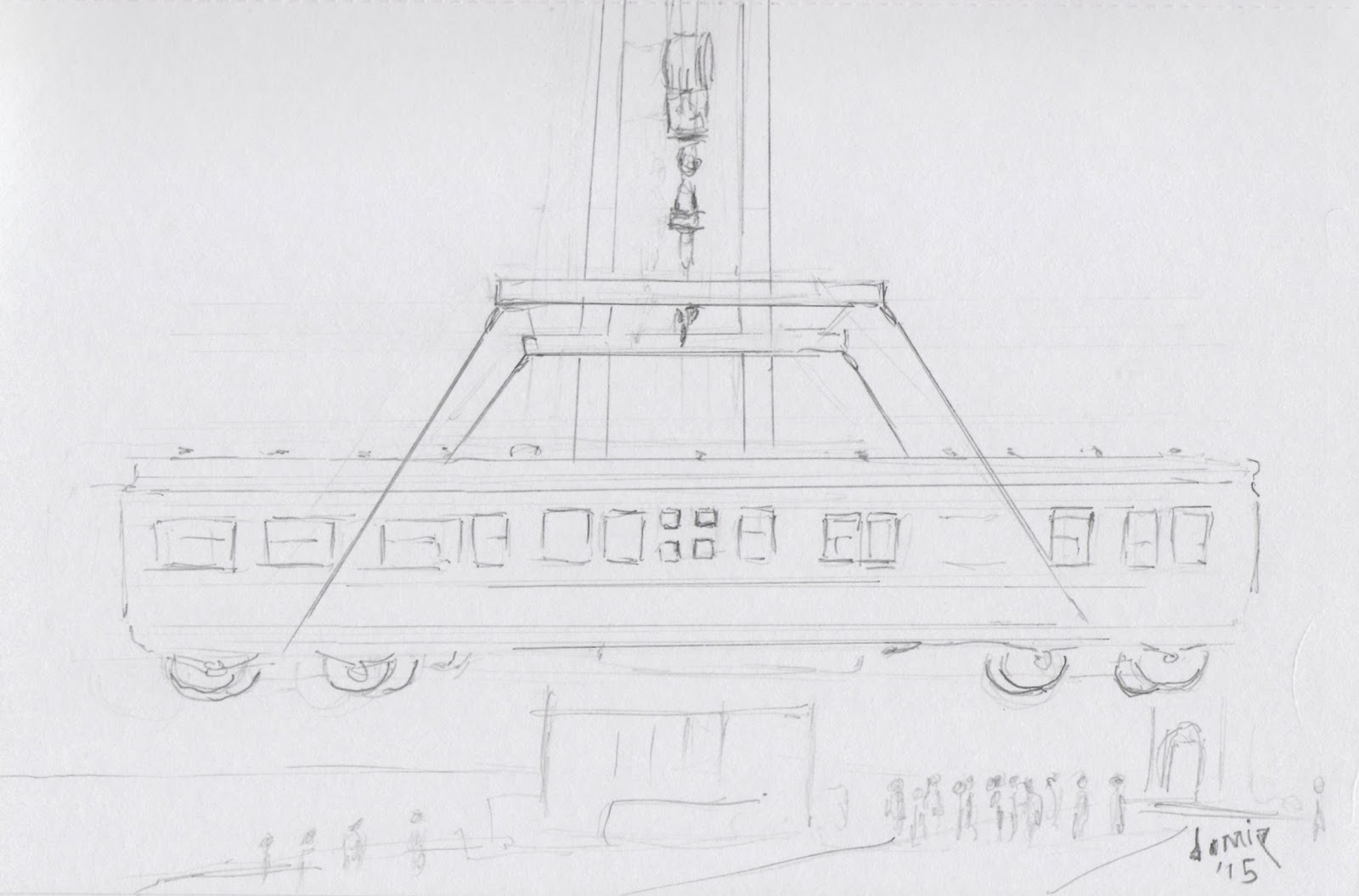
Impression sketch of a train being loaded at Tilbury docks, on its way to the front - by Jamie. See original at: http://www.dailymail.co.uk/news/article-2605886/Poignant-archive-pictures-ambulance-trains-transported-soldiers-wounded-First-World-War-hospitals-Britain.html

By special arrangement,
At a cost of sixpence a ticket
The public were granted inspection
Of an ambulance train, made
By the Eastern Railway Company.

Made at the Stratford
Works and on route to army
Service in France - The special train
Temporarily at No 1 Platform,
Liverpool Street Station London.

To last two days on 6 and
7th August, the ticket allowed
Viewing to see inside for full access -
The specifications at 445 tons,
864 feet long; to hold 342 wounded.

Specifically, 280 sitting
And 162 lying down patients,
Along with accommodation of staff
Of orderlies, nurses and
Doctors; in usage of every space.

Seen as cheerfully decorated
Gangways, connected corridors,
While compartments may be isolated
As needed - any patient on
The mobile hospital may be separated,

Those suffering infections
Disease had asbestos barriers
In an independent part of the train -
With kitchens, linen stores
Pharmacy and operating theatres.

All this was on view to those
Who paid sixpence - on the first
Day 2000 were sold, between 7.30 a.m.
To 10 am - a steady stream
Of public would flow until 4.15p.m.

Monies raised from public
Experience, were to fund comforts
For railway troops serving in France -
On 7th August the train
Was then due to leave for the continent.

by Jamie Mann.
Anon.,1915 Railway Ambulance Train - Public Inspection. The Daily Telegraph, [online] 6 August. P.7. Col.4. Available at http://www.telegraph.co.uk/news/ww1-archive/11776342/Daily-Telegraph-August-6-1915.html [Accessed: 6 August 2015].
Mann, J., 2015. 100 years Ago - Poems by Jamie Mann. [letter] (Personal communication, 6 August 2015). 


#WW1 #WW1centenary #GreatWar #WW1poem #GreatWar #WW1centenary #worldwarone #worldwaroneremembered #WW1Trains