Showing posts with label Champagne. Show all posts

Monday, 23 May 2016

Poem ~ Battle Plan:1916 - Tuesday, 23 May 1916 - Thursday, 25 May 1916


Source: File: Joseph Joffre, Commander in chief of French Army in 1914. [online] See an original image at: <https://en.wikipedia.org/wiki/Joseph_Joffre> [Accessed: 23 May 2016]

Source: File: Field Marshal Douglas Haig. [online] See an original an image at: <https://en.wikipedia.org/wiki/Douglas_Haig,_1st_Earl_Haig> [Accessed: 23 May 2016]

Source: File: General Foch. [online] See an original an image at: <https://en.wikipedia.org/wiki/Ferdinand_Foch> [Accessed: 23 May 2016]

After 11 months of a European struggle
Between allies and an offensive Germany,
Came the proposed need of clear strategy -
French Commander-in-Chief General Joffre
June 1915, set out ideal for the allies to unify
Their forces more effectively at Germany.

Between allied countries Britain, France,
Belgium, Russia, Serbia and Italy, formed
An Initial Inter-Allied Military Conference -
Arranged for 7 July 1915, held at Chantilly -
A need for regular meetings led to both
English and French leaders decisions.

17 November 1915, the two prime ministers
Met, to confirm requirement to organise armies
By a permanent committee - the documentation
By Joffre followed with the 'Plan Of Action' -
For coordinated forces of Russian, Italian,
British and French, due for date mid 1916.

At the military Conference 16 December
1915, Lieut-General Sir Archibald Murray
Presented a treatise on future of the war - but
Days later Robertson replaced Murray, while
Haig replaced French - as strategy confirmed
France and Flanders were centres of war.

Close cooperation would be on European
Ground - all efforts were to be for combined
Allied strength for offensive attacks around
Spring 1916. At December's end the Chantilly
Meeting Called by Joffre, formed a proposal
Before French President and ministers.

Following his appointment General Haig,
As commander of British Forces in France
And Flanders, came under French pressure
To combine their allied attack across a 60
Mile Front - the situation to be Somme -
Centred between Roye and Compiegne.

General Foch was ordered to prepare
French, from Somme River to Lassigny
In south - the idea for an offence on front
That saw stalemate over all other fronts,
And backed by British for success - Haig
Then agreed to take tenth Amy at Lens.

Modification of General Joffre’s proposal
Came by January 1916 - that by April's
End, five offences would be ready; three
South East, Oise, Champagne and Somme -
Haig would then create a seven-mile Front
North of the Somme to create damage.

This was to be in three months; 20 April.
Haig refused on three counts; to soften the
Enemy had no strategic purpose - also to be
Politically unsound - or likely seen as defeat
By their enemy; nor could forces be ready -
The proposal could only be bataille d’usure.

Along side French ideas, Haig asked
His Field Marshall's to devise parallel
Schemes - to consider available usage
Of 20 divisions over a 10 mile stretch -
And at which front to be most effective,
Alongside battle plans for frontlines.

They also had to consider Flanders;
About Houthulst, Lille area, Messines
And Wytschete Ridge, which was then
Discussed at first of what then became
Weekly Army Commanders Conference -
A finalised plan revealed 14 February.

Joffre amended his idea, to abandon
Of wearing out enemy before launch
Of a big offensive - the plan became
For minor British moves at La Bassee
And Ypres - while combined French
And British to be in area of Somme.

This major attack would be around
Date of 1 July 1916 - but then matters
Changed as German 5th Army launched
An attack of Région Fortifiée de Verdun -
Within five days Joffre knew Verdun
Would not be a short-lived conflict.

At the start of March General Haig
Was to carry on prepartions for north
Of the Somme - possibly earlier than
July - at the end of March a final plan
Was a fight at Lassigny and Hebuterne.

A change of importance was to drain
Germans away from Verdun - to alter
Initial start of 1 August to 1 July - Haig
Took over the planning of manoeuvres,
With support of General Rawlinson -
An 8 day bombardement would begin.

The plan was certain, with British army
Numbers increased by Earl Kitchener -
In August 1914 the five divisions grew
To 43 Divisions - 1 January 1916, saw
Around a million soldiers stand ground
Of France - munitions were yet to match.

At the end of January 1916 David Lloyd
George, Munitions Minster promised
By April, production would be increased -
Although no account was made of quality
Of gunnery and shells being produced -
Preparations stepped up a gear for July.

by Jamie Mann.

Source: File: Battle of the Somme - Spartacus Educational. Online. Available at: <http://spartacus-educational.com/FWWsomme.htm> Accessed 23 May 2016

Source: File: The Long, Long Trail: British tactical planning for the start of the Somme offensive, 1916. Online. Available at: <http://www.longlongtrail.co.uk/battles/battles-of-the-western-front-in-france-and-flanders/the-battles-of-the-somme-1916/british-tactical-planning-for-the-start-of-the-somme-offensive-1916/> Accessed 23 May 2016

Mann, J., 2016. 100 years Ago - Poems by Jamie Mann. [letter] (Personal
communication, 23 May 2016). 


#WW1 #WW1centenary #GreatWar #WW1poem #GreatWar #WW1centenary #worldwarone #worldwaroneremembered #WW1Somme

Wednesday, 14 October 2015

Poem ~ Sky Pursuit - Thursday, 14 October 1915


Impression sketch of Sky Pursuit  - by Jamie
With the Champagne campaign close
To reaching its height, a two man
French crew took flight; their mission
To destroy an enemy railway station.

Within a cloudy sky, the French craft
Was to come face to face with a German
Aircraft, formed of a substantial size.

This a double engine air Cruiser in fast
Flight undaunted them who set to engage -
French bullets rattled across the space
Between them - when the gun jammed.

The observer shouted to the pilot
To dive - equally adept and instantly
The German also spiralled after them.

The French observer was hindered
By 90mm bombs – knowing that
If need to crash land they would blow -
He hurriedly removed the fuses.

On taking out the last one, a bullet
Hit him in the back - then another
Cut his wrist, as part of a propeller
Hit his eye - the observer held on.

Then the craft under assault, jerked
As the pilot shouted he had been
Hit in the stomach - he collapsed.

The observer took to the controls -
Managing to level off he saw
Sunlight shine on helmets below -
Were they falling to enemy lines?

The pilot called out, beneath them
Were French lines - in safety they
Hit ground - badly hurt both men
Were advised for Legion of honour.

by Jamie Mann.

Anon.,1915. French Airman's Pluck - Fight With Big Aeroplane. The Daily Telegraph, [online] 13 October. P.7. Col.3. Available at: http://www.telegraph.co.uk/news/ww1-archive/11922630/Daily-Telegraph-October-13-1915.html [Accessed: 14 October 2015].

Mann, J., 2015. 100 years Ago - Poems by Jamie Mann. [letter] (Personal communication, 14 October 2015). 


#WW1 #WW1centenary #GreatWar #WW1poem #GreatWar #WW1centenary #worldwarone #worldwaroneremembered #WW1French

Tuesday, 13 October 2015

Poem ~ Sorley: Secret Poet - Wednesday, 13 October 1915


Source: File: Captain Charles Sorley.jpeg [online] see an original image at: <https://en.wikipedia.org/wiki/Charles_Sorley> [13 October 2015].

Among the many talented who chose
To go to war, was the son of a University
Professor, William Ritchie Sorley -
His son Charles Hamilton Sorley, born
Aberdeen, educated at Marlborough. 

Already proving his talent for debate,
Charles Sorley gained a scholarship
To University College Oxford - aged 18
The young scholar decided to take his
Study in 1913 to Germany for a year.

August 1914 in Germany at University
Of Jena, Sorley found that in the war’s
Opening, he was held in Trier for a day -
Released, he was told by authorities
To promptly leave their country. 

Putting aside university Charles Sorley
Sought a commission - this he did
Joining the Suffolk’s, as an officer -
2nd Lieutenant - to arrive on the line
Of France and Belgium, by May 1915.

Sorley was to fight at Ploegstreet
In Flanders - which led to promotion -
Now a Captain, the young officer
Was to find himself in the biggest
Battle of the year, so far, at Loos.

After only a month as Captain Sorely,
The allied attack began September  -
The BEF and French army role would
Be to divert German numbers from
Russian Front, to relieve their pressure.

While allies had superior numbers,
The Germans fought back the French 
Attacks at Champagne and Vimy Ridge -
An overview of unfolding events were
Made in the 7th Suffolk’s war diaries.

13 October saw the morning create
Heavy bombardment onto the German
Lines - into a haze of smoke, British
Commenced the attack, when German
Machine guns opened up on them.

British loses began to rise, to number
70 of ranks to include; a major, a Captain
And lieutenants - Suffolk’s found selves
In situation with all grenade supplies
Used - then to assist Norfolk Regiment.

In loss of trained bombers and leaders
Captain Sorley was suddenly in charge
Of D Company – A Captain who had
quietly recorded such experiences
into collection of some collated poems.

That morning, perhaps adding some
Line to a composition, he secured
The 37 he had so far written, into his
Kit, before leaving his dugout; maybe
A new idea played in back of his mind.

Alongside the Norfolk bombing crew
The 20 year old Captain Sorley, found
Himself leading support to catch a sap -
This was his job; like many others any
University career had been put on hold.

In thickest battle he did all he could -
With those men about him pulled
Out from normal lives, to eagerly threw
Bombs at other men - they scrambled
Against an equally keen bomb crew.

An officers average life of was six weeks - 
Charles Sorely had reached four of them -
The Captain shuffled with his men into haze
Of chaos - his presence caught by sniper’s
Opportunity, who fired into a poet’s head.

Placed under the earth close to where
He had been killed, his resting place
Would never be found again - only when
His kit was opened were seen 37 poems;
One amid millions now devoid of a voice.

by Jamie Mann.

Source: File: Poet Charles Sorley killed at Loos [online] Available at: <http://www.history.com/this-day-in-history/poet-charles-sorley-killed-at-loos> [Accessed: 13 October 2015]

Mann, J., 2015. 100 years Ago - Poems by Jamie Mann. [letter] (Personal communication, 13 October 2015). 


#WW1 #WW1centenary #GreatWar #WW1poem #GreatWar #WW1centenary #worldwarone #worldwaroneremembered #WW1Poets

Thursday, 8 October 2015

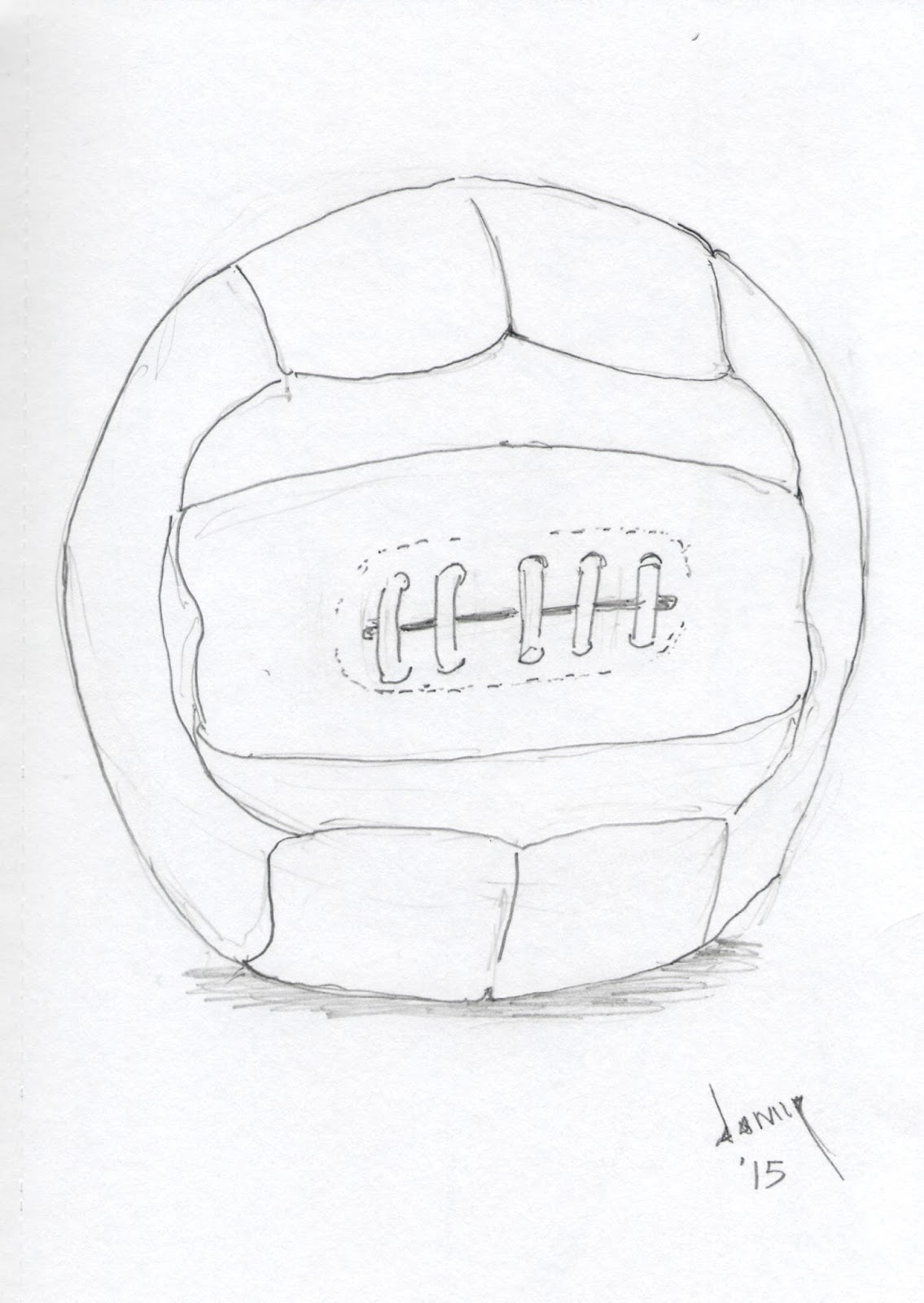
Poem ~ Forward With A Football - Friday, 8 October 1915


Impression sketch of WW1 football - by Jamie. Taken from original at:
 
As part of the campaign
To break German defences,
Of Champagne and Artois,
Launched the battle of Loos,
On 25 September 1915.

A Free Church Chaplain,
Rev Perry of Newport,
Was in attendance to tell
Of bravery of every man -
All described as heroes.

One section were faced
To fight impregnable
Position - in preparation
An officer readied
His boys for the charge.

Earlier a football had
been passed around, with
Each platoon man signing
His name - with orders
Called to go over top.

The officer on the parapet
Kicked off the ball -
To shout 'Follow up lads!'
The ball moved onwards
As he was shot down;

Still the soldier lads set off.

by Jamie Mann.

Anon.,1915. Follow The Football. The Daily Telegraph, [online] 8 October. P.7. Col.5. Available at: http://www.telegraph.co.uk/news/ww1-archive/11914679/Daily-Telegraph-October-8-1915.html [Accessed: 8 October 2015].

Mann, J., 2015. 100 years Ago - Poems by Jamie Mann. [letter] (Personal communication, 8 October 2015). 


#WW1 #WW1centenary #GreatWar #WW1poem #GreatWar #WW1centenary #worldwarone #worldwaroneremembered #WW1Loos