Showing posts with label Raid. Show all posts

Sunday, 13 August 2017

Poem ~ Mobbs War, Monday 13 August 1917 - Wednesday 15 August 1917

Source: File: Edgar Roberts Mobbs. See an original image at: <https://commons.wikimedia.org/wiki/File:Edgar_Mobbs.jpg> [Accessed 13 August 2017]

From the Boys Own World to a world war,
Figures of standing in arts and sport,
Edged from civilian life into khaki.
Already a legend on the sports field was
Edgar Mobbs, rugby player and cricketer.

Born Northampton, Edgar Roberts Mobbs
Lived Buckinghamshire, Dartmouth
House Olney, his formative home.
At 8 years 1882 Edgar played in rugby
Team of under 10's, to follow into house team.

A knee injury aged 16 meant a break from
Rugby for 5 years; instead to play cricket
And hockey - the tallest of 4 brothers
And 2 sisters, Edgar was faired haired and
Blue eyed at 6 foot -1903 he returned to rugby.

A career of success followed, to raise his
Status to sporting star - as captain
Of Northampton Rugby Club for
6 years Mobbs scored 177 tries - 1909
He played for England against Australians.

With his stature, physique, strength
And pace, Edgar was made a force
On the field - with Barbarians,
Northampton and East Midlands
Teams, also to include Toulouse, France.

Edgar Mobbs Aged 32 in 1913, decided
To retire from sport, to follow in father's
Steps within motor industry - when
Mobbs considered emigration to
Canada in 1914, European war broke out.

The sports man volunteered - set to gain
A commission but was refused,
Reason being over the age limit -
Yet undeterred Edgar used his own
Influence for others to form a special corps.

Joining as a private alongside 'Mobbs
Army,’ this Sportsman's Battalion
Became part of the 7th Northants
D company - to include other rugby
Players with Captains' of Bedford and Devon.

With his big personality promotion would
Follow. Arrival in France led Mobbs
Into Battle of Loos - rapid rise led
Him to become Major Mobbs - April
1916 he took command of 7th Northants.

After promotion to Lt Colonel, Mobbs
Alongside his company, fought
In Battle of the Somme - during
Attack on Guillemont village,
Lt Colonel Mobbs took a shrapnel hit.

Following mentions in Despatches
Twice, Lt Colonel Mobbs was
Awarded the DSO. December
1916, the following year, took
The Northants to another sector.

April 1917 and the Battle of Arras saw
D company gain many casualties.
7 June, whilst fighting in Ypres
Salient, Lt Colonel Mobbs took
A further wound in action at Messines.

Under 20 days later Lt Colonel Mobbs
Was back with his battalion - over
18 months Private Mobbs reached
Lit-Colonel - coveted as great
Hero of sport with boyish personality.

Soldiering had given Mobbs renewal -
He declared, 'heaps better than
Rugger' - adding it has more
'Variety' - discipline and grind
Of training appealed as a challenge.

Edgar Mobbs took to soldiering
With ease, as those around
Him witnessed how he felt all
Loss of those in his company -
To say that he would be back again.

Despite wounds, his ability to recover
Did not keep Mobbs from front
For too long. On 29 July duty
Posted Mobbs near Zillebeke,
At the Canada Street tunnels HQ.

Involved in launch of the third battle
Of Ypres, Lt. Colonel Mobbs
Was at hand to the front where
He witnessed many of the walking
Wounded return, stating loss of officers.

To follow duty to lead his men Mobbs
Moved to Shrewsbury Forest -
31 July the attack began with
Lt Colonel Mobbs forwarding
The company, ignoring his own status.

As Battalion commander Mobbs
Should not have been there -
In the thick of it at Lower Star
Post, he discovered a section
Of the battalion cornered by enemy.

Requisitioning hand grenades Mobbs
Gained a volunteer runner - the plan
Revived the old game tricks back,
In a two pronged rugby flanking
Movement, was how to take out guns.

Despite another reminder Mobbs
Headed off - the runner was
Quick - he could feel that old
Surge, back on the field the ball
Under arm; a try was just forty yards.

Thirty-five yards behind him a dull
Yell; 'for gods sake get down sir!'
Almost 30 yards Mobbs saw
The Flash of sweeping bullets -
Ready to let the Hun take a catch.

A teammate suddenly saw Mobbs
Drop, believing he had thrown
A grenade he fell alongside
Lt Colonel to see his wound -
A bullet had gone through his neck.

They paused on the lip of a shell hole.
Mobbs gasped to halt attempt
To dress the hit - he scrawled 
The gun position, pushed the map
Into the runner's hand with firm orders.

Shakily the man read Mobbs message.
'Am seriously wounded' - despite
Protests to leave him, Mobbs gave 
Orders; return see to his wound
Only after the need of reinforcements.

Lying in mud Mobbs could not fight
A fitful sleep - with ten minutes
His men found Lt Colonel Mobbs
Had died alone - action demanded
That they could not convey his body.

The Sports man's battalion pressed
On with duty - their leaders body
Would never be recovered, lost
In the battle - they just fought even
Stronger, to avenge a good man's death.

by Jamie Mann.

Anon.,1917. Private To Lieut-Colonel - Famous Footballer Killed. The Daily Telegraph, [online] 06 August 1917. P.6. Col.2. Available at: <http://www.telegraph.co.uk/news/ww1-archive/12214752/Daily-Telegraph-August-6-1917.html> [Accessed: 13 August 2017].

Source: File: England Rugby: Remembering Edgar Roberts Mobbs. Available at: <http://www.englandrugby.com/news/features/remembering-edgar-roberts-mobbs/> [Accessed 13 August 2017]

Source: Olney and District Historical Society:  Edgar R Mobbs DSO (1882-1917) - Legendary Soldier Sportsman. Available at: <http://www.mkheritage.org.uk/odhs/articles/edgar-roberts-mobbs-dso-1882-1917/> [Accessed 13 August 2017]

Mann, J., 2016. 100 years Ago - Poems by Jamie Mann. [letter] (Personal communication, 13 August 2017). 


#WW1 #WW1centenary #GreatWar #WW1poem #GreatWar #WW1centenary #worldwarone #worldwaroneremembered #WW1Belgium

Monday, 31 July 2017

Poem ~ Paris Attacks - Tuesday, 31 July 1917

Source: File: From Geographical Imaginations: Is Paris Burning? A look-out man operates a portable siren above the city. See an original image at: <https://geographicalimaginations.com/2012/10/20/is-paris-burning/> 
[Accessed 31 July 2017]

Within war comes propaganda;
Opposing sides give denial
Of what the other side says.

Arial activity over the capital
Of France, found multiple
German bombing air raids.

As a precaution army of Paris
Firemen warned the people
Of enemy crafts approaching.

Weird, unusual sounds stirred
Paris, as firemen on roofs blew
On bugles or sounded sirens.

Above air raid alarms French
Air craft took flight over city,
In a darkening, melting sky.

Ground and sky became
As one - deep darkness cut
By beams of searchlights.

German official reports told
Of railways targeted in Paris,
To hit their mark with damage.

By Saturday, French replies
Made denial - that enemy
Planes had left no destruction.

Neither material loss nor loss
Of life - wireless messages
Were received by Admiralty.

Yet Parisian military bases
And railways were hit, with
German pilots safely returned.

Sunday July 29th, a Journal
Told of a suburban air raid
To describe damages done.

One store of combustibles
had been hit - also a factory
Yard, to leave small effects.

Two more fell appropriately
Into gutters, while shell havoc
Hit beds of innocent cauliflowers.

Any resulting explosions
Lacked involved descriptions,
As another bomb hit a centre.

Noted as important, maybe
Military, one turret exploded;
Being close to civilian houses.

The blast blew out material
To injure a single sleeping lady -
More bombs harmlessly fell.

Some hit one large enclosure,
With three in a boulevard -
Another damaged flowerbeds.

Sunday 29 July saw repeat.
30 minutes after midnight
Came the sounds of bugles.

Firemen called reveille and
Again set sirens loud across
Sleepy Paris, all as a caution.

Readied French squadrons
Took action to flight; reportedly
Sending enemy backwards.

News via Petit Journal, from
Versailles said bombs exploded,
All lost in the open countryside.

by Jamie Mann.

Anon.,1917. Bombs On Paris - No Victims Or Damage. The Daily Telegraph, [online] 30 July 1917. P.4. Col.6. Available at: http://www.telegraph.co.uk/news/ww1-archive/12214740/Daily-Telegraph-July-30-1917.html [Accessed: 31 July 2017].

Mann, J., 2016. 100 years Ago - Poems by Jamie Mann. [letter] (Personal communication, 31 July 2017). 


#WW1 #WW1centenary #GreatWar #WW1poem #GreatWar #WW1centenary #worldwarone #worldwaroneremembered #WW1Paris

Thursday, 25 February 2016

Poem ~ Yorkshires Seek Prisoner - Friday, 25 February - Saturday, 26 February 1916


Impression sketch for Yorkshires Seek Prisoner - by Jamie

As rumours go, based on truth,
Was story of Canadian troopers,
Taking up the hobby of dipping
Into trenches - making short
A shift of work returning home,
To convey a prisoner or two.

In liking for a type of such Red Indian
Warfare, there were also others; young
British officers who, being itchy all day
For the night to come, when time allowed
Night patrols in their moving out to wire.

Another rumour in the then
Trenches of Yorkshire lads,
Was their general's pleasure,
To bring a prisoner to him -
A proposal of a sortie was
Soon discussed in dug outs.

One non commissioned officer
In league with an eager sergeant,
Formulated their idea into a plan.
Completed by four lieutenants,
Who set to find their volunteers.

Included was one private
With a waggish humour
And roguish eyes - two
Parties after dark found
Yards equal to miles, with
The dead earth lit by flares.

At intervals of regularity came
A sudden whoosh, as rockets
Flared the dark - with sudden
Stark white lights, the parapets
And wire made stark silhouettes.

Beneath the harsh lit
White, crawling forms
Of Yorkshire men halted -
Pressing exposed selves
Downwards, into the spin
Of earth beneath them.

When darkness held them again,
They crawled on fingers - inch
By inch - following blindly the path
Of leading subalterns, towards
A gap of a curved enemy trench.

Between two bays that
Flashed in white relief,
The Yorkshires paused -
In the loop they listened
Intently, hearing a sentry
Stamping his cold feet.

The sentry paced back and forth,
For warmth he gave a quiet whistle.
His exhale patterning in harsh light
Of white flares where he thought
He was alone, unaware of English.

The Yorkshires lay close
To him, holding breathes,
Clasping revolvers - two
Lieutenants fingered way
To the parapet - behind
Men were left to instinct.

Any orders would alert the sentry;
One man led himself to clamber
Down into trench, only yards from
The sentry - as a wolf he tensed
For his prey, as footsteps came.

Moving in the dank sunk
Was a black form, marked
By glowing cigarette nub;
A German officer on rounds.
The man leapt away, his
Feet hung over the trench.

With legs lying in open air, head
Towards British lines - the officer's
Passing cloak, gently stroked his
Heels - the lad twisted in tension,
To see the German go on his way.

Close by, the lonely
Sentry made a  whistle,
A tune of home to try
And cheer his isolation,
When the alert of a click
Changed everything.

One lieutenant aimed his gun
But the mud filled its mechanism,
So it could not fire - the sentry
Spun, his whistle became a gasp -
Now he was blind with terror.

To fall from the parapet
Was a British sergeant -
Before him the boy sentry
Suddenly shrieked with
A yell - an English hand
About his German throat.

The fingers were trying to strangle
Him - he struggled when a second
Englishman an officer, was before
Him - to hold a cold barrel against his
Neck, to feel thump of a dud revolver.

The first officer sought
To knock him out, while
A trigger squeezed and
Blew away the sentry’s
Life - the same bullet also
Shot the sergeant's hand.

Now all alarm was raised - attempts
To gain any prisoner was lost, with
Thuds of German boots, hurrying 
To a lost rescue of their fellow sentry;
The raiding party scrambled away.

Over the slimy parapet
they fell into a watery ditch -
All attempts were to race
For their home trench -
Under the white flares
And heel snapping bullets.

The split of two parties had found
The other Yorkshire group troubled,
To find their way across a sodden
Ditch - they came against enemy
Wire, slowed down by making a gap.

In breaking through
The leaders split - the
Sergeant to the left
Lieutenants to right -
Their men close behind
To creep forwards.

In the target bay the sergeant soon
Discovered two German sentries,
Whose alert facial status prompted
Him to throw them a grenade -
The noisome result looked to work.

From a dugout two
Germans appeared
Into the smoky hole -
The sergeant sent
Another bomb, when
More soldiers came.

Making for a sharp exit - along
With him the party crouched,
As the enemy flung bombs
Towards them - only to realise
Their lieutenant was missing.

Turning back to find
Him, the sergeant saw
From out of the dark,
A shadow lift  - a flare
Burst revealed a white
Face, a result of wounds.

Despite a bayonet neck injury
And shrapnel hit, the Lieutenant
Lead the party back to safety -
Only one left of their number had
A delay; the grinning eyed man.

Lying in a ditch,
The Yorkshire man
Maintained calm -
Although caught
By the enemy wire,
Expectant of death.

Certain that his bombs had
Killed a number of the Hun,
He tried to get free of the trap.
His boots were caught - only by
Removing them he might get out.

Feeling that they
Were very good
Boots, he could
Not part with them -
Twisting once, then
Again he was free.

Both parties returned in safety,
Despite a lack of any prisoner
There were no regrets in giving
The Germans the jumps - which
Continued over consecutive nights.

Apparently seeing
Shadows, the Hun 
Habitually tossed
Bombs at their  
Own barbed wire; 
To humor the Yorks.

by Jamie Mann.

Anon.,1916. Daring Yorkshires - 'No Man's Land' Exploit. The Daily Telegraph, [online] 25 February 1916. P.9. Col.2. Available at: http://www.telegraph.co.uk/news/ww1-archive/12169037/Daily-Telegraph-February-24-1916.html [Accessed: 25 February 2016].


#WW1 #WW1centenary #GreatWar #WW1poem #GreatWar #WW1centenary #worldwarone #worldwaroneremembered #WW1WesternFront

Thursday, 4 February 2016

Poem ~ Jolly Trench Raiders - Friday, 4 February 1916


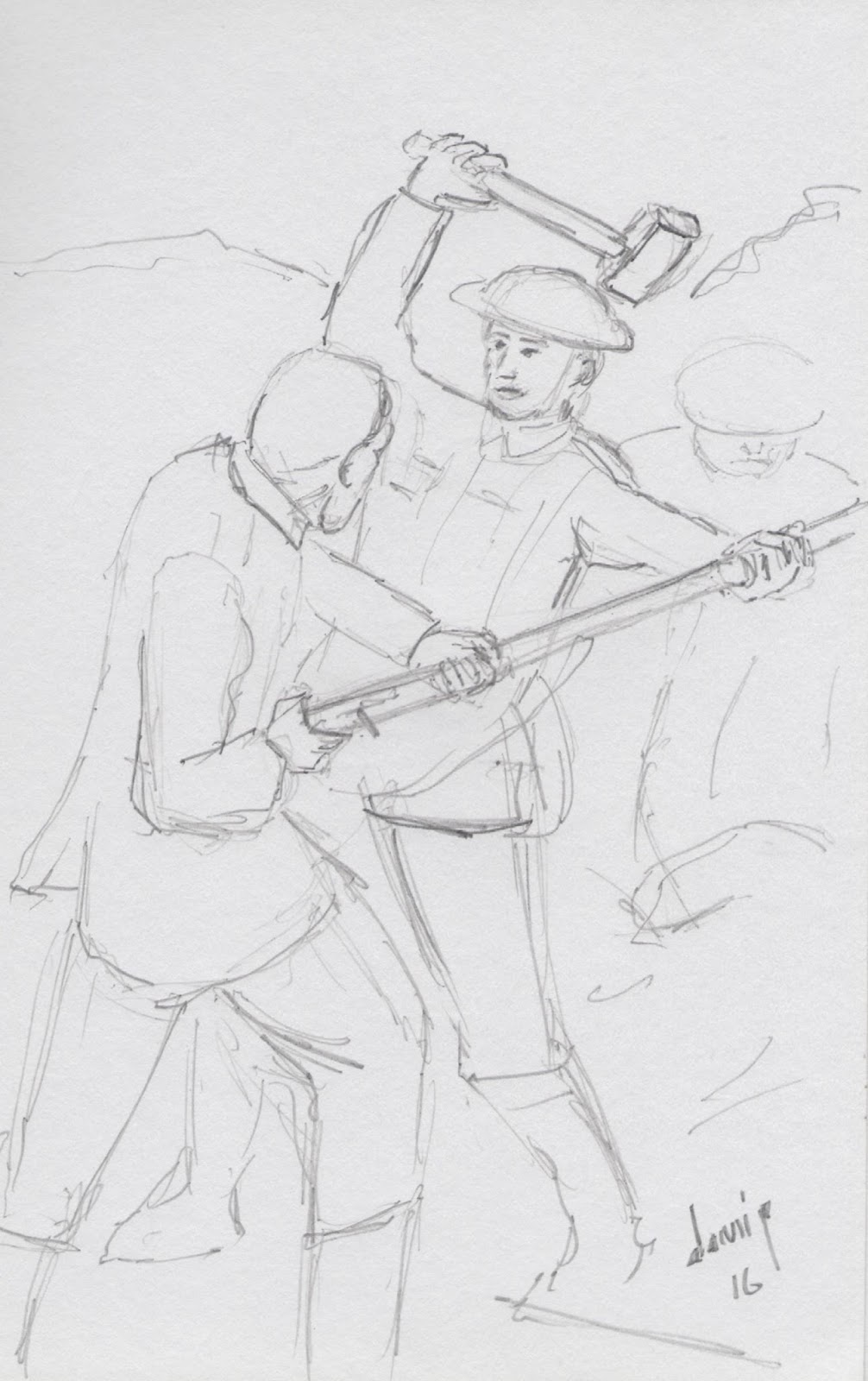
Impression sketch of trench raider with two pound hammer - by Jamie.

Within the humdrum tedium of trench
Existence - where nothing might
Seem to ever progress - a possible chance
For the soldier to actually get
Something done, was often welcomed.

Within the Kemmel-Wyteschaete area
A selection of British men, along
With their officers, were quickly pleased
As punch when being chosen
To form a dangerous, raiding party.

Deep in a wintery dark night with mist
Hanging around, an officer
Saw them embark, as chuffed as a bunch
Of dogs with tin tails, to raid
Trenches of Kemmel-Wyteschaete road.

The stillness was not exactly what
They thought ideal -
To prefer teeming rain and howling
Winds to keep their
Opponents, sheltering in the dugouts.

Still they moved out with a mission,
To include the surprise
Of elements, that could not be given -
Should the enemy learn
To know the impossible as possible.

150 yards of dirty charnel earth,
Lay between opposites -
Punctuated by hard entanglements
Of barbed wire, which
Had taken months of perfection.

Across and through this landscape,
The raiders had to make
Silent progression - for any detection
Was to result in annihilation -
How this achieved could not be told.ow this was done

Once done, they close in on a sentry
Suffering with seizures
Of coughing fits - with his choking’s
Nearly killing him, a quick
Bayonet from the dark ended him.

A picture of these men hovered
On the parapet, to look
Down into designer built trenches -
Peopled by shadowy men,
Who fell in a fray of rapid confusion.

First left then right, were described
Flashes of crimson death -
Amid the surprised yells, an officer
Emptied his revolver,
To grab a German rifle for a club.

As assailants made their attack,
Germans hurried out
From dugouts - some in blankets
Shocked from sleep -
While hand bombs blow out insides.

Rousing out those last unfortunates
With blasting bombs,
Some allied assailant types, showed
Innovation in chosen
Weapons - as a man with a hammer.

With these raiders taking down lives
With their hands,
The odd request for one two pound
Hammer was given -
The man later quizzed for his reasons.

The heavy tool, the man explained,
Was something he used
In daily business back at home - such
A heavy headed item he
Could put to use over anything else.

Then an arranged signal was raised
For attackers to withdraw -
After the brief affair, these soldiers
Precisely made their way
Back, as Germans manned their guns.

Only to find how the machine guns had
Been disabled - British
Losses came to three, as two soldiers
Helped one wounded
Man - all three to fall at the parapet.

That calm misty night boomed,
Prompted by the raid -
Snapping at heels an angry enemy
Sought revenge - flashes
Of rifles puckered down the line.

Deep darkness blurred with flares
As allied artillery woke,
To blast out shells over German
Lines, likely suffering
With shelling hitting their trenches.

As later noted in the officially made
Communication, was
How methods to win the war could
Only be achieved,
By striking out to kill every Boche.

by Jamie Mann.

Anon.,1916. Daring Exploit of British Soldiers - Raid On A Trench. The Daily Telegraph, [online] 4 February 1916. P.6. Col.3. Available at: http://www.telegraph.co.uk/news/ww1-archive/12134547/Daily-Telegraph-February-4-1916.html [Accessed: 4 February 2016].


#WW1 #WW1centenary #GreatWar #WW1poem #GreatWar #WW1centenary #worldwarone #worldwaroneremembered #WW1WesternFront

Thursday, 23 April 2015

Poem ~ A Story of Sidney Sipper, Aviator - Friday, 23 April 1915


Impression Sketch of aerial bombing technique - By Jamie Mann. An original images can be seen at: http://www.amazon.co.uk/Russian-Scout-German-Torture-Panasuk/dp/B000S8DL5A

Impression Zahnradfabrik Friedrichshafen, G.m.b.H., 1915. (The Cog-wheel and Gear Works).  Friedrichshafen and Lake Constance in the background - By Jamie Mann. An original images can be seen at: http://www.gutenberg.org/files/32570/32570-h/32570-h.htm

The sister of Sydney Sippie, an aviator,
Wrote to tell her New Zealand friend,
Living in Wellington, about her brother's
Exploits, over the frontline of France.

Proudly speaking of young Sydney,
Who one bitterly cold morning, some
Weeks before - had set off on a flight
With avaitors Briggs and Babbington.

In temperatures under ten degrees
Below zero, the flight commanders
Took to the skies at ten in the morning.
Determinedly to head for enemy target.

On reaching Friedrichshafen, under
Enemy fire of eight machine guns,
Sydney could see nothing of Briggs;
The air filled with shrapnel bullets.

With the target spotted below, of gas
And other industrial sites, Sydney
Sippie dropped his flight to release
His bombs over enemy buildings.

Coming into view beside him, waved
Commander Babbington - yet still
No sign of Briggs - having dropped
His load, Sydney Sipper started bac.k

Commander Sipper's tactic was
To volplane down to a nearby lake,
To rise again, under cover of mists,
His intentions worked to fool enemy.

A German report stated he crashed
Into the lake - Sydney flew across
Mountains over 260 miles, to arrive
On the same spot, all in 3 hours 50.

Despite some slight written confusion
In the narrative, Commander Briggs
Was heard to have been captured,
Having been shot down in early stages.

The sister of Sydney Sipper was glad
It was not him - after a shock  to hear
One captured and one shot down, came
To receive relief in a wire from Sydney.

In carrying on accoun,t Sydney’s sister
Tells how both flyers were, the next day,
Decorated with the Legion of Honour -
Before the complete garrison at Belfort.

Little more than boys with Sydney 25
And Babbington, younger than him,
The band played and flags were flying
As the garrison marched with salutes.

After a whole days to celebrate, boys
Were then given an elaborate dinner -
In presence of staff officers, colonels
And generals being presented to them.

Their menus of the meal were signed
By them, with some well known names
Among them - The sister of Sydney
Concludes on a more sombre note.

Her brother had been at Antwerp during
The bombardment - amid the last to leave
They crossed the pontoon bridge, shielding
Their faces from the oil burning on water.

by Jamie Mann.

Anon.,1915. A Daring Young Airman. The New Zealand Freelance, [online] 23 Apr. P.23. Col.1-2. Available at: http://paperspast.natlib.govt.nz/cgi-bin/paperspast?a=d&d=NZFL19150423.2.37&e=-------10--1----0--[Accessed: 23 April 2015].

Mann, J., 2015. 100 years Ago - Poems by Jamie Mann. [letter] (Personal communication, 23 April 2015). 

http://paperspast.natlib.govt.nz/cgi-bin/paperspast?a=d&d=NZFL19150423.1.23&e=-------10--1----0--

#WW1 #WW1centenary #GreatWar #WW1poem #GreatWar #WW1centenary #worldwarone #worldwaroneremembered #WW1New Zealand