Showing posts with label Australia. Show all posts

Monday, 10 April 2017

Poem ~ Cadet Bombardier Harry Warren - Thursday, 12 April 1917 - Saturday, 14 April 1917

Source: File: Harry Collier Warren. Available at: <https://rslvirtualwarmemorial.org.au/explore/people/72073> [Accessed 12 April 2017]

The experience was exhilarating
As they left the ground - sudden rushing
Of air against his face, Harry Collier Warren
Saw the blurring of ground move away
From beneath their craft - the lift inside
His belly, a lightness held by wings.

Harry was learning to fly, a member
Of the Australian Flying Corps - the Avro
Carried them neatly, high into the air. Lincoln
Fields and South Carlton had in seconds
Shrunk to toy size the Cadet's instructor
2nd Lt Gland Lowery called orders.

Cadet Warren acknowledged Lowery
As they lifted steadily in the early April
Sky - the young Australian briefly felt control
Of the Avro 504B B389 - only one of thirty
Contracted, from the Wolverhampton
Sunbeam Motor Car Co. Limited.

Cadet Warren grinned in pleasure
To consider how far he had then come
From home; South Australia.  Harry's family
Lived at Port Pirie, a small seaport on east
Coast. Only aged 19 from Freemantle,
He had sailed on HMAT A7 Medic.

His Majesty’s Australian Transport
Medic had returned back into service
After 14 years. Previously the boat was used
In the Boer war to transport troops -
His previous life as Articled Clerk
Seemed a long, long time ago.

The troopship had taken them across
To Egypt. Harry Collier Warren was then
With the 3rd Australian Field Artillery Brigade -
His service number 1899 - being a driver he
Would never have imagined his chance,
To be able to join the Royal Flying corps.

They climbed steadily higher, Lowery
Had the control again of the dual craft -
Harry felt his was the big adventure, far away
From days of training to be a solicitor back
In Australia - The biplane carried them
Easily to reasonable height of 150 feet.

A seven-cylinder Gnome Lambda rotaryEngine chugged away. Lieutenant LowerySteered them into a good position ready forCadet Warren's second flying lesson. Possibly In the lads eagerness the craft lurched intoA sudden spin; Lowery tugged controls.

No response. The spin took away any
Ability for him to regain control - suddenly
The plane flipped into a nose dive  - in silence
Of the accident's inquest the one survivor,
2nd Lt Gland Lowery, advised that he
Was unable to recover from spin.

Bombardier Harry Collier Warren had
Died from accidental injuries aged 23.
A court of enquiry decided how the spin had
Resulted, possibly from the cadet's use -
Lieutenant Lowery was lucky to survive.
Harry's sister and family later learned
By post, to say a brother had died.

by Jamie Mann.

Anon.,1917. Flying Fatalities. The Daily Telegraph, [online] 9 April 1917. P.5. Col.4. Available at: <http://www.telegraph.co.uk/news/ww1-archive/12214440/Daily-Telegraph-April-9-1917.html> [Accessed: 12 April 2017].

Source: File: RSL Virtual War Memorial, Warren Harry Collier. Available at: <https://rslvirtualwarmemorial.org.au/explore/people/72073> [Accessed 12 April 2017]

Mann, J., 2016. 100 years Ago - Poems by Jamie Mann. [letter] (Personal communication, 12 April 2017). 


#WW1 #WW1centenary #GreatWar #WW1poem #GreatWar #WW1centenary #worldwarone #worldwaroneremembered #WW1Australia

Friday, 3 March 2017

Poem ~ Sydney Lad On The Somme - Saturday, 3 March 1917- Sunday, 4 March 1917


Source: File: Private (Signaller) Arthur Joseph Hill. See an original image at: <http://www.iwm.org.uk/collections/item/object/205301221> [Accessed 03 March 2017]

Source: File: Arthur Joseph Hill. See an original image at: <http://beyond1914.sydney.edu.au/profile/3168/arthur-joseph-hill> [Accessed 03 March 2017]

Source: File: Letter from Arthur Hill, father of A.J. Hill. See an original image at: <http://beyond1914.sydney.edu.au/profile/3168/arthur-joseph-hill> [Accessed 03 March 2017]

i
A Sydney lad of Waverly New South Wales,
Left home of 60 Wiley Street,
With his father's name - Arthur Joseph Hills
Had departed to take part in war.

Born 18 September 1897 Arthur's early
Education in Waverly; Christian
Brothers College to University of Sydney,
To study English till 1916.

In schooling career his bright disposition
Was recognised; upright with
Manly participation in sports and class -
Captain of 1st 15 football team.

Arthur Hill's ability had been well proved
And matriculated, in 1915
He made a place at University to gain
A bursary for a good future.

Then aged 18, Arthur enlisted February
On the 23 day, to attend signal
School at Kiama - examinations taken
Made him first class signaller.

Within six months, at rank of Corporal,
24th August Arthur Hills
Departed Australia, with expeditionary
Australian Imperial Forces.

Late 1916, Signaller Arthur Hill in France
With Reinforcements Battalion,
Took part in actions about the Somme;
Bapaume as Germans retreated

Corporal perhaps was a temporary rank;
Private Arthur 'Snowy' Hill,
Affectionately named being tall, stout lad,
With light hair and complexion.

ii
Into 1917 a military operation carried
Out codenamed 'Alberich' -
In 1916 had formed German salient’s
Of saint-Quentin and Arras.

This was a planned strategy to regroup
To the Hidenburg line to cut
Front, for ease of defence - though allies
Believed this was a retreat.

Preparations had seen German troops
Destroy commune’s roads and
Railways while poisoning water supplies,
Leaving booby traps behind.

The dawn of 1917 still offered no sign
Of allied Victory, when
The shift away of German presence from
Salient’s made hope.

The area lay in close sight of Australian
Trenches, where Signaller
Arthur Hill 3827,  took part in the operation
To move into gaps left.

17 March 1917, would see the Australians 
Make a road to Main Square
Of Bapaume - where an Anzac army band
Made appearance to play.

Yet a time delayed mine had been placed
Below the town hall, to
Blew within days to bury troops; meanwhile
Snipers were an issue.

iii
Amid later accounts of the Australian Red
Cross, came informants
Of those close to Signaller Private Arthur
Hill, to clarify events.

Pte. J. Glynn 3815, Pte. W. Curran 4015,
C. Wallbank, Pte. Mckenzie 384,
Cpl T Mckenzie 1116, Pte. L. O. Lees 3835;
Snowy Hill's mate, Pte. F. Dunne.

The Australians were close to Bollecourt,
In Sunray Trench the lad
Nicknamed Snowy, Pte. Arthur Hill 3827
Helped gain 1/2 mile of trench.

Pte. Glynn told how Snowy had been part
Of fatigue duty at Sunray
Trench, close to the 'crater' - then under
German counter attacks.

Varied versions by likely battle confusion,
As Pte. W Curran 4015
Said shelling in the early hours struck
Snowy down instantly.

Yet all others said that sniper problem
Had got him - Pte. Glynn
Believed a sniper took Hill down through
The heart - killed outright.

Cpl. Mckenzie 1116, was at the time there
As a witness that Pte. Hill
Had moved just above the parapet, to be 
Target of a keen sniper.

Pte. Mckenzie 384, a close mate, said
Hill was also known as 'honey' -
That they shared leave in London. Only
Later to find out what happened.

Others were there close to the signaller,
Paul Vincent of A Coy,
Told that Pte. Arthur Hill had looked over
Parapet of Mosoon trench.

Some sniper took a rapid aim to shoot
The signaller through
The neck - C. Wallbank was with him
And confirmed his identity.

Another uncertainty lay over Hill's grave;
Close by to Sunray trench,
But his mate failed to find it and later told
It lay at Cameron Sap.

Pte. Lees reported how Hill's death had
Been registered with
Padre Ward - a cross marked the grave,
How his effects sent home.

Days later his father, Arthur, wrote to thank
University Union President, for
Kind letter of sympathy for a son's death -
Signed, yours respectfully.

Thursday 22 February 1917, another day
2nd day 29th Week
In the 3rd year of war, an Australian man
Was shot digging a sap.

A day short of one year in joining, had
Seen Pte. Arthur Hill killed -
22 February 1917 genuinely popular lad,
Named Honey and Snowy.

by Jamie Mann.

Source: File: Explore Military Uniform. Available at: <https://uk.pinterest.com/pin/294422894375837134/> [Accessed 03 March 2017]

Source: File: Beyond 1914 - The University of Sydney and the Great War. Available at: <http://beyond1914.sydney.edu.au/profile/3168/arthur-joseph-hill> [Accessed 03 March 2017]

Source: File: Bapaume To Bullecourt (1917). Available at: <http://aso.gov.au/titles/historical/bapaume-to-bullecourt/notes/> [Accessed 03 March 2017]

Source: File: [PDF] 3827 Private Arthur Joseph Hill - Australian War Memorial. Available at: <https://www.awm.gov.au/images/collection/pdf/RCDIG1047611--1-.pdf> [Accessed 03 March 2017]


#WW1 #WW1centenary #GreatWar #WW1poem #GreatWar #WW1centenary #worldwarone #worldwaroneremembered #WW1Australia 

Saturday, 19 March 2016

Poem ~ Flags For Irish Sons - Sunday, 19 March 1916

Impression sketch of Ireland Flag Day Fundraising Pin Badge - by Jamie. An original image can be seen at: <http://www.britishmilitarybadges.co.uk/product/k1b-95-ww1-irish-soldiers-ireland-flag-day-fundraising-pin-badge/> [Accessed: 19 March 2016]
           
Coinciding on a day of celebration,
17 March 1916 saw Irish Flag Day,
Stand alongside the feast of Saint
Patrick - A woman led organisation
Saw the distribution of the green
Flag as a national commemoration,
For soldiers from a sister nation.

A green flag with harp was distributed,
To be sold by the metropolis ladies,
To number 3000 - Trafalgar Square
Filled with singing strains of 'Wearin'
Of the Green' - alongside these flags
The traditional shamrock was worn,
In English appreciation of Irish troops.

Across the water to that true emerald
Isle, laid the heart of the festival day  -
The start being a man of Roman times.
As a youth kidnapped to Gaelic lands
To be slave for Irish raiders - eventually
To find god who led him to the coast,
Where a boat would guide him home.

With his faith found, Patrick became
A priest and with his love for Ireland
Returned, to convert many people
To Christianity - by teaching methods    
He likely utilised a three-leaved plant,
To explain the holy trinity - a common
Shamrock became Patrick's symbol.

Centuries later saw 1541 make unity
Of Personal Union, when kingdom
Came the English King of Ireland -
But lack of reform to break minority
Rule of Anglo-Irish, led to United
Irishman rebellion 1798 - a crushed
Uprising made a 1800 Act of Union.

Yet a protestant parliament of Ireland
Was a false representation of people,
Whose majority had held catholic
Discontent - quickly founded as
Oppositions manifested in various
Forms, to seek independent Ireland -
100 years on saw further changes.

From emerging various groups that
Came by 1905, Sinn Fein for an Irish
Nation, in confronting the illegality
Of 1800 act of Union - a Parliament
For the Irish allowed only land owners
To vote and Protestants to sit within -
Challenges emerged by varied leagues.

Standing by each other, men of Ireland
Joined the cause, to fight against
Germans invaders or European peace -
Irish regiments filled with volunteers,
All gave the impression of union
Solidity - across waters from different
Dominions perhaps to mirror Australia.

Friday 17 March 1915 and Politician
Andrew Fisher, High Commissioner
For Australia, made a speech at London
Irish Club - a government leader over
Three occasions for his country,
Fisher expressed sympathy for the Irish
Who were among best of Dominions.

Among his underlying words Fisher
believed how Ireland, with deep roots
Of national sentiment, would find full
Free expression, on a day not long
Away - that they shall show enemies
how freedom and liberty to manage
Own affairs, should be greater than life.

To repeated cheers Fisher made
Feelings known that across world,
Ireland not just spoke but acted -
How, whatever might be done
Or not done, Ireland would remain
And stand true to the crisis end -
Yet what enemy was suggested?

by Jamie Mann.

Anon.,1916. Mr Fisher on Irish Loyalty. The Daily Telegraph, [online] 18 March 1916. P.11. Col.3. Available at: http://www.telegraph.co.uk/news/ww1-archive/12196041/Daily-Telegraph-March-18-1916.html [Accessed: 19 March 2016].

Anon.,1916. Irish Flag Day. The Daily Telegraph, [online] 18 March 1916. P.12. Col.7. Available at: http://www.telegraph.co.uk/news/ww1-archive/12196041/Daily-Telegraph-March-18-1916.html [Accessed: 19 March 2016].

Source: File: Saint Patrick's Day. Online. Available at: <https://en.wikipedia.org/wiki/Saint_Patrick's_Day> Accessed 19 March 2016

Mann, J., 2016. 100 years Ago - Poems by Jamie Mann. [letter] (Personal communication, 19 March 2016). 


#WW1 #WW1centenary #WW1poem #GreatWar #WW1centenary #worldwarone #worldwaroneremembered #WW1Ireland

Monday, 22 February 2016

Poem ~ Australian Trooper 'Bluegum' - Tuesday, 22 February 1916

Impression sketch of Oliver Hogue aka Trooper Bluegum,

- by Jamie. An original image that can be seen at: <http://mosman1914-1918.net/project/blog/oliver-hogue-aka-trooper-bluegum-1880-1919> [Accessed: 22 February 2016]


To download an ebook version of 'Trooper Bluegum at the Dardanelles' by Oliver Hogue book  see: <http://www.gutenberg.org/ebooks/46097>

Born Sydney Australia, Oliver Hogue
Proved he had sporting ability,
To perfect his skill as horseman -
When school ended, young Oliver
Believed himself a born Bushman.

With youth and time Oliver setout
To cycle East coast Australia -
To cover the countless miles to Cairns.
Suiting the outdoors, his career
Involved him as commercial traveler.

Back in Sydney 1907, Oliver Hogue
Turned his talent to journalism,
With the Sydney Morning Herald.
To believe in 1914 he could become
The country’s official war correspondent.

While denied this route he took
Another path as a trooper with
6th Light Horse Regiment - to leave
For the front 21 December 1914,
On SS Suevic of the white Star Line.

By then commissioned as Second
Lieutenant, with a destination
Of Egypt - for the next months
He served Gallipoli as a soldier,
Until enteric fever sent him to England.

Once back in Sinai area Oliver Hogue,
Now Lieutenant, became orderly
Officer to Colonel Ryrie - basically
Still a journalist, Hogue's recorded
Experience in letters to family and Herald.

Despite all Hogue stayed cheerful,
To stick to reporting the truth -
An officer to be known across
Australia for his accounts, under
The pseudonym Trooper Bluegum.

Writing out verbal pictures of Gallipoli
He contributed various articles
To T.P.'s Journal of Great Deeds
With readable, straightforward
Ways to say how he avoided a scratch.

'While blokes like Paddy Ryan
Gained a hole in hat and DCM -
While Billy Sing had a shoulder
Wound - how at total 30,000
Dead came the single word to quit.'

With a chatty style to state his
Hurt at leaving their sleeping pals
At Anzac - the story would
Stick, even in peace between
Campaigns, Bluegum didn't forget.

by Jamie Mann.

Anon.,1916. Trooper 'Bluegum'. The Daily Telegraph, [online] 22 February 1916. P.12. Col.3. Available at http://www.telegraph.co.uk/news/ww1-archive/12165475/Daily-Telegraph-February-22-1916.html [Accessed: 22 February 2016].

Source: Mitchell, E. File: Hogue, Oliver (1880–1919). Australian Dictionary of Biography. Online. Available at: <http://adb.anu.edu.au/biography/hogue-oliver-6700> [Accessed 22 February 2016]

Source: Major Oliver 'Trooper Bluegum' Hogue. Australian War Memorial. Online. Available at: <https://www.awm.gov.au/people/P10675880/> [Accessed 22 February 2016]


#WW1 #WW1centenary #GreatWar #WW1poem #GreatWar #WW1centenary #worldwarone #worldwaroneremembered #WW1Australia

Saturday, 2 January 2016

Poem ~ League of German Fear - Sunday, 2 January 1916


Source: File: A 1915 Anti-German League, Australian badge.jpg. [online] An original image is Available at: <https://commons.wikimedia.org/wiki/File:AGLbadge.jpg> [Accessed: 2 January 2016]

With first column of joyful news
To tell of births - alongside Happy
New Year greetings, from Cheri
Mr. A De Hem and Miss Eddes -
Echoed by Mrs. Roger's greetings
And thanks for wishes, during
Her illness, above a sober square.

Below a personal advert set out
How numbers solely in London,
For 10,729 Germans uninterned -
The figures replied to a question
Made by house of commons -
To be 10,729; the advert quizes
How long is state to continue?

Such views were nothing new,
And could date back to middle
Ages, in dislike of all things as in
Danish Chronicon Lethrense -
The middle of nineteenth century,
With rise of Germany's power
And solidity in unification was fear.

From wars strike of 1914, riots
Against all German presence
Had occurred - to continue
Brewing, not just in Britain yet
All over the world - in Empire
State of Australia by 1915,
A league was well established.

Tuesday 23 November 1915,
Darlinghurst saw a meeting
In open air of the Anti-German
League - in a call for dismissals
All to be made for any German
Presence in Australian office.

In advertising, 1 January 1916,
Was the British AGL to claim
How neutral countries, believed
Britain mad - in peril of alien
Enemies still at large - a call
Being adverts purpose to all
True British, to join the AGL.

The League's purpose was
To place pressure on those
Allowing Germans to be
Uninterned - the need being
Called for a million members,
To help the battle cry to make
Everything German taboo.

The unity of this league
Would spread across the
Empire, to justify existing
Germanophobia and play
Of pre war fears - a public
Should send for application.

by Jamie Mann.

Anon.,1916. Personal Column: 10,729 Germans. The Daily Telegraph, [online] 1 January 1916. P.1. Col.2. Available at: http://www.telegraph.co.uk/news/ww1-archive/12072922/Daily-Telegraph-January-1-1916.html [Accessed: 1 January 2016].

Mann, J., 2016. 100 years Ago - Poems by Jamie Mann. [letter] (Personal communication, 1 January 2016). 


#WW1 #WW1centenary #GreatWar #WW1poem #GreatWar #WW1centenary #worldwarone #worldwaroneremembered #WW1Homefront

Saturday, 1 August 2015

Poem ~ Australia Day Parades - Sunday, 1 August 1915


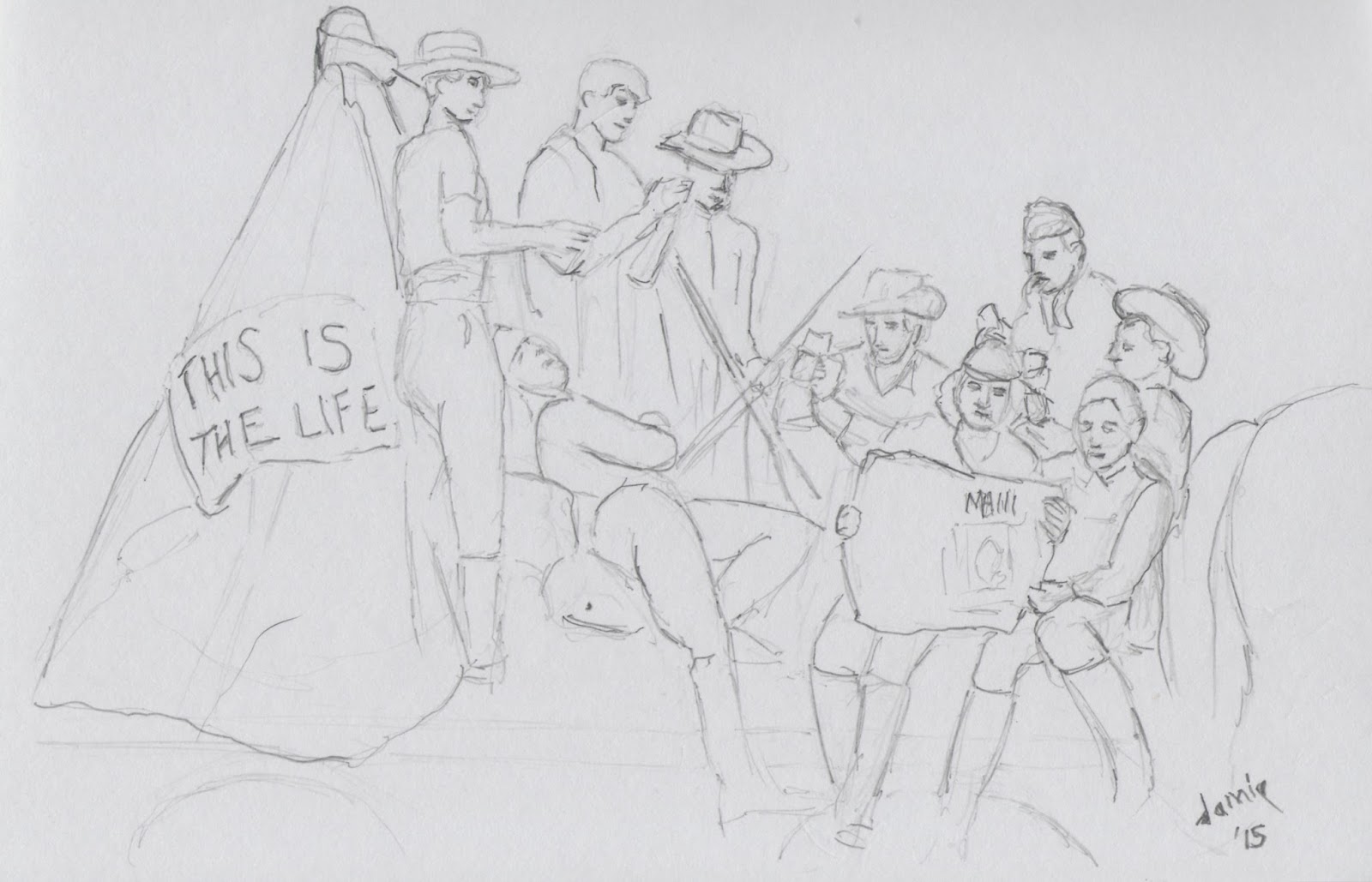
Impression sketch of Float depicting life at the Front, Australia Day parade, Gosford, 30 July, Photograph by R. Hazlewood of Epping NSW - by Jamie. See original at: https://www.awm.gov.au/collection/REL33602/


Two crossed flags - a Union Jack
And the National Australia flag;
A Union Jack set out in the canton -

The southern constellation, along
With Commonwealth star, set in
Blue; printed on a white silk ribbon.

To show union of two nations joined
In common mission for their heroes -
Labeled 30 July 1915, Australia Day.

Creations of ribbons and badges
Produced for raising patriotic funds -
To be held across both countries.

Other days set aside had helped
War ravaged countries, included
Belgian Day - this 30 July intent,

Was to help Red Cross Australian
Division - symbolised by Australian
Map, stating 'Dardanelles' in red.

In growth of this country’s identity,
Celebrations built on national pride,
In a single days witness of parades.

Such route marches, both at home
And elsewhere - the public would
See wounded men of Dardanelles.

On the day, the Sydney Morning
Herald told of military authorities
Organised by a Colonel Wallack.

With medical support, Gallipoli
Wounded of ten men were able
To attend the street procession.

The governor's carriages would
Convey these wounded heroes,
To lead others in ambulances -

Wagons and decorated motor
Vehicles - to follow would then
Pass a variety of detachments.

After them to be naval reserves; 
Some 600 in numbers with cadets
Of the training ship, HMAS Tingira.

Next, men from war ships in port,
Along with 'A' Squadron of 7th
Light Horses, all in full regimentals.

Behind these would be the Khaki
Of Australian Field Artillery;
Their guns to be drawn by horses.

To follow these to be detachments
From Liverpool camp; of infantry
Reinforcements and rifle reservists.

A military parade would continue,
With those training in Liverpool,
Of Army Medical reinforcements.

Red Cross Wagons and motor
Ambulances, supported by corps,
Senior cadets and mounted police.

The Australian day parade routes
Set to leave at 11.30 a.m. near
St Mary's Cathedral, Domain Gates -

Progress King's Street to Queen's
Square, to Macquaire and Bridge
Street, to reach the railway station.

Amid such English place names,
Between each section, two bands
Would march in continual music.

Gosford Times included a report,
Whose parade include the humor
Of the Anzac by horse and cart.

A float organised by Mr Johnson,
Held eight Anzac men, to cause
Onlookers to give shouts of joy.

By a cross of rifles, a prone man
On rocks bore his face, subject
To a toilet of a regimental shave.

About three other Anzacs stared
Intently stare on a game of cards,
Each hoping to hold a good hand.

One resting smoking man reads,
To share the Mail with a mate;
All blasé to the cart stuck in a rut.

Hung on the slump of a bivouac
Topped by a slouch hat, holds
A banner to claim 'this is the life.'

by Jamie Mann.

Anon.,1915. Wounded Soldiers. The Sydney Morning Herald, [online] 30 July. P.7. Col.3-4. Available at: http://trove.nla.gov.au/ndp/del/article/15575515 [Accessed: 1 August 2015].

Mann, J., 2015. 100 years Ago - Poems by Jamie Mann. [letter] (Personal communication, 1 August 2015). 


#WW1 #WW1centenary #GreatWar #WW1poem #GreatWar #WW1centenary #worldwarone #worldwaroneremembered, #WW1Australia