Showing posts with label India. Show all posts

Monday, 16 May 2016

Poem ~ Bravery Of Lance-Naik Lala - Tuesday, 16 May 1916


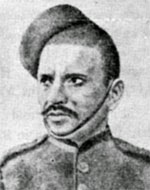
Impression sketch of Lance-Naik Lala. [online] See original image at: <https://commons.wikimedia.org/wiki/File:VCLala.jpg>  [Accessed: 16 May 2016]

During the siege struggle of Kut
In region of Mesopotamia,
A number of battles tried to free
British and Indian troops,
Encircled by the Ottoman forces.

Following both battles of Wadi
And Hanna the Ottoman
Army made camp on strip of land,
Between marshes and river
Tigris - known as 'Hanna defile.'

Under two days of bombardment
By British guns, the decision
Was to charge the Ottoman lines.
Yet ahead was flooded land
And well-placed machine guns.

Among the Indian soldiers ready
To charge Lance-Naik
Whose hometown of North India,
Hamirpur, that lay
In the lap of the Himachal Pradesh.

Aged 38 the Indian man was a long
Way from Martyr's land -
Now in Indian Army, No 501 Lance-
Nail Lala, 41st regiment
Of Dogras, stood his ground to fight.

Within the devastation of this battle
Was an attempt to cross
600 yards of watery Earth - amid
Air wreaked havoc
Lance-Naik set out to give help.

Not too far from the enemy's side
Lance-Naik had created
A hurried shelter - already he had
Seen to four wounds
Indian fellows - he looked again.

Out in the open Lance-Naik heard
An officer of a British
Regiment calling out - little more
Than a hundred yards
From where he lay near Ottomans.

Without hesitation Lance-Naik
Reached the officer
And pulled him back to safety
Of his shelter - seeing
To his wounds to hear another cry.

Above the din of metal he heard
The human voice -
His own Adjutant was wounded -
He crawled out
To him - defiant of death's chance.

Other wounded Indian men were
With him - Lance-Naik
Wanted to move them to shelter
To take them on his back,
But the officer stated his refusal.

Instead Lance-Naik took off his
Uniform in order
To provide them human warmth -
When darkness gave
Cover, he carried the first to shelter.

Then in quick return, Lance-Naik
Took a stretcher and
Worked hard until they all returned.
Within that single day,
Lance-Naik earned Victoria Cross.

Along way from home and safe
Lap of the Himalayas,
Lance-Naik had shown courage
And devotion - to be
Held as a fine example by the king.

by Jamie Mann.

Anon.,1916. Indian VC Hero. The Daily Telegraph, [online] 15 May 1916. P.9. Col.2. Available at: <http://www.telegraph.co.uk/news/ww1-archive/12210082/Daily-Telegraph-May-15-1916.html>  [Accessed: 16 May 2016].

Source: File: Salute To The Indian Soldier - We Fought True. Online. Available at: <http://www.salute.co.in/we-fought-true/> Accessed 16 May 2016

Mann, J., 2016. 100 years Ago - Poems by Jamie Mann. [letter] (Personal communication, 16 May 2016). 


#WW1 #WW1centenary #GreatWar #WW1poem #GreatWar #WW1centenary #worldwarone #worldwaroneremembered #WW1India 

Saturday, 21 February 2015

Poem ~ Unrest and Rebellion - Friday, 21 February 1915

Source: File: Sikh Temple Stockton, Calafornia (U.S.A.) 1912 One of the centres of Gadar Activities.jpg, 2015. This Gurdwara, or Sikh temple, in Stockton, California, was one of the centres of activity in America in 1912. [online] Available at:<http://www.thestar.com.my/Lifestyle/Features/2014/06/28/The-Singapore-mutiny/> [Accessed: 20 February 2015].

i
With many loyal and proud troops of Indian
Sepoy's fighting on the European front,
Back in their homeland, distrust of colonial
Rule had steadily gathered momentum.

A situation had formed from global status,
That had over time, gathered assistance
Of others - to include Irish republicans,
United States and German countries -
Who all shared a belief against the rule
Of the dominanting British Empire.

Well before the British Raj's creation made
For Queen Victoria - within native states
And British India, lay unrest - as in Sepoys
1850's mutiny, formed from many factors.

For scores of Indians this had never gone
Away - Despite 1914's faith and loyalty,
Punjab and Bengal regions were centers
Of discontent - where anti colonial feelings
Ran high - Although one faction carried out
Peaceful disobedience,  others sought
An armed revolution for Independence.

Indian expatriates sought to prompt actions
Of insurrection - as in Berlin Committee's
Cause For Indian Independence by shared
Activity, within America's Ghadar party.

With close connections between India
And Canada an event triggered a change
In May 1914 - ten years before, economic
Needs saw a great scale of immigration
From Punjab to Pacific coast of America.

But Canadian reaction of legislation limited
South Asians into the country and made
Restrictions for political rights of present
Residents - stirring anti-colonial emotions.

Organisation between India’s expatriates
Led to an Indian Independence League
And to the Ghadar Party from 1913 -
Ambitions of raising an armed revolution
At British authorities, took a step closer.

Organizers’ planned a hard-line strategy
For revolt amid all Indian soldiers within
The British Indian Army that had controlled
The Status quo - from out of San Francisco
Came literature in form of Free Hindustan
Journal, to stir Indian Sepoys to their side.

ii

In May 1914 an incident happened to act
As Catalyst - aboard SS Komagata Maru,
Punjabi Sikhs sailed to Vancouver, Canada.
Yet ship's passengers held in port for two
Months, until the immigrants were forced 
To return to India and Calcutta - where
An act enforced their transport onto Punjab.

From the resulting riots at Budge Budge,
Ghadar leaders used enflamed reactions -
Where deaths had occurred on both sides -
A disaffected Indian population emerged.
Yet India still assisted the Europe's war as
British Raj in raising 15000 Indian troops.

October 1914 - the Indian Army of the 5th
Light Infantry Regiment moved from Madras
To Singapore, replacing the Yorkshire Light
Infantry, sent to the French Front - thus Indian
Leaders began their revolution movements.

German assistance started to build supplies
Of arms, as ex-pat Ghadarites returned home.
From start of war a figure Mahatma Gandhi
Extolled virtues to fight for British Raj allies
As Indians were citizens of the British Empire.
Thus thousands of Indian volunteer men
Came forward, in contrast to Ghadar brothers.

iii

Preparations continued into January of 1915 -
Employing use of inkpots in rebel bomb making -
Thus believing the Sepoy forces would rally,
A unified uprising was set 21 February 1915.
The plan for Punjab, was for 23 Cavalry to seize
Weapons and kill their officers - an uprising
Of the 26th Punjabs would signal the mutiny.

This conspiracy was to fail in later stages, with
A spy, Kirpal Singh of the British Indian Army -
Recruited by Punjab CID, gained connections.
He entered the Headquarters at Mochi Gates,
On 15 February, accessing information of date
And scale - Guessing fact of a leak the event
Was brought sooner to evening of 19 February.

While a last minute change discovered that day
The Ghadar organisers made no move to stop
Kirpal Singh, alerting Liaqat Khan to changes -
The infiltrator returned to prepare to signal when
The Rebels assembled - The spy though, taken
And held, escapeed under ploy of nature's call.

Fighting started on the 15th February 1915 -
The capital of Burma Rangoon, first saw 130th
Baluchi Regiment attempt stopped  - while in
Singapore the 5th Light Infantry rebelled, with
Fifty percent of troops and a hundred Sikh
Police - lasting for seven days the mutiny was
Only stopped with assistance from Japanese,
Russian and French ships of reinforcements.

With propaganda done, the scene was set
For 15 February with Indian officers spreading
Ideas that Indian soldiers were to be deployed
To europe - or possibly to stand against Ottoman
Forces - the Singapore Commander addressed
The sepoy regiments’ farewell parade, whose

Destination of Hong Kong was not yet stated.
Then at 3.30 p.m. four out of eight companies
Rebelled, with 100 Sikh police - two British officers
Trying to restore order were killed - breaking into
Three groups, the rebels set on 10 British guards,
Breaking into Tanglin Barracks to gain ammunition -
Where interned German refused to help mutineers.

Descending onto Keppel Harbour And Pasir
Panjang, the Ghandar fighters shot 18 civilians -
As another group blocked a route into Singapore,
With siege of Colonel Martin Vice Admiral's house.
In desperation  Sir Martyn Jerram sent a radio plea
Requesting help of allied Warships in the vicinity.

With Martial Law imposed, volunteer units of Malay,
Chinese and British made deploy along with marines
From HMS Cadmus and numbers of British regular
Troops. After two days stand offs, three allied ships
Montcalm, the Russian Orel, Otowa and Tsushima
Of Japan brought reserves to the British numbers.

The rebellion lost its direction, as most mutineers
Were dead or injured - the ending by 20 February
Concluded with an immediate enquiry - 47 British
Had been killed by the finish, with mass arrests
And executions ending this mutiny within the war.

by Jamie Mann.

Source: File: Ghadar Mutiny. From Wikipedia, the free encyclopedia. [online] Available at: <http://en.wikipedia.org/wiki/Ghadar_Mutiny > [Accessed: 21 February 2015].

Source: File: Kirpal Singh (spy). From Wikipedia, the free encyclopedia. [online] Available at: <http://en.wikipedia.org/wiki/Kirpal_Singh_%28spy%29> [Accessed: 21 February 2015].

Source: File: The Singapore Mutiny – A Reclaimation, A documentary on 1915 Sepoy Mutiny of Singapore.  From Wikipedia, the free encyclopedia. [online] Available at: <https://singaporemutiny.wordpress.com/tag/mutiny/> [Accessed: 21 February 2015].

Source: File: The Star (Malaysia) Report on Singapore Mutiny BY TAN YI LIANG. Published: Saturday June 28, 2014 MYT 12:00:00 AM Updated: Monday June 30, 2014 MYT 11:26:35 AM. [online] Available at: <http://www.thestar.com.my/Lifestyle/Features/2014/06/28/The-Singapore-mutiny/> [Accessed: 21 February 2015].

Mann, J., 2015. 100 years Ago - Poems by Jamie Mann. [letter] (Personal communication, 21 February  2015). 


#WW1 #WW1centenary #GreatWar #WW1poem #GreatWar #ww1centenary #worldwarone #worldwaroneremembered #WW1Singapore

Monday, 8 December 2014

Poem ~ First VC's of Indian Army - Tuesday, 08 December 1914


 Source: File: Darwan Sing Negi.jpg, Subterranean Sepoys -A Radio Play about Life in the Trenches for the Indian Army on the Western Front. [online] Available at: <http://trenchindians.com/sepoys-in-wwi/#sthash.0hFydd0o.dpbs> Accessed: 8 December 2014].

  Source: File: Khudadad Khan.jpg, Khudadad Khan, Wikipedia, the free encyclopedia. [online] Available at: <http://en.wikipedia.org/wiki/Khudadad_Khan > Accessed: 8 December 2014].


With the King-Emperor’s approval,
Members of the Indian army Corps,
Were awarded the Victoria Cross -
To be the first for just gallantry,
In the Indian Expeditionary army.

In the 1st Battalion of 39th Garwal Rifles
Naik Darwan Singh Negi was posted
Near Festubert, France –
During the night of 23-24 November,
The regiment set to make clear,
And retake some occupied trenches.

In a strategy that would become
Standard, the Garwal rifles
Attacked, to flank either side
Of one occupied trench –
They moved down and in -
Firing, bombing and bayoneting
To clear away their enemy.

With the first, Naik Darwan Singh Negi
Stepped forward, about each curve
Of the trench - under return fire from
Rifle and grenades, at close range.

Naik Darwan Singh Negi fought,
Despite being wounded twice,
In the head and in the arm -
By fight's end the man was seen,
Covered from head to foot,
Quite stained with his blood.

The VC for Naik Darwan Sing Negi
Given for great gallantry fighting
In face of enemy - on 5 December,
King George V had asked Negi
What he might do for him.

Came an unhesitant reply
For a homeland request.
Where he lived -
There were no schools.
Might one be made?
The process of this appeal,
Was immediately begun.

On 31 October in Belgium,
The onslaught of the Germans,
To gain French ports,
First had to get around Ypres,
The Belgium town.

129th Duke of Connaughts
Own Baluchis had arrived
And rushed out to support,
The pressured British -
With two companies,
Stationed in  Hollebeke Sector
About the village of Gheluvelt.

Still outnumbered, companies
Suffered increasing casualties.
Two machine gun teams
Had been kept operational,
Throughout the day -
Halting enemy breakthroughs.
One man of Sepoy rank,
Khudadad Khan.
Found himself in great adversity.

One machine gun fell from action,
Hit by a shell, while a British
Detachments Officer was wounded.
The machine gun position,
Was then overrun and the men,
Fell under bayonets and bullets -
With the exception of Sepoy Khan,
Who was left for dead.
Alone and badly wounded,
The Sepoy stayed at his station,
Until night – despite his wounds,
crawling back To his regiment.

Due to his, and the Baluchis actions,
The Germans were held back,
Until British and Indian reserves,
Arrived - thereby the line,
Was fully strengthened
And the ports safety ensured.

Sepoy Khudadad Khan,
Was the first South Asian
To receive the Victoria Cross -
On the same day as
Naik Darwan Singh Negi.

by Jamie Mann.

Anon.,1914. India’s First VC’s -Gallant Deeds. The Daily Telegraph, [online] 8 Dec. p.8. Col.6. Available at: http://www.telegraph.co.uk/news/ww1-archive/11275709/Daily-Telegraph-December-8-1914.html [Accessed: 8 December 2014].

Mann, J., 2014. 100 years Ago - Poems by Jamie Mann. [letter] (Personal communication, 08 December 2014). 


#WW1 #WW1centenary #GreatWar #WW1poem #GreatWar #ww1centenary #worldwarone #worldwaroneremembered


Monday, 15 September 2014

Poem ~ Post to Indian Troops -Tuesday, 15 September 1914


The Military Secretary, from the India Office,
Stipulates the processes of communication
And requests to all officers' next of kin,
For anyone known to them, within
The Indian Expeditionary Force, for advice
Of any address change since April ’14.
General postal distribution to the units,
Of the Indian army, cannot be given –
But any sent addressed to the India Office,
Marked 'Indian Expeditionary Force,'
Will be forwarded, circumstances allowed.

Instructions state all parcels or letters sent,
Should give regimental number, rank, name,
Squadron, battery, company, battalion,
Regiment (or unit) staff appointment -
Or department of addressee – Furthermore,
Care is required in correspondence for all
Officers, warrant and non-commissioned
Officers and men, if they are detached,
Elsewhere, including other departments.

Postage rates for letters are 1d per ounce,
And 1d for postcards - letters for registration
Can be accepted, except for express delivery,
Or insurance - until further notice is made.
Parcels cannot be sent from India Office,
To the Expeditionary Forces, unless prepaid
At parcel full rates for Egypt. Private telegrams
Cannot be accepted by India Office to transmit;
Being subjected to a great deal of delay.
Any communication is therefore better by post.

Parcel contents need to be written on cover,
To comply with all regulations of customs.
With name and address of sender on letter
And parcels, should they return - undelivered.

by Jamie Mann.

Anon.,1914. Indian Army - Letters to the Troops. The Daily Telegraph, [online] 15 Sept. p.4. Col.3. Available at: http://www.telegraph.co.uk/news/ww1-archive/11077896/Daily-Telegraph-September-15-1914.html  [Accessed: 15th September 2014].

Mann, J., 2014. 100 years Ago - Poems by Jamie Mann. [letter] (Personal communication, 15 August 2014). 


#WW1 #WW1centenary #GreatWar #WW1poem #GreatWar #ww1centenary #worldwarone #worldwaroneremembered