Showing posts with label 1915_0313. Show all posts

Friday, 20 March 2015

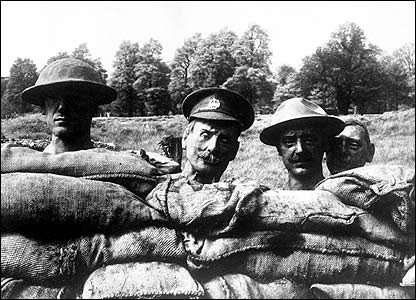
Poem ~ A Dummy Trap - Saturday, 20 March 1915


Source: File: dummy heads.jpg, 2015. Not just a German Trick, Papier-mache dummy heads were used by the French and British to trick snipers in the trenches. 20 March 1915. [online] Available at: <http://www.freerepublic.com/focus/f-news/1805449/posts/> [Accessed: 20 March 2015].

As a trooper in the Duke of Cornwall’s
Light Infantry, Private Albert Moore
Aged 39, offered himself as a volunteer.

The battalion had found themselves
Deep within the fight, about Neuve
Chapelle, late into night of 13 March.

A reconnaissance of a German trench
Was needed  - their officer stated risks
And would not order any man to go.

They were in the area of Armentieres,
As they crawled out to the barbed wire
On the German side, to see a sentry.

Trooper Moore said to the officer to stay
Still, or the sentry would raise the alarm -
Advising to lay quiet; to work way forwards.

As some minutes passed, they believed
They could take the sentry prisoner -
At eighty yards from the enemy trench,

The trooper said how he would crawl
Nearer, to stalk him from the rear -
As the Officer kept his total attention.

With a stomach crawl, Albert Moore got
To within ten yards of the very still sentry,
Slowly pulling himself up to the figure.

He signalled the officer's approach, to state
It was a dummy - to show they had no fear
The Officer said that he should push it over.

Trooper Moore put a hand to the shoulder,
A push resulted in sound like a clock's turn.
As it might explode was advice of 'head down.'

The trooper gave second shove and the figure
Exploded - both dummy and man flew up
Into the air - Moore came down in flames.

In the dummy’s body had been a substance,
Like sticky treacle, providing victim a lingering
Agony - Private Moore hit the ground in pain.

Unaware if his officer was still there, Moore
Pushed himself to a ditch of water and fell in.
In dazed awareness he jolted with a touch.

The Officer was there - as Moore said farewell
Believing that he would not live for very long -
But the Officer picked him up, to carry him.

At six yards they tumbled, Moore wracked
In pain - again the officer held him stand
And somehow walked him to an open road.

They quickly came a cross a listening patrol  -
Once in safety, Trooper Moore collapsed
Then heard officer's words, stating his bravery.

Unaware of wounds severity, had likely allowed
Moore to walk each step to safety - then blinded 
Beyond recovery, with many mutilated wounds.

Yet with his mind sound, Moore recounted
The story, on his arrival at Norwich Hospital -
To lie amid wounded, a victim of a booby trap.

by Jamie Mann.

Anon.,1915. Explosive Dummy - Victims Graphic Story. The Daily Telegraph, [online] 20 Mar. P.10. Col.4. Available at: http://www.telegraph.co.uk/news/ww1-archive/11480917/Daily-Telegraph-March-20-1915.html [Accessed: 20 March 2015].

Mann, J., 2015. 100 years Ago - Poems by Jamie Mann. [letter] (Personal communication, 20 March 2015). 


#WW1 #WW1centenary #GreatWar #WW1poem #GreatWar #WW1centenary #worldwarone #worldwaroneremembered #WW1Armentieres #WW1NeuveChapelle

Thursday, 19 March 2015

Poem ~ Prisoners of Neuve Chapelle - Friday, 19 March 1915


Source: File: Wounded from Neuve Chapelle.jpg, 2015. British,Germans and Indians The Daily Telegraph, [online] 19 Mar. P.12. Col.3-5. [online] Available at: <http://www.telegraph.co.uk/news/ww1-archive/11480912/Daily-Telegraph-March-19-1915.html > [Accessed: 1 March 2015].

Accounts came
Through, of the fight for the ruins of Neuve Chapelle.
11th March and how battered German troops were to out
To make regains.

On the following morning,
Came renewal of counter attacks about Neuve Chapelle -
Only to suffer losses, but with gains of many prisoners
Into the British hands.

Effects of exhaustion,
Led many Germans under fire to raise their hands.
At Port Arthur - south of the village Neuve Chapelle,
Lay a communication trench

From which seventy
Enemy were captured as one  - while north East, an
Enemy in British Trenches about Neuve Chapelle
Were driven out.

Germans believed weary,
The infantry stormed houses into Neuve Chapelle -
About Moulin Dupietre - to rush at them with bombs,
Catching eighty prisoners.

Then entire companies
Threw up their arms about the village Neuve Chapelle  -
Exhausted, by lack of food and in trenches full of water
Without rations on their line.

Bombardment effects
Saw German survivors crawl out in dazed conditions -
As on the 10th, in approach to lines of Neuve Chapelle -
Taken by surprise.

The village had by then
Become a ruined shambles - about all the ruined houses
Bodies were strewn, as dead occupants of Neuve Chapelle;
Became prisoners of death.

Within one night,
A patrol moved under darkness, about Neuve Chapelle,
To come across a figure before a trench - a dummy trap
To explode on contact.

Then on the 13 March,
German Counter attacks reserves behind Neuve Chapelle -
At Bois du Beiz - but guns retaliated to melt them away
From the woods.

Still more prisoners -
So by the 4th day, totaled 1,700 - during the 12th and 13th,
Pilots carried out their mission above Neuve Chapelle,
To hit railways of Douai and Don.

A quite lapse fell
By the 14 March, with enemy efforts turning to other parts
About St Eloi - leaving the village of Neuve Chapelle
Devoid of fighting.

Bombardments continued,
To turn on settlements affected away from Neuve Chapelle -
A station at Quesnoy and Aubers - where a tower hit, shot
Into the air and crumbled in dust.

An event to rankle
British troops occurred, when in a break at Neuve Chapelle,
Settled down to eat and drink rum - a hit caused evacuation.
Once regained all food was gone.

Now prisoners told,
Who had been in fight from start, that at Neuve Chapelle
A terrific attack never before witnessed - angered captured,
Stating this was total murder.

They had forgotten
Their own methods of intense concentration in field warfare,
Which the allies gave back, to cause at Neuve Chappelle
Resentment and effrontery.

Despite enemy conditions
Of exhausted troops and reports of undernourished men,
German discipline kept them clean, about Neuve Chapelle's
Filthy living conditions.

A German promise made,
Was to first finish off the Russian front within a short time  -
To turn on the British - perhaps not now at Neuve Chapelle;
Still their optimism remained.

A Spirit to match
The weary troops of the British - whose own companies
Marched back with trophies of their time in Neuve Chapelle,
With captured 'picklehauben.'

by Jamie Mann.

Anon.,1915. Battle of Neuve Chapelle - Splended Story of British Heroism - Trenches Rushed - Enemy Taken by Surprise. The Daily Telegraph, [online] 19 Mar. P.9. Col.2-3. Available at: http://www.telegraph.co.uk/news/ww1-archive/11480912/Daily-Telegraph-March-19-1915.html [Accessed: 19 March 2015].

Mann, J., 2015. 100 years Ago - Poems by Jamie Mann. [letter] (Personal communication, 19 March 2015). 


#WW1 #WW1centenary #GreatWar #WW1poem #GreatWar #ww1centenary #worldwarone #worldwaroneremembered #WW1NeuveChapelle

Monday, 16 March 2015

Poem ~ Duel in the Park - Tuesday, 16 March 1915


Telegraphist, Albert James Dunn,
With the Horse Guards Post Office,
On Saturday was at the Embankment.
With a little time to make a break,
He had a bag of food he fed
To the birds, about the water.

An incongruous sight caught his eye.
A soldier, who turned out to be
Private Patrick Kerr of 4th Battalion
Of the Royal Dublin Fusiliers - was
In chase of a man - waving a bayonet
Sword. He lost the pursuit as the man
Jumped safely onto a tramcar.

Still fiercely clutching the weapon,
Private Kerr walked to Albert Dunn,
In demand to know what he was up
To - From his manner the telegraphist
Could tell he had been drinking.
Keeping calm, Dunn proceeded
To humour the drunken soldier.

At this point, Dunn screwed
Up the empty paper bag, to throw
It into the river - agitated by this
Private Kerr in sudden excitement,
Grabbed his arm, declaring that
He was a German spy - between
Them a sudden struggle started.

Making a bayonet swipe at Dunn,
The blade cut into his uniform,
Causing a slight abdomen wound.
Pushing away the attacker, Dunn
Ran, chased by the armed man.

Police Constable 522 E strolling
On his duty, about the Embankment,
Heard shouts, to see two soldiers
Running towards him  - one chased
By another waving what looked
Like a sword - PC 522 E drew
His truncheon, then clashed
With the armed soldier - with
Truncheon against sword, to try
And knock it from his hand.

In failing this he grabbed hold
Of the man's wrist, twisting
His arm till he dropped the blade.
Kerr, excited and agitated when
His arrest was finally declared,
Said he felt his actions were
For his country, fighting a spy.

Monday 15 March, saw the event
Unfold at Bow Street Police Court,
With charge of assault raised. 
The Magistrate Graham Campbell,
Heard how Kerr had arrived in
London on Friday, from Scotland.

About that time Kerr had too
Much to drink. At the nearby station
Of Charing Cross, Kerr then got in
A conversation with a foreigner -
To soon believe a link between him
And the Soldier feeding the birds.

Seeing how the man had thrown
Something into the river, Private
Kerr wanted to stop him - but had
Not intended to cause any harm.
Called to speak was an officer
Of Private Kerr’s regiment.

The officer said he had enlisted
19 January, but had been absent
Without leave since 5th, of current
Month. In defence Kerr said he had
Been to Scotland to visit his ill wife -
Declaring anxiety to reach the front;
He wanted to get into the trenches.

The magistrate concluded how
Private Kerr, being so under
Influence of drink, did not know
What he was doing - in this matter
Private Kerr was sentenced
To six weeks hard labour.

by Jamie Mann.

Anon.,1915. Bayonet v Truncheon - Scene on the Embankment. The Daily Telegraph, [online] 16 Mar. P.4. Col.5. Available at: http://www.telegraph.co.uk/news/ww1-archive/11471524/Daily-Telegraph-March-16-1915.html [Accessed: 16 March 2015].

Mann, J., 2015. 100 years Ago - Poems by Jamie Mann. [letter] (Personal communication, 16 March 2015). 


#WW1 #WW1centenary #GreatWar #WW1poem #GreatWar #WW1centenary #worldwarone #worldwaroneremembered  #WW1London

Friday, 13 March 2015

Poem ~ Pappenheim: Would-be Saboteur - Saturday, 13 March 1915


Sketch of Captain Werner von Pappenheim by Jamie - see original image at:
http://www.van-ham.com/datenbank-archiv/datenbank/theodor-rocholl/portraet-eines-deutschen-offiziers-in-china-werner-von-pappenheim.html

German misbehavior spread
Out, into the regions of China  -
Stretching effects of Europe’s
War - adding to the global scale.
Their endeavor for sabotage,
To use route of East Central Asia,
Into Mongolia and the Northeast
Region of Manchuria.

Within the early stages of war,
In the city of North East China,
Mukden - since called Shenyang -
The German Consulate presence
Had been rumored to have incited
The hunghutze - Red Beards -
Being Chinese rebel bandits,
Who had previously plagued
A Russian presence in Manchuria.
Germans prompted Hunghutze
To raid Easter Chinese Railway.

Yet without any satisfactory
Results from this alliance, came
Captain Werner von Pappenheim
The German Military Attaché
In Pekin - he decided he would
Undertake such a simple mission
Himself - with preparations made
Pappenheim cleverly secured
Chinese Passports, for himself
And seven Germans - their
Pretences being for a hunting trip
Out into the Khingan Mountains.

Having escaped Tsingtao, which
Had seen battle, only months
Before, they were reported to be
Between Tsitsihar and Buhaidu.
This sabotage party, consisted
Of four Chinese, a Mongol, seven
Germans, five horses and twenty
Camels - in a heading towards
Manchuria - their known mission
Was to assault the Siberian
Railway, in destroying Russian
Tunnels and tracks.

Under Pappenheim's lead
The caravan was packed
With explosives, to hit lines
Between Tsitsihar ad Hailar.
Additionally Pappenheim also
Carried a small treasury -
50,000 rubles of the money
He offered a Mongol chief,
For the mercenary employ
Of 300 of their men.

Taking pursuit, the Russians
Had been alerted by two
Of their national merchants,
Abraham Berkovitz and
Grigorii Shadrin - who told
Their Russian Consul in Hailar.
Between Kalgan and railways,
Along the Tea Road the Germans
Were easily tracked by spies and
Officers of Russian Intelligence
In Irkutsk, were informed.

5th Transamur Border Cavalry
Regiment then set out to
Capture Pappenheim. Rewards
Were offered to forthcoming
Mongol princes to make capture -
But one prince, Babush-Shab,
On 20 February trapped and took
The German saboteur party.
Slaughtering the men, they
Destroyed evidence and bodies
With their own incendiary benzol.

by Jamie Mann.

Anon.,1915. Siberian Railway - Amazing German Plot. The Daily Telegraph, [online] 13 Mar. P.6. Col.4. Available at: http://www.telegraph.co.uk/news/ww1-archive/11467829/Daily-Telegraph-March-13-1915.html [Accessed: 13 March 2015].

Mann, J., 2015. 100 years Ago - Poems by Jamie Mann. [letter] (Personal communication, 13 March 2015). 

http://www.telegraph.co.uk/news/ww1-archive/11467829/Daily-Telegraph-March-13-1915.html


#WW1 #WW1centenary #GreatWar #WW1poem #GreatWar #WW1centenary #worldwarone #worldwaroneremembered #WW1China  #WW1Russia