Showing posts with label 1915_05. Show all posts

Tuesday, 7 March 2017

Poem ~ Sussex Pledge Broken - Wednesday, 7 March 1917- Thursday, 8 March 1917


Source: File: torpedoed Cross-channel ferry Sussex at Boulogne, March 1916. The entire forepart of the ship was destroyed in the attack. See an original image at: <http://study.com/academy/lesson/sussex-pledge-definition-lesson.html> [Accessed 7 March 2017]

Within hours of the Laconia's loss, survivor
Reporter Floyd Gibbons of Chicago Tribune,
Composed his account of certain night, February
25 1917 - over the next few days newspaper
Debates expressed American opinions.

Only 11 months before a diplomatic crisis 
Had threatened America's neutrality; German
UB 29 in a grave error of judgment, had attacked 
What was believed to be a Mine Sweeper - 
A daily passenger ferry left Folkestone.

The situation at sea had seen declared
War zones; German frustrations at land-war
Stalemate turned towards the sea - from 1916
Unrestricted U Boat policy of attacks were
Made against shipping, though restricted.

The Lusitania that had been torpedoed
In May 1915 had initially riled America with
The deaths of 128 Americans - in order to pacify
USA, Germany curbed U-boat attacks; armed
Merchant ships again valid targets by 1916.

March 1916 the Sussex carried civilians;
Being a cross channel ferry sighted by UB 29
Believed to be a mine layer the ferry was targeted.
The Sussex did not sink yet damage was heavy;
Amid the 80 casualties were 25 Americans.

President Woodrow Wilson's reaction
Was a threat to cut off all diplomacy with
Germany - actions were swift to Wilson's angry
April speech - on 4 May came a promise
With Germany's 'Sussex Pledge.'

The Sussex Pledge promised that no
Passenger ships would be targeted - while
Merchant ships would only be sunk; after being
Searched for weaponry passengers and crew
Would be made safe - rescinded by 1917.

Germany confidently believed that
They might win the war swiftly by an act
At sea, whereby unrestricted warfare would
Defeat allied forces, before any chance
Of the USA joining in conflict.

The Laconia attack sparked debate,
As daily American newspapers endorsed
The Governments view, to see the Laconia
Sinking as an overt act - such event
Were changing opinions in USA.

Tuesday 27 February an address
Made by President Wilson saw mixed
Reactions, about ambiguous nature of armed
Neutrality; 'peace at all costs' had then
Been the central policy of USA.

President Woodrow Wilson, along
With legal advisor Robert Lansing, met
To confer how blatantly Germany had gone
Against their word of the 'Sussex Pledge,'
Resulting in a new congress policy.

A quote from the New York Times
Called on all Americans to defend their
Liberties of the nation - a right to sail the seas
Securely and without risk - any surrender
Would show a nation lacking courage.

Debates in arming of American shipping
Were yet to be tested - to stretch the mind
How America might enter a war centered purely 
In Europe - President Wilson believed only
An invasion of the US would cause war.

Only time might tell any future 
Direction; in the meantime all American
Consular officers, along with all diplomats,
Started a process of leaving Austria,
Breaking with the central powers.

At the foot of America on Mexican 
Border, stretching from Tijuana across
To Brownsville, had been brewing a line
Of adversity - although regarding war
The country shared USA neutrality.

Mexico itself was in the throws
Of lengthy revolution - with strained
Politics openly made the hispanic country
An ideal sideline for German intent -
To entice Venustiano Carranza.

The President of Mexico held key
To deflect the USA; the Zimmerman
Telegram decoded message had revealed
German intent to restart their submarine
Warfare, to curtail 'Sussex Pledge.'

Ideal was that America remained
Neutral - if this did not happen then
Germany proposed a Mexico alliance -
The carrot being financial support
For regaining all lost territories.

Arizona, Texas and New Mexico taken
In the 1848 Mexican cession in the treaty
Of Guadalupe Hidalgo; von Eckardt was given
Free reign to gain Mexico as an ally,
By a settlement to retake territory.

Von Eckardt instructions was to distract 
President's attention; that in a few months
England would be compelled to make peace.
'Make war together make peace together,'
Was motto of an alliance with Mexico.

Although the telegram kept options
Open, von Eckardt was requested to use
His initiative; also to mediate some agreement
With Japan, who was then fighting alongside
The allied powers; signed Zimmerman.

Strains of mutual dislike lay all around;
America was anti Mexican, with element
Of anti British - with anti Germany in Mexico
Was anti America - German held hopes
For a Mexico-American war to break.

So a scene was set - with the 'Sussex
Pledge' trashed, to see by start of March
Defensive arms to be carried by American ships.
A direct result of overt act; diplomacy ties
With Germany fell - time might tell.

by Jamie Mann.

Source: File: US Department Of State: American Entry into World War I, 1917. Available at: <https://2001-2009.state.gov/r/pa/ho/time/wwi/82205.htm> [Accessed 7 March 2017]

Source: File: Wikipedia: Sussex Pledge. Available at: <https://en.wikipedia.org/wiki/Sussex_pledge> [Accessed 7 March 2017]

Source: File: The First World War, East Sussex. The Sussex Pledge. Available at: <http://www.eastsussexww1.org.uk/the-sussex-pledge/> [Accessed 7 March 2017]


#WW1 #WW1centenary #GreatWar #WW1poem #GreatWar #WW1centenary #worldwarone #worldwaroneremembered #WW1America

Friday, 12 June 2015

Poem ~ French Offence at the Dardanelles - Monday, 31 May 1915


An official report from the Dardanelles,
Covered events of 25 April to 4 May -
After talking of the British aspect,
To state French involvement in Asiatic.

With British moved to their assigned
Landings, French, Marine and Senegalese
Took to their small boats, led by torpedo
Boats and trawlers to the Meander.

Their task, to touch ground and take
A foothold - on a place was a few square
Yards below the Kum Kale fortress,
That bristled with machine and rifle guns.

Placed upon a windmill, sat a mitrailleuse 
Prepared and ready to take fire. Enemy 
Preparations were waiting, to repel
A single invader onto Ottoman ground.

Yet they did not account for determination
Of French. Below a sheath of hurtling fire,
The first boats made way to the ledge,
When a shell directly hit one of the boats.

As a leading captain leapt over to wade
Ashore, the Sengegal moved to the ledge
With the Captain taking a shot to the arm
He still moved on to scale fortress walls.

The windmill gun joined in, as the first
Shots clicked, a warship made a direct
Aim destroying the spitting windmill gun;
The Senegalese drove into the fortress

They drive enemy back into their village
As other detachments joined them -
Reforming a new line the Turks also
Gained renewed forces to join fighting.

Pushing through the day into night,
The Turks formed into four waves
Of attack - and four times breaking
Into a wall of Senegalese bayonets.

Morning light broke across hundreds
Of dead bodies, across 400 metres -
The 26th saw calmness as the enemy
Sat demoralised by night's attempts.

The Turkish line then rested back
Between Kum Kale and Yenishehr
To find themselves under fire from
Fire of battle ships and French 75's.

The effect was said to cause disarray
Amid the Turkish with them splitting
Moving back under French Shrapnel
As 500 waved white flags in surrender.

With Turkish resistance apparently broken
The French In completing their mission
Were under General Commander-in-Chief
Orders given out for re-embarkation

With Kum Kale engaged on the Asiatic
Coast British set to opposite coastline
To win a line of hills of the peninsula –
With British French Took to Cape Helles

As they came to the line a confrontation
Of Turkish counter attacks attempted
To push them back to the sea - 1 May
To 4 May regiments of Turks appeared.

Day and night mowed they charged
As other Turks came to face same
Fate - as the French kept their feet
On the peninsula with fortifications

While positions were reinforced
Preparations set to overthrow inland
Defence so the allied fleet might pass
Easily through the straits to success.

by Jamie Mann.

Anon.,1915. French Army at the Dardanelles -The Kum Kale Feint - Official description. The Daily Telegraph, [online] 31 May. p.7. Col.2. Available at: http://www.telegraph.co.uk/news/ww1-archive/11633912/Daily-Telegraph-May-31.html  [Accessed: 31 May 2015].

Mann, J., 2014. 100 years Ago - Poems by Jamie Mann. [letter] (Personal communication, 31 June 2015). 


#WW1 #WW1centenary #GreatWar #WW1poem #GreatWar #WW1centenary #worldwarone #worldwaroneremembered #WW1Dardanelles

Sunday, 31 May 2015

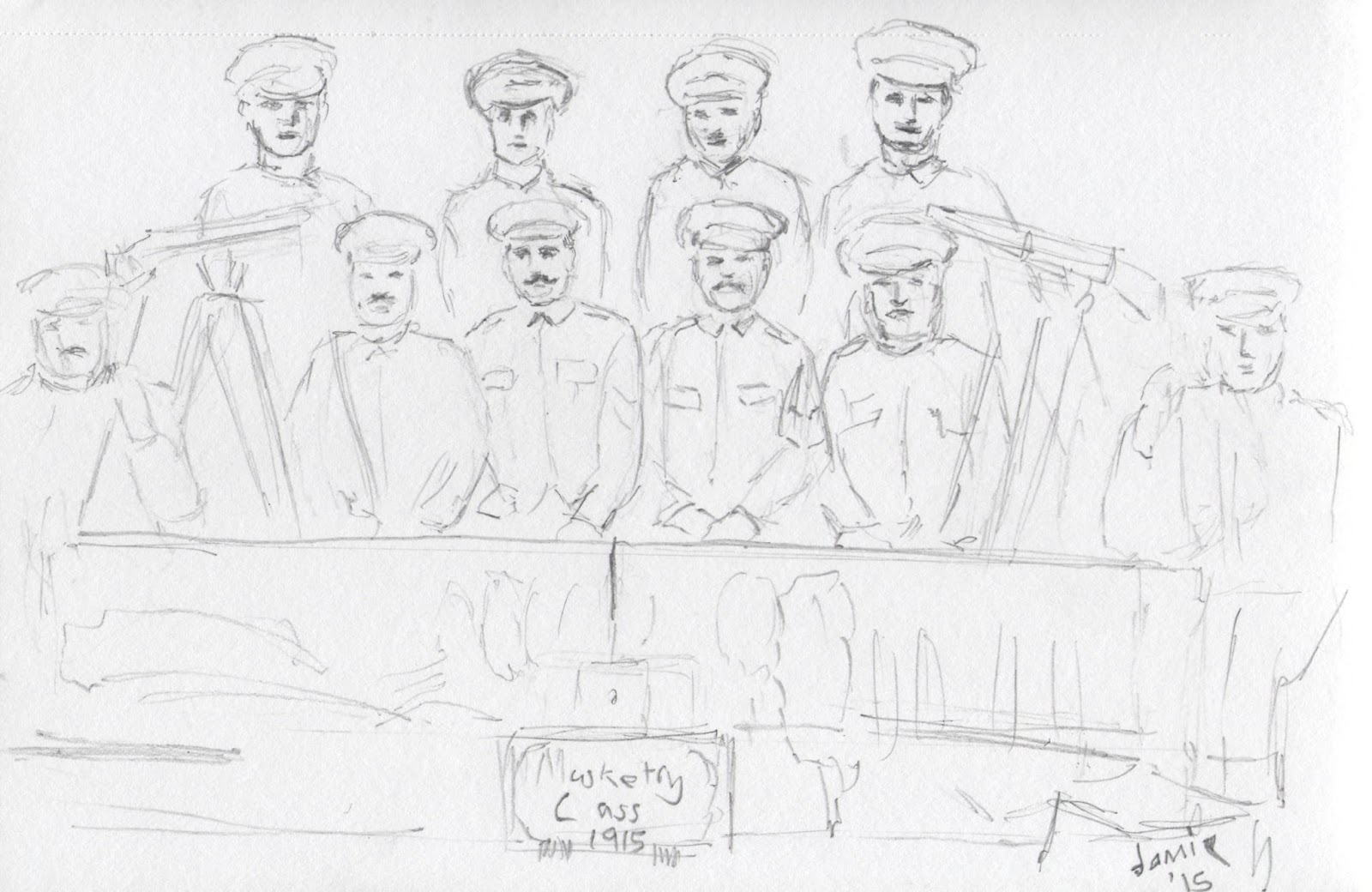
Poem ~ School for Marksmen - Monday, 31 May 1915


Impression sketch Musketry Class 1915 - by Jamie. taken from an original image which can be seen at: http://www.rifleman.org.uk/Landscape_Targetry.htm 


1915 Saturday 27 May, Pall Mall
London saw a spring meeting,
For National Rifle Association – 
In the chair Lord Cheylesmore
Spoke, how the meeting should
Discuss July’s competitions -
Yet many members were away
Using skills on frontline; now
There would be no programmes.

With domination of war, Bisley
Had only seen one musketry
Course, run with assistance from
Captain Summers and Major
Richardson, men and officers
Had gained Bisley certificates.

Raised at a previous meeting,
Lord Cheylesmore had requested
Telescopea - with an offer coming
From a lady for one on a mahogany
Stand - to be met with laughter  -
Current telescopic sights available
Were German - although approval
Had been given to a British scope
Designed by Major Lattey  - one
Of which was passed around.

Between laughter and cheers,
The meeting went on to say how
Machine Gun course was being
Attended, by over a 1000 men –
How professional and amateur
Men worked together, which could
Only benefit the war office -
The association being a best friend.

Bisley School's Chief Instructor,
Major Richardson told how well
The school worked - How 1,191
Men had been passed - 384
Instructors were now employed
In the New Army – one instructing
Musketry to 1000 men - to total
A million and quarter men.

by Jamie Mann.

Anon.,1915. National Rifle Association  - training Marksmen. The Daily Telegraph, [online] 31 May. p.3. Col.6. Available at: http://www.telegraph.co.uk/news/ww1-archive/11633912/Daily-Telegraph-May-31.html  [Accessed: 31 May  2015].

Mann, J., 2014. 100 years Ago - Poems by Jamie Mann. [letter] (Personal communication, 31 June  2015). 


#WW1 #WW1centenary #GreatWar #WW1poem #GreatWar #WW1centenary #worldwarone #worldwaroneremembered #WW1London

Monday, 25 May 2015

Poem ~ Bengal V India on French Pitch - Tuesday, 25 May 1915


Source: File: Indian cavalry playing football at the front 1915.jpg, 2015. Photos show Indian soldiers' lives behind World War I trenches. The Original can be seen at: scroll.in/article/668737/photos-show-indian-soldiers-lives-behind-world-war-i-trenches [Accessed: 25 May 2015].


A French village was to witness a rare sight,
On a piece of ground where occurred a football
Match, to be between 18th Bengal Lancers
And Indian 3rd Skinners Horse Cavalry.

In shirtsleeves an officer acted as referee,
As linemen positions were to be observed
By two Sikhs – from a distance sounds
Travelled over hills.

The front line guns rumbled on as actions
On a temporary pitch, surrounded by rows
Of Indians, gathered to watch the game;
With gun noise ignored.

A scene was set of an impressive sight
Of Indian men with their ‘noble turbans’ - all
With enjoyable humor; officers from both
Regiments became excited.

As at any match of football, were debates
Over rival teams, with individuals who may
Save the game for their side - all turbans
And puttees temporarily discarded.

Indian players proved selves adept at British
Institution, possibly outside their normality
Of experience – distinction between ranks
Was seen to blur.

Tunic and collars put aside, as the audience
Cheered and jeered their adopted teams -
Camaraderie and fitness of both cavalry
Regiments being evident in play.

While cavalry had experience of trench
War, in such a static fight, these regiments
Longed for enemy retreat, when on horse
They would take the charging lead.

by Jamie Mann.

Anon.,1915. Indian Footballers – a Battle Front Incident. The Daily Telegraph, [online] 25 May. P.6. Col.4. Available at: http://www.telegraph.co.uk/news/ww1-archive/11624538/Daily-Telegraph-May-25-1915.html [Accessed: 25 May 2015].

Mann, J., 2015. 100 years Ago - Poems by Jamie Mann. [letter] (Personal communication, 25 May 2015). 


#WW1 #WW1centenary #GreatWar #WW1poem #GreatWar #WW1centenary #worldwarone #worldwaroneremembered #WW1India