Showing posts with label German Bombing. Show all posts

Monday, 31 July 2017

Poem ~ Paris Attacks - Tuesday, 31 July 1917

Source: File: From Geographical Imaginations: Is Paris Burning? A look-out man operates a portable siren above the city. See an original image at: <https://geographicalimaginations.com/2012/10/20/is-paris-burning/> 
[Accessed 31 July 2017]

Within war comes propaganda;
Opposing sides give denial
Of what the other side says.

Arial activity over the capital
Of France, found multiple
German bombing air raids.

As a precaution army of Paris
Firemen warned the people
Of enemy crafts approaching.

Weird, unusual sounds stirred
Paris, as firemen on roofs blew
On bugles or sounded sirens.

Above air raid alarms French
Air craft took flight over city,
In a darkening, melting sky.

Ground and sky became
As one - deep darkness cut
By beams of searchlights.

German official reports told
Of railways targeted in Paris,
To hit their mark with damage.

By Saturday, French replies
Made denial - that enemy
Planes had left no destruction.

Neither material loss nor loss
Of life - wireless messages
Were received by Admiralty.

Yet Parisian military bases
And railways were hit, with
German pilots safely returned.

Sunday July 29th, a Journal
Told of a suburban air raid
To describe damages done.

One store of combustibles
had been hit - also a factory
Yard, to leave small effects.

Two more fell appropriately
Into gutters, while shell havoc
Hit beds of innocent cauliflowers.

Any resulting explosions
Lacked involved descriptions,
As another bomb hit a centre.

Noted as important, maybe
Military, one turret exploded;
Being close to civilian houses.

The blast blew out material
To injure a single sleeping lady -
More bombs harmlessly fell.

Some hit one large enclosure,
With three in a boulevard -
Another damaged flowerbeds.

Sunday 29 July saw repeat.
30 minutes after midnight
Came the sounds of bugles.

Firemen called reveille and
Again set sirens loud across
Sleepy Paris, all as a caution.

Readied French squadrons
Took action to flight; reportedly
Sending enemy backwards.

News via Petit Journal, from
Versailles said bombs exploded,
All lost in the open countryside.

by Jamie Mann.

Anon.,1917. Bombs On Paris - No Victims Or Damage. The Daily Telegraph, [online] 30 July 1917. P.4. Col.6. Available at: http://www.telegraph.co.uk/news/ww1-archive/12214740/Daily-Telegraph-July-30-1917.html [Accessed: 31 July 2017].

Mann, J., 2016. 100 years Ago - Poems by Jamie Mann. [letter] (Personal communication, 31 July 2017). 


#WW1 #WW1centenary #GreatWar #WW1poem #GreatWar #WW1centenary #worldwarone #worldwaroneremembered #WW1Paris

Monday, 3 April 2017

Poem ~ Zeppelin Hunters - Tuesday, 3 April 1917 - Wednesday, 4 April 1917

Source: File: The wreck of Zeppelin L 33 near New Hall Cottages, Essex coast. See an original image at: <https://www.flickr.com/photos/britishlibrary/12459200283/> [Accessed 3 April 2017]
Source: File: Mrs. Lewis and family in front of a zeppelin L 33 down, September 1916, New Hall Cottages, Essex coast. See an original image at: <https://www.flickr.com/photos/nationaalarchief/6934945744/> [Accessed 3 April 2017]

i
Within the rural idyll of Essex,
Came events of war to break the peace.
An enemy mission sent on a raid
Above English soil saw Zeppelins in skies
Over villages, as in Little Wigborough.

Not far from sea and estuaries,
Proved a likely route to and from London
For Zeppelins seeking escape
Across the North Sea, over English rural land
And farms as happened with L 33.

In what had become a fairly
Common event, new German zeppelins
Chanced a raid on English
Capital city in month of September 1916.
L 32 and L 33 found trouble.

L32 making its way to London
Was seen by anti aircraft gunnery, dropping
Bombs close to Purfleet - after
Turning about an interception came by RFC's
Frederick Sowrey on night patrol.

Lit by searchlights L 33 proved
Easy target for Sowrey, to fire incendiaries
Into the craft's belly; the zeppelin
Being downed at Great Burstead, fairly close
To Snails Farm by area of Billericay.

Zeppelin L 33 managed to reach
Target of London to have some success
Killing civilians - the crew led
By Kapitan Alois Bocker - but came under
Anti aircraft fire to gain damage.

Night patrols targeted the enemy
Close to Chelmsford - taking various hits
L 33 escaped to continue over
Essex, throwing out equipment ballast  
In attempt to regain height.

Yet Bocker knew any successful
Escape across sea had become impossible.
Travelling for a short distance
They made it to fly over Little Wigborough
And isolated New Hall Cottages.

ii
The airship became grounded
In the darkness - Kapitan Bocker felt duty
To inform any local people
Of crews intentions to destroy the ship; likely
Including a scared Lewis family.

They knocked on doors; fearful
Families would not answer to Germans.
Giving up, the crew set fire
To wrecked L33 and after it had exploded
The crew calmly left.

In smart fashion the Germans
Marched along lanes to make their way
Towards Peldon - police were
Aware of the Zeppelin, as a lone constable
On a bicycle appeared.

PC Nicholas surprised
To see these marching men in night's depth
Halted - by torchlight he
Quizzed if they had seen a zeppelin landing;
Bocker spoke politely.

He asked how far to Colchester.
Detecting an accent PC Nicholas advised him
Six miles - he then followed
The marching men into Peldon village, where
PC354 Smith took charge.

After their formal arrest
An organised escort of 8 special constables
Politely marched Germans
To Mersea Island. Meeting military halfway,
The crew were handed over.

While Constable Nicholas
Had single handed, routed them to Peldon -
Promotion was given over
To Constable Smith, for his cool act of arrest;
To be known as Sgt. 'Zepp' Smith.

iii
With polite, orderly nature
Of an enemy crew made captives, such downed
Crafts like Zeppelin L32
Were quick targets for eager souvenir hunters;
Even if a smouldering wreck.

Barely two hours after
L32 had been struck down, many local people
Were out to see wreckage -
Long lines of car lights from London invaded
The area, to cause chaos.

By 8 a.m. local narrow lanes
And approaches were blocked by traps, motor
Cars, pedestrian’s, motor
Cycles, carts and bicycles, along with hundreds
Of cyclists cluttering the fields.

Quite undeterred by rows
Of armed soldiers and police protecting the site,
Figures eagerly scoured
Any fields for wreckage signs; a local economy
Boosted by lemonade sellers.

The L33 was yet another
Burnt wreck of twisted aluminium, to attract
Civilian hunters of remnants.
That same month an Essex bench had seen
A postcard seller and Innkeeper.

Innkeeper Edward Straggling,
Along with postcard vendor Jack Lewis (maybe
Of New Hall Cottages), were
Both charged Under Defence of the Realm Act,
For holding wreckage fragments.

Jack Lewis had been seen
On the streets, to show various zeppelin relics,
Selling pieces for 1 shilling.
Edward Straggling parked his motorbike then
Met Lewis with a bag of items.

An officer of the law saw and
Approached; the bag held aluminium pieces
Which were zeppelin parts
The Police officer proceeded to arrest them.
Straggling took to his bike.

Although the case was to be
Dismissed the chairmen stated it was sad
How people made money
In such a way, when their lives were in danger
From enemy crafts.

Some months later such
Events continued - on 30 March 1917 saw
A man of Essex, a ploughman
Charged before a magistrate, for keeping
Stolen zeppelin items.

Aluminium frames along
With girders from the L33, which came down
Close to his cottage,
24 September 1916. He held a speedometer
Of the craft, found 4 months later.

He advised the magistrate
The large items were given to him by those who
Removed the zeppelin.
Believing he held no guilt a case was dismissed,
Yet with a final request.

In memory of September
Night when the German crew came knocking
On his house door, might
He keep the aluminium fragments? - the Bench
Agreed, decision was no.

by Jamie Mann.

Anon.,1917. Zeppelin Mementoes. The Daily Telegraph, [online] 02 April 1917. P.5. Col.6. Available at: <http://www.telegraph.co.uk/news/ww1-archive/12214426/Daily-Telegraph-April-2-1917.html> [Accessed: 03 April 2017].

Source: File: Two Zeppelins on a bombing mission brought down in Essex.. Available at: <http://www.historyhouse.co.uk/articles/zeppelins.html> [Accessed 03 April 2017]

Mann, J., 2016. 100 years Ago - Poems by Jamie Mann. [letter] (Personal communication, 03 April 2017). 


#WW1 #WW1centenary #GreatWar #WW1poem #GreatWar #WW1centenary #worldwarone #worldwaroneremembered #WW1Zeppelins

Tuesday, 27 September 2016

Poem ~ Zeppelin Attack - Wednesday, 27 September 1916 - Thursday, 28 September 1916


Source: File: 1915 Army recruitment poster. See an original image at: <https://commons.wikimedia.org/wiki/File:It_is_far_better_to_face_the_bullets.jpg> [Accessed 27 September 2016]

While the fighting on the front continued,
There was no let up on the home front -
Zeppelin raids continued on a mission
To bring confusion and damage over
English shores. In a south London
Suburb of a correspondent’s home,
Came a personal experience.

Recognising the crackling of distant
Gunfire, the correspondent went
Out onto the street - time close
About midnight. Distant, muffled
Sounds to be only sign of any
Kind of event - all of a sudden
A green flare lit the darkness.

The strange burst of light brought
The neighbouring buildings into
Flickering relief - drifting down,
Lighting the underside of an
Airship; joined by further two
Flares falling as green stars,
Observed by the reporter.

For ten minutes he stood to watch.
Following dull drones of zeppelin
Engines, in returned darkness,
Came in rapid succession a fall
Of six bombs, dropping across
The London suburb - fleeing
Raiders followed the roads.

By trail of damaged pockmarked
Civilian homes, the zeppelin
Took advantage of mapping
Above tramline routes and 
Roads over south London -
Dropping their explosives
Loads and incendiaries.

Occurring during one late Saturday
Night, this raid over London saw
One witness, a newsagent, who
As usual did not close up shop
Until the hour of midnight - ten
Minutes after locking up, this
Shop owner heard noise 
Of shells and gunfire.

Explosive sounds were a distance
Away - being unable to see any
Disturbance on the streets, he
Climbed the stairs where his
Family lived over the shop -
Only a short time later, noisy
Shells bursts came closer.

The shop owner went to look from
His window and saw mid air the
Bomb burst - the resulting force
Flung him across the bedroom
Onto the bed - unharmed, yet
Distress was made worse by
Shattered electric lights bulbs.

With a rewind of seconds the shop
Owner stood at a window - eyes
Fixed on a moving shape that
He described as bursting,
Before it hit the ground; his
Close proximity feeling
Full effects of a blast.

From sudden explosive reactions
The area around the epi-centre
Created over-pressurised air -
Faster than light air particles
Of high compression flew out
In all directions; a blast wave
Had caused initial destruction.

An old woman was walking down
The road, at the same time as
The shopkeeper felt the force
Of compressed air - all glass
Fragmented into a shards,
As he was picked up by
The blast waves impact.

As he was carried across a room
The old lady was also lifted and
Dropped down at a distance,
Unhurt - transformed energy
Became shockwaves more
Powerful to push energy
Through the old lady.

With the shopkeeper flying backwards
He absorbed the effect unaffected,
Only to be stunned, safely landing
On the bed in milliseconds. Waves
Of the shells burst then formed
A blast wind - the outward
Push causing a vacuum.

What the shopkeeper had found odd,
Was fact that none of the glass
Fell inside - what had happened
Was a vacuum in sudden refilled
With air - this suction force of
High intensity acted to pull all
Glass and debris backwards.

The concussive force resulted -
Also to lift the shopkeepers
Roof a full four inches - by
Final fragmentation the
Bomb fell into the public
Park opposite the shop,
Creating a deep crater.

By bombing London on Saturday
Night the Zeppelin fortunately
Chose a late hour, when less
People were on the streets,
Than if it had been 10 p.m. -
Still to affect those who
Were traveling home.

One lady returning from the theatre,
Having then stepped out of a taxi
Cab, felt the sudden explosive
Concussion, to throw her down -
Others were injured as she
Saw 15 people helped from
Their damaged homes.

by Jamie Mann.

Anon.,1916. Scenes In London - Bombs On A Road. The Daily Telegraph, [online] 26 September 1916. P.9. Col.5. Available at: <http://www.telegraph.co.uk/news/ww1-archive/12213293/Daily-Telegraph-September-26-1916.html> [Accessed: 27 September 2016].

Mann, J., 2016. 100 years Ago - Poems by Jamie Mann. [letter] (Personal communication, 27 September 2016). 


#WW1 #WW1centenary #GreatWar #WW1poem #GreatWar #WW1centenary #worldwarone #worldwaroneremembered #WW1London

Sunday, 7 August 2016

Poem ~ Zeppelins; The Next Generation - Monday, 7 August 1916


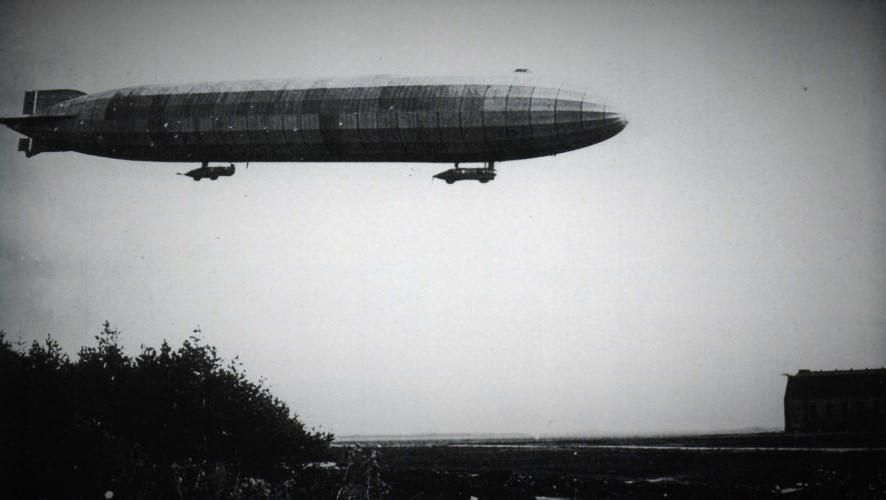
Source: File: A Giant Zeppelin. See an original image at: <https://en.wikipedia.org/wiki/List_of_Zeppelins> 
[Accessed 7 August 2016]

Equal to German sea ambitions,
Another generation of Zeppelin
Airships took to the skies - seen
As giant cruisers, that by some
Alternative time of Trans Ocean
Service, to link German to America.

Via the World New York news
From Berlin, told of machines
And pride of their inventor; these
Next developments in Zeppelin
Told of their gigantic proportion -
Able to move at great heights.

Zeppelins to number 8, set
Out on a mission to menace
The English - L.11, L.14, L.16
L.17 L.22 L.31 among these -
Giant air ships broke form to
Separate along English coast.

At Suffolk L.11 took a path
Inland over river Debden -
To drop bombs on Bawdsey.
By flares at Kirton awoke
A searchlight on the craft,
Who replied with 4 bombs.

Likely mistaking the river
Debden for the river Orwell
L.11 turning direction,
Next to appear at Felixstowe,
In game of back and forth
Over ground, under fire.

By 2 a.m. L11 made it over
Harwich Harbour, to drop
A bomb onto Landguard
Fort - damaging windows
And tents, to flee 2.35 a.m.
Fired at by Shingle St. guns.

Wind sucking power enabled
Zeppelins faster speeds, to tell
How one of these returned
From a trip over England, of
237 odd miles, within two
Hours, after a bomb delivery.

By Jamie Mann.

Anon.,1916. Gigantic Zeppelins - German Boasts. The Daily Telegraph, [online] 5 August 1916. P.9. Col.2. Available at: <http://www.telegraph.co.uk/news/ww1-archive/12212487/Daily-Telegraph-August-5-1916.html> [Accessed: 7 August 2016].

Source: File: Zeppelin Raids, Gothas And 'Giants' - Britain's First Blitz 1914-1918. Available at: <http://www.iancastlezeppelin.co.uk/89-aug-1916-1/4592178832> [Accessed 7 August 2016]

Mann, J., 2016. 100 years Ago - Poems by Jamie Mann. [letter] (Personal communication, 7 August 2016). 


#WW1 #WW1centenary #GreatWar #WW1poem #GreatWar #WW1centenary #worldwarone #worldwaroneremembered #WW1zeppelins

Thursday, 26 May 2016

Poem ~ Goading An Enemy - Friday, 26 May 1916


Source: File:  Photograph of 1/22nd Battalion London Regiment (The Queen’s), 1916. [online] See an original image at: <https://trinityremembers.wordpress.com/their-stories-3/> [Accessed: 26 May 2016]

Up to the day in August 1914,
Unrelated men had undertaken
Daily tasks in the city.

Bankers and stockbrokers
Annually, making thousands
Of pounds a year.

Others were men of Fleet Street,
Daily reporting news of empire
To outbreak of war.

One day that changed fortune
Saw such men take to route
To join a king's call.

Months of training turned these
Civilian men into eager soldiers
For a London regiment.

One innocuous day on the front,
A non-specific London regiment
Came under attack.

On this regiment's section was
A German decision to send some
50,000 shells

Over fifty minutes the bombarding
Bombs made a wreck of trenches
Wire, swept like 'chaff'.

The held line was starting to thin,
As London soldiers were wounded
And killed by blasts.

A last bomb burst and the Germans
Readied to invade a space, where
Surely no one lived.

Still in cautious stealth, they began
To walk though the cordite haze,
When they came to halt.

Ahead on the parapets, stood men
Of London with their bayonets fixed -
Goading their approach.

Not so many yards separated
Opposites - 'Come on Fritz!' went
The English shout.

Declining the invite, the Germans
Turned under a hail of thousands
Of retaliating bullets.

Back to their trenches they ran -
Survivors leaving casualties
In their wake.

Learning of his London regiment,
Their Brigadier General then sent
Warmest congratulations.

by Jamie Mann.

Anon.,1916. London Regiment's Bravery. The Daily Telegraph, [online] 19 May 1916. P.10. Col.1. Available at: <http://www.telegraph.co.uk/news/ww1-archive/12210234/Daily-Telegraph-May-23-1916.html>  [Accessed: 26 May 2016].

Mann, J., 2016. 100 years Ago - Poems by Jamie Mann. [letter] (Personal
communication, 26 May 2016). 


#WW1 #WW1centenary #GreatWar #WW1poem #GreatWar #WW1centenary #worldwarone #worldwaroneremembered #WW1WesternFront 

Monday, 18 April 2016

Poem ~ Zeppelin Raid: East Coast - Tuesday, 18 April 1916 - Thursday, 20 April 1916

Impression sketch of Zeppelin L15 Brought down in the Thames Estuary - by Jamie. From original images that can be seen at: <http://www.illustratedfirstworldwar.com/item/a-raiding-zeppelin-brought-down-in-the-thames-estuary-the-l-15-iln0-1916-0408-0004-001/#> [Accessed: 11 April 2016]

i
An ambitious plan had commenced
By end of day 31 March 1916 -
When five zeppelin crafts edged
Across the sea, towards East
Counties of England.

The five, as they neared British
Shores, divided to take various
Courses - airships detached
To form two squadrons;
Heading to targets.

Bombs from the air numbered
Ninety - among them to fall
On Ipswich - one zeppelin
Had to alter course, with
Engine problems.

Kapitanleutnant Martin Dietrich
In Zeppelin L22, in leaving
The Nordholz base, gave
His orders; 518-foot craft
Headed to Grimsby.

Their presence detected, attracted
Ground searchlights and aims
Of anti aircraft guns - despite
Shots, no real damage
Was done.

ii
L22 began to unload payload
Of 25lb bombs, intended
For the Grimsby Docks -
But ground was hit,
In open country.

Without success L22 moved
Out to sea, where a flare lit
Pier prior to a return try -
Three more bombs fell
Across Cleethorpes.

Within billets of Baptist Church
Hall, Manchester Reserves -
There for coastal defences
Of River Humber - were
To suffer a direct bomb.

Sea View Street was hit first,
As another destroyed local
Council officers - the third
On Baptist Church Hall;
27 men killed.

Four of the men playing cards
In cellar were to be rescued -
While another four died
From wounds - a total
Of 53 soldiers injured.

iii
In vague reports of newspapers,
stated attacks on east coast -
While the Times referred to
A village of no significance;
As L15 flew elsewhere.

Kapitanleutnant Joachim Brethaupt,
In Command of L15 airship, aimed
For London targets and reached 
The Thames estuary - when
Its presence was spotted.

A later dispute formed claims over
Which ground crew had made
Initial hit - from two batteries 
Of anti aircraft crews -
Tilbury and Purfleet.

Both ground-based defences took
To raking sky with gunfire - yet
L15 crew gave idea to a hit
Made by a flyer, that had
Followed them.

Second Lieutenant Alfred de Bathe,
Brandon, who was to get DSO
For his assault on the L15;
Yet the crew claimed
He had lost height.

iV
Lights searching the dark sky,
Locked onto the Zeppelin,
With shells busting all
Round her - then
To strike tail.

Items were seen thrown from the craft
To include machinery and their gun -
London's Lord Mayor's promise
Of money reward to gun crews,
Prompted their competition.

While source of gunnery remained
Mystery, the L15 was struck - the
Crews attempt to ditch weight
Was to fail, over the sea
Of Thames Estuary.

Close to The Kentish Knock lightship
The German airship struck water -
One Zeppelin crew member,
Willy Albrecht drowned -
While 15 survived.

Time was 12.15 a.m.1 April 1916,
While the time reported varied
As to events - witnesses saw
Disturbances, gather about
Stricken Zeppelin.

V
Danish steamer Svantolm's Captain
John Pell, had heard noises of air
Bound shots - later to see patrol
Boats about the wreckage
Of a huge Zeppelin.

From the boats about the craft, one
German was seem to emerge
From a cover, to crawl out
Over envelope - hands
Held up in surrender.

Other figures followed to number -
All but one taken ashore, to be
Marched without boots,
To ambulances, with  
Suggest injuries.

Kapitanleutnant Joachim Brethaupt
Seen to be dejected, insisted how
He be treated in great respect -
But soon adopted a more real
State of mind, as he lined
Up with his crew.

Those about him wore ordinary
Naval uniforms - while captain
Had a sealskin coat against
The cold - a rumour was an
Intention to destroy craft.

Vi
Any man left to blow the craft would
Be doomed - so by drawing lots
A junior officer was chosen -
But plan never happened;
Salvage was attempted.

Commander of the Steam Trawler
Olivine, Lieutenant Mackinstosh,
Said whilst sinking, the craft
Floated on a smooth sea;
At 3.30 a.m.

Seen as a burly young fair-haired
Commander, Brethaupt wore
'Pour le Marit' ribbon for his
London bombing raid from
Date, October 13 1915.

This officer also wore Iron Cross -
Whilst the second in command,
Ober Lieutenant Kuhner, had
Once lived in London - 
Where his sister lived.

Another photo of the crew was
A thickset man, a navigator
Of L15 - having once lived
In America, the German 
Spoke fluent English.

A salvage operation attempted
To pull L15 to low waters,
Continued - to recover
Salvageable parts,
And a body.

by Jamie Mann.

Anon.,1916. Zeppelin Raids - Latest German Inventions. The Daily Telegraph, [online] 10 April 1916. P.8. Col.8. Available at: <http://www.telegraph.co.uk/news/ww1-archive/12208865/Daily-Telegraph-April-15-1916.html>  [Accessed: 18 April 2016].

Source: File: ZEPPELIN RAIDS - ZEPPELIN L15 BROUGHT DOWN. Online. Available at: <http://trove.nla.gov.au/newspaper/article/91377020> [Accessed 18 April 2016]

Source: File: Zeppelin L.15. Online. Available at: <sussexhistoryforum.co.uk/index.php?topic=1825.0> [Accessed 18 April 2016]

Mann, J., 2016. 100 years Ago - Poems by Jamie Mann. [letter] (Personal communication, 12 April 2016). 


#WW1 #WW1centenary #GreatWar #WW1poem #GreatWar #WW1centenary #worldwarone #worldwaroneremembered #WW1Lincolnshire