Showing posts with label 1915_10. Show all posts

Tuesday, 18 April 2017

Poem ~ Villages Devastated - Friday, 20 April 1917

Source: File: The destruction of the church in Moÿ-de-l'Aisne, February 1917. Available at: <http://02610.moy.free.fr/Moydelaisne/02610.moy/Infos/Municipalite/Moyquand/N23/Lanciers.html> 
[Accessed 18 April 2017]

With the western front in France,
Reaching its 35th week in 3rd
Year of war, devastation of lives
Of the population had no conclusion.

Between the invasion of Germany
Taking over ground of Aisne
And reunification of that area,
Came reports of great annihilation.

Making a visitation of the retaken
Region, Chairman of the Aisne
Refugee Committee D.Camp,
Learned of systematic destruction.

Eleven French towns and villages
Were wiped off the map -
The occupiers had used
Variations of means in process.

Battering rams had been built
To destroy ancient town
Walls; dynamite, petrol tar
All employed to take down houses.

Exteriors of churches still stood
But all contents taken,
Graveyards lay broken -
Opened vaults emptied to bury own.

Some 25 miles from Laon town,
Lay Ugny le Gay - little
More than a hamlet
Of 234 people, lay in persecution.

Germans made tax of exactions.
First demanded monies
February 1915; £140.00 -
The same demand again in August.

September 1915 saw how the Mayor
Of Ugny le Gay and others
Were imprisoned, until
Payment of £500.00 were handed over.

October 1915, £200 fee equivalent
In francs was demanded -
12 months later, October
1916, another extortion sum of £1500.

When finally the Germans were forced
From the area, the people
Found their possessions
Had been seized, pillaged and abused.

Young girls of the village were taken
Away - villagers disinterred as
Germans set homes on fire
Destroying machinery and fruit trees.

Any French people who returned to their
Villages, would have struggled
To see where their homes had
Once stood; to see crushed stone piles.

by Jamie Mann.

Anon.,1917. Devastated France. The Daily Telegraph, [online] 9 April March 1917. P.6. Col.5. Available at: <http://www.telegraph.co.uk/news/ww1-archive/12214440/Daily-Telegraph-April-9-1917.html> [Accessed: 20 April 2017].

Mann, J., 2016. 100 years Ago - Poems by Jamie Mann. [letter] (Personal communication, 20 April 2017). 


#WW1 #WW1centenary #GreatWar #WW1poem #GreatWar #WW1centenary #worldwarone #worldwaroneremembered #WW1France

Tuesday, 1 December 2015

Poem ~ Nurses Escape Salonika - Wednesday, 1 December 1915


Source: File: Hospital work in Serbia. jpeg, [online] Available at: <http://www.inverclydeww1.org/topics/women-at-war> Accessed: 1 December 2015].

To provide assistance to Serbian forces
Against Bulgarian forces, two brigades
Of Franco-British troops landed Salonica,
In October 1915 - prompted by prime
Minister of Greece - only to arrive too late.

From out of the situation, two nurses
Of the Red Cross told their tales -
Salonica 30 November, to arrive there
With nothing but clothes they wore -
All kit left abandoned on Prizrend road.

The English nurse, sister Miss Lewis
Along with miss Annandale - South
African Matron - were in a Red Cross
Unit, attached to Second Serbian army -
That had defended Serbian town Pirot.

Despite the town likely to fall to forces
Of Bulgaria, the nurses wanted to stay
With the wounded, but a commander
Insisted they leave with the retreating
Army - to abandon all injured soldiers.

They left with the retreat, the day prior
To Pirot's fall to all Bulgarian forces -
Annandale and Lewis told of bravery
Of Serbs - where wounded conveyed
In bullock carts made no complaints.

The matron could not forget the harsh
Manner of retreat, with six members
Of the Red Cross unit - in their running
Short of food had at one point, a single
Small black loaf shared between them.

To reach Libra - where Naval detachment
Of the British, shared out their rations.
Behind them they had left all equipment;
Tents worth £1000 and instruments
Of £300 - along with all the transport cars.

On that road of retreat, the Red Cross
Unit saw and passed the littered dead
And wounded - without a possibility to
Help them - such experiences decided
Their assistance to help in the Balkans.

by Jamie Mann.

Anon.,1915. The Retreat from Invaded Serbia - Heroic Serb Wounded. The Daily Telegraph, [online] 1 December. P.9. Col.2. Available at: http://www.telegraph.co.uk/news/ww1-archive/12019592/Daily-Telegraph-December-1-1915.html [Accessed: 1 December 2015].

Mann, J., 2015. 100 years Ago - Poems by Jamie Mann. [letter] (Personal communication, 1 December 2015). 


#WW1 #WW1centenary #GreatWar #WW1poem #GreatWar #WW1centenary #worldwarone #worldwaroneremembered #WW1Serbia

Saturday, 31 October 2015

Poem ~ Mongrel Hero - Sunday, 31 October 1915


Impression sketch of Zouave's mongrel dog  - by Jamie

Situated in the Ile e France and the eastern
Suburbs of Paris, lay Nogent Sur Marne,
Close to the commune Maison Blanche -
A quiet name for an asylum house.

With peace gone by 1914, all these
Inmates were relocated to Brittainy -
For Maison Blanche to take a new role
In the recovery of disabled French soldiers.

The number of 750 men became residents,
Whose recovery involved expeditions,
In friends motor cars to Paris centre -
Only 10 kilometres away - lost limbs,

Did not stop their cheerfulness.
As they could be seen in the Paris
Streets as something ‘pathetic’ - yet
They prove their resilient to conditions.

Within Maison Blanche, those soldiers
That were, worked in a workshop
And learned to adapt in trades.
A man who had lost both legs,

Along with his right and left
Hands, except the thumb, learned
To hold a brush between the stump
And thumb in order to paint pottery.

By this method he began to earn a
A small income - while another
Man, having been a sculptor
Stonemason, used plaster,

In making models with his left
Hand he worked with comrades
To number four - all with both arms
To produce work in making 10f a day.

Another resident of the Maison Blanche
Was a mongrel dog, who lived there
With his disabled master, a Zouave
Who had been in light infantry.

Coming from Algeria, at wars
Start, he insisted on taking his
Dog with him to the French front -
Both lived together in the trenches.

The Zouave, in rank of sergeant, one
Night went on a reconnaissance
Mission, with six other men -
Close to a heavy explosion,

The seven men became buried
Beneath a mass of earth - by some
Sense in missing his master, the dog
Left the trenches to seek this Zouave.

In realisation his master was in danger,
The mongrel found the place where
Where they were buried and began
To dig - until he found his master.

Seeing the shrapnel wound on
His leg, the dog instinctively began
To lick this – which the surgeons later
Said had prevented onset of gangrene.

Popular with all the soldiers, this dog
Proved a good poacher, in catching
Hares – close by, some stretcher
Bearers heard his dog barking,

With howling yelps – to believe
That he had caught another hare.
So that these men went out to find
The dog guarding the Zouave and men.

The party brought back all wounded
Soldiers to safety - The injured
Zouave taken to a hospital
To have a leg amputated.

Distraught for the company
Of his companion, the Zouave
Insisted his dog was brought to
Him, or that he would let himself die.

With the operation done the dog
Slept on his bed, then together
They lived at Maison Blanche
The Zouave with one leg.

Described as a curious looking
Animal, the Zouave told that there
Was in him a breed of a pointer, along
A fox terrier and another mystery strain.

The mongrel dog of Maison Blanche, wore
A silver collar and medal, presented by
The Blue Cross - with intelligent eyes
He was a heroic mongrel amid men.


by Jamie Mann.

Anon.,1915. The Zouave's Dog. The Daily Telegraph, [online] 29 October. P.11. Col.4. Available at:  http://www.telegraph.co.uk/news/ww1-archive/11955418/Daily-Telegraph-October-29-1915.html  [Accessed: 31 October 2015].

Mann, J., 2015. 100 years Ago - Poems by Jamie Mann. [letter] (Personal communication, 31 October 2015). 


#WW1 #WW1centenary #GreatWar #WW1poem #GreatWar #WW1centenary #worldwarone #worldwaroneremembered #WW1Paris

Friday, 30 October 2015

Poem ~ Stealing From The Dead - Satuday, 30 October 1915


Source: File: British Military Kit.jpeg [online] see original image at: <http://www.telegraph.co.uk/history/world-war-one/11006139/Inventories-of-war-soldiers-kit-from-1066-to-2014.html> [30 October 2015].


Crime in war time never once ceased,
As new opportunities to steal goods
Of military kind - as that had occurred
With luggage and kit looting in transit
To England - belonging to officers killed.

Belongings to those who died on duty,
Left France for relatives at home - a sad
Regular journey that was intercepted
By those in trust, that were employed 
By the Great Western Railway service.

In hearing at Marylebone Police court
Stood Richard Quartley a Railway carman,
Aged 32 of Shirland Road, Paddington -
A vanguard, Albert William Allen from
Southam Street Westbourne Park age 17.

They were in league with a licensed
Victualler, Albert Fountain from Bury
St Edmunds’ Market Tavern aged 36.
On arrest admittance came from Allen
That with Quartley they opened kit bags.

The luggage numbered about 20 - they
Took property that had a total value
Of £200 - all items except one, belonged
To officers killed in action - the police
Seized the property held by the three.

Charges were made of theft of field
Glasses, a revolver and items, these
Included; blankets, shoes boots, badges,
Underclothing waterproof coats, rugs,
Leggings, watches, cigarette cases.

Additionally were found binoculars
Cameras, mufflers electric torches,
Razors, prismatic compasses scarves
Clinometers, jewellery, and medals
All taken in disregard and disrespect.

While some articles contained officers
Names, others had names erased - amid
Those affected Mrs Mary Drury from
Knightsbridge - identified  articles found
At the homes of Fountain and Allen.

2nd Lieutenant D'Albany Drew Drury
Was a prisoner of war in Germany his
Mother recognised some stolen items,
In receiving some of his kit from war
Office; a 15-guinea camera was missing.

John Tippet, medical student, confirmed
A rain-proof field coat, with his brothers
Name; Lt. Tippet, 5th Kings Shropshire Light
Infantry, killed 19 August at Armentieres;
A room of such property awaited identity.

by Jamie Mann.

Anon.,1915. Dead Officers Kits - Systematic Loot in Transit. The Daily Telegraph, [online] 29 October. P.14. Col.2. Available at:  http://www.telegraph.co.uk/news/ww1-archive/11955418/Daily-Telegraph-October-29-1915.html  [Accessed: 30 October 2015].

Mann, J., 2015. 100 years Ago - Poems by Jamie Mann. [letter] (Personal communication, 30 October 2015). 


#WW1 #WW1centenary #GreatWar #WW1poem #GreatWar #WW1centenary #worldwarone #worldwaroneremembered #WW1London

Thursday, 29 October 2015

Poem ~ Rebel Recruiters - Friday, 29 October 1915


Impression sketch of Doctor Thomas Addis. jpeg. See original image at: http://blogleodraco.blogspot.co.uk/2011/04/continuacao-de-biografias-de-autores-2.html


From two American cities, reactions

Converged over clash of recruitment; 
San Francisco, Thursday 28 October

Happened arrests of two Englishmen.

Dr Thomas Addis and Ralph Blair,
Under conviction of conspiracies -
For their plot to hire resident men
In the US for British military service.

Three other British men; Harry Lane,
Lieutenant Croft and Clive Lawrence -
Came under similar charges but were
Found not guilty of any such crime.

Thursday 28 October 1915, Washington
Saw reactions of British Ambassador
As surprised, as these Englishmen set
Out to recruit Englishmen in America.

Their actions were held in violation
Of an obsolete statute; a government
Admittance came in contradictions -
If such laws existed in other nations

To suggest USA at war, such a statute
Would work against American people -
An appeal would be sought to gain
Diplomatic governmental solutions.


by Jamie Mann.


Anon.,1915. Recruiting in America - Englishmen convicted. The Daily Telegraph, [online] 29 October. P.8. Col.6. Available at: http://www.telegraph.co.uk/news/ww1-archive/11955418/Daily-Telegraph-October-29-1915.html [Accessed: 29 October 2015].

Mann, J., 2015. 100 years Ago - Poems by Jamie Mann. [letter] (Personal communication, 29 October 2015). 


#WW1 #WW1centenary #GreatWar #WW1poem #GreatWar #WW1centenary #worldwarone #worldwaroneremembered #WW1America

Tuesday, 27 October 2015

Poem ~ German Plans In USA - Wednesday, 27 October 1915


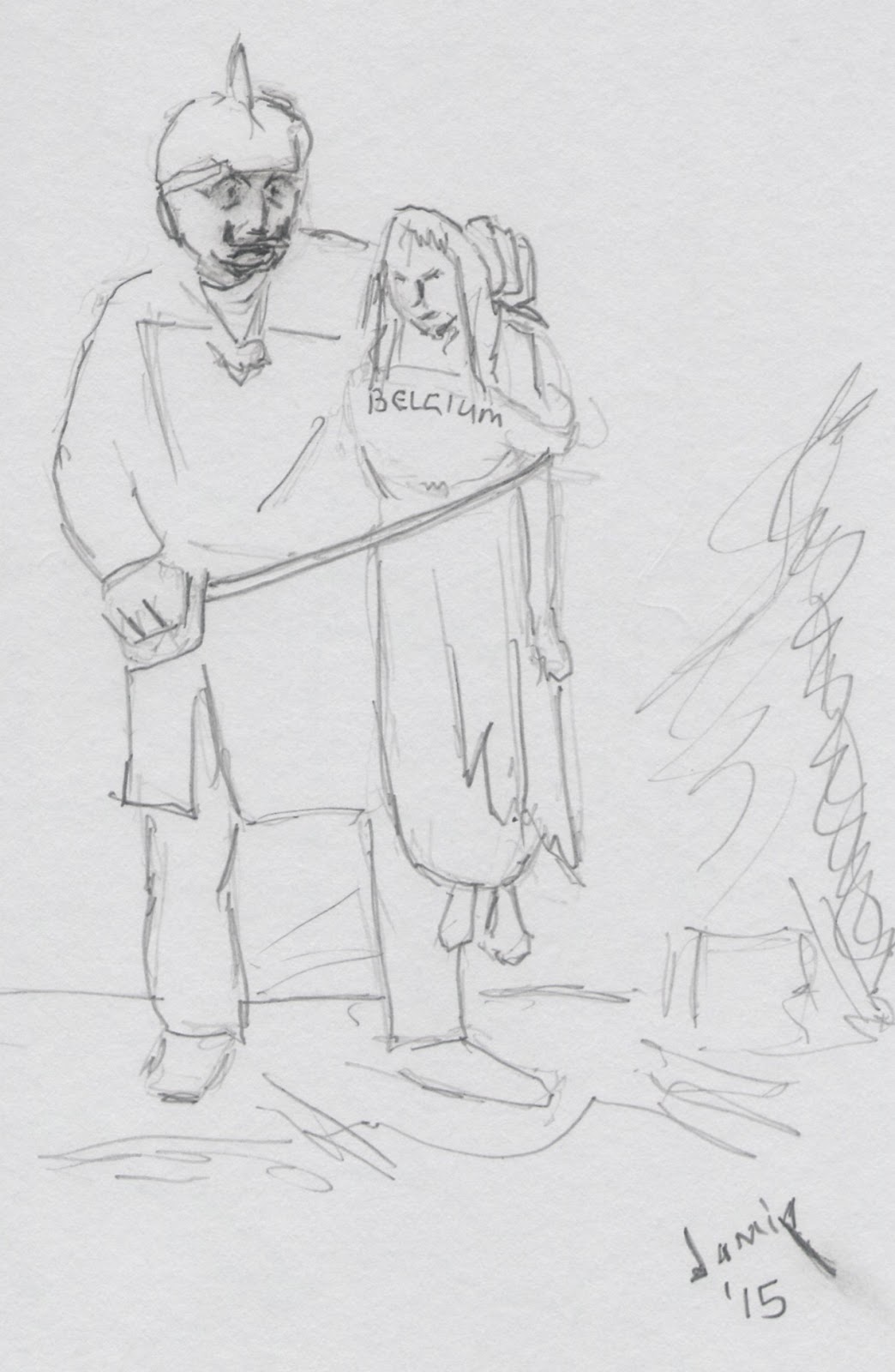
Impression sketch of The Kaiser Commits Atrocities in Belgium, New York World, 1914, 1915 - by Jamie. Taken from original at: http://www.authentichistory.com/1914-1920/2-homefront/4-hysteria/


A reminder to all neutral nations,

Was Kaiser Wilhelm’s ambitious

Plans - in forms of underground
German operations, by gold reserves
Used to advance German causes.

Amid the largest neutral countries,
United States of America became
Aware of German plots, by arrests
In the US; Weehawken, New Jersey -

Agents of Germany held in custody -
In another threat to national security
A movement had been attempted
To displace the American munitions
Industries, but the plot was defeated;

Blocking orders were put in place -
Coming from across the Atlantic
A formal protest came from Austria-
Hungary, against munitions supplies,
Made and delivered to their enemies.

President Wilson's office replied,
How American trade was under
Process of what their traders had
Always said; this was their right.

Facts further released, showed
Another plot from months before -
Agents of German services worked
Underground - supplied with money
To buy persons into their scheme.

One agent's confession informed
How they developed over three
Months to perfect their clockwork
Mine - to attach to stern of vessels,
That took supplies to the allies.

The mechanism would ensure
An explosion, when the boat had
Been at sea for over a day - they
Were almost there, when arrested.

With information released, one
Agent, it was learned, had been
A German officer - who had won
The iron cross on the Marne -
In possession of a substance.

Chlorate of Potash, with weight
Of 480lb - an ingredient of what
Were called 'Sugar bombs.'
He further confessed of secret
Service to help him enter the USA.

This ‘officer and gentleman’ stated
How he had therefore acted alone -
To avoid Count Bernstorff and staff
From any involvement in the plan.

The Federal Secret Service worked,
In showing their skills, in untangling
The German infiltrations and schemes.
Assisted by the likes of those turned
Informer;  a German soldier, Seile.

Complications lay within the USA,
By very fact of millions of Germans,
Along with Austro-Hungarians,
Who resided in that country, to excise
Their influences in the localities.

The likelihood being, of Germany's
Hopes to lay on this fact - but further
Immigration in all probability, worked
To retain patriotic American ideals.

The spies presence displayed evidence
Of world wide intent of military claws;
as in a Mexico plot - friends of Prussia’s
Prince Henry friend, had made intentions
To damage President Wilson's office.

by Jamie Mann.


Anon.,1915. New German Plots. The Daily Telegraph, [online] 27 October. P.8. Col.5. Available at: http://www.telegraph.co.uk/news/ww1-archive/11946108/Daily-Telegraph-October-27-1915.html [Accessed: 27 October 2015].


Mann, J., 2015. 100 years Ago - Poems by Jamie Mann. [letter] (Personal communication, 27 October 2015). 


#WW1 #WW1centenary #GreatWar #WW1poem #GreatWar #WW1centenary #worldwarone #worldwaroneremembered #WW1America