Showing posts with label England. Show all posts

Thursday, 11 August 2016

Poem ~ France and England, Tunnel Link - Friday, 11 August 1916 - Sunday, 13 August 1916

Source: File: Albert Mathieu-Favier put forward the first ever design for a cross-Channel fixed link. See an original image at: <http://www.eurotunnelgroup.com/uk/the-channel-tunnel/history/> [Accessed 11 August 2016]

Source: File: French mining engineer, Aimé Thomé de Gamond, spent 30 years working on seven different designs. See an original image at: <https://commons.wikimedia.org/wiki/File:Channel_Tunnel_1856_idea_from_Gamond_1a.png> [Accessed 11 August 2016]

An interest had been proposed
Before and shelved - revived
And again put aside - then a new
Call came for construction
Of a tunnel that could closely link
England to her ally of France.

114 years previously a proposal
Made by Albert Mathieu-Favier
A French Engineer, for a tunnel.
Oil lamps would light the path
For horse drawn stagecoaches,
To mid point of an artificial island.

An Island where horses changed
Yet political anxiety and friction
Over security prevented such an
Idea - yet within 12 months Henry
Mottray suggested submerging
An iron tunnel into the channel.

Nothing happened until the 1830s -
Over the next 3 decades another
French engineer, Aimé Thomé
De Gamond, developed thoughts
Of steam trains travelling under 
The channel waters, by 7 designs.

Aimé Thomé de Gamond's ideas
Were approved by Napoleon
III and Queen Victoria - perhaps
By the early twentieth century
The dreams of submerged, easy
Travel to France to be a possibility.

Then in 1880 on both sides
Of the channel were attempts
Of a boring machine - starting
To dig down, underground
At Shakespeare Cliff towards
The sea to reach 6,211 feet.

From French Sangette 5,476
Feet were reached, but by 1882
The project shelved, regarding
Defence of British Isles - only
To rise again by 1916 - into wars
Third year plans where revived.

Despite all previous security
Issues, Council of Department
For the Sine by a vote, sought
To revive a channel tunnel -
Work to build a link, would
Start as soon as possible.

United by their war against
Germany - a post-war link
Would somehow increase
Strength against enemy’s
Economic plans, currently
Being devised, if defeated.

More immediately digging
A link tunnel, as historically
Proposed, would allow by
Their military union, safety
In transport of materials and
Troops from channel attacks.

By Jamie Mann.

Anon.,1916. Channel Tunnel. The Daily Telegraph, [online] 8 August 1916. P.8. Col.3. Available at: <http://www.telegraph.co.uk/news/ww1-archive/12212489/Daily-Telegraph-August-8-1916.html> [Accessed: 11 August 2016].

Source: File: Groupe Eurotunnel History - Early Projects. Available at: <http://www.eurotunnelgroup.com/uk/the-channel-tunnel/history/> [Accessed 11 August 2016]

Source: File: Channel Tunnel From Wikipedia, the free encyclopedia. Available at: <https://en.wikipedia.org/wiki/Channel_Tunnel> [Accessed 11 August 2016]

Mann, J., 2016. 100 years Ago - Poems by Jamie Mann. [letter] (Personal communication, 11 August 2016). 


#WW1 #WW1centenary #GreatWar #WW1poem #GreatWar #WW1centenary #worldwarone #worldwaroneremembered #WW1France

Sunday, 7 August 2016

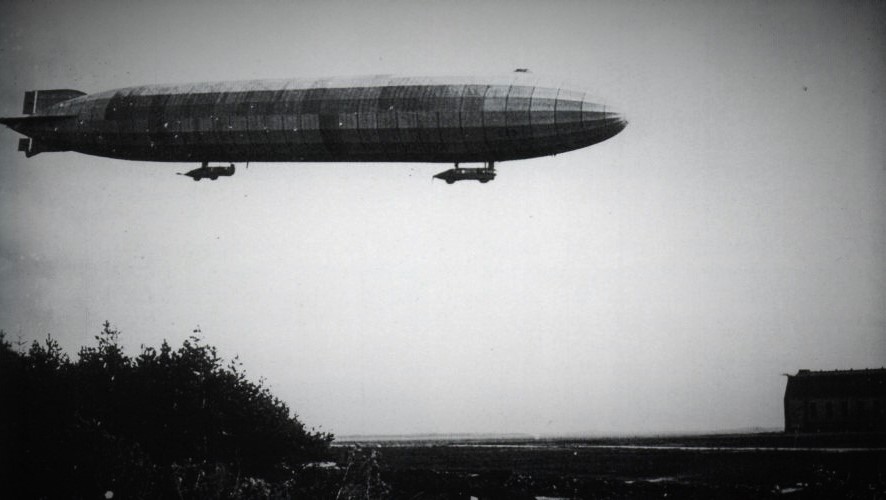
Poem ~ Zeppelins; The Next Generation - Monday, 7 August 1916


Source: File: A Giant Zeppelin. See an original image at: <https://en.wikipedia.org/wiki/List_of_Zeppelins> 
[Accessed 7 August 2016]

Equal to German sea ambitions,
Another generation of Zeppelin
Airships took to the skies - seen
As giant cruisers, that by some
Alternative time of Trans Ocean
Service, to link German to America.

Via the World New York news
From Berlin, told of machines
And pride of their inventor; these
Next developments in Zeppelin
Told of their gigantic proportion -
Able to move at great heights.

Zeppelins to number 8, set
Out on a mission to menace
The English - L.11, L.14, L.16
L.17 L.22 L.31 among these -
Giant air ships broke form to
Separate along English coast.

At Suffolk L.11 took a path
Inland over river Debden -
To drop bombs on Bawdsey.
By flares at Kirton awoke
A searchlight on the craft,
Who replied with 4 bombs.

Likely mistaking the river
Debden for the river Orwell
L.11 turning direction,
Next to appear at Felixstowe,
In game of back and forth
Over ground, under fire.

By 2 a.m. L11 made it over
Harwich Harbour, to drop
A bomb onto Landguard
Fort - damaging windows
And tents, to flee 2.35 a.m.
Fired at by Shingle St. guns.

Wind sucking power enabled
Zeppelins faster speeds, to tell
How one of these returned
From a trip over England, of
237 odd miles, within two
Hours, after a bomb delivery.

By Jamie Mann.

Anon.,1916. Gigantic Zeppelins - German Boasts. The Daily Telegraph, [online] 5 August 1916. P.9. Col.2. Available at: <http://www.telegraph.co.uk/news/ww1-archive/12212487/Daily-Telegraph-August-5-1916.html> [Accessed: 7 August 2016].

Source: File: Zeppelin Raids, Gothas And 'Giants' - Britain's First Blitz 1914-1918. Available at: <http://www.iancastlezeppelin.co.uk/89-aug-1916-1/4592178832> [Accessed 7 August 2016]

Mann, J., 2016. 100 years Ago - Poems by Jamie Mann. [letter] (Personal communication, 7 August 2016). 


#WW1 #WW1centenary #GreatWar #WW1poem #GreatWar #WW1centenary #worldwarone #worldwaroneremembered #WW1zeppelins

Friday, 30 October 2015

Poem ~ Stealing From The Dead - Satuday, 30 October 1915


Source: File: British Military Kit.jpeg [online] see original image at: <http://www.telegraph.co.uk/history/world-war-one/11006139/Inventories-of-war-soldiers-kit-from-1066-to-2014.html> [30 October 2015].


Crime in war time never once ceased,
As new opportunities to steal goods
Of military kind - as that had occurred
With luggage and kit looting in transit
To England - belonging to officers killed.

Belongings to those who died on duty,
Left France for relatives at home - a sad
Regular journey that was intercepted
By those in trust, that were employed 
By the Great Western Railway service.

In hearing at Marylebone Police court
Stood Richard Quartley a Railway carman,
Aged 32 of Shirland Road, Paddington -
A vanguard, Albert William Allen from
Southam Street Westbourne Park age 17.

They were in league with a licensed
Victualler, Albert Fountain from Bury
St Edmunds’ Market Tavern aged 36.
On arrest admittance came from Allen
That with Quartley they opened kit bags.

The luggage numbered about 20 - they
Took property that had a total value
Of £200 - all items except one, belonged
To officers killed in action - the police
Seized the property held by the three.

Charges were made of theft of field
Glasses, a revolver and items, these
Included; blankets, shoes boots, badges,
Underclothing waterproof coats, rugs,
Leggings, watches, cigarette cases.

Additionally were found binoculars
Cameras, mufflers electric torches,
Razors, prismatic compasses scarves
Clinometers, jewellery, and medals
All taken in disregard and disrespect.

While some articles contained officers
Names, others had names erased - amid
Those affected Mrs Mary Drury from
Knightsbridge - identified  articles found
At the homes of Fountain and Allen.

2nd Lieutenant D'Albany Drew Drury
Was a prisoner of war in Germany his
Mother recognised some stolen items,
In receiving some of his kit from war
Office; a 15-guinea camera was missing.

John Tippet, medical student, confirmed
A rain-proof field coat, with his brothers
Name; Lt. Tippet, 5th Kings Shropshire Light
Infantry, killed 19 August at Armentieres;
A room of such property awaited identity.

by Jamie Mann.

Anon.,1915. Dead Officers Kits - Systematic Loot in Transit. The Daily Telegraph, [online] 29 October. P.14. Col.2. Available at:  http://www.telegraph.co.uk/news/ww1-archive/11955418/Daily-Telegraph-October-29-1915.html  [Accessed: 30 October 2015].

Mann, J., 2015. 100 years Ago - Poems by Jamie Mann. [letter] (Personal communication, 30 October 2015). 


#WW1 #WW1centenary #GreatWar #WW1poem #GreatWar #WW1centenary #worldwarone #worldwaroneremembered #WW1London

Friday, 22 May 2015

Poem ~ Drowning of a Lady and Soldier - Saturday, 22 May 1915


 Impression sketch of skiff dangerously close to weir - by Jamie.

On the Friday evening of 21 May,
Seemed an ideal opportunity,
For a boating trip at Sunbury.

In the evening Private Totley,
And Private Wilkinson, both
Of the Honourable Artillery
Company, invited two lady’s.

Taking out a skiff onto the water,
The two soldiers helped them
Into the boat and pushed out;
Heavy recent rains made effect.

The levels having risen, caused
An increase in the current
And the boats became beyond
Control, so they plunged the weir.

The tragedy found them thrown
Into water - led to saving of Private
Wilkinson and a lady, but Totley
And his lady friend were drowned.

by Jamie Mann.

Anon.,1915. Soldier and Lady Drowned. The Daily Telegraph, [online] 22 May. P.9. Col.7. Available at: http://www.telegraph.co.uk/news/ww1-archive/11621705/Daily-Telegraph-May-22-1915.html [Accessed: 22 May 2015].

Mann, J., 2015. 100 years Ago - Poems by Jamie Mann. [letter] (Personal communication, 22 May 2015). 

http://www.telegraph.co.uk/news/ww1-archive/11621705/Daily-Telegraph-May-22-1915.html


#WW1 #WW1centenary #GreatWar #WW1poem #GreatWar #WW1centenary #worldwarone #worldwaroneremembered #WW1HomeFront

Saturday, 31 January 2015

Poem ~ Battle of Dogger Bank - Sunday 31 January 1915


Source: File: German battlecruisers.jpg, 2015. (L - R) Derfflinger, Moltke and Seydlitz en route to Dogger Bank.. [online] Available at: <http://en.wikipedia.org/wiki/Battle_of_Dogger_Bank_%281915%29> [Accessed: 31 January 2015].

Source: File: Petty Officer Stoker ­Edward ­Attwood.jpg, 2015. Petty Officer Stoker ­Edward ­Attwood was one of the first men killed at the Battle of Dogger Bank in the North Sea on 24 January 1915. [online] Available at: <http://www.theguardian.com/lifeandstyle/2012/jul/07/readers-favourite-photographs-songs-recipes> [Accessed: 31 January 2015].

From glaciated debris, a moraine had formed,
In the Pleistocene ages  - with time, a period
Of glaciations and the melting of ice, carried
Transported rocks and silt sized glacial flour -
Within the undulations of time, to make a low
Landmass above the sea, to form an open land bank. 

That spreading space between a smaller and
Larger land mass, where early people roamed,
Until the ice age ended - with greatest of floods -
To spill across the moraine, makes an island,
To be named by mankind as England - as that
Sunken landmass of Doggerland, became Dogger Bank.

Moving rapidly through time, over one thousand
Nine hundred and fifteen years ahead - formed
By the Western Calendar  - opened up another
Human war of civilized lands - Then in advanced
Stages of machine led conflict - as their craft
Took to the sea, to trespass the waters of Dogger Bank.

With the submarine strategy of German navy,
Having been suppressed  - a further tactic
To hit the British Isles, came by an attack
Onto three coastal towns, on 16 December,
Under an attack of shells left civilians dead.
The Germans having taken their path by Dogger Bank.

With many navel battles having taken place,
And acts by German craft, setting on the Island
Of the British, brought attacks of coastal areas -
Forced the need of naval reconnaissance
Off the East coast of England - keeping watch,
For further enemy approach of North Sea's Dogger Bank.

Admiral Eckermann, promoted to Vice Admiral,
Being chief of staff to German High Seas Fleet,
Desired an operation to take on the British Fleet.
Yet the man in command, Admiral Ingenohi -
Disagreed, with the SMS Von der Tann out
Of action for dry-dock maintenance - their fastest
A well-armed turbined warship. On Eckermann's
Continued Insistence, Admiral Hipper was sent to Dogger Bank.

A capture of a codebook, gained by Russian forces,
Led to shared information with their British allies.
The book's contents opened up an ability to decode
Enemy radio traffic, to learn how Admiral Hipper
Had begun the process for a new coastal raid.
Five battle crafts, light cruisers with destroyers
Moved south ready for Hipper and his ships.
The British fleet waited above the submerged Dogger Bank.

A German fleet Led by Seydlitz, and followed
By Derfflinger, Moltke and Blücher - along with
Light cruisers Rostock, Kolberg - while Stralsund
And Graudenz led the forward screen, nineteen
Torpedo boats, formed half-flotilla, to each light
Cruiser - a fierce German formation moved to Dogger Bank.

Back in Room 40 enemy wireless messages
Were intercepted - the precise detailed plans
Of Hipper could not be made, but an operation
Was heading for the East Coast and North Sea.
English fleet acted quickly with a rendezvous
of Commodore Tyrwhitt's Harwich Force, came
Moore's 2nd Battlecruiser Squadron, second
Light Cruiser Squadron of Goodenough - and
Beatty's 1st Battlecruiser Squadron - to meet
8 a.m. 24 January - 30 miles north of the Dogger Bank.

By 8:15 a.m. the enemy Kolberg spotted Aurora
Of Harwich Force - who sent out their searchlight.
A reply of two hits began retaliation - while Hipper
Turned his cruisers into the fire - Northwest saw
A signal of smoke of British warships - Blücher
At the rear, fired on a light cruiser and destroyers,
Coming from the stern - to start the battle of Dogger Bank.

Hipper's battle cruisers were in poor position
To move south to retreat - limited by their speed.
The British steaming ability, soon made gains -
As Blücher found herself under fire from Lion, then
Tiger and Princess Royal made hits - by 10:09 a.m.
German fire turned on Lion, to be hit on waterline,
With another on its forward turret, to stop its gun.
Now sea war raged in waters, that lay above Dogger Bank.

The New Zealand, now in range of Blücher, made
Fire. 10:35 and the German force was all in range
Of British ships -11:00 and Blücher was battered
By heavy shelling - Moltke, Derfflinger and Seydlitz
Made hits on Lion. At 11:48 Indomitable had arrived,
With Beatty's orders to destroy Blücher - that was
Now on fire and listing to port, above the waters of Dogger Bank.

Within Blücher's badly hit bulk - started the end.
A survivor stated how the shells took stokehold,
With half empty bunkers of coal alight - inside
The engine room, a shell sprayed oil - to make
Flames of green and blue - an explosion from
Air pressure in the confined space, sent a great
Explosion; men amid machines would meet death.
Now it was inevitable that Blücher would sink in Dogger Bank.

Reports of U-boats ahead forced British evasive
Movements, allowing German ships to make distance.
Beatty, in the damaged Lion, gave cruisers orders
To hit enemy’s rear- but signals confused they still
Set on Blücher - the ship fought to repulse cruisers.
Then Aurora made two hits with torpedoes - all her
Guns silenced, except the rear mount - now at point
Blank, seven more torpedoes bit into the Blücher -
To capsize - like ants the crew scrambled into sea of Dogger Bank.

With Blücher sinking, British destroyers moved
To rescue survivors - yet a Zeppelin believing
The Blücher to be British, dropped bombs onto
The destroyers who had to withdraw - among
The 1,200 crew, only 234 lived along with their
Captain Erdmann - the Blücher concentration had
Allowed battle cruisers to escape - the Derfflinger
Seydlitz, and Moltke were to assist the Blücher,
But the flagship's severe damage left her to sink in Dogger Bank.

by Jamie Mann.


Source: File: Battle of Dogger Bank (1915) Wikipedia, the free encyclopedia. [online] Available at: <http://en.wikipedia.org/wiki/Battle_of_Dogger_Bank_%281915%29> Accessed: 31 January 2015].

Mann, J., 2015. 100 years Ago - Poems by Jamie Mann. [letter] (Personal communication, 31 January 2015). 

http://en.wikipedia.org/wiki/Battle_of_Dogger_Bank_%281915%29


#WW1 #WW1centenary #GreatWar #WW1poem #GreatWar #ww1centenary #worldwarone #worldwaroneremembered 

Monday, 18 August 2014

Poem ~ An Account of French Mobilisation – Tuesday, 18 August 1914


On returning to France from England, an eye witness,
Accounts the mobilisation of a keen French army.
Stepping onto the soil of Boulogne gives first encounter
Of a territorial army - a hurried bringing together of men,
Who guard all bridges, tunnels and every railway line.

A mix of men, 31 to 45 years - while most wear uniform;
Blue blouse and white trousers a red Kepi on heads,
Some still wear mufti – all with 3 days growth of beards.
They walk about with rifles, all the time fixed with bayonet.
Our witness has an impression, they are all old soldiers,
Recalled to their Grande Armée - Proudly they brandish
Their arms at any passing train who are filled with troops.
They call out ‘Bonne Chance! Viva la France!’

All the while are many accounts of spies prowling about.
One states that a German Café owner, distracted a sentry,
To give him a drink as his son lays dynamite – both were shot.
Such stories are exaggerations, but numerous arrests,
Are made and used for examples to other potential spies.
The older territorial’s are happy and keenly guard Paris,
To allow their younger counterparts form front line defence.
To join his regiment our witness goes on by train, without hurry
Which stops at all stations to take on troops, moving on slowly.

Among the men our witness listens in on conversations –
There is no desire for war, yet confidence of a fight fills soldiers,
Many with relief, ‘We have been on alert for past ten years!’ 
Men make and declare strange views of England and Russia,
While there is a desire to see their allies on the battle line -
For them there seems no reason for continued delay.
From this train our witness sees other trains pass slowly by,
Decorated with garlands taking regiments, artillery and cavalry.

Men cry out ‘Vive le guerre!’ making many promises
To women folk to bring them back the Kaiser’s moustache.
A director of a factory, now Artillery Major, sits in 3rd class
With wife and children - bemoans he has not been given first class.
Unhappy he reprimands a soldier who smokes and then snores.
Such soldiers are the peasants, taken from fields and factories,
Moving to barracks where they will keep up their spirits up noisily.
Our witness is luckier, when a friend tells him of a comfortable space
Thus our witness completes his journey on the 4th day of mobilisation.

With another week before his unit is formed, gives our witness time
To learn, reflect and become adapted to military knowledge and ways.
That same day the last regiments of those on active service depart
For the frontier, leaving their barracks for new eager reservists -
They will follow in 8 days’ time – all is done in a calm exchange,
As the deserted barracks fill with eager, good-tempered men.
In this new section of the active army, are men 25 to 30 years of age.
Married and fathers alike they are keen to be familiar with soldiering,
Forming a military brotherhood. All taken from normal lives witness
Their country transform, passing through a complete change of life.

Residing in a provincial town our witness finds the place ‘en fete’ -
Regiments leave one by one with garlands of flowers, music and song.
Soldiers fill the streets and proud uniformed officers inhabit the cafes.
No one is uncertain of success and even pacifists are keen to sign up.
Our witness moves from streets into houses - no one is without someone
Leaving for war. On visiting an old friend he finds young men of house
Enter as lieutenant’s, sergeants and privates - while the elders remain quiet.

There is somehow a strong belief that victory will not be far away,
Perhaps reinvigorating France and homesickness for Alsace and Lorraine,
That has cut its way deep into the soul of France for forty years,
That somehow victory will create a better, less brutal Europe.
By all accounts there is a real hatred of Germany. Our witness accounts
Two Basques at Bayonne confronting a German who scoffed at them.
Leaving him with a fractured skull – a less brutal Europe?

by Jamie Mann

Anon., 1914. The Class Leveller - Off To The War - What Mobilisation Means. The Daily Telegraph, [online] 18 Aug. p.4. Col.1. Available at: http://www.telegraph.co.uk/news/ww1-archive/11034569/Daily-Telegraph-August-18-1914.html [Accessed: 18th August 2014].

Mann, J., 2014. 100 years Ago - Poems by Jamie Mann. [letter] (Personal communication, 18 August 2014). 


#WW1centenary #GreatWar #WW1 #WW1poem #GreatWar #ww1centenary #worldwarone #worldwaroneremembered