Showing posts with label 1916_0404. Show all posts

Wednesday, 9 November 2016

Poem ~ African Duel - Thursday, 9 November 1916 - Saturday, 11 November 1916


Impression sketch of duel between Major Rouling and Captain Godovius - by Jamie.

In arduous fighting on an alternative front,
Ran the Campaign of East Africa - formed
From out of guerrilla events - emerging via
German East Africa into Protectorate,
Under British rule of the Great Rift Lakes.

African dominions had been taken, divided
For some years, when influence of European
Conflict had spread across the African held
Lands - Borders were fought over area
Of Ruanda-Urundi, in shifting occupations.

Belgian control had edged their front against
German occupiers - from out of western
Belgian Congo where Congolese emerged -
After European borders had been shattered,
Came inevitability of 1914 colonial conflicts.

The situation made for a very different front -
Dormant volcanic range of the Mfumbiro
Mountains, which for Belgians led north-east,
Heavily wooded hills amid lakes and rivers;
For Germans fertile mountain Ruanda area.

Laying between Mfumbiro and lake Kivu
Stretched a narrow passageway, to create
Only one practical route to invade Ruanda
From north; though the south offered easier
Way Col. Molitor led Belgian north troops.

A formation of a plan by Col. Molitor would
Involve an initial invasion from either sides
Of lake Kivu, followed by advance out of
Lutobo - April 4 1916, Belgian Congolese
Action commenced, led by Major Rouling.

The German hold under Captain Wintgens
Had a firm situation about the river Sebea
At Kissenji - Attempting to avoid a trap,
Captain Wintgens commenced evacuation
From his river lines - a Belgian success.

From convergence of attacks Ruanda
Was snipped away - Major Rouling set
Into motion large scale manoeuvres
Under Lt. Colonel Olsen - a southern
Brigade commenced from Tanganyika.

Forces crossed the Rusizi, a northern
Section, with Col. Molitor sent a south
West section to meet Olsen - while
Forces were directed southeast to lake
Victoria Nyanza, to secure lines by July.

Reports of actions from 21 July came
To the attention of Lieut-General Smuts,
The British force commander against
German East Africa - to include Belgian
Position SW corner, lake Victoria Nyanza.

The Germans retreated there, prompted
By British presence on western shore -
At Bukoba towards the smaller Belgian
Presence, the clash came to involve
A duel between enemy commanders.

Situated in close distance of thirty yards
A western style shoot out had started -
German Commander Godovius took
Shots at Belgian Major Rouling; armed
With revolvers each aimed at equivalent.

The first of five bullets hit Godovius
Who retaliated, to kick at Rouling who
Did not surrender but fired his revolver -
To receive another bullet back - the hit
Too close to his eye, to lose his sight.

While Godovius, by some fluke survived
despite severe wounds, was then captured.
With heavy German losses many fled
With Belgians in chase - their commander
Being taken, to be kept prisoner in India.

By Friday 3 November 1916 Rouling was
Back on European soil, to state Germans
Had nothing additional to gain in Africa -
Suggesting their wish was to surrender.
Major Rouling was awarded African Star
By M. Renkin, Belgian colony minister.

by Jamie Mann.

Anon.,1916. Belgian Officer's Duel. The Daily Telegraph, [online] 04 November 1916. P.10. Col.4. Available at: <http://www.telegraph.co.uk/news/ww1-archive/12213555/Daily-Telegraph-November-4-1916.html> [Accessed: 09 November 2016].

Source: File: East Africa: Military Operations. Available at: <http://www.theodora.com/encyclopedia/e/east_africa_military_operations.html> [Accessed 09 November 2016]

Mann, J., 2016. 100 years Ago - Poems by Jamie Mann. [letter] (Personal communication, 09 November 2016). 


#WW1 #WW1centenary #GreatWar #WW1poem #GreatWar #WW1centenary #worldwarone #worldwaroneremembered #WW1Africa

Tuesday, 5 April 2016

Poem ~ The Craters Of St Eloi - Wednesday, 5 April 1916 - Friday, 7 April 1916

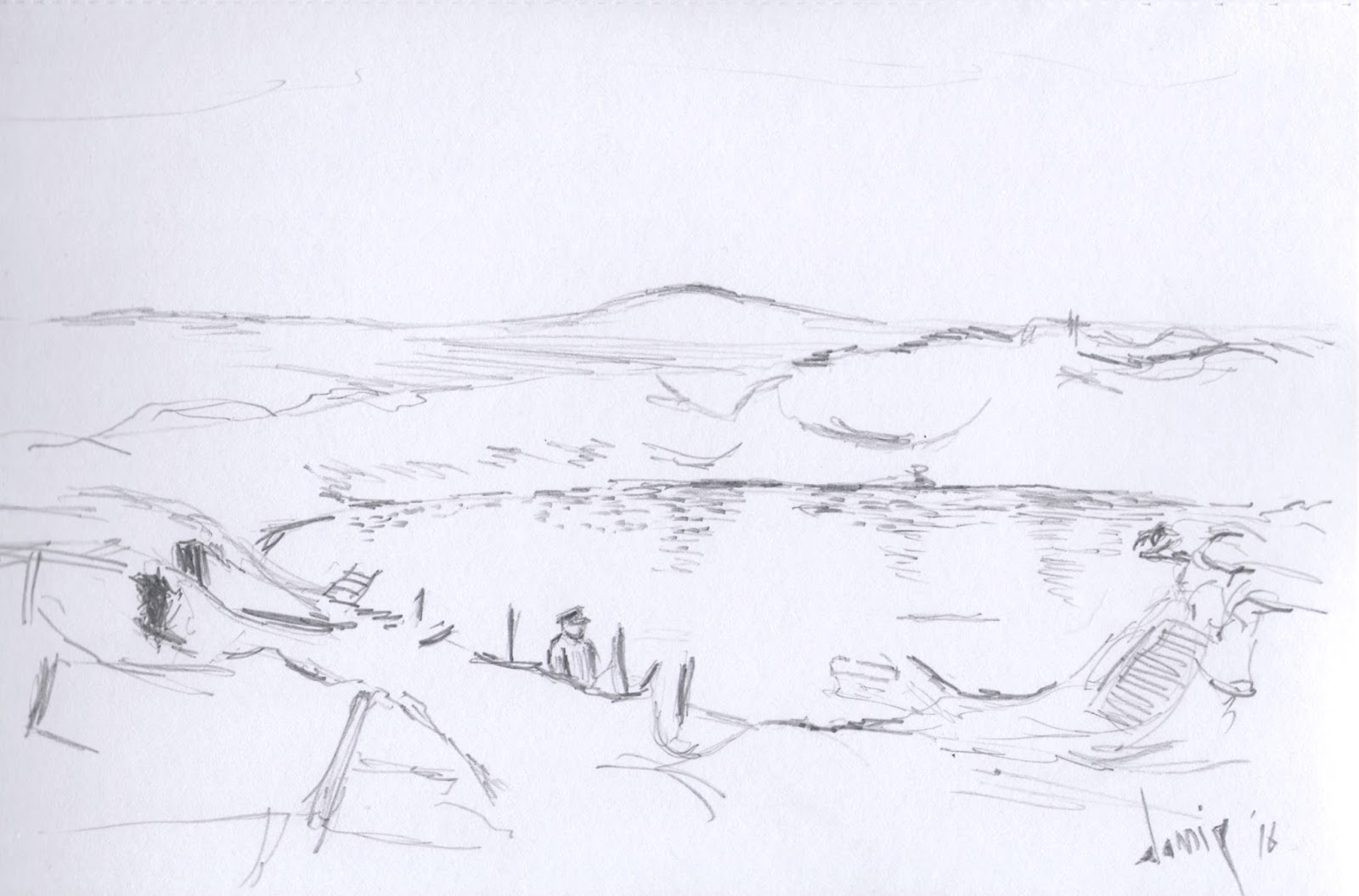
 Impression sketch of crater at St Eloi - by Jamie. From an original image that can be seen at: <http://www.militaryhistoryonline.com/forums/ViewPost.aspx?ForumID=56&ID=30517> [Accessed: 5 April 2016]

i
From days of early Flanders
The persona of Saint Eligius,
Had set on his task to convert
Pagans to Christianity religion,
With his twenty year mission -
His name dedicated to St Eloi
a village in a Flemish province.

Within a twentieth century
Mission, that same ground
Of St Eloi saw transformation
To total war, with sustained
Battles -1915 saw burrowed
Exchanges underground,
With tunneller's drafted in.

By subterranean methods,
A renewed struggle began
With six large mines, created
Beneath the German lines -
The decided plan for British
Intensions to move forward,
To capture destroyed lines.

Canadians afterwards would
Follow forwards, to secure
Captured systems - prior
To zero hour Germans had
control of ground; the land
Already battered, had mines
Prepared by sapper teams.

Into 87th leap year day
The 27th March at 4.15 a.m.
Awoke with tremendous
Gunfire - one followed by
Another of six mines, whose
Sound carried through air;
Heard on English shores.

Every man felt the earth
Shuddering, as volcanoe
Plumes of yellow smoke
Lifted skywards - debris
Rained upon pockmarked
Earth - six huge craters had
Formed in no mans land.

Amid the British forces
Lifting from sodden soil -
Khaki against blighted
Earth - Brodie clad heads
Over hunched shoulders
Came Northumberland
London's Royal Fusiliers.

With one Northumberland
Officer ready to provide
His regiment's story to
The Scotsman - the fight
the best organised to date,
Became known by name
Of Battle of St Eloi Craters.

The tunnelling companies
Had carried out operations
So secretly, the German
Presence had not guessed
What was about to happen -
A lull had till then, lasted
Across area for two days. 

A quagmire of peace could
Be seen for anyone, who
By chance could have stood
on ground, would have never
Been aware of two armies
in opposition, concealed;
Odd sniper fire interrupted.

ii
A dull drizzling morning
With possibility of heavy
Showers was observed,
Just before the ground rent
Heavenwards - the young
Officer relayed the problem
Of Northumberland’s role.

manoeuvres were acted out
Oddly, like a game - to enter
The maze of wire covering
The slope before German
Positions - slowly working 
To a pocket sized parapet,
That escaped the explosion.

A German machine gunner
Propped up on a parapet,
As they set foot among
The wire, to offer selves
Up as targets - but calmly
They worked through
By an amusing method.

A game spread amid men;
They adopted 'pick a back,'
As soldiers started to carry
Their comrades, who gave
Short reply to enemy fire -
Their aim to pick off any
Visible machine guns.

Within the gritty task,
The men took to amuse
Selves in transformation
To cavalry status - riders to
'Gee up' and chaffing each
Of their 'horse,' to criticise
Points of others mounts.

With the game of horse and
Rider making it through
The wire maze, dismount
Orders brought normality -
Back in role of foot soldiers,
They leapt down into enemy
Trenches, in warning shouts.

Their listeners though were
Just an audience of dead
And dying men - some
Lives lost within their sleep -
They came to a dug out,
Where a sentry stood
Upright, as on alert guard.

They yelled at the figure
To surrender - but he
Gave no answer - a man
With bayonet raised,
Rushed towards him -
Only to recoil in horror;
The sentry was dead.

Still on guard in death,
Looked on by those who
Would see him dead again.
With eyes described in
A look of 'the other world' -
With life severed in duty,
He was left at his post.

Moving further inwards,
Others were dazed from
An earthquake broken sleep,
Crouched or seated in pain
Of ignorance of the event -
Shocked to see strangers,
As a man in a dugout spoke.

'My God the English!' he
Found no escape, to be
Taken away with others
As prisoners - between
Them, arguing as to how
The invaders came - to
Land in massed airships?

iii
Some others suggested
They had burrowed
Up as moles - they could
Not fathom they had
Made their way across
Land of no man, that
Had been under guard.

A battle of St Eloi craters
Had begun with success -
The shattering sounds
Heard back in England,
With swarms of British
King's prisoners en mass;
Canadians made a start.

While spring had retained
Winter's wet conditions
Within the Belgium soil,
The rapid divisions arrival of
2nd Canadians in their first
Major engagement, brought
There without preparation.

Out of bitter, muddy earth
The British found success,
In hand-to-hand combat -
To win third German line -
While confusion lay amid
Enemy; mines irreparably
Altering their landscape.

Those great craters had
Been exploded, to create
A vast space over 180
Feet across and depth
Of 49 feet - with sleet
And wind, water began
To create glutinous mud.

For seven terrible days
Conditions took their toll,
With hundreds killed amid
Fighting chaos - exhausted
British gained relief from
Eager Canadian's 4 March
Arrival, in Belgium’s St Eloi.

Without blindfolds Canadians
Still had only a blinkered  
Idea of their situation and
German presence - by dates
Of 4 and 5 March, constant
Bombardment hampered
Efforts to improve defences.

With more deaths every
Minute, the 2nd Canadian
Pioneer Battalion tried
To drain their trenches -
The sight was a challenge
To the stomach of any man,
Upon the sight of that land.

'We were walking on
Dead soldiers,' Frank
 Mahout later wrote to his
Wife at home in Canada.
All about men attempted
To bandage wounds
As shells still fell around.

Soldier Private Fraser,
A Calgary bank clerk, gave
The scene at daybreak;
To see body parts protruded
Everywhere in the mud,
Marking out the yards - while
30 dead floated in crater.

Odd sights were captured
By moments of shock;
The German sentry corpse
Still on guard, or a tall, slim
English lieutenant who lay
Quite dead - his boyish face
Wearing a peaceful look.

Under nightshift fighters,
6 April at hour 3.30 a.m.
The ruins of St Eloi saw
German battalions attack,
Along the Canadian held
Main road - communication
Losses led to their retreat.

Another dawn lifted, renewed
German efforts had started
To recapture all grounds
Lost to them from battles
Start - confusion was relayed
By heavy rain, while the fight
For craters was still to end.

by Jamie Mann.

Anon.,1916. The Dead Sentry - The Story of St Eloi. The Daily Telegraph, [online] 5 April 1916. P.12. Col.3. Available at: <http://www.telegraph.co.uk/news/ww1-archive/12206739/Daily-Telegraph-April-5-1916.html>  [Accessed: 5 April 2016].

Source: File: Sint-Elooi. Online. Available at: <https://en.wikipedia.org/wiki/Sint-Elooi> Accessed 5 April 2016

Source: File: Battle of St. Eloi Craters. Online. Available at: <http://www.thecanadianencyclopedia.ca/en/article/battle-of-st-eloi-craters/> Accessed 5 April 2016

Mann, J., 2016. 100 years Ago - Poems by Jamie Mann. [letter] (Personal communication, 5 April 2016). 


#WW1 #WW1centenary #GreatWar #WW1poem #GreatWar #WW1centenary #worldwarone #worldwaroneremembered #WW1StEloi