Showing posts with label Football. Show all posts

Sunday, 25 December 2016

Poem ~ Season Of Peace And War - Monday, 25 December 1916 - Tuesday 26 December 1916

Source: File: Ruheben Camp festive card. Sketch depicting the card as they might have appeared in 1917 ‑ had the war ended that year. See an original image at: <https://www.worldwar1postcards.com/christmas-postcards.php> [Accessed 15 December 2016]

Reaching a bridge of 24 months from
First war Christmas, came 1916 festivities -
Situations of moods had long changed,
Across bitter stalemate of frontlines.

For the dead there were no celebrations.
Many that had once kicked a football
Across No Mans Land, long laid below
Or scattered across its poisoned mud.

Verdun, Somme and many new names
Of battles marked the bitter losses - any
Type of fraternisation forbidden by orders;
No football games of Hun versus Tommy.

Yet such truces of peace were not totally
Diminished - many Germans called out
Across the void to the Tommy and the Poilu
For 'Trêve de Noël' and 'Weihnachtsfrieden.'

The French spirit for 'live and let live' saw
Sectors sing to each other in native songs,
Along with exchanged gifts thrown across
Closest spaces of their outermost trenches.

Still the season, though subdued, continued.
Back in blighty had been orgainsed programs,
To get Christmas puddings to the front troops;
Though jokes abounded, if they would arrive.

With frozen stalemate in mud and the worst
Weather for more that 30 years, shortages
Were taking a grip - seasonal telegrams did
Not halt to tell men’s families of their deaths.

Not to forget the detained, held in camps from
Either side - with those most talented devising
Festive postcards - the artistic in the Ruhleben
Civilian camp held since 1914, drew designs.

In a card for xmas two detainees stare beyond
The wire towards the rising sun in hope of 1917;
A version shows them dancing before a happy
Sun and posts without wire, had the war ended.

A cherub builds three blocks for each war year;
1916 atop 1915 and 1914 - while yet another
Card, a smirking cherub kicks away the blocks -
Tentatively wishing happy forebodings for 1917.

With many an unlucky Tommy still on duty
In the trenches - as witnessed by news reporters
Such as Philip Gibbs - where after frosts, sleet
And snow found Christmas Eve a mild day.

Winter sunshine reflected across swamps
And flooded holes described in poetic images;
As supply columns churned their ways through
Mud, delivering feast day supplies to troops.

Gibbs saw soldiers as Noah like figures building
Colonies of huts, with attempts to abate floods -
Figures everywhere, splattered stiff with pale mud,
Emerged from lines imbued with Christmas spirits.

By subdued daylight Tommy's, Jocks and Anzacs
Sought out trinkets in nearest of French village
Markets - while on eve of feast day the reporter
Found a crowded restaurant, ready to celebrate.

Characters at every table; Tommy’s and Poliu
In salute of Entente Cordiale; 'Bonne chance!'
'Nous Les Aurons' and counter Christmas wishes
To old Fritz - here and there sat puzzled faces.

Young faces of 1916 recruits, amid the mature
Old Contemptibles, drawn into other temporary
Moods - away from the easy warmth and light
He took a few steps into darkness, to see blinks
Of horizon shells - somewhere soldiers died.

by Jamie Mann.

Gibb. P.,1916. Tommy's Xmas Eve - Scenes And Contrasts - A Memorable Picture. The Daily Telegraph, [online] 26 December 1916. P.7. Col.1-2. Available at: <http://www.telegraph.co.uk/news/ww1-archive/12214032/Daily-Telegraph-December-26-1916.html> [Accessed: 26 December 2016].

Source: File: Picture Postcards From The Great War  - WW1 Christmas Postcards  by Tony Allen- 1914-1918. Available at: < https://www.worldwar1postcards.com/christmas-postcards.php> [Accessed 26 December 2016]

Mann, J., 2016. 100 years Ago - Poems by Jamie Mann. [letter] (Personal communication, 26 December 2016). 


http://worldwaroneblogger.blogspot.co.uk/

#WW1 #WW1centenary #GreatWar #WW1poem #GreatWar #WW1centenary #worldwarone #worldwaroneremembered #WW1Christmas

Wednesday, 13 July 2016

Poem ~ Football On The Somme - Thursday, 13 July 1916

Source: File: Captain Billie Nevill.  See an original image at: <http://www.twickenham-museum.org.uk/detail.php?aid=255&cid=8&ctid=1> [Accessed 13 July 2016]

Source: File: The Football Charge of 8th Btn. The East Surreys at The Somme.  See an original image at: <http://www.queensroyalsurreys.org.uk/new_museum/20th_century_room/Case5/The_Football.shtml> [Accessed 13 July 2016]

Seeking out stories of Big Push's
First day, led to an East Surrey regiment.
One among the many that took
Part, whose driven success against odds
To be an everyman battalion.

Time replayed as a gramophone
Groove back to 1 July zero hour, whistles
Blew - in their assembly trenches
East Surreys took to the field 7.50 a.m.
They lifted to pace out a path.

Optimism of an officer showed
In his bottle of champagne he carried -
To be shared with close comrades
After they walked over the German lines.

Company officer Captain Nevill,
Produced four footballs - each platoon
Were given one - at kick off
They would form a dribbling competition.

This would last a mile and quarter -
Platoon commanders kicked off the balls
In unison - within minutes Captain
Nevill fell - still the footballs were kicked,
As they walked into a bullet hail. 

In unison men’s cursing cried
Against the enemy side - then that game
Faltered as their survival took
Lead over balls lost in long grass; the hour
Passed noon as the survivors…

Changed to bombs and bayonets
To clear out the German trenches - time
12.22 p.m. gained for a heavy
Price - from four, two footballs were found.

The plan was send them home -
At Kingston Regimental Depot, to preserve
As trophies of that days hard won
Success, by men of East Surrey regiment.

From out of the overall picture
Came individual feats of soldiers - with
One man's claim to have slain
Seventeen Germans by his own hand.

One quiet appearing Tommy
Was indicated, who had handed his rifle
To a friend to hold, while he
Took down a Boche with his bare fists.

Why? The answer; 'the bloke
Was too old to shoot down in cold blood
And too thin to bayonet.'
Another story involved machine gunners.

Two men detected a German
Machine gun in a dugout, with permission
They got the blighted thing
To work - then they lifted it to the parapet.

At a close communication
Trench, some Germans were watching,
Unsure of British numbers -
The two East Surrey machine gunners
Let loose with three belts.

Behind them, under a mile,
Approached a column of  enemy artillery
Ammunition - the two turned
The machine gun to sweep at this enemy.

At this unexpected attack,
The German convoy tried its best to escape
At a gallop - though by then
The damage had already been done to them.

Three caught machine guns
Were taken, captured as battalion trophies -
One desperate sight was seen -
Nearby to a German gunner chained to his
Machine, a soldier hung.

The suicide suggested reasons
Of being driven mad, by shattered nerves
From the bombardment that
Had lasted for days - other brutal evidence
Lay in found cat-o-nine-tails.

By admittance of heavy losses
Stories continued - with compressed
Hours of experiences and spirit
That, while dented, had a determined
British stance to avenge losses.

A grizzled soldier, introduced
As a bit of a battalion character, stepped
Up to open contents of a bag;
A bugle, a helmet, a sword knot, an officer's
Dagger and wallet of postcards.

The trench loot poured out,
As this soldier stated how the officer
Had been angry to have his
Revolver taken; 'that is private property.'

To argue would have wasted
Time - so he just directed his bayonet
At the fellow and 'the swanker
Understood;’ this ended the argument.

Witness to their stories later
Saw unfamiliar field guns being pulled,
Without sign of ammunition -
To realise the machines were captured
Limbers of German 77's.

by Jamie Mann.

Anon.,1916. 1916. Gallant East Surreys - A Charge With Footballs. The Daily Telegraph, [online] 12 July 1916. P.10. Col.2. Available at: <http://www.telegraph.co.uk/news/ww1-archive/12211961/Daily-Telegraph-July-12-1916.html>[Accessed: 13 July 2016].

Mann, J., 2016. 100 years Ago - Poems by Jamie Mann. [letter] (Personal communication, 13 July 2016). 


#WW1 #WW1centenary #GreatWar #WW1poem #GreatWar #WW1centenary #worldwarone #worldwaroneremembered #WW1Somme

Friday, 9 October 2015

Poem ~ Loos: New Army Trooper - Saturday, 9 October 1915


Source: File:  British infantry advancing into a gas cloud during the Battle of Loos.jpeg, [online] Available at: <https://en.wikipedia.org/wiki/Battle_of_Loos> Accessed: 9 October 2015].

Planned preparations to go over top,
Had included the use of six
Footballs - to be kicked across field
Of No Man's Land  - in belief
That Germans would be shocked.

The night before one commanding
Officer sent bullets into
Five of them, making them useless.
Still one had survived,
Hidden in tunic of sergeant Edwards..

By one account of one soldier,
Whose story commenced
22 September 1915, in a French
Village, some miles behind
The ready established firing line.

At the point of readiness the Tommy
Lay beneath his groundsheet
The rain pattering, echoing down
His back - tapping like fingers
He thought back leading to that time.

Somehow he would write this down
To send back home - on the
Wednesday past, in a French village
The Captain informed them
Of a big advance and their part to play.

Within two hours they started a march
That lasted over next three
Nights - Friday 24th they reached
A base town, at midnight;
Resting there until morning light.

Saturday and a Colonel stepped
Up to remind them,
Of their Englishness - the regiments
Honor being in their hands;
Part of Kitchener's New Army Units.

This young Tommy was a new trooper
Recollected awe-inspiring
Spectacle of sights on French roads -
Thousands of transports
Moved to mix with Red Cross motors.

The countryside dense as any city -
Everywhere men walking,
Sitting, lying, hobbling or carried -
These broken bleeding
Forms yet kept their cheerfulness.

Passing these forms in neat fours,
Tired cheers called out
'They are running like hell, boys!'
Such scenes repeated
Over kilometers, to line of artillery.

Already the gun lines had spat
Out shells, incessantly
On the Germans - over twenty four
Hours they stayed
Until 6 p.m. to witness artillery duel.

Although it seemed quite one sided,
Receiving little in return -
Experience continued - the new army
Moved on once again,
To a place captured that morning,

Another new sight - stretcher-bearers
Carried a Scots officer -
Deathly white except for a fag
In corner of his mouth
And in one eye, a cool monocle.

Still their movement did not stop -
Leaving a village at dusk.
Separating in platoons they spread
Over half a mile - to drop
In the cold to lay under waterproofs.

Now he returned to that moment -
The rain pattered his back
Stiffening in the chill air, stayed still
In enclosing darkness  -
Until the hour reached nine o’clock.

The new Tommy stood - as a unit
Moved on slow, silent,
And steady to captured trenches
Just ahead - when 'fun'
Began in sound of a sudden whizz.

Fifty yards to his right an explosion -
A Hun 'hello' in form
Of a 'Jack Johnson'; an express train.
The biggest shell of Hun
To make a crater with billowing smoke.

Still the shells came, one a minute
Seeking out guns behind -
Who then retaliated, ten for each
German - 'creation split'
Earth and dark shattered all about.

United in their coolness they passed
First line - queuing
To get though the wire onto second
Line. As emerging a turnstile
They spread rapidly as rifle fire came.

Bullets picked out at them to make
Their first casualty - one
Subaltern was shot. He dived down,
Beside him a Sgt-Major
Sent him backwards on a mission.

Before the first line, the ammunition
Mules remained, unable
To cross - they needed the boxes.
The officer had to remain
So Tommy sped a return path.

Now admitting to first real fear - alone
As aerial torpedoes of Jacks
Blew all atoms to nothingness - within
Yards death was flying around,
Recognisable parts lying beneath him.

It was as if the Hun were all aiming
At him - in a 200 yard race
He broke every single record, making
It to the mules - time passing
Found this Tommy was back on line.

'Get ready to advance!' minutes later
A call: 'Advance!' - The New
Army seemingly in hurry to get paid,
Steady, spreading out
A yard apart - emerged line after line.

Like a rehearsed dance sequence,
Dressing by the right -
To fill gaps, settling to a walk slowly,
Under madness of Hades,
To reach three quarters of a mile.

Drunken shells and every type
Of fire rained about -
But enemy targeting was 'rotten,'
Then inside range
Of their orchestra, they stopped.

Barbed wire again - at 300 yards -
Determined they worked
In units, making small rushed
Advances - twenty yards
Then reduced to only five yards.

Without slowing or keeping cool,
The trooper realised
Himself amidst the first attack line -
German machine guns
In a wood to the right began.

Almost at the wire, they had
To turn about - retire
Was no option - until others
On the right could get
Progress - to try once again.

As he ran this experienced
Trooper felt pain
On his arm - evidence of a hit.
Back at woods edge
Their halt was briefly called.

Once again, adrenalin driven
They raised up - yet
His left hand could not lift his rifle.
Binding his arm he had
To watch them go on ahead.

Somewhere, from a likely
Dressing station,
He wrote his account, to add
That he learned
Those trenches were cleared.

By exchanged words of recovery,
All soldiers had stories,
To say the Hun on seeing boys,
Ran or begged mercy;
Quality of own machine guns reply
200 to every enemy 100.

by Jamie Mann.

Anon.,1915. The Big Attack - A Soldier's Story - Rush for the Trenches. The Daily Telegraph, [online] 8 October. P.6. Col.8. Available at: http://www.telegraph.co.uk/news/ww1-archive/11914679/Daily-Telegraph-October-8-1915.html [Accessed: 9 October 2015].

Mann, J., 2015. 100 years Ago - Poems by Jamie Mann. [letter] (Personal communication, 9 October 2015). 


#WW1 #WW1centenary #GreatWar #WW1poem #GreatWar #WW1centenary #worldwarone #worldwaroneremembered #WW1Loos

Thursday, 8 October 2015

Poem ~ Forward With A Football - Friday, 8 October 1915


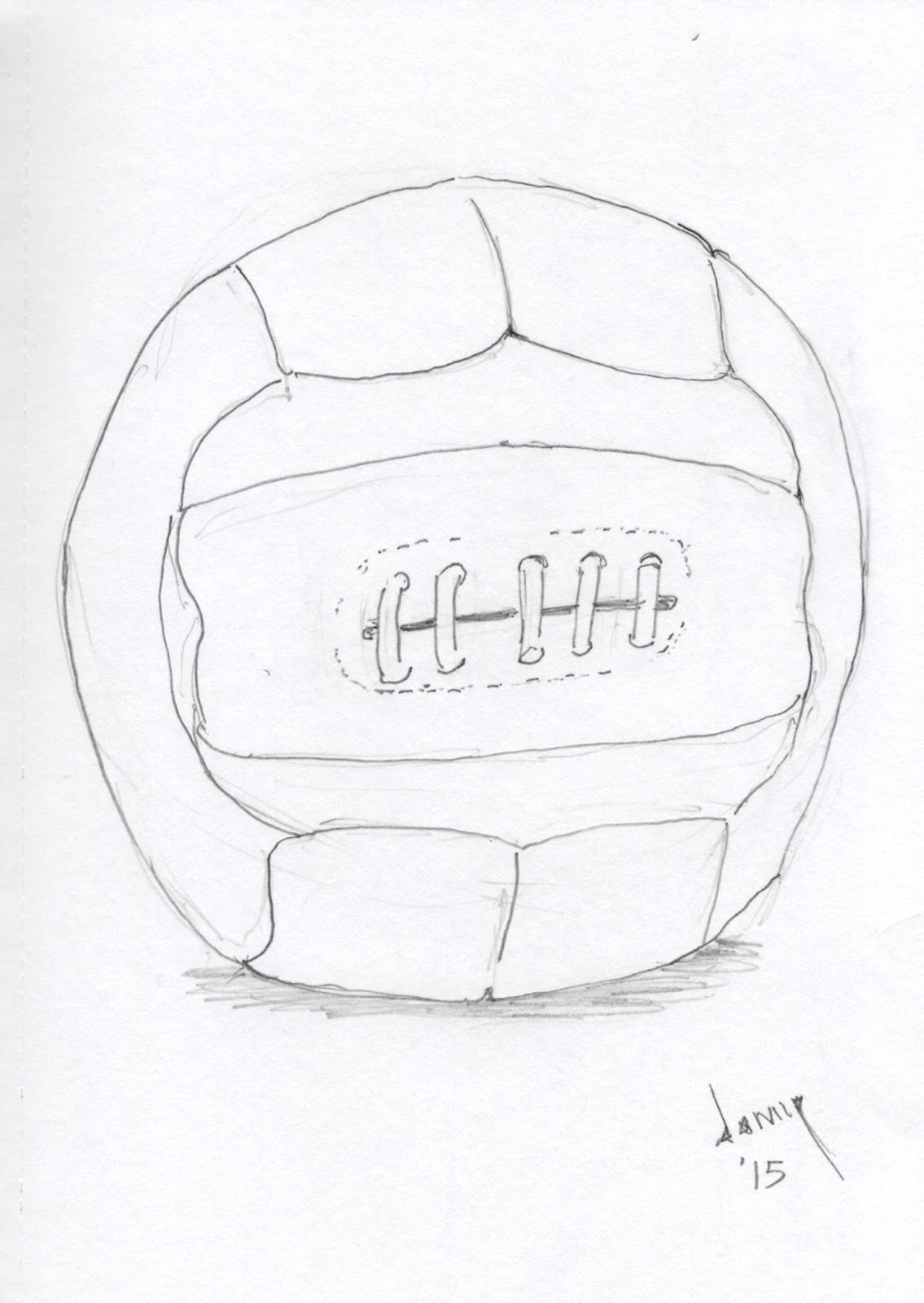
Impression sketch of WW1 football - by Jamie. Taken from original at:
 
As part of the campaign
To break German defences,
Of Champagne and Artois,
Launched the battle of Loos,
On 25 September 1915.

A Free Church Chaplain,
Rev Perry of Newport,
Was in attendance to tell
Of bravery of every man -
All described as heroes.

One section were faced
To fight impregnable
Position - in preparation
An officer readied
His boys for the charge.

Earlier a football had
been passed around, with
Each platoon man signing
His name - with orders
Called to go over top.

The officer on the parapet
Kicked off the ball -
To shout 'Follow up lads!'
The ball moved onwards
As he was shot down;

Still the soldier lads set off.

by Jamie Mann.

Anon.,1915. Follow The Football. The Daily Telegraph, [online] 8 October. P.7. Col.5. Available at: http://www.telegraph.co.uk/news/ww1-archive/11914679/Daily-Telegraph-October-8-1915.html [Accessed: 8 October 2015].

Mann, J., 2015. 100 years Ago - Poems by Jamie Mann. [letter] (Personal communication, 8 October 2015). 


#WW1 #WW1centenary #GreatWar #WW1poem #GreatWar #WW1centenary #worldwarone #worldwaroneremembered #WW1Loos

Monday, 25 May 2015

Poem ~ Bengal V India on French Pitch - Tuesday, 25 May 1915


Source: File: Indian cavalry playing football at the front 1915.jpg, 2015. Photos show Indian soldiers' lives behind World War I trenches. The Original can be seen at: scroll.in/article/668737/photos-show-indian-soldiers-lives-behind-world-war-i-trenches [Accessed: 25 May 2015].


A French village was to witness a rare sight,
On a piece of ground where occurred a football
Match, to be between 18th Bengal Lancers
And Indian 3rd Skinners Horse Cavalry.

In shirtsleeves an officer acted as referee,
As linemen positions were to be observed
By two Sikhs – from a distance sounds
Travelled over hills.

The front line guns rumbled on as actions
On a temporary pitch, surrounded by rows
Of Indians, gathered to watch the game;
With gun noise ignored.

A scene was set of an impressive sight
Of Indian men with their ‘noble turbans’ - all
With enjoyable humor; officers from both
Regiments became excited.

As at any match of football, were debates
Over rival teams, with individuals who may
Save the game for their side - all turbans
And puttees temporarily discarded.

Indian players proved selves adept at British
Institution, possibly outside their normality
Of experience – distinction between ranks
Was seen to blur.

Tunic and collars put aside, as the audience
Cheered and jeered their adopted teams -
Camaraderie and fitness of both cavalry
Regiments being evident in play.

While cavalry had experience of trench
War, in such a static fight, these regiments
Longed for enemy retreat, when on horse
They would take the charging lead.

by Jamie Mann.

Anon.,1915. Indian Footballers – a Battle Front Incident. The Daily Telegraph, [online] 25 May. P.6. Col.4. Available at: http://www.telegraph.co.uk/news/ww1-archive/11624538/Daily-Telegraph-May-25-1915.html [Accessed: 25 May 2015].

Mann, J., 2015. 100 years Ago - Poems by Jamie Mann. [letter] (Personal communication, 25 May 2015). 


#WW1 #WW1centenary #GreatWar #WW1poem #GreatWar #WW1centenary #worldwarone #worldwaroneremembered #WW1India