Showing posts with label 1914_1105. Show all posts

Monday, 8 December 2014

Poem ~ First VC's of Indian Army - Tuesday, 08 December 1914


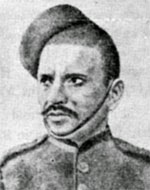
 Source: File: Darwan Sing Negi.jpg, Subterranean Sepoys -A Radio Play about Life in the Trenches for the Indian Army on the Western Front. [online] Available at: <http://trenchindians.com/sepoys-in-wwi/#sthash.0hFydd0o.dpbs> Accessed: 8 December 2014].

  Source: File: Khudadad Khan.jpg, Khudadad Khan, Wikipedia, the free encyclopedia. [online] Available at: <http://en.wikipedia.org/wiki/Khudadad_Khan > Accessed: 8 December 2014].


With the King-Emperor’s approval,
Members of the Indian army Corps,
Were awarded the Victoria Cross -
To be the first for just gallantry,
In the Indian Expeditionary army.

In the 1st Battalion of 39th Garwal Rifles
Naik Darwan Singh Negi was posted
Near Festubert, France –
During the night of 23-24 November,
The regiment set to make clear,
And retake some occupied trenches.

In a strategy that would become
Standard, the Garwal rifles
Attacked, to flank either side
Of one occupied trench –
They moved down and in -
Firing, bombing and bayoneting
To clear away their enemy.

With the first, Naik Darwan Singh Negi
Stepped forward, about each curve
Of the trench - under return fire from
Rifle and grenades, at close range.

Naik Darwan Singh Negi fought,
Despite being wounded twice,
In the head and in the arm -
By fight's end the man was seen,
Covered from head to foot,
Quite stained with his blood.

The VC for Naik Darwan Sing Negi
Given for great gallantry fighting
In face of enemy - on 5 December,
King George V had asked Negi
What he might do for him.

Came an unhesitant reply
For a homeland request.
Where he lived -
There were no schools.
Might one be made?
The process of this appeal,
Was immediately begun.

On 31 October in Belgium,
The onslaught of the Germans,
To gain French ports,
First had to get around Ypres,
The Belgium town.

129th Duke of Connaughts
Own Baluchis had arrived
And rushed out to support,
The pressured British -
With two companies,
Stationed in  Hollebeke Sector
About the village of Gheluvelt.

Still outnumbered, companies
Suffered increasing casualties.
Two machine gun teams
Had been kept operational,
Throughout the day -
Halting enemy breakthroughs.
One man of Sepoy rank,
Khudadad Khan.
Found himself in great adversity.

One machine gun fell from action,
Hit by a shell, while a British
Detachments Officer was wounded.
The machine gun position,
Was then overrun and the men,
Fell under bayonets and bullets -
With the exception of Sepoy Khan,
Who was left for dead.
Alone and badly wounded,
The Sepoy stayed at his station,
Until night – despite his wounds,
crawling back To his regiment.

Due to his, and the Baluchis actions,
The Germans were held back,
Until British and Indian reserves,
Arrived - thereby the line,
Was fully strengthened
And the ports safety ensured.

Sepoy Khudadad Khan,
Was the first South Asian
To receive the Victoria Cross -
On the same day as
Naik Darwan Singh Negi.

by Jamie Mann.

Anon.,1914. India’s First VC’s -Gallant Deeds. The Daily Telegraph, [online] 8 Dec. p.8. Col.6. Available at: http://www.telegraph.co.uk/news/ww1-archive/11275709/Daily-Telegraph-December-8-1914.html [Accessed: 8 December 2014].

Mann, J., 2014. 100 years Ago - Poems by Jamie Mann. [letter] (Personal communication, 08 December 2014). 


#WW1 #WW1centenary #GreatWar #WW1poem #GreatWar #ww1centenary #worldwarone #worldwaroneremembered


Thursday, 6 November 2014

Poem ~ Earnings of a Lady Typist - Friday, 6 November 1914


No other class of women workers,
Than girl typists - had felt the harder
Pinching effects on them from war.

Closure of the Stock Exchange
And other financial business’
Caused cause a great demise
In employment of many women.

The end of English Agents offices,
In the trade for foreign goods,
Has also added to the big effect.

Finding themselves in a pitiful plight,
With promise of a dreary winter ahead,
Were ladies with any other skills.

The National Patriotic Association
Chairman, Sir George Pragnell,
Devised a particular scheme -
By his knowledge of organising,
Of the wholesale drapery trade.

Knowing of strains in manufacturing
Sir Pragnell had insight to see 300,000
Army webbed belts being quickly used.

The Queen's appeal to all the women
Of the Empire, had well met the target
For the patterned belt - with more needed.

Sir Pragnell's keen and able abilities
Convinced the War Office for the best
Belt pattern would be the French -
Made of double flannel, was a protective,
Warm field garment, for all their soldiers.

Progress came with the Committee,
On Unemployment and a War Office
Contract, for such garments.

The easily crafted belts, could provide,
Opportunities for any girl typists
With no effect on workers,
In any other current industries.

Word spread as wild fire in the city,
Of exclusive employment for girls,
Provided by the Patriotic Association.

At their offices at St Paul's Churchyard,
Came the call - hand or machine sewers
Aimed at lady typists out of work -
Or any other means of livelihood.

On production of good references,
Each applicant was given a card
To complete; name, statement,
Typing skills and shorthand speed,
And knowledge of sewing possessed.

Each girl given enough cloth to make,
Four belts at home overnight – returned
To earn them 3d each, if finished well.

These belts were formed of flannel straps
Being 1 and 1/2 yards in total length -
Wider at the front, tapering at the ends.

Two lengths of the flannel - to be neatly
Sewn together, with stout webbing, either
End - making with an over sewn slit upon
One side, for the other end to pass through,
Giving an adaptable belt, for any sized man.

In satisfactory receipt of said made belts,
The sewer received another bundle of ten-
In completing these, receiving a half crown.

The process repeats for 5 days a week -
So 12s and 6d can be earned, it’s believed.
Any able girl can make two belts per hour.

While those with a sewing machine
Can complete one every 20 minutes.
Each belt is expertly checked -

Attention made to the webbings strength.
200 girls are then daily employed
Between them making 2000 belts daily,
With a grand total of 10,000 per week.

Continued preparations are needed
For men in the field and in training.
So needs for these are likely to last.

Supplies of flannel start to shrink
With requisitions of the navy arm -
As Red Cross, Russia and France
Make requisition for woollen goods -
So is the need to build reserves.

This process creates growth
Of registering girls for work -
When a young man answers
His country's call, a girl is chosen
To take his place -for some organisers'
It is a surprise how many ladies
Possess exceptional abilities.

An employer requesting a girl with able 
Knowledge of figures – after an hour’s exam
One girl’s skills changed a city man’s mind.
Another lady proved her worth; a rapid
Shorthand writer of Spanish and French. 

Viscountess St Cyres, representing
Association of Women Clerks,
And Secretaries joined panel for
Professional Classes War Relief Fund.

Her purpose; to find women clerks
Work in their profession - with particular
Attentions given to highly trained,
And most competent women.

Funds from one philanthropist provided
Trained secretaries for schemes
Of public relief  - that might have
Only found volunteers or untrained clerks.

On occasions when work cannot be found,
Younger members are to be trained,
For other posts in colonies or elsewhere.

by Jamie Mann.

Anon.,1914. Girl Typists - Scheme of Paid Work. The Daily Telegraph. [online] 6 Nov. p.4. Col.1-2 . Available at: http://www.telegraph.co.uk/news/ww1-archive/11208699/Daily-Telegraph-November-6-1914.html [Accessed: 6 November 2014].

Mann, J., 2014. 100 years Ago - Poems by Jamie Mann. [letter] (Personal communication, 6 November 2014). 


#WW1London WW1 #WW1centenary #GreatWar #WW1poem #GreatWar #ww1centenary #worldwarone #worldwaroneremembered

Poem ~ Sky Accident - Friday, 6 November 1914


Farnborough,
At the Royal Aircraft Factory,
In the evening of Thursday
Fifth November,
A terrible Incident occurred.

The factory was staffed
By those undertaking
Development of aircraft.
Mr Busk being one
Of the staff, decided
To take a flight during
The late afternoon, into dusk.

Standing at the aerodrome,
A colleague observed
His progress - when he saw
A stream of sparks coming
From the rear of the craft.

At this point it was realised
The pilot had shut down
The engine - from about
700 feet, he took a steep
Volplane, to the ground.

With the craft falling swiftly
In this flight, the sparks turned
Quickly to flames - when still
At height the plane fell, tumbling
In a ball of fire crashing,
In the midst of Laffan’s Plain,
A mile or so away.

At once, an ambulance,
Fire extinguisher and
Emergency breakdown car,
Raced out to the plain -
To find, on reaching the spot,
There was nothing
They could do but watch.

The burning machine,
Was impossible to get near,
Until it was almost reduced
To ash – the body of Mr Busk
Being found terribly charred.

A cordon was made about
The scene, by military Police.
The aviator's sad remains,
Taken to Connaught Hospital.
While the debris of the craft,
Was gathered and moved
To the factory, to be examined,
For what had gone wrong.

by Jamie Mann.

Anon.,1914. Airman Burnt to Death. The Daily Telegraph. [online] 6 Nov. p.8. Col.7. Available at: http://www.telegraph.co.uk/news/ww1-archive/11208699/Daily-Telegraph-November-6-1914.html [Accessed: 6 November 2014].

Mann, J., 2014. 100 years Ago - Poems by Jamie Mann. [letter] (Personal communication, 6 November 2014). 


#WW1 #WW1centenary #GreatWar #WW1poem #GreatWar #ww1centenary #worldwarone #worldwaroneremembered

Poem ~ Death in the Fog - Friday, 6 November 1914


In correction of previous
Accounts, is the report
Of a Sub–Lieutenant,
Of the Royal Naval Reserve;
Mr Petchell Burt Murray -
From Worsley Manchester,
And his unfortunate death.

In September having joined,
The Flying Corps Naval wing,
Sub - Lieutenant Murray,
Became a pupil at the Upavon
Central Flying School.

In training he had been
Seen to have remarkable
Proficiency, by limited experience.
On 5 November, this officer
Was sent up by his Instructor,
Making an early morning flight.

The weather was at first clear. 
But while flying, a dense fog
Formed - making for anxieties.
Such poor conditions would
Create a dangerous descent.

On Carlton Down, a shepherd,
Looking after his flock of sheep,
Stood within the shroud of fog.
Came the noise of an aircraft,
Within the stillness of that mist,
The eerie drone of that machine,
Surrounded the watching shepherd.

Looking about, he saw a break
In the grounded cloud - with
The swift movement of the plane -
Possibly the pilot was confused, 
Lost as where to land - the noise
Moved on. The shepherd seeing
To his flock, soon after heard,
The noise of a deathly crash.

It was some time before the mist
Dispersed revealing craft and pilot.
Lieutenant Murray was found, quite still
Strapped in the body, of the craft,
His neck had been neatly broken.

The aircraft nose was embedded,
 At a depth in the ground, leading
To the probability that he had
Been unable to regulate a descent.
The ground being hidden by fog
Upon his fall of 100 mph rate.

The verdict was accidental death.
In a tribute, the coroner valued
Such services of British Aviators.
Lieutenant Murray, in this war,
Had given his life for his country -
As if he had died in the trenches;
The Lieutenant was 20 years old.

by Jamie Mann.

Anon.,1914. Naval Airman Killed  - Flight in a Fog. The Daily Telegraph. [online] 6 Nov. p.5. Col.5. Available at: http://www.telegraph.co.uk/news/ww1-archive/11208699/Daily-Telegraph-November-6-1914.html [Accessed: 6 November 2014].

Mann, J., 2014. 100 years Ago - Poems by Jamie Mann. [letter] (Personal communication, 6 November 2014). 


#WW1 #WW1centenary #GreatWar #WW1poem #GreatWar #ww1centenary #worldwarone #worldwaroneremembered