Showing posts with label 1916_10. Show all posts

Saturday, 19 November 2016

Poem ~ Battle of Ancre: Heights and Lows - Sunday, 19 November 1916 - Saturday, 25 November 1916

Source: File: Battle of the Ancre. Prisoners taken in Beaumont Hamel by the 51st (Highland) Division, 13 November 1916.. See an original image at: <https://commons.wikimedia.org/wiki/File:The_Battle_of_the_Somme,_July-november_1916_Q4507.jpg> [Accessed 19 November 2016]

i
From September's push for Thiepval Ridge,
Emerged a new allied fight in the battle
Of the Anrce Heights - when summers path
Had led into inevitable autumn weather.

The allied struggle found Thiepval fortified
And determinedly defended - organised
Issues and poor weather conditions played
Badly against General Joffre’s intentions.

Days fed into one another to reach date
27 September - after a night and morning
Of German shelling, Canadian patrols made
Discovery; Germans had made a withdrawal.

North east of Courcelette, Canadian brigades
Moved on the trenches of Dyke Road, to gain
Their set objective -1st Canadians at Kenora
Trench, omly forced back in fight for occupation.

6 p.m. on 27th, an enemy bombing party failed
To retake Dyke road trenches - another allied
Advance found Zollern Redoubt fully devoid
Of Germans - Canadian gains finally joined.

A postponed advance led to orders for 3 p.m.
Still a further delay gave no definite hour -
The south edge of Stuff Redoubt was reached;
Again links formed up by Brigades successes.

With Zollern and Bulgaren trenches secured,
Into the early hour of 28th September resumed
Advance via Thiepval - 5.45 a.m. - then on hour
Of 11 a.m. the area about Thiepval was gained.

ii
Over the last official days of Thiepval's
Battle, the fighting had intensified about
Redoubts of Stuff and Schwaben - where
The British objective had been reached.

Yet many stubborn, dug-in Germans halted
British attempts to completely clear out the
Redoubts; although they captured a good
Section of the Schwaben by 30 September.

Without any final outcome a new chapter
Began; September ended badly for Germany,
In the region losing 135000 soldiers - with
Prisoners taken by army reserves of 10,000.

The Somme push from the summer was not
Yet over, with another chapter about the river
Ancre - troops were quickly gathered around
The northern bank, as divisions converged.

This was in the early days of October, when
Attacks were due on 4th to last until the 12th -
Intent had been to create a pocket by artillery
Hits about Irles, Pys, Puisieux and Miraumont.

Slowness on the Ancre's south bank sought
To gain Regina trench - determined Germans
Held on; inclement conditions made for delays
Both sides of the river to be almost impossible.

Mid October's turbulent conditions weighed
Down body and spirit into a trial - any plan
That Haig had made had become reliant
On pockets of environmental improvements.

iii
A shorter, sharper battle plan had emerged
By mid October, when a previous operation
From September was finally cancelled, for
Favour of a converging attack of river Ancre.

With fourth army failures and postponements
From dire weather, plans were again revised.
Haig and Gough desires different planned
Dates of attack, settled to wait for fair weather.

A need was for freedom of saturated ground.
With a conference called, no firm dated could
Quite be agreed; Haig and Foch 4 November,
Debated 4th army plans at Querrieu chateau.

Further came talks on 8 November at fifth army
Toutencourt headquarters where Gough, with
Corps commanders, proposed further attacks -
If the weather remained dry on 13 November.

Three days before, the time 5.45 a.m. was set
By Gough - Haig looked over the plans to give
Agreement; depended on weather if all went
Well, they would push towards Irles and Pys.

Five divisions would act alongside the river -
Gough's plan was to shrink the enemy salient
Between Serre and Thiepval; set out were
3 objectives, initially from Beaucourt Station.

First to gain 800 yards over Beaumont to Redan
Ridge; secondly 1000 yards west of Beaucourt
Onwards to Star wood - the third target to be
Puisieux road out of Stuff trench and Schwaben.

iV
From redoubt to line of Hansa, edging them
Out of defences to secure Beaucourt road
Bridges, target time 7.25 a.m. - a tactic was
Set to keep Germans in their comfort zone.

Each morning, 30 minutes prior to dawn,
Heavy artillery struck German frontline;
Hoping for the enemy to be complacent,
So they would not react to actual attacks.

Zero hour was set for 5.45 a.m. followed
By specific timed activity - 18 pounders
Would curtain advance - six minutes later
This would creep ahead over five minutes.

A barrage paused on German reserve lines,
Then onwards - giving 56 minutes to their
First objective - also using a machine gun
Barrage against their German equivalent.

Into the night of 11 November 1916, the rain
Ebbed away - a full moon rose to shine
Over a battered scape - as dawn came a mist
Manifested and general visibility quickly fell.

The curtain of dense fog helped the troops
Hiding their advance - though many soldiers
Lost the course of the barrage, further disabled
By heaving selves through thick, glutinous mud.

6.15 a.m. 117 Brigade advanced from Mill
Road, working to clear enemy dugouts along
The Ancre riverbank, meeting with lost troops;
Together to attack and take St Pierre Divion.

V
The 39th and 118th, unseen by Germans,
Advanced to Hansa line 7.30 a.m. - while
Battalions North West fought across to Mill
Trench, to reach Beaucourt Mill by 10 a.m.

Taking part in the forward force three tanks
Were to be involved, to set off from Thiepval.
But with one breaking down another found
Itself bogged; only one made the German line.

There the tank had tipped into a dug out, to be
Attacked at 7 a.m. - a pigeon was released
To get help, but for two hours none arrived.
Infantry appeared 9 a.m. and the enemy fled.

Amid the divisions the 9th Royal Scots were
Held in reserve - in keeping a diary Private
A. Macpherson had witnessed the approach
Of those tanks towards front on 12 November.

Near Auchonvillers they heard sounds of an
Engine running - odd reflective shapes lifted out
A trench, in its chinks of armour light escaped.
Without any time to stand and watch they left.

Waking from a few compressed hours of sleep,
Private Macpherson with his brigade, readied.
Being in position before the time of 5 a.m. then
Under sudden thunderous drumroll of gunnery.

Later he said, 'hard to believe humans could live
Through such a whirlwind of fire' - then a pensive
Wait, after columned shapes of prisoners came,
Marched down Mailly Maillet; a sign of success.

Vi
Beaumont Hamel stronghold had been taken,
Only to be tempered by failure - one division
Had not succeeded. The Royal Scots brigade
Were ordered to move out by that afternoon.

Private Macpherson and others readied
Under greatcoats and haversacks, to drag
Gun barrow through Mailly Maillet - while
Over their heads German shells whined.

From right of Auchonvillers Macpherson saw
Further prisoners - many dazed and fearful;
As one voice called, 'Guerre fini pour moi!'
Their guards searching them for souvenirs.

The reserves orders were to leave the gun
Barrows and ammo - with the battalion they
Moved along a rail-line near Auchonvillers
Where tanks edged outwards in snail pace.

Into slow hours of night they paused by old
Trenches and fresh shell holes - a salvo
Of shells aimed at the batteries, prompted
The whole battalion to get down to cover.

In seconds of silence blurted megaphones
Ordering - 'Number... ready to fire... fire!'
A stereo of 'bang, bang, bang' edging all
Along the line, to shake bodies and souls.

Seeping cold, edged into their fitful waiting
Game - someone illegally lit a fire - almost
Immediately were yelled orders, 'put it out!'
Soon they edged along Tipperary Avenue.

Vii
Filing down the communication trench was
Slowed by numbers - each having to weave
About collapsed walls left by tank tracks -
Briefly climbing onto Auchonvillers road.

Then dropping down into St Johns Road
Support trenches - some confusion flowed
Between them - without any officer present
The battalion stretched out, down the road.

Then a thunderous enemy bombardment.
The curse of shells hit a point on the trench.
Shouts of casualties were called out, a gun
Crew's lost survivors turned, about to move.

Back down in the narrow Tipperary trench, being
Shallow it lacked total safety, as Hun appeared
To have it in site - huddled down, they waited
For another shells arrival, like an express train.

A roar over hunched heads, tearing the ground
Throwing debris over them - a torture of a few
Minutes between each salvo - all expectant
Of death, sharing out words of casualty names.

Waiting, damning lack of orders - word of mouth
In Chinese whispers to say, 'back to the trench
Opening' - they edged down, fully knowing there
Was no authority in the order but glad to be safe.

They followed steps of companies to Auchonvillers,
Where police guards stopped them to quiz, why
They were leaving the line? But no one knew -
Came a random officer - confusion still continued.

Viii
Companies for White City? or for Auchonvillers?
Two were told to turn back in advance - not
Attached to them the Scots remained, to await
Correct orders - they roosted on the duckboards.

Night passed long and cold - cramp and dawn
Came. Combined efforts utilised bits of wood
To make a fire. Boiled water for tea and warmed
Tins of kippers served all a satisfactory feast.

14 November opened little better than the 13th -
A procession of souvenir hunters passed on route
To Mailly Maillet - the Scots advanced to Brooke
Street cutting into St Johns road to see results.

The bombardment of the last night very evident
In parapet damage - they stepped over bodies
To be guided by a runner sent by their officer;
Ordered down line to man some battered dugout.

by Jamie Mann.

Source: File: 51st Highland Division. The Battle Of Ancre (Beaumont Hamel) November 1916. Available at: <http://51hd.co.uk/history/battle_ancre_beaumont_hamel> [Accessed 19 November 2016]

Source: File: Battle of the Ancre. Wikipedia, the free encyclopedia. Available at: <https://en.wikipedia.org/wiki/Battle_of_the_Ancre_Heights> [Accessed 19 November 2016]

Source: File: Battle of the Ancre Heights. Wikipedia, the free encyclopedia. Available at: <https://en.wikipedia.org/wiki/Battle_of_the_Ancre> [Accessed 19 November 2016]

Source: File: The role of the 63rd (Royal Naval) Division in the Battle of the Ancre, November 1916. Available at: <http://www.ww1wargraves.co.uk/ww1_cemeteries/lt_colonel_tetley.asp> [Accessed 19 November 2016]

Source: File: 51st Highland Division. Pte. MacPherson Account of 154 Brigade at Beaumont Hamel 12-14 Nov 1916. Available at: <http://51hd.co.uk/accounts/pte_macpherson_beaumont_hamel> [Accessed 19 November 2016]

Mann, J., 2016. 100 years Ago - Poems by Jamie Mann. [letter] (Personal communication, 19 November 2016). 


#WW1 #WW1centenary #GreatWar #WW1poem #GreatWar #WW1centenary #worldwarone #worldwaroneremembered #WW1Ancre

Tuesday, 25 October 2016

Poem ~ Tank Sickness - Wednesday, 25 October - Friday, 27 October 1916

Source: File: Germans attacking tank. See an original image at: <http://wio.ru/tank/ww1tank.htm> [Accessed 25 October 2016]

To see inside a tank see, Weapons of War: Mark 1 Tank Available at: <http://www.bbc.co.uk/history/worldwars/wwone/launch_ani_mark_one_tank.shtml>

Amid the newest formations of force
Came the crews of tanks, whose
Experiences brought another aspect
Of war out of the western front.

One recruit of a crew an Australian,
Maintained a diary to tell of one
Week inside the fighting machine in
A story to the Manchester Guardian.

Initially an unpleasant set of feelings
Akin to seasickness - in the motion
Of the craft he dealt with the nausea
Of tank sickness, to find his tank legs.

With such legs he climbed inside
With the tank corps - a Subaltern,
3 Drivers and 4 Gunners - minimal
Training made for strange sensation.

The Australian decided being inside
To be worse than in a submarine -
Imagination became heightened - in
A confined space nothing was visible.

Once away though, limited vision
Continued restricted views - then out
In the midst of battle sounds of hail
On a galvanized roof deafened all.

Next a series of 'hammer blows'
Of heavier weaponry against their
Shell - still the driver carried them
Onwards making it, all unscathed.

Crawling at a methodical pace until
There was a lurch, the Australian felt
They were 'booked through' - a look
Out saw they were astride a trench.

With the enemy close by their orders
Were to 'give them hell' - this they
Did, raking bullets right and left -
Allowing a peek it was grim humour.

Outside their tank were Germans
Acting as frightened rabbits, easily
Shooting them down in bunches -
Halting escape to their burrows.

In hopeful futility the Hun brought
Out machine guns to rattle their hide,
Without making any indentations -
They came across more fearful Huns.

As if possessed the enemy scattered,
To be scythed in the process - some
Officer sought to gather his men back
Together, awaiting the metal tank.

As the crew began anew the enemy
Scattered once more - all around
Infantry followers rounded up any
Survivors, who stared open mouthed.

Their wide eyes watched the crawling
Tank - then on the Tuesday they did
It all again. The Australian spoke in
His diary of Germans as silly blighters.

German tactics believed some ability
To succeed with rushing the tank from
All sides, as if raiding a fort - Devilish
Plucky but mad, to be hit point blank.

On the third time out, the Wednesday,
Found the tank approaching some
Village - a place where a Hun party
Stood to greet them - a big mistake.

By obscured vision it appeared they
Might be the mayor and other big pots -
Somewhat large figures made a warm
Reception of machine guns and more.

Trying to board the sealed machine -
With a laugh to return their fire; 'tank
Reception Committee dispersed' - amid
Smoky cloud and flames one stood.

Rotund and purple in his rage, he ran
Like a part in a sack race; 'funny as hell.'
The old man threw himself down in
Made gestures of terror and surrender.

On another casual touring day, this
Australian witnessed rounding up
Of surrendering Hun when one said,
It was 'not fair to fight with such things.'

This was their affair - despite any racket
Germany sought to give - taking air the
Crewman asked one such cheeky chap
If they should get Kaiser's permission?

The joke went over his head as they
Gave another big shock, to counter any
Enemy surprise of entrapment, where
They rolled into midst of their ambush.

In a repeat of terrified fleeing, enemy
Quickly took to heels in all directions - only
A few lingered to fire back, but were easily
Crushed, for Yorks to pick up the pieces.

by Jamie Mann.

Anon.,1916. Inside a 'Tank' - Grim And Humorous Tales. The Daily Telegraph, [online] 17 October 1916. P.10. Col.7. Available at: <http://www.telegraph.co.uk/news/ww1-archive/12213438/Daily-Telegraph-October-17-1916.html> [Accessed: 25 October 2016].

Mann, J., 2016. 100 years Ago - Poems by Jamie Mann. [letter] (Personal communication, 25 October 2016). 


#WW1 #WW1centenary #GreatWar #WW1poem #GreatWar #WW1centenary #worldwarone #worldwaroneremembered #WW1Tanks

Thursday, 20 October 2016

Poem ~ Patriotic Gesture - Friday, 20 October - Saturday, 21 October 1916

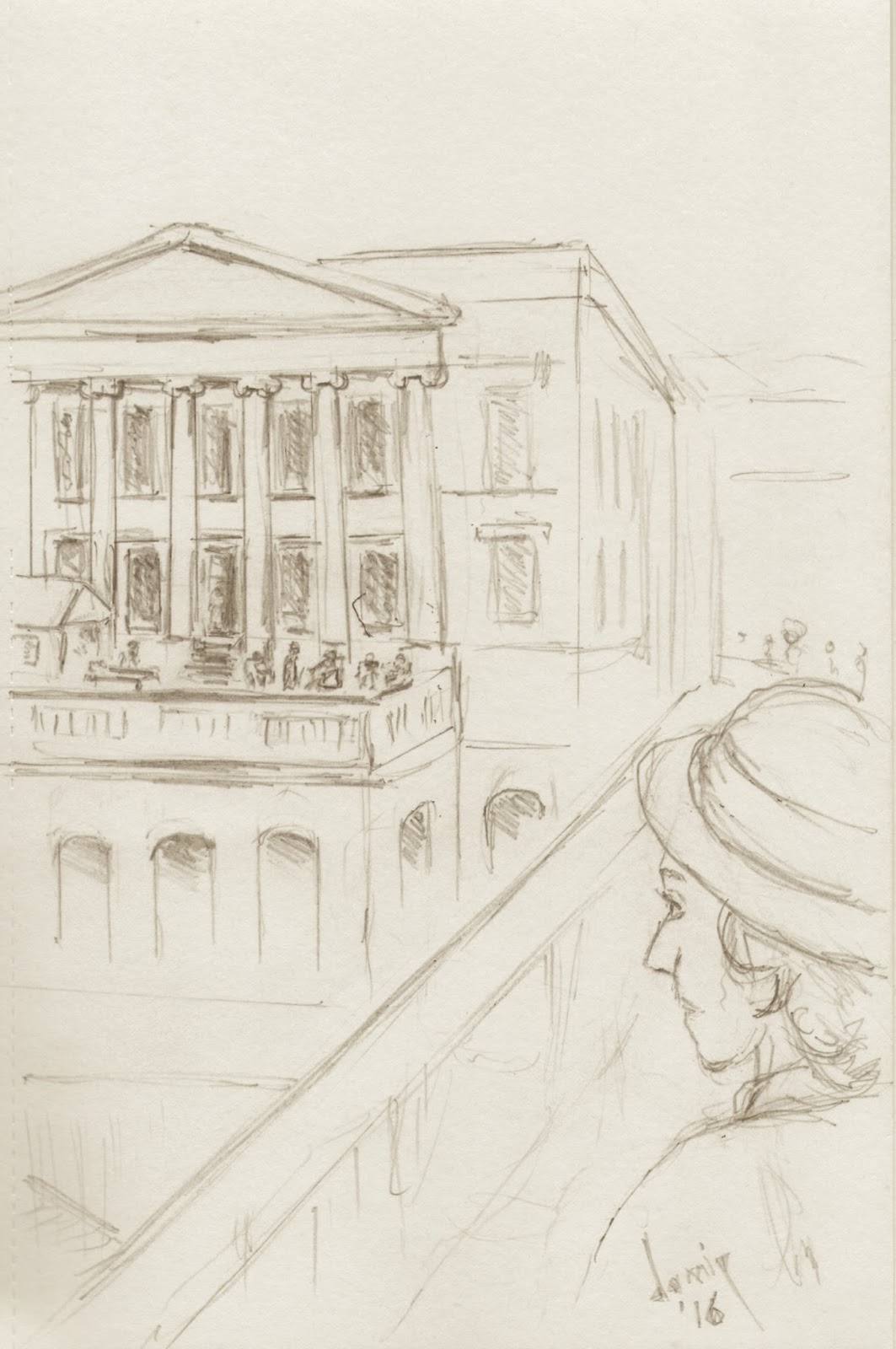
Impression sketch for a girl's patriotic gesture.

Established in the heart of the English capital,
The Fishmongers Hall had witnessed many
Varied eras over 600 years, from medieval
Beginnings as a city guild; once destroyed
In the great fire of London was then rebuilt.

With such a history the Fishmongers Hall
Again adapted in 1914 in a time of war -
Alderman wives in approaching many
Firms made request to Fishmongers Hall.
Then owned by a city livery company.

In need to treat wounded men, the hall agreed
To become Royal Red Cross Hospital; while
Small and grand facing the River Thames, the
Situation served well for recovering officers
With 27 beds; opened on 1 October 1914.

Along with the apartments used on the first
Floor, the Great Hall was divided into five
Cubicles next to the windows. Positioned
Amid the gilded decoration, was another
Room divided into two, to hold four beds.

A wooden hut was constructed out on
The balcony - for those cases of septic
Nature or needing open air - on the quiet
Side were other rooms for more serious
Wounded, with X-ray and operating rooms.

A 27-bedded hospital gave environment akin
To homeliness with armchairs, electric lights
And reading tables - pink rugs next to beds
With down quilts - meals served in rooms
Allowing two guest visitors for afternoon tea.

Situated alongside London Bridge, endless
Traffic passed by. This included one young
Lady, who decided to write to the grand
Hospital offering her services - prompted
By her daily excursions across the bridge.

Though her actual name was finally omitted
From the published transcript, Jane as she
Might be called for purposes here, would
Have seen wounded men taking the air
On the balcony - being moved to assist.

The House Surgeon of Fishmongers Hall
Hospital, had received the letter from Jane,
A city worker, who began by apologetically
Saying she was taking liberty in her question,
To ask after the process of healing wounds.

Jane had heard that there had been a lack
Of skin - which if grafted to the wounded
Man, would to be better and easily healed.
For this purposes Jane made offer of her
Own skin, as much as practically possible.

Jane informed the house surgeon of her
Situation - being obliged to travel every
Day into the city to earn a living - this
Was not an impulsive idea - no doubt
Having seen arrivals of ambulances.

Jane’s own situation disallowed any
Chance to help soldiers as other girls
Her age had done - how she might help
Then by offering her own skin - she wanted
To do this for her two fighting brothers sakes.

Having taken much time to think of this
Contribution, Jane stated how she knew
Of nowhere else to write - furthermore that
If they could not use her services for taking
Skin grafts, where else might she approach?

by Jamie Mann.

Anon.,1916. A Girl's Patriotism - Offer to Hospital. The Daily Telegraph, [online] 10 October 1916. P.5. Col.3. Available at: <http://www.telegraph.co.uk/news/ww1-archive/12213439/Daily-Telegraph-October-18-1916.html> [Accessed: 20 October 2016].

Mann, J., 2016. 100 years Ago - Poems by Jamie Mann. [letter] (Personal communication, 20 October 2016). 


#WW1 #WW1centenary #GreatWar #WW1poem #GreatWar #WW1centenary #worldwarone #worldwaroneremembered #WW1London

Tuesday, 11 October 2016

Poem ~ What To Do With 'Drunken' Officers - Wednesday, 11 October - Sunday, 15 October 1916

Impression sketch for What To Do With 'Drunken' Officers.

i
In a number of insubordinations, various
Appearances of officers stood before
Major-General Lord Cheylesmore, who
Presided at a court-martial, Westminster.

A Commandant of Bisley Camp School
Of musketry, who had in his youth been
Described as an all round sportsman -
Though 'a little too eager to shoot birds.'

Eager Major-General Lord Cheylesmore 
Was fond of 'teaching the young idea
To shoot' - along with Karl Hans Lody trial
He had many court-martials under his belt.

Major-General Lord Cheylesmore now
Turned his talents to home grown issues -
He faced an accused Second Lieutenant
F. L. Whalley, who had pleaded not guilty.

A charge held on the Lieutenant as drunk
On 6 September 1916, at the Wimbledon
Common camp, 10.45 p.m. - the court
Listened to how Whalley's story unfolded.

A taxi cab driver appeared at servant's
Hut on the camp, asking for Lieutenant
Whalley's servant Private Donovan, who
He addressed, to request the officer’s fare.

The driver had refused the idea of being
Given a cheque - although not very clear,
Private Andrews likely went to officers
Mess, to inform another officer of events.

A further witness confirmed how Lieutenant
Whalley was slumped on his bed to appear
Drunk - in shaking him he asked him what
He was going to do; 'give the man a cheque.'

Whalley asked them to write this for him -
Private Donovan advised the driver a cheque
For 25s would be posted - in his evidence
Whalley informed court of personal worries.

Since late August his concerns centred 
About his wife having recently given birth -
On 5 September he had been all day at the
Nursing home, returning to camp at 9 p.m.

He could not sleep so then returned
To the nursing home by 1 a.m., where
Two Doctors held no hope for his wife.
In addition the child would not survive.

Staying there for many hours he finally
Left 9 p.m. Whalley took a taxi to stop
At a hotel, to drink 3 sodas and brandies
He had not eaten - but nor was he drunk.

Collapse came from mental worry and
Physical exertion - court then heard how
Whalley had been in army 11 years with
4 years active service in South Africa.

During that time no crime had been made
Against him - a letter was provided by late 
Lord Roberts to Whalley's parents, to say 
He had been part of his close bodyguard.

Whalley carried out his duties smartly,
As a keen soldier - while Captain Neale
Advised he proved to be excellent officer
And popular with colleagues and men.

ii
From Bedfordshire Yeomanry stood
Second Lieutenant H. E. R. Craig, to be
Accused that on 16 September 1916 he 
Was at Empire Music Hall Promenade.

He was found dancing whilst in uniform.
Captain T. V. Brown, Assistant Provost
Marshal of Australian Force, saw Craig
Step dancing, his arm around a civilian.

Captain Brown spoke to Craig to say his
Behaviour did not become an officer -
The Lieutenant replied he was not doing
Any harm - the Captain asked for his card.

The reply was, 'I have not got any,' to add
Was his word not good enough? then given
An order to report on Monday. 'I cannot
Do it' - then Craig followed Captain Brown.

Craig had asked for Brown's card in order
He may lodge a complaint; at 11.15 p.m.
A Captain Cameron asked him, after what
Brown had said, why did he follow him?

Craig denied he followed Brown - asked
Again if he understood he was to report
To the Provost-Marshals office the next
Morning - the reply was, 'I cannot report.'

After repeating that he must report, Craig
Was told not to loiter but go on his way -
Giving back reply, 'I shall stay where I like.'
At that point he was arrested and taken.

Travelling quietly in the taxicab Craig was
Quite sober - at Scotland Yard Lieutenant
Craig was put into a cell, to perform steps
Of a dance as the door was being locked.

Lieutenant Craig faced court-marshal over
3 charges of insubordination to a superior
Officer - this he denied, stating how he had
Only been at Promenade talking to a friend.

Further to explain that after being led into
The cell, where all the windows were open,
Lieutenant Craig stamped his feet to keep
Warm and that he had not been dancing.

iii
Second Lieutenant A. E. N. Phillips, an
Officer of the Royal Garrison Artillery sent
A telegram to the Anti Aircraft company,
Commander Captain Rotteburg one Saturday.

His words, 'kindly excuse me parade this
Morning: unavoidably detained.' Without word
Until Monday 18 September, to say by wire
He would report Tuesday with explanations.

Second Lieutenant A. E. N. Phillips was
Actually absent from Friday 15 to Tuesday
19 September - in his decision not to give
Any explanations, he instead gave evidence.

Stating that his section had no weekend duty,
Phillips had not realised that there were strict
Regulations in what his absence had meant -
If known he would not have taken time away.

Lieutenant Phillips defended his character,
To state he had been in the Matabeleland
And Natal Mounted Police, South Africa -
Having gained medals prior to his arrival.

He had decided to leave his police post there
To travel to England and fight for the Empire.
Having heard evidence, the court remained
Undecided on Lieutenant Phillips sentence.

Vi
On another day, without any connection,
A second Lieutenant of the Australian
Imperial Force, G. D. Lemon, had been
Present in London, 23 September 1916.

Second Lieutenant Lemon faced charges
Of drunken behaviour in Leicester Square
10.30 p.m. when he should have reported
To camp, catching his train from Waterloo.

Missing the 5.50 p.m. train that evening,
Lemon advised he was unaware of having
To get a specific train - he met an Australian
Friend, intending to travel to camp with them.

Lemon planned his return Sunday morning.
His promotion to rank of Second Lieutenant
From private had occurred in 1916; a court
Martial existed from August, for being drunk.

With Lieutenant Lemon's sentence yet to be
Decided, as was Second Lieutenant Phillips,
Lieutenant Craig, the keen, sober dancer's
Summing up said 'not guilty' - while Whalley's
Concerns for his wife, was found 'not guilty.'

by Jamie Mann.

Anon.,1916. Courts-Martial - Charges Against Officers. The Daily Telegraph, [online] 7 October 1916. P.x14. Col.1. Available at: <http://www.telegraph.co.uk/news/ww1-archive/12213397/Daily-Telegraph-October-7-1916.html> [Accessed: 11 October 2016].

Mann, J., 2016. 100 years Ago - Poems by Jamie Mann. [letter] (Personal communication, 11 October 2016). 


#WW1 #WW1centenary #GreatWar #WW1poem #GreatWar #WW1centenary #worldwarone #worldwaroneremembered #WW1London