Showing posts with label 1915_07. Show all posts

Friday, 31 July 2015

Poem ~ Civil and Soldier Travellers - Saturday, 31 July 1915


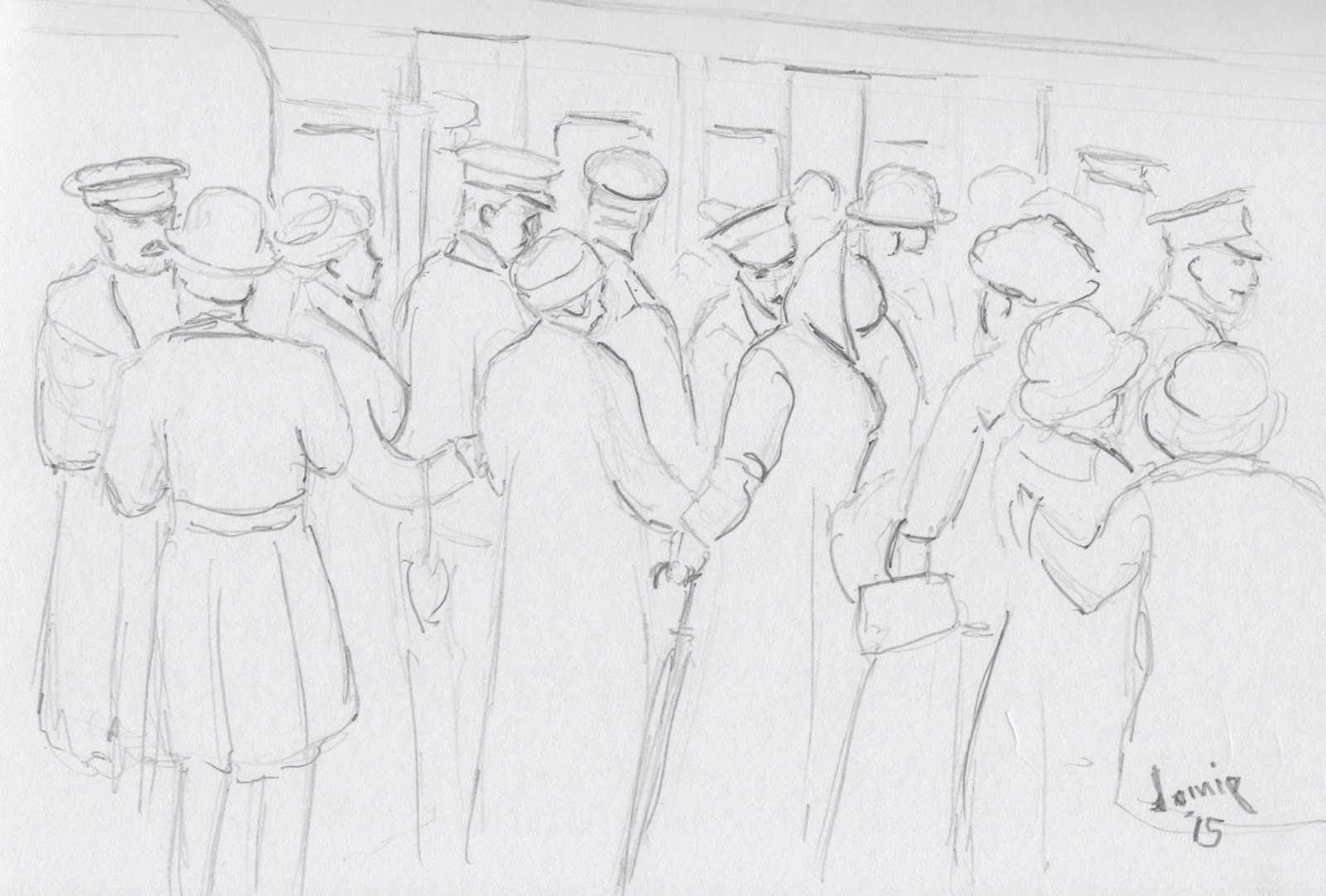
Impression sketch of a crowd saying goodbye to soldiers leaving Victoria Station in London, during World War I - by Jamie. See the originals at: http://www.vintag.es/2013/10/old-photos-of-world-war-i-in-1915.html#ixzz3hrtT2pAq

One war, like no other,
Brought social changes
In re-evaluations,
Of familiar institutions.

In just barely a year,
From one mans act,
By an assassination
Of some archduke.

In passage of slow days,
Came changed views -
As in one time of day
Sight of men in khaki.,

Who made up numbers
Of railway passengers,
Would have caused
A great speculation -

To become a regular
Presence - to cause
No more attention
Than city passengers.

Numbers of soldiers
Would then regularly
Outnumber others -
All railway stations.,

Became places akin
To military camps;
Boys carried bags as
Women took tickets.

All ordinary type folk,
Rubbed shoulders
Of men, who'd seen
War’s vicious effects.

Dust of western front,
Was likely to catch
On civilian clothing -
With foreign odours.

Hands held less books
To favour newspapers -
Becoming more norm
In the traveller's hands.

Some camaraderie,
Was almost tangible -
With man to man and
Chivalry toward woman.

Depiction of that state
Described as 'wonderful'
The changes to be seen
Over August holidays.

Stereotypes of men
Aboard trains, wrapped
In self, with new eyes
Open civility to those.,

Once disregarded -
While the tedium for
Tedious troop trips,
Relieved by a word.,

In honest good cheer -
While those deserved
Of sympathy, would be
Newly enlisted youth.

Youth in trepidation,
To report to stations -
New in dedicating one
Life to country's call.

Such train encounters,
Is call essential helping-
Hand to such heroes -
As them in the making.

By example, people may
Have given cheer, as in
Seasoned travellers,
Commercial businessmen.,

In weekly moves between
From Leeds, Manchester,
Southwards - might buy
Raw recruits a cup of tea.

One belief given is for
The fallacy that soldiers
All need fags  - as many
Did not actually smoke -

Prompting awareness
Of soldierly cultivation;
Many a man came from
Intelligent professions -

Deserved of intelligent
Conversations - to state
The sober behaviours
Of men turning to soldiers.

In rare drunk behaviour
The chivalrous recruit,
Can be seen to support
Women and children.

Men such as these,
Will ask permission
Of women to smoke
In such compartments.

Although tired from
Marching, they will easily
Stand throughout long
Journeys to free a seat.

A recruit's habit aboard
Is help little ones climb
Or leave their carriages
Additionally these youth.,

Finding dining cars
Might be devoid of food
Will easily resign selves
To their fate of hunger.

Thus is one articles hope
In influencing civilian
Bank holiday travellers
Of the khaki presence

How to support these
Men - not as hooligans
But simply splendid men
Journeying their way.

by Jamie Mann.

Anon.,1915. Troops in Trains  - Civilian Interest. The Daily Telegraph, [online]  31 July. P.10. Col.7. Available at: http://www.telegraph.co.uk/news/ww1-archive/11773708/Daily-Telegraph-July-31-1915.html [Accessed: 31 July 2015].

Mann, J., 2015. 100 years Ago - Poems by Jamie Mann. [letter] (Personal communication, 31 July 2015). 


#WW1 #WW1centenary #GreatWar #WW1poem #GreatWar #WW1centenary #worldwarone #worldwaroneremembered #WW1Trains

Thursday, 30 July 2015

Poem ~ A Break From Bombs - Friday, 30 July 1915


Source: File: Woolwich Royal Arsenal.jpg. World War One: Royal Arsenal's battle to feed the guns By Greig Watson BBC News, 5 June 2014. The Original can be seen at: http://www.bbc.co.uk/news/uk-england-26272844 [Accessed:  30 July 2015].

With summer's seasons
Of holidays in full swing
Despite wartime - morale
Set to raise the Woolwich
Royal Arsenal workers.

With the August bank
Holiday set to combine
The traditional 'beano
Day,' granted by royal
Warrant of George III.

The Annual Beanfest
Day, commemorated
This king’s visit - 6 July
1773 - this had existed
Until Edwardian years.

Reinstated, the July
Day combined with
2 August - Sunday
In-between made for
Longest rest of war.

Out of the 40,000,
Some 3,000 would be
Still on duty, to carry
Out maintenance for
One years constant run.

While this great needed
Overhaul of well used
ammunition apparatus
is made, the workers will
Likely rest in their gardens.

by Jamie Mann.

Anon.,1915. Woolwich Arsenal Holiday. The Daily Telegraph, [online]  29 July. P.10. Col.6. Available at: http://www.telegraph.co.uk/news/ww1-archive/11744429/Daily-Telegraph-July-29-1915.html [Accessed: 30 July 2015].

Mann, J., 2015. 100 years Ago - Poems by Jamie Mann. [letter] (Personal communication, 30 July 2015). 


#WW1 #WW1centenary #GreatWar #WW1poem #GreatWar #WW1centenary #worldwarone #worldwaroneremembered #WW1London

Tuesday, 28 July 2015

Poem ~ Hooge - Wednesday, 28 July 1915


Impression sketch of Hooge Crater  - by Jamie. See the original at: http://www.ww1battlefields.co.uk/flanders/hooge.html

East of Ypres sat Hooge,
On a ridge called Bellwaerde -
Here was the home of a house
Chateau de Hooge, destined
To be in midst of a war.

From the Flemish quiet,
Of days where the chateau
Stood, erased in sad erosion -
To crumble down to dust,
Never to be rebuilt.

A decisive attack decided
To take place, about this area
In order to improve allied lines -
Construction of a mine, made
To be detonated at 7 p.m.

A Middlesex regiment lay
Opposite 126th Wurtemburge
Regiment - backed by 66th Artillery
Of German Forces – tensely
Waiting officer's signal.

Once the massive charge
Exploded, the infantry would
Rush ahead to gain occupation
Of the crater - at a distance
Platoons awaited action.

A Middlesex battalion, set
With bayonet fixed - reserve
Troops were readied in support -
The ground between them
And enemy, lay debris.

The hour shattered in
Sudden force as the earth
Flew - to throw men off their feet;
Melting German trenches
To dust, as spoilage fell.

A gaping space opened
Enemy’s neat breastwork
Out - smoke and dust emanated -
Wounded, with mainly dead
Germans lay all about.

In seconds, whistles
Blew and the Middlesex
Lifted into a smoldering inferno,
To meet stunned survivors;
With little resistance.

Bombers came after
The assault line, setting out
To progress - turned the crater
Into to allied defences, while
Bombers split into three.

Storming down three
Each trench path to drive
Back Germans that might still
Shelter; followed by soldiers,
Armed by fixed bayonets.

A gift of bombs aimed
In every dugout, only when
A traverse is made, is lobbed
Another - explosions are 
Followed by bayonets.

Such action needs
A flow of bomb supplies,
As the vulnerable bomber man,
Runs the risk of being hit,
Before he gets a target.

In an orchestra of this
Action-run-lob-halt-bayonet,
Agility is needed for progress,
Down any narrow spaces,
Of blocks and wounded.

Those bombers under
Lead of Lieutenant Erskine,
Who, taking part in operation
Came to defended dugout;
He used a pick to enter.

Hacking the roof in order
To throw a bomb, Lieutenant
Erskine had almost achived this
When a shot hit him down;
A fatal wound to his chest.

As daylight failed, action
Of bombing began to halt -
In retaliation, the minenwerfers
Woke, to toss high explosives
Into the occupied crater.

The minenwerfers named
Variously as ariel torpedoes
Gained more friendlier names;
As sausages and Rum-Jars,
In likeness to rum rations.

A night's bombardment
Continued to fade, with day
Counterattacks proving to be
Inadequate - with German
Reluctance to return.

With empathetic limits
To know the effects of loss
Of mates by a man's side - still
It seemed how the Tommy
Calmly kept to his duty.

An officer stopped, spoke
To one man at danger point
Asking how matters were going -
A reply of few aimed at them;
Unaware of any that did hit.

As replacements came,
To take over those exhausted
Troops - German shell batteries
Continued - parapets reversed,
And broken wire repositioned.

Hooge’s crater gave small
Extension to the allied front -
A stalemate was still held, as spits
Of counter attack against
Other counter attacks.

As activity settled back
Into routine, another salient,
South of Hooge, was hit by a mine
Knocked enemy’s hold - whose
Counter mine made no effect.

by Jamie Mann.

Anon.,1915. Attack at Hooge Position - Enemy Trench Mined - Daring Bomb Throwers. The Daily Telegraph, [online]  26 July. P.10. Col.6. Available at: http://www.telegraph.co.uk/news/ww1-archive/11742053/Daily-Telegraph-July-26-1915.html [Accessed: 28 July 2015].

Mann, J., 2015. 100 years Ago - Poems by Jamie Mann. [letter] (Personal communication, 28 July 2015). 


#WW1 #WW1centenary #GreatWar #WW1poem #GreatWar #WW1centenary #worldwarone #worldwaroneremembered #WW1Hooge

Wednesday, 22 July 2015

Poem ~ 'Land of the Cursed Water' - Thursday, 22 July 1915


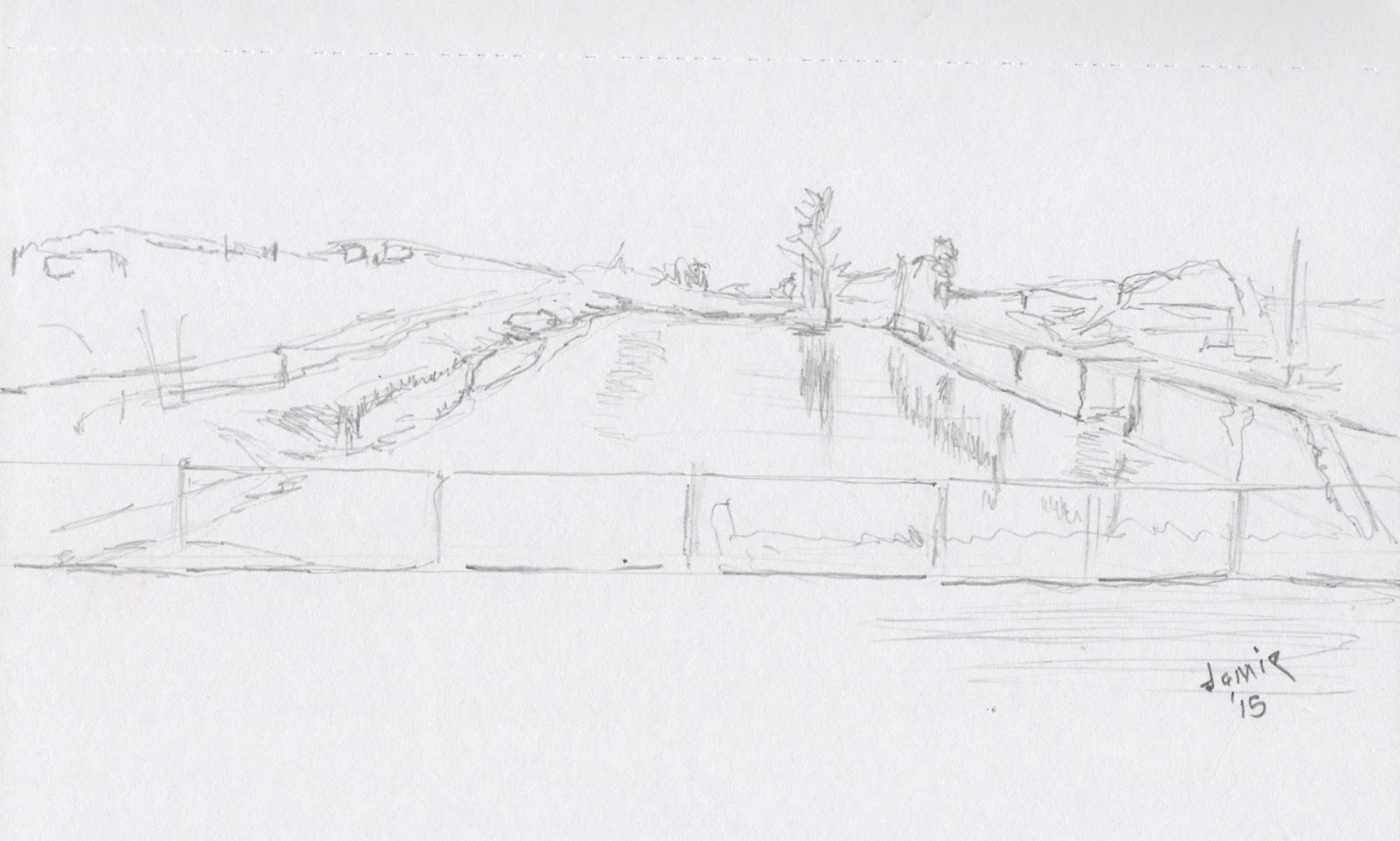
Impression sketches Canal at Boesinghe entrance to Ypres before and during war - by Jamie. See the originals at: http://www.gutenberg.org/files/36213/36213-h/36213-h.htm

An official French communication,
From 10 July 1915, gave information
Of further failed German attacks,
About the Yser canal – a wounded
French solider had provided a picture.

The German perspective of a ‘Land
Of cursed waters,' was given by one
Captured German. From their place
On right bank, here enemy made hold.

While all German caution had been
Taken, word reached French command
Of enemy preparations, for full attack -
With this information the French were
Prepared and ready for such an assault.  

9 July opened, with dawn of German
Gas bombs on the French left bank.
After the gas bombs, at 9 a.m. massed
German force provided little surprise.

An enemy formed a funnel attack over
The old stone bridge of Boesinghe -
Previously having made heavy attempt
In October 14 - chain bridges slung
Across, about the bridge of Yser canal.

Some shallow water allowed a waded
Crossing  - thus the German made
A tenuous hold on the French side -
Then confident, to be given new orders.

German troops were to take French
Second line trenches, a short distance
On - by then the bridges streaming
With German grey setting to reinforce
Their hold on the left bank of the Yser.

At a stage when a Bavarian Company
Filled the bridge, their luck halted in hit
By French 75’s - within moments bridge
Heads hit to fall into waters below,
With many Bavarians amid broken stone.

With crossing destroyed, more attempts
Of German chain bridges were hurriedly
Thrown across, amidst French counter
Attacks of Belgian and French Marines
Fixed bayonets, out to clear the left bank.

Chaos took over within German Lines -
They struggled, falling in their attempts
To assist two of their stranded battalions;
French 75's re focused on sappers work.

Under French fire they abandoned
Materials, if those soldiers were not hit
They fell to submerge in the canal depth;
Survival became nearly impossible,
'In the land of the cursed water.'

by Jamie Mann.

Anon.,1915. Fighting at Boesinghe – Germans Trap. The Daily Telegraph, [online] 22 July. P.10. Col.2. Available at: http://www.telegraph.co.uk/news/ww1-archive/11739263/Daily-Telegraph-July-22-1915.html [Accessed: 22 July 2015].

Mann, J., 2015. 100 years Ago - Poems by Jamie Mann. [letter] (Personal communication, 22 July 2015). 


#WW1 #WW1centenary #GreatWar #WW1poem #GreatWar #WW1centenary #worldwarone #worldwaroneremembered #WW1Boesinghe

Wednesday, 15 July 2015

Poem ~ German Food, Turkish Flies - Thursday, 15 July 1915


Impression sketch of NZ Medical Corps soldiers under Red Cross flag - by Jamie. 
See the original at: http://www.nzhistory.net.nz/media/photo/soliders-gallipoli-red-cross-flag

From employment of Reuters,
A Reporter made experiences
With the ordinary soldier from
Gallipoli. Comparison begins,

With what is rainwater, shells
And mud to the western front - 
Sun heat and flies are part
Of the Gallipoli experience.

Time, over prior two months
Had a bleaching relentless sun.
That hung unbroken in the sky
Devoid of cloud or rains - only,

Exception had been two tropical
Night storms - such high drying,
Hard weather was likely to carry
On for another two months more.

For the pale skinned Britisher,
Now at this continent, will be
More sun he would have seen,
Than in any of the previous two -

Years spent at home in Britain.
The languor of Asiatic breezes
Skimmed across the alien lands
In shimmer of a lazy heat haze. 

Men urged willing relief for an
English North Easterly breeze.
While such heated conditions
Are more normal for soldiers,

Of Egypt and Australia. A trend
In the heat for open neck shirts -
With Envy of Gurkhas who then
Exposed lower limbs in shorts.

Shorts still worn with puttees,
Allowed air to circulate - less
Shocking than English knees
Until tanned by a heated sun.

Those who could not get hold
Of 'sun knickers' improvised,
By cutting off trouser legs; such
Men became classified as a nut.

For some in a further enterprise
Were men who made a hem -
The fashion conscious for shorts
With a turn up - disadvantages,

To this look came in populations
Of local flies, that had tendency
To swarm and crawl any exposed
Anatomy; always irritation of flies.

The most annoying of presence;
Flies of Gallipoli – perhaps more
So than the Turks themselves.
An absence of the lord was taken,

By beeelzebub, who employed
Vermin  - all foods placed on table
For more than a few moments,
Turned foul black with movement.

Flies, big and bloated sought
More and when jam appeared
On the menu - as it often did,
A man was required speed,

To get jam rapidly into mouth.
A letter sent to supplies, noted
This Reuters man, tells supply
A need for dull coloured jams.

Khaki Jams, such as apricotm
To avoid attraction of airborne
Devil, sending men to madness.
For those who try to catch rest,

In midday dug outs to avoid
Fly swarms - flies that swarmed
On army waste and the unburied,
Between opposing trenches.

Flies that flick about faces and
Exposed flesh; flies enflamed
Tempers - increasing suffering
Of the wounded- even a breeze,

Blowing off the straits hardly
Touched flies -to fly in wind's teeth.  
Whenever a gale caught a swarm
Out to sea – the air would darken,

Like some pending plague - black
Swoops back the devil's Diptera -
In spite of flies armies in Gallipoli
Is described as solidly healthy -

Added to the biscuits and bully
Beef, a variety was then added
With fresh bread and arrival
Of Frozen meat from Australia.

Foods included potatoes, onions
As other supplies are provided 
For - as with adequate cigarettes,
Whose quantities not as many,

As they would like - demands
were more paper and envelopes -
A Greek run 'restaurant' provided
Additional variety to their diets.

Greeks supplied butter and milk -
While many prices were beyond
Means of some Tommy’s, they
Could buy canned vegetables,

Or fruit - this Reuters agent knew
Of one Tommy, in much umbrage,
Having parted for a shilling, a can
Of milk to find it was German.

Another time a box of cigarettes
Appeared on which was stamped
An English esquire who was
German - other cigarettes seen,

Were made expressly for one hun,
'Sache-Feldartillerie Regiment
Nr 68 '- described as a very poor
Standard wishing that Rgt. many.

One rarity was the appearance
Of newspapers - leading to locally
Made local daily paper 'Peninsula
Press' supplied to the battalions,

In order to keep abreast of wider
War, each fighting government
Are covered - even to learn what
Happens close along Turkish front.

by Jamie Mann.

Anon.,1915. A Soldier's Life at the Dardanelles - Plague of Flies - German Made Luxieries. The Daily Telegraph, [online] 15 July. P.11. Col.1. Available at: http://www.telegraph.co.uk/news/ww1-archive/11732049/Daily-Telegraph-July-15-1915.html [Accessed: 15 July 2015].

Mann, J., 2015. 100 years Ago - Poems by Jamie Mann. [letter] (Personal communication, 15 July 2015). 


#WW1 #WW1centenary #GreatWar #WW1poem #GreatWar #WW1centenary #worldwarone #worldwaroneremembered #WW1Gallipoli