Showing posts with label Women. Show all posts

Thursday, 26 January 2017

Poem ~ Munitions And Women - Friday, 26 January 1917 - Saturday, 27 January 1917

Source: File: Women working at the Ferranti factory. See an original image at: <http://www.centenarynews.com/article?id=3291> [Accessed 26 January 2017]

On the 4th floor of Harrods, London SW,
The Georgian restaurant acted as a venue;
Depicted for a select clientele were massed
Workers, working in country’s protection.

Engaged in night and day manufacturing
In defence of the nation, half a million
Women were employed by the Ministry
Of Munitions - established in May 1915.

Displayed at the London SW address,
Was a photographic exhibition of women
Workers, undertaking the armaments
Manufacture in black and white images.

In England's reorganised industries were
Some 4,600 centres making armaments;
Along side national factories of munitions,
In which able women played a vital role.

The exhibition, organised by Munitions
Of Ministry, were aimed at the Georgian
Restaurant patrons, who would peruse
The honest black and white depictions.

15 varied types of industry were shown
In 250 photographs - ordinary women
Working in completion of arms and how
These workers were given much support.

Hospital and welfare canteens shown
Alongside the munitions workers - taking
Control of manufacturing explosives,
Barbed wire, shipbuilding and aircraft.

Engineering, both electrical and general
And building of gunnery the purpose
Of this project acting a recruitment;
Women and more women are needed.

An appeal went out to all 18 to 45 year
Old women to approach their nearest
Employment exchanges, or provincial
Training centres, in London or counties.

A bill of fare would then explain the cost 
Of living for a woman in consideration;
These were real images of real women,
With dirt stained and determined faces.

by Jamie Mann.

Anon.,1917. Women's Munitions Works - Exhibition Of Photographs. The Daily Telegraph, [online] 16 January 1917. P.10. Col.4. Available at: <http://www.telegraph.co.uk/news/ww1-archive/12214109/Daily-Telegraph-January-16-1917.html> [Accessed: 26 January 2017].

Mann, J., 2016. 100 years Ago - Poems by Jamie Mann. [letter] (Personal communication, 26 January 2017). 


#WW1 #WW1centenary #GreatWar #WW1poem #GreatWar #WW1centenary #worldwarone #worldwaroneremembered #WW1Women

Wednesday, 11 January 2017

Poem ~ Sergeant Flora; Serbian Fighter - Thursday, 11 January 1917 - Monday 15 January 1917


Source: File: Private Flora Sandes. See an original image at: <http://www.badassoftheweek.com/sandes.html> [Accessed 11 January 2017]

i
There was a girl Flora Sandes,
Born in 1876, North Yorkshire -
Flora was a daughter of an Irish
Clergyman Samuel Sandes.

A middleclass background
Of likely genteel upbringing,
Did nothing for the determined
Young girl, who did not favour
Girl's dolls or sewing - to only
Wish she might have been a boy.

Formative years of Flora Sandes
Saw her family move to Suffolk,
Where she favored hobbies
Of shooting and horse riding.

Dreams of adventures filled
Her young mind, as she charged
Across fields on horseback with
An imaginary sword of Crimea
Status to attack Russian rank -
Her father loved Flora's spirit.

A proper education for a young
Lady could do nothing to stay
Victorian values of feminine
Pursuits, to favour masculinity.

18 in 1894 Flora undertook
To train as a stenographer -
A drive for adventure became
Funded by money left her from
A wealthy uncle, allowing her
To undertake travel passion.

She took a route through Cairo,
Across the Atlantic, to travel
To Canada’s British Columbia
And Unites States of America.

Here the gun totting Flora shot
A man - the act she described
As self defence - returning home
To London she learned to drive
And bought a French racing
Car, while joining a shooting club.

ii
Flora by 1912 was in Serbia for the
Brief Balkan war - where a league
Of Greece, Montenegro, Bulgaria
And Serbia faced Ottoman Empire.

The First Aid Women’s Yeomanry
Assisted to bring aid to wounded -
Originally from Omdurman battle
Of 1898 - here a wounded sergeant
Saw how many died from lacking
First aid; his idea was a new corps.

This would be mounted nurses,
Who could ride onto the field
After battle, to render first aid -
This evolved into the Yeomanry.

As war ended in 1913 Flora was
Back home, to live with her old
Father and nephew Dick, where
Her boredom was evident from
Chaotic household, until August
1914 - a fresh war had emerged.

28 July had seen Serbia invaded
By Austria Hungary - within
Seven days Flora Sandes had
Travelled into the danger zone.

Led by Mabel Grouitch, a unit
Of St John's Ambulance made
Of 36 women in Kragujevac -
On the front line Flora nursed
In varied military hospitals; within
A year she could speak Serbian.

In October 1915 Flora joined
Serbian Red Cross, alongside
The Iron Regiment, the Serbian
Army’s 2nd Infantry Regiment.

With odds against them Serbia
Was being forced to retreat - escape
Could only be by Albanian heights.
Infantry and the Red Cross made
It to a stage where ambulances were
Unable to pass - Flora took decision.

iii
In a declaration, Flora stated
She would become a private
In the 2nd Regiment, taking
Off her Red Cross badge.

A report of a wounded soldier
Brought to notice the unusual
Wounded fighter, in a Salonkia
Hospital filled by male soldiers.

12 December 1916, reporter
F. Calvert met the brown eyed
Fresh faced, cropped grey haired
Lady, at No 41 military hospital
Camp, to accommodate 1,600
Men; Flora Sandes sat up in bed.

Lying in the nurses ward Sandes
Smiled to explain the bandages
On her right hand arm - along the
Shoulder to knee - had been injured.

Broken bones and torn flesh were
Result of Private Sandes encounter
With a Serbian hand bomb - when
Assiting Serbes clerance of a trench;
Her bravery had been rewarded
Given by Prince Regent of Serbia.

Days before on behalf of the Prince,
A Royal aid-de-camp visited Flora,
To ceremonially award her a gold
And Silver Cross of Kara-George.

In Serbia The Order of Karađorđe's
Star was that country’s highest
Decoration - for bravery in combat -
Flora Sandes reached under her
Pillow and held up decorated cross
For inspection by the reporter.

Flora’s story was relayed to say
How she had first entered the war
As a nurse - by the autumn retreat
Of 1915, she was rear guard private.

iV
Private Sandes actions led to gain
Of promotion to Sergeant Sandes.
The army reached Corfu to find
Recuperation - Flora was involved
Next on Macedonian front to fight
In campaign; 12 September 1916.

More than ninety days passed as
Sergeant Sandes fought alongside
Serbian men, every hour filled
With frontline acts of gunfire.

High ground made the front,
With foe of Bulgaro-Germans
In fight north from Gornitchevo
And Kaymakchalan, to Hill 1,212.
Snow lay on ground- they waited
For order to rise up and attack.

Flora and her soldiers paused
For some time, when order came
To attack at 7 a.m. - as officer she
Led the way, but admitted a flaw.

Her men were faster to arrive first.
Sergeant Sandes closed as fast
As she could to the Bulgarian line
With some others when a grenade
Was thrown into their midst - two
Others in explosion fell wounded.

Close by an officer saw her fall
And crawled across snow to Flora
And dragged her back to rocks;
Pulled by a broken arm caused pain.

Dressed on field and taken away
By stretcher, she praised her rescuers.
Grenade splinters had caused some
25 wounds - with some yet to be
Removed - reporter Calvert spoke
Of her high spirits and her request.

Asking Calvert to gain her a volume
Of Rudyard Kipling especially to read
'If' again; 'the finest poem written'- words
To challenge a son to become a man.

by Jamie Mann.

Calvert, F., 1916. Woman Soldier - Fought In Serbia - Scottish Lady's Medal. The Daily Telegraph, [online] 30 December 1916. P.11. Col.1. Available at: <http://www.telegraph.co.uk/news/ww1-archive/12214039/Daily-Telegraph-December-30-1916.html> [Accessed: 11 January 2017].

Source: File: Flora Sandes. Wikipedia. Available at: <https://en.wikipedia.org/wiki/Flora_Sandes> [Accessed 11 January 2017]

Source: File: Flora Sandes. Ellen Castelow. Available at: <http://www.historic-uk.com/HistoryUK/HistoryofBritain/Flora-Sandes/> [Accessed 11 January 2017]

Mann, J., 2016. 100 years Ago - Poems by Jamie Mann. [letter] (Personal communication, 11 January 2017). 


http://worldwaroneblogger.blogspot.co.uk/

#WW1 #WW1centenary #GreatWar #WW1poem #GreatWar #WW1centenary #worldwarone #worldwaroneremembered #WW1Women

Friday, 9 December 2016

Poem ~ Mystery Of Private Brazil - Saturday, 9 December 1916 - Sunday 10 December 1916

Source: File: Edwin and Annie Brazil - researched by Thomas Uhlarik, John Hampden Grammar School. Wikipedia. Available at: <http://www.galaxypix.com/Sally/Losttheplot/Tellthemofus/BrazilE.html> [Accessed 9 December 2016]

Source: File: Attestation papers of Edwin Brazil. Available at: <http://www.bac-lac.gc.ca/eng/discover/military-heritage/first-world-war/personnel-records/Pages/item.aspx?IdNumber=61953> [Accessed 9 December 2016]

Source: File: Wycombe and the Somme part 4 Gilbert Bates and Edwin Brazil researched and performed by pupils from John Hampden Grammar School and Wycombe Abbey School.  See original footage: <https://www.youtube.com/watch?v=g19ChiaNn78&feature=youtu.be&t=6s> [Accessed 9 December 2016]

i
Tucked away in an almost insignificant report
Page 14, column 3 of The Daily Telegraph,
Noted the loss of a Canadian soldier; although
Facts around him were left as a mystery.

An Englishman Edwin Brazil born Colchester
Essex, 26 June 1875, whose circumstances
Went unexplained; married, Edwin was living
In Canada by the second year of war.

Following his reasons Edwin joined the services
As a Canadian, with 179th Battalion Cameron
Highlanders of Canada - declaring his kin within
Attestation papers dated 13th November.

Next of kin being his wife Annie Huntley Brazil
From High Wycombe, Buckinghamshire
In England, though Edwin was living Winnipeg,
Manitoba in Canada; his trade a wood carver.

Then aged 39 and five months Edwin Brazil
Had a medical examination 12 November 1915.
Height 5 foot 9, described as having thinning
Black hair, fresh complexion with brown eyes.

His chest at full expansion was 38', and noting
He had operation wound on left foreleg -
The medical Captain considered him fit; Brazil's
Attestation signed by a lieutenant Colonel.

Having been recruited in Winnipeg, Canada
Edwin Became Private Brazil 859265 and
Sailed to England, 4 October 1916, on H.M.T.
Saxonia - arriving Liverpool 13 October.

Private Brazil was soon promoted to the post
Of Acting Corporal - by date 17 October to be
Stationed at the Sandling Camp in Folkestone.
Gaining leave Edwin visited his old home.

ii
With 6 days leave to spend, Edwin travelled
Returning to his wife living at 'Brouhaul,'
Amersham Hill, High Wycombe - situated on
A leafy road of various substantial houses.

When those few days came to an end acting
Corporal Edwin Brazil informed his wife
That it was time for his returning to Sandling
Camp - that night Edwin left their home.

Edwin though had no intentions in travelling
To camp, instead he travelled into London,
For whatever reason - then 25 November 1916
Saturday, Edwin Brazil was out walking.

The hour was dark as Edwin Brazil crossed
Grosvenor Place, when all of a sudden
He was hit by a motor bus - the driver and
Others close by went to assist him.

Before he could be taken to St Georges
Hospital, Acting Corporal Brazil died
Of his injuries, lying on the London street -
An inquest was held 30 November 1916.

In conclusion the driver was exonerated from
Any blame, as the verdict of the inquest
Declared this as accidental death - Edwin
Brazil was laid to rest High Wycombe.

Records showed that his last known address
To be Mrs Reeves, 242 Ellen St, Winnipeg,
Canada, though Edwin would declare his will
And estate to 'my wife, Anna Huntley Brazil.'

The mystery of Corporal Brazil perhaps no
Mystery - having married young to Annie
Stevens to become estranged by his behaviour
His wife had hoped that he might change.

Emigrating to Canada, still working as a wood
Carver, Edwin sought a new life - only to return
To England, to see Annie after long years - yet
A hope of love again lost in pointless death.

by Jamie Mann.

Anon.,1916. Killed By Motor. The Daily Telegraph, [online] 1 December 1916. P.14. Col.3. Available at: <http://www.telegraph.co.uk/news/ww1-archive/12213905/Daily-Telegraph-December-1-1916.html> [Accessed: 9 December 2016].

Source: File: Edwin Brazil. Available at: <http://buckinghamshireremembers.org.uk/php_scripts/bksidget.php?id=516> [Accessed 9 December 2016]

Source: File: Canadian Virtual War Memorial: In Memory of Corporal Edwin Brazil. Available at: <http://www.veterans.gc.ca/eng/remembrance/memorials/canadian-virtual-war-memorial/detail/343890> [Accessed 9 December 2016]

Source: File: Edwin Brazil, researched by Thomas Uhlarik, John Hampden Grammar School. Available at: <http://www.galaxypix.com/Sally/Losttheplot/Tellthemofus/BrazilE.html> [Accessed 9 December 2016]

Mann, J., 2016. 100 years Ago - Poems by Jamie Mann. [letter] (Personal communication, 9 December 2016). 


#WW1 #WW1centenary #GreatWar #WW1poem #GreatWar #WW1centenary #worldwarone #worldwaroneremembered #WW1Canada

Thursday, 20 October 2016

Poem ~ Patriotic Gesture - Friday, 20 October - Saturday, 21 October 1916

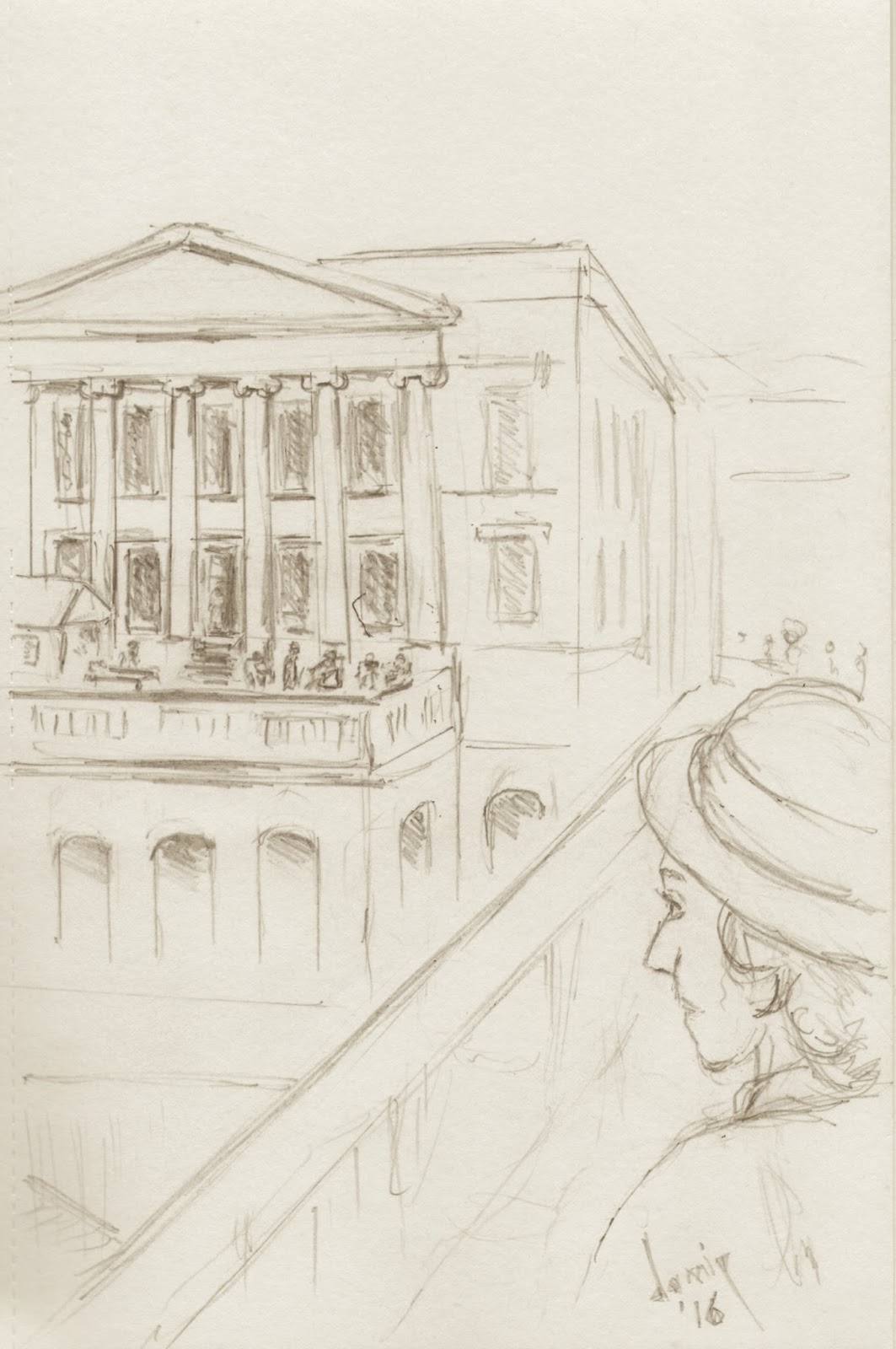
Impression sketch for a girl's patriotic gesture.

Established in the heart of the English capital,
The Fishmongers Hall had witnessed many
Varied eras over 600 years, from medieval
Beginnings as a city guild; once destroyed
In the great fire of London was then rebuilt.

With such a history the Fishmongers Hall
Again adapted in 1914 in a time of war -
Alderman wives in approaching many
Firms made request to Fishmongers Hall.
Then owned by a city livery company.

In need to treat wounded men, the hall agreed
To become Royal Red Cross Hospital; while
Small and grand facing the River Thames, the
Situation served well for recovering officers
With 27 beds; opened on 1 October 1914.

Along with the apartments used on the first
Floor, the Great Hall was divided into five
Cubicles next to the windows. Positioned
Amid the gilded decoration, was another
Room divided into two, to hold four beds.

A wooden hut was constructed out on
The balcony - for those cases of septic
Nature or needing open air - on the quiet
Side were other rooms for more serious
Wounded, with X-ray and operating rooms.

A 27-bedded hospital gave environment akin
To homeliness with armchairs, electric lights
And reading tables - pink rugs next to beds
With down quilts - meals served in rooms
Allowing two guest visitors for afternoon tea.

Situated alongside London Bridge, endless
Traffic passed by. This included one young
Lady, who decided to write to the grand
Hospital offering her services - prompted
By her daily excursions across the bridge.

Though her actual name was finally omitted
From the published transcript, Jane as she
Might be called for purposes here, would
Have seen wounded men taking the air
On the balcony - being moved to assist.

The House Surgeon of Fishmongers Hall
Hospital, had received the letter from Jane,
A city worker, who began by apologetically
Saying she was taking liberty in her question,
To ask after the process of healing wounds.

Jane had heard that there had been a lack
Of skin - which if grafted to the wounded
Man, would to be better and easily healed.
For this purposes Jane made offer of her
Own skin, as much as practically possible.

Jane informed the house surgeon of her
Situation - being obliged to travel every
Day into the city to earn a living - this
Was not an impulsive idea - no doubt
Having seen arrivals of ambulances.

Jane’s own situation disallowed any
Chance to help soldiers as other girls
Her age had done - how she might help
Then by offering her own skin - she wanted
To do this for her two fighting brothers sakes.

Having taken much time to think of this
Contribution, Jane stated how she knew
Of nowhere else to write - furthermore that
If they could not use her services for taking
Skin grafts, where else might she approach?

by Jamie Mann.

Anon.,1916. A Girl's Patriotism - Offer to Hospital. The Daily Telegraph, [online] 10 October 1916. P.5. Col.3. Available at: <http://www.telegraph.co.uk/news/ww1-archive/12213439/Daily-Telegraph-October-18-1916.html> [Accessed: 20 October 2016].

Mann, J., 2016. 100 years Ago - Poems by Jamie Mann. [letter] (Personal communication, 20 October 2016). 


#WW1 #WW1centenary #GreatWar #WW1poem #GreatWar #WW1centenary #worldwarone #worldwaroneremembered #WW1London

Tuesday, 11 October 2016

Poem ~ What To Do With 'Drunken' Officers - Wednesday, 11 October - Sunday, 15 October 1916

Impression sketch for What To Do With 'Drunken' Officers.

i
In a number of insubordinations, various
Appearances of officers stood before
Major-General Lord Cheylesmore, who
Presided at a court-martial, Westminster.

A Commandant of Bisley Camp School
Of musketry, who had in his youth been
Described as an all round sportsman -
Though 'a little too eager to shoot birds.'

Eager Major-General Lord Cheylesmore 
Was fond of 'teaching the young idea
To shoot' - along with Karl Hans Lody trial
He had many court-martials under his belt.

Major-General Lord Cheylesmore now
Turned his talents to home grown issues -
He faced an accused Second Lieutenant
F. L. Whalley, who had pleaded not guilty.

A charge held on the Lieutenant as drunk
On 6 September 1916, at the Wimbledon
Common camp, 10.45 p.m. - the court
Listened to how Whalley's story unfolded.

A taxi cab driver appeared at servant's
Hut on the camp, asking for Lieutenant
Whalley's servant Private Donovan, who
He addressed, to request the officer’s fare.

The driver had refused the idea of being
Given a cheque - although not very clear,
Private Andrews likely went to officers
Mess, to inform another officer of events.

A further witness confirmed how Lieutenant
Whalley was slumped on his bed to appear
Drunk - in shaking him he asked him what
He was going to do; 'give the man a cheque.'

Whalley asked them to write this for him -
Private Donovan advised the driver a cheque
For 25s would be posted - in his evidence
Whalley informed court of personal worries.

Since late August his concerns centred 
About his wife having recently given birth -
On 5 September he had been all day at the
Nursing home, returning to camp at 9 p.m.

He could not sleep so then returned
To the nursing home by 1 a.m., where
Two Doctors held no hope for his wife.
In addition the child would not survive.

Staying there for many hours he finally
Left 9 p.m. Whalley took a taxi to stop
At a hotel, to drink 3 sodas and brandies
He had not eaten - but nor was he drunk.

Collapse came from mental worry and
Physical exertion - court then heard how
Whalley had been in army 11 years with
4 years active service in South Africa.

During that time no crime had been made
Against him - a letter was provided by late 
Lord Roberts to Whalley's parents, to say 
He had been part of his close bodyguard.

Whalley carried out his duties smartly,
As a keen soldier - while Captain Neale
Advised he proved to be excellent officer
And popular with colleagues and men.

ii
From Bedfordshire Yeomanry stood
Second Lieutenant H. E. R. Craig, to be
Accused that on 16 September 1916 he 
Was at Empire Music Hall Promenade.

He was found dancing whilst in uniform.
Captain T. V. Brown, Assistant Provost
Marshal of Australian Force, saw Craig
Step dancing, his arm around a civilian.

Captain Brown spoke to Craig to say his
Behaviour did not become an officer -
The Lieutenant replied he was not doing
Any harm - the Captain asked for his card.

The reply was, 'I have not got any,' to add
Was his word not good enough? then given
An order to report on Monday. 'I cannot
Do it' - then Craig followed Captain Brown.

Craig had asked for Brown's card in order
He may lodge a complaint; at 11.15 p.m.
A Captain Cameron asked him, after what
Brown had said, why did he follow him?

Craig denied he followed Brown - asked
Again if he understood he was to report
To the Provost-Marshals office the next
Morning - the reply was, 'I cannot report.'

After repeating that he must report, Craig
Was told not to loiter but go on his way -
Giving back reply, 'I shall stay where I like.'
At that point he was arrested and taken.

Travelling quietly in the taxicab Craig was
Quite sober - at Scotland Yard Lieutenant
Craig was put into a cell, to perform steps
Of a dance as the door was being locked.

Lieutenant Craig faced court-marshal over
3 charges of insubordination to a superior
Officer - this he denied, stating how he had
Only been at Promenade talking to a friend.

Further to explain that after being led into
The cell, where all the windows were open,
Lieutenant Craig stamped his feet to keep
Warm and that he had not been dancing.

iii
Second Lieutenant A. E. N. Phillips, an
Officer of the Royal Garrison Artillery sent
A telegram to the Anti Aircraft company,
Commander Captain Rotteburg one Saturday.

His words, 'kindly excuse me parade this
Morning: unavoidably detained.' Without word
Until Monday 18 September, to say by wire
He would report Tuesday with explanations.

Second Lieutenant A. E. N. Phillips was
Actually absent from Friday 15 to Tuesday
19 September - in his decision not to give
Any explanations, he instead gave evidence.

Stating that his section had no weekend duty,
Phillips had not realised that there were strict
Regulations in what his absence had meant -
If known he would not have taken time away.

Lieutenant Phillips defended his character,
To state he had been in the Matabeleland
And Natal Mounted Police, South Africa -
Having gained medals prior to his arrival.

He had decided to leave his police post there
To travel to England and fight for the Empire.
Having heard evidence, the court remained
Undecided on Lieutenant Phillips sentence.

Vi
On another day, without any connection,
A second Lieutenant of the Australian
Imperial Force, G. D. Lemon, had been
Present in London, 23 September 1916.

Second Lieutenant Lemon faced charges
Of drunken behaviour in Leicester Square
10.30 p.m. when he should have reported
To camp, catching his train from Waterloo.

Missing the 5.50 p.m. train that evening,
Lemon advised he was unaware of having
To get a specific train - he met an Australian
Friend, intending to travel to camp with them.

Lemon planned his return Sunday morning.
His promotion to rank of Second Lieutenant
From private had occurred in 1916; a court
Martial existed from August, for being drunk.

With Lieutenant Lemon's sentence yet to be
Decided, as was Second Lieutenant Phillips,
Lieutenant Craig, the keen, sober dancer's
Summing up said 'not guilty' - while Whalley's
Concerns for his wife, was found 'not guilty.'

by Jamie Mann.

Anon.,1916. Courts-Martial - Charges Against Officers. The Daily Telegraph, [online] 7 October 1916. P.x14. Col.1. Available at: <http://www.telegraph.co.uk/news/ww1-archive/12213397/Daily-Telegraph-October-7-1916.html> [Accessed: 11 October 2016].

Mann, J., 2016. 100 years Ago - Poems by Jamie Mann. [letter] (Personal communication, 11 October 2016). 


#WW1 #WW1centenary #GreatWar #WW1poem #GreatWar #WW1centenary #worldwarone #worldwaroneremembered #WW1London