Showing posts with label No Mans Land. Show all posts

Monday, 16 January 2017

Poem ~ Owen: A Letter Home - Tuesday, 16 January 1917 - Sunday, 21 January 1917


Impression sketch of Wilfred Owen crawling towards advanced post  by Jamie

i
From Billet to canvas to cattle wagon,
Came stages of transportation -
Within twelve days of arrival Wilfred
Owen no longer had protection.

The rocking, sliding ride amid others,
Took them towards inevitability -
A mistletoe code home broke all rules
To spell S e r r e; a ghostly place.

West of there British trenches marked
An edge; reserve, support and front
Lines - foul conditions still being used -
A communication trench led him.

First sign of the front met Owen's eyes;
They likely waded in knee deep
Waters - poisoned rainwaters that glints
By sunlight, tarnished in decay.

Early January and deep winter held
Its promise of snow - snow that
Briefly alleviated the churned ground -
Its brief purity sucked down.

Lieutenant Wilfred Owen would later
Find time to describe the state
Of the front in a six paged letter home,
Sent to, 'My own sweet Mother.'

ii
Penned five days into his first arrival there
By subjective analysis the pressure
Of each stroke suggests Owen's tiredness,
Sensitivity and likely empathy.

Words set out with deep indents, whose
Characters stand upright - added
To here and there with thoughts or small
Words, struck in favour of others.

Wishes for freedom spaces words, along
With logical and practical character
By lack of slants, as each connected letter
Shows careful systematic decisions.

With i's whose dots often fly away
To the right, confirm this male
Writer’s imagination - ability topped
Of capital T suggested optimism.

Emotions of the man are portrayed
By choice of expressions -
Openly he is 'bitterly' disappointed
In not receiving her letters.

In honesty the officer informs his
Mother, no reason to deceive
How he had suffered 'seventh hell,'
Over the previous four days.

iii
Dante’s vision takes Wilfred Owen
Whose poet’s circles transport
Him to the seventh circle; made from
Three rings, first is the outermost.

On banks of boiling blood and fire are
Violent beings and murderers -
In the middle ring harpies feed on the
Vegetation formed by suicides.

There wild dogs tear to shred wasters -
The innermost ring are irreverents
Who stand on scolding sands beneath
Torrential, burning, hellish rains.

Such describes the state of the front
Where before Owen has been,
Beyond the very core of No Mans Land.
'I held an advanced post.'

In a singular parameter he is joined;
'We marched 3 miles a shelled
Road dissolved into a flooded trench,
Finally flattened into nothing.'

It was night as they aimed for the dug
Out in the midst of No Mans Land
Up and over the top into utter darkness,
That held no chance of light.

iV
In varieties of depth of up to five feet
Of mud, Owen at pains, describes
How this is no ordinary mud not even
Sloppy but a deep sucking clay.

By properties of an octopoda creature
Of mythology; an ability to suck
Anything down into doom - here men
Have been known to drown.

Some can only escape by discarding
Equipment, waders and even
Their clothes, in order to crawl from the
Slippery claws - many have fallen.

Relentlessly machine guns stuttered
With high explosives all around -
Yet the darkness seemed able to absorb
Any light, so no flare revealed them.

Blind men in a brail of a path, the party
Reached the dug out - each three
Quarters dead, there relieved observers.
Owens responsibility was not over.

In charge of other posts even further
Into hells depth, he found another
Advanced post - here he left bombers
To number 18; nearby were others.

V
Slight relief came as one junior officer
Took charge of those - the dug out
Where they stood was six feet, water
Though held the first two feet.

Air of a kind was contained in the four
Feet left - here forms of 25 men
Were squeezed together; short sentences
Conveyed Owen's abject misery.

Though only afternoon this was January.
Ten minutes dragged into an hour -
To say '50 hours that were the agony of my
Happy life'; bled despondency.

Water was still rising, as the Germans
Knew they were there and did
Not want them - German shells wailed
Through the dark as hells hounds.

Owen admitted to being on very edge
Of breaking point - he stared down
Into the water, almost to let himself drown.
Shelling faded as 6 p.m. struck hour.

At 150 yards lay yet another British post
That should take only sixty seconds
To walk; Owen waded, climbed, crawled
To take 30 minutes to reach.

Vi
The most danger came from friendly fire
Of machine guns behind - holding
To humor he compared them to Mary’s
Canary, who he could support more.

In plain horror the sentries, one of whom
He had not taken as his servant, were
Blown away - if taken the fellow would be
Alive; servants don't do sentry duty.

In safety Owen ordered the other sentries
Half way down the dug out stairs,
Under the intense bombardment - yet one
Lad blown down stairs was blinded.

To close with short sentences in effect
Of disjointed thoughts; 'I suppose
I am well, though the left platoon officer
In hospital completely exhausted.'

Perhaps like the officer that he relieved
Owen suffered a deeper shock;
The man left after 24 hours to abandon
3 Lewis guns for a court martial.

For honesty allowed Wilfred to declare
All this to Susan, as that place
Was the worst Manchester’s ever held -
He would never go back there.

Vii
By hurried last lines to complete sixth
Page, squeezed together by open
Half coded criticism, against a fellow
Distinguished countryman.

The shared Welsh ancestry of Lloyd
George, the Prime minister
Of the British war time government,
Whom this soldier cursed.

Though any leader might be par for
The course - he gave his mother
Allowance to pass on his experiences
To others, such as cousin Leslie.

Under the curious reference, 'Owen
Owen' to hint at the Medieval
Ruler, who led welsh revolt against
The English, in vain self-status.

Self consciously perhaps his intent
Always for a wider audience -
A letter, not just for his mother's gaze,
But to show others the truth.

His own eyes opened by the harsh
Reality and to contain a source
That would remain in Owen's mind
Of a sentry tumbling blind.

By Jamie Mann.

Source: File: Letter from Wilfred Owen to his mother on January 16 1917. Available at: <http://battlefieldtrip.wikispaces.com/Wilfred+Owen> [Accessed 16 January 2017]

Source: File: What does your handwriting say about you?. Available at: <http://www.dailymail.co.uk/sciencetech/article-2380858/What-does-handwriting-say-Study-finds-5-000-personality-traits-linked-write.html> [Accessed 16 January 2017]

Source: File: 9 Circles of Hell (Dante's Inferno). Available at: <http://historylists.org/art/9-circles-of-hell-dantes-inferno.html> [Accessed 16 January 2017]

Source: File: Owain Glyndŵr. Wikipedia. Available at: <https://en.wikipedia.org/wiki/Owain_Glyndŵr> [Accessed 16 January 2017]

Mann, J., 2016. 100 years Ago - Poems by Jamie Mann. [letter] (Personal communication, 16 January 2017). 


#WW1 #WW1centenary #GreatWar #WW1poem #GreatWar #WW1centenary #worldwarone #worldwaroneremembered #WW1WilfredOwen

Sunday, 25 December 2016

Poem ~ Season Of Peace And War - Monday, 25 December 1916 - Tuesday 26 December 1916

Source: File: Ruheben Camp festive card. Sketch depicting the card as they might have appeared in 1917 ‑ had the war ended that year. See an original image at: <https://www.worldwar1postcards.com/christmas-postcards.php> [Accessed 15 December 2016]

Reaching a bridge of 24 months from
First war Christmas, came 1916 festivities -
Situations of moods had long changed,
Across bitter stalemate of frontlines.

For the dead there were no celebrations.
Many that had once kicked a football
Across No Mans Land, long laid below
Or scattered across its poisoned mud.

Verdun, Somme and many new names
Of battles marked the bitter losses - any
Type of fraternisation forbidden by orders;
No football games of Hun versus Tommy.

Yet such truces of peace were not totally
Diminished - many Germans called out
Across the void to the Tommy and the Poilu
For 'Trêve de Noël' and 'Weihnachtsfrieden.'

The French spirit for 'live and let live' saw
Sectors sing to each other in native songs,
Along with exchanged gifts thrown across
Closest spaces of their outermost trenches.

Still the season, though subdued, continued.
Back in blighty had been orgainsed programs,
To get Christmas puddings to the front troops;
Though jokes abounded, if they would arrive.

With frozen stalemate in mud and the worst
Weather for more that 30 years, shortages
Were taking a grip - seasonal telegrams did
Not halt to tell men’s families of their deaths.

Not to forget the detained, held in camps from
Either side - with those most talented devising
Festive postcards - the artistic in the Ruhleben
Civilian camp held since 1914, drew designs.

In a card for xmas two detainees stare beyond
The wire towards the rising sun in hope of 1917;
A version shows them dancing before a happy
Sun and posts without wire, had the war ended.

A cherub builds three blocks for each war year;
1916 atop 1915 and 1914 - while yet another
Card, a smirking cherub kicks away the blocks -
Tentatively wishing happy forebodings for 1917.

With many an unlucky Tommy still on duty
In the trenches - as witnessed by news reporters
Such as Philip Gibbs - where after frosts, sleet
And snow found Christmas Eve a mild day.

Winter sunshine reflected across swamps
And flooded holes described in poetic images;
As supply columns churned their ways through
Mud, delivering feast day supplies to troops.

Gibbs saw soldiers as Noah like figures building
Colonies of huts, with attempts to abate floods -
Figures everywhere, splattered stiff with pale mud,
Emerged from lines imbued with Christmas spirits.

By subdued daylight Tommy's, Jocks and Anzacs
Sought out trinkets in nearest of French village
Markets - while on eve of feast day the reporter
Found a crowded restaurant, ready to celebrate.

Characters at every table; Tommy’s and Poliu
In salute of Entente Cordiale; 'Bonne chance!'
'Nous Les Aurons' and counter Christmas wishes
To old Fritz - here and there sat puzzled faces.

Young faces of 1916 recruits, amid the mature
Old Contemptibles, drawn into other temporary
Moods - away from the easy warmth and light
He took a few steps into darkness, to see blinks
Of horizon shells - somewhere soldiers died.

by Jamie Mann.

Gibb. P.,1916. Tommy's Xmas Eve - Scenes And Contrasts - A Memorable Picture. The Daily Telegraph, [online] 26 December 1916. P.7. Col.1-2. Available at: <http://www.telegraph.co.uk/news/ww1-archive/12214032/Daily-Telegraph-December-26-1916.html> [Accessed: 26 December 2016].

Source: File: Picture Postcards From The Great War  - WW1 Christmas Postcards  by Tony Allen- 1914-1918. Available at: < https://www.worldwar1postcards.com/christmas-postcards.php> [Accessed 26 December 2016]

Mann, J., 2016. 100 years Ago - Poems by Jamie Mann. [letter] (Personal communication, 26 December 2016). 


http://worldwaroneblogger.blogspot.co.uk/

#WW1 #WW1centenary #GreatWar #WW1poem #GreatWar #WW1centenary #worldwarone #worldwaroneremembered #WW1Christmas

Saturday, 8 October 2016

Poem ~ Death Wire of Holland - Sunday, 08 October - Tuesday, 10 October 1916


Source: File: The Wire of Death. See an original image at: <http://www.dodendraad.org/index.php/wire-of-death> [Accessed 8 October 2016]

With dummy guards making up numbers,
Across the Dutch German border, more
Seriously the Dutch Belgian frontier was
Given another method; the 'Wire of Death.'

In August 1914, waves of Belgium refuges
Had begun to cross into Holland, to avoid
The occupation - joining family or seeking
To fight by taking that route to join allies.

After six months the German occupiers
Sought to prevent this, commencing by
Building a fence - not just any fence - that
From Aix-la-Chapelle over to Scheldt River.

German fears that among 30,000 fleeing
Could be smugglers, or worse spies taking
Vital information - wires built at 3 metres
High to stop them, carried 20,000 volts.

Therefore an electrified fence had
Ability to contain occupied population -
In addition were desertions of German
Soldiers, crossing over Holland’s border.

From the coast of Knokke was begun
This fence - the builders being Belgian
Labourers - German Military engineers
Led poorly provided 'volunteer' groups.

They wore ordinary shoes and civilians
Clothes - to note that by closure of first
Day half the volunteers had fled, to make
Escape across into Dutch countryside.

The construction involved more one wire;
A central wired fence carrying a charge;
On each side a non-electric wire. Laying
Out the route trees many were cut down.

East to west construction commenced
April 1915 raised in stages - by summer
Areas of Boekhoute, Maldegem, Neerpelt
And between Mindeerhout and Aredonk.

The start of electrification then began
24 July 1915 - though total completion
Continued until mid 1916 - without power
Stations sources of electrification varied.

Electric power to feed the wire came from
Local generators and factories; Zelzate
Lommel, Kaulille Merksem and Kapellen;
The fence was then guarded 24 hours.

The wire of death followed the wavering
Border, constructed on the Belgian side,
Leaving a No Mans Land between frontier
And border, often to include whole villages.

As other villages found the wire through
Their centre, as at Overslag - in addition
Huts and confiscated houses in intervals
For connecting and controlling power.

Border to border fences were impractical
So gates had to be constructed to allow
Passage; Militärdurchlässe had military
Purposes, with Zivildurchlässe for civilians.

Only with few exceptions were civil people
Allowed passage, for life and death reasons.
Meanwhile agents sought to bribe guards
While others took chances to get through.

Where a river interrupted the wire was made
A chance to swim - other elaborate ways set
To build scaffolding, from each side in wood
Ladders, or open the wire by wooden widows.

With the death wire in place the German
Occupiers of Belgium created divisions
Of families - while many made it across
Others lost their lives; shot or electrocuted.

by Jamie Mann.

Source: File: Twenty questions about the wire of death. Available at:  http://www.dodendraad.org/index.php/wire-of-death> [Accessed 8 October 2016]

Source: File: High Voltage Fence (The Netherlands and Belgium). Available at: <http://encyclopedia.1914-1918-online.net/article/high_voltage_fence_the_netherlands_and_belgium> [Accessed 8 October 2016]

Source: File: A Deadly Fence. Available at: <http://www.greatwar.nl/frames/default-fence.html> [Accessed 8 October 2016]

Mann, J., 2016. 100 years Ago - Poems by Jamie Mann. [letter] (Personal communication, 8 October 2016). 


#WW1 #WW1centenary #GreatWar #WW1poem #GreatWar #WW1centenary #worldwarone #worldwaroneremembered #WW1Holland

Tuesday, 5 April 2016

Poem ~ The Craters Of St Eloi - Wednesday, 5 April 1916 - Friday, 7 April 1916

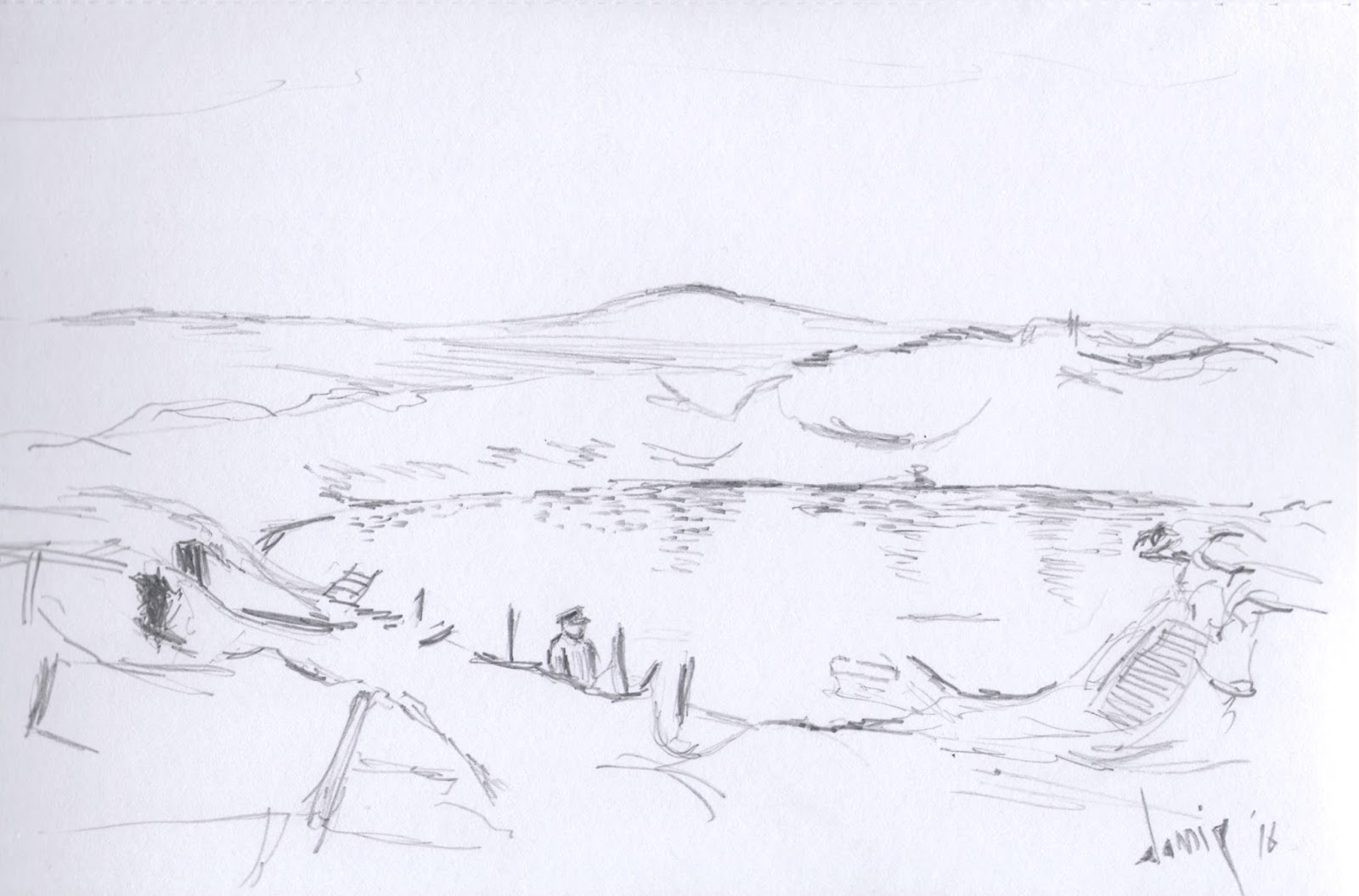
 Impression sketch of crater at St Eloi - by Jamie. From an original image that can be seen at: <http://www.militaryhistoryonline.com/forums/ViewPost.aspx?ForumID=56&ID=30517> [Accessed: 5 April 2016]

i
From days of early Flanders
The persona of Saint Eligius,
Had set on his task to convert
Pagans to Christianity religion,
With his twenty year mission -
His name dedicated to St Eloi
a village in a Flemish province.

Within a twentieth century
Mission, that same ground
Of St Eloi saw transformation
To total war, with sustained
Battles -1915 saw burrowed
Exchanges underground,
With tunneller's drafted in.

By subterranean methods,
A renewed struggle began
With six large mines, created
Beneath the German lines -
The decided plan for British
Intensions to move forward,
To capture destroyed lines.

Canadians afterwards would
Follow forwards, to secure
Captured systems - prior
To zero hour Germans had
control of ground; the land
Already battered, had mines
Prepared by sapper teams.

Into 87th leap year day
The 27th March at 4.15 a.m.
Awoke with tremendous
Gunfire - one followed by
Another of six mines, whose
Sound carried through air;
Heard on English shores.

Every man felt the earth
Shuddering, as volcanoe
Plumes of yellow smoke
Lifted skywards - debris
Rained upon pockmarked
Earth - six huge craters had
Formed in no mans land.

Amid the British forces
Lifting from sodden soil -
Khaki against blighted
Earth - Brodie clad heads
Over hunched shoulders
Came Northumberland
London's Royal Fusiliers.

With one Northumberland
Officer ready to provide
His regiment's story to
The Scotsman - the fight
the best organised to date,
Became known by name
Of Battle of St Eloi Craters.

The tunnelling companies
Had carried out operations
So secretly, the German
Presence had not guessed
What was about to happen -
A lull had till then, lasted
Across area for two days. 

A quagmire of peace could
Be seen for anyone, who
By chance could have stood
on ground, would have never
Been aware of two armies
in opposition, concealed;
Odd sniper fire interrupted.

ii
A dull drizzling morning
With possibility of heavy
Showers was observed,
Just before the ground rent
Heavenwards - the young
Officer relayed the problem
Of Northumberland’s role.

manoeuvres were acted out
Oddly, like a game - to enter
The maze of wire covering
The slope before German
Positions - slowly working 
To a pocket sized parapet,
That escaped the explosion.

A German machine gunner
Propped up on a parapet,
As they set foot among
The wire, to offer selves
Up as targets - but calmly
They worked through
By an amusing method.

A game spread amid men;
They adopted 'pick a back,'
As soldiers started to carry
Their comrades, who gave
Short reply to enemy fire -
Their aim to pick off any
Visible machine guns.

Within the gritty task,
The men took to amuse
Selves in transformation
To cavalry status - riders to
'Gee up' and chaffing each
Of their 'horse,' to criticise
Points of others mounts.

With the game of horse and
Rider making it through
The wire maze, dismount
Orders brought normality -
Back in role of foot soldiers,
They leapt down into enemy
Trenches, in warning shouts.

Their listeners though were
Just an audience of dead
And dying men - some
Lives lost within their sleep -
They came to a dug out,
Where a sentry stood
Upright, as on alert guard.

They yelled at the figure
To surrender - but he
Gave no answer - a man
With bayonet raised,
Rushed towards him -
Only to recoil in horror;
The sentry was dead.

Still on guard in death,
Looked on by those who
Would see him dead again.
With eyes described in
A look of 'the other world' -
With life severed in duty,
He was left at his post.

Moving further inwards,
Others were dazed from
An earthquake broken sleep,
Crouched or seated in pain
Of ignorance of the event -
Shocked to see strangers,
As a man in a dugout spoke.

'My God the English!' he
Found no escape, to be
Taken away with others
As prisoners - between
Them, arguing as to how
The invaders came - to
Land in massed airships?

iii
Some others suggested
They had burrowed
Up as moles - they could
Not fathom they had
Made their way across
Land of no man, that
Had been under guard.

A battle of St Eloi craters
Had begun with success -
The shattering sounds
Heard back in England,
With swarms of British
King's prisoners en mass;
Canadians made a start.

While spring had retained
Winter's wet conditions
Within the Belgium soil,
The rapid divisions arrival of
2nd Canadians in their first
Major engagement, brought
There without preparation.

Out of bitter, muddy earth
The British found success,
In hand-to-hand combat -
To win third German line -
While confusion lay amid
Enemy; mines irreparably
Altering their landscape.

Those great craters had
Been exploded, to create
A vast space over 180
Feet across and depth
Of 49 feet - with sleet
And wind, water began
To create glutinous mud.

For seven terrible days
Conditions took their toll,
With hundreds killed amid
Fighting chaos - exhausted
British gained relief from
Eager Canadian's 4 March
Arrival, in Belgium’s St Eloi.

Without blindfolds Canadians
Still had only a blinkered  
Idea of their situation and
German presence - by dates
Of 4 and 5 March, constant
Bombardment hampered
Efforts to improve defences.

With more deaths every
Minute, the 2nd Canadian
Pioneer Battalion tried
To drain their trenches -
The sight was a challenge
To the stomach of any man,
Upon the sight of that land.

'We were walking on
Dead soldiers,' Frank
 Mahout later wrote to his
Wife at home in Canada.
All about men attempted
To bandage wounds
As shells still fell around.

Soldier Private Fraser,
A Calgary bank clerk, gave
The scene at daybreak;
To see body parts protruded
Everywhere in the mud,
Marking out the yards - while
30 dead floated in crater.

Odd sights were captured
By moments of shock;
The German sentry corpse
Still on guard, or a tall, slim
English lieutenant who lay
Quite dead - his boyish face
Wearing a peaceful look.

Under nightshift fighters,
6 April at hour 3.30 a.m.
The ruins of St Eloi saw
German battalions attack,
Along the Canadian held
Main road - communication
Losses led to their retreat.

Another dawn lifted, renewed
German efforts had started
To recapture all grounds
Lost to them from battles
Start - confusion was relayed
By heavy rain, while the fight
For craters was still to end.

by Jamie Mann.

Anon.,1916. The Dead Sentry - The Story of St Eloi. The Daily Telegraph, [online] 5 April 1916. P.12. Col.3. Available at: <http://www.telegraph.co.uk/news/ww1-archive/12206739/Daily-Telegraph-April-5-1916.html>  [Accessed: 5 April 2016].

Source: File: Sint-Elooi. Online. Available at: <https://en.wikipedia.org/wiki/Sint-Elooi> Accessed 5 April 2016

Source: File: Battle of St. Eloi Craters. Online. Available at: <http://www.thecanadianencyclopedia.ca/en/article/battle-of-st-eloi-craters/> Accessed 5 April 2016

Mann, J., 2016. 100 years Ago - Poems by Jamie Mann. [letter] (Personal communication, 5 April 2016). 


#WW1 #WW1centenary #GreatWar #WW1poem #GreatWar #WW1centenary #worldwarone #worldwaroneremembered #WW1StEloi