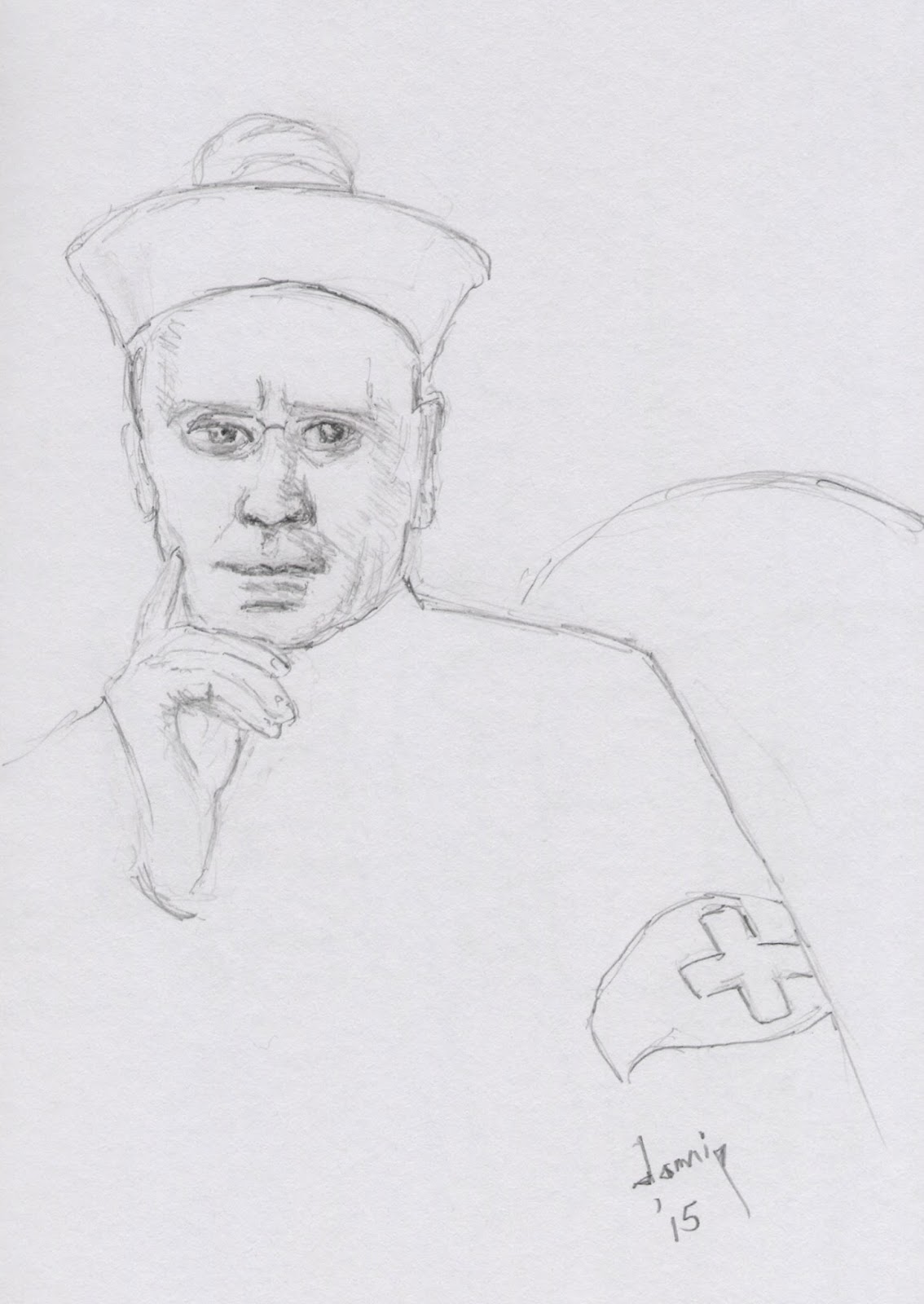
In Augusts’ massacre of Dinant village,
Was disregard of Belgian neutrality.
Ordered by a German Commander was,
Cold bloodied murder of 674 civilians.
As suddenly the enemy made a disorderly
Retreat to the University town of Louvain.
That fortress town, that bore witness
To first heavy fighting and brutality,
Of an unforgiving brutal invader.
A symbolic pawn, the Belgian town
Was burned and civilians slaughtered -
Reasons being civilian resistance - Fire
Engulfed Louvain’s University library.
A message to the world for those who
Resist German might - fear spread,
Becoming rife in that region - with acts
Of punishment to civilians between
The town of Louvain and Malines.
A village, Thildouch, lay between
The towns of Malines and Louvain,
Where during the siege of Antwerp,
Lay headquarters of the German Army;
The Convent Of Thildouch, on the banks
Of the Willebrooek canal, dominated
The rural settlement. This religious
House built in the nineteenth century,
With extensive buildings, would make
A good base for any invading army.
The Belgium School of the convent,
Was home To English girl pupils.
As the Germans in the mid month
Of August broke through Liege,
The nuns received many telegrams,
From worried parents, beseeching
That their children be returned,
Quickly to their homes in Britain.
Such a task was not an easy feat,
For the railway station of Wespelar,
Was almost three miles distant.
A decision made, one early afternoon
The English pupils were assembled
Together in the Salle des Fetes.
Addressed by Sister Mere Ambroisine,
The girls were told to get their coats,
In order that they may take a walk.
Probably not thinking, that they might
Not return, the girls moved down
The steps of their convent school.
A nominated nun, knowing the risk
She was undertaking, did not panic
The girls as they walked each mile.
Perhaps surprised, they were led
Into the station yard - they realised
The plan; they were to leave Belgium.
Chatting in their anxieties, these
Girls wondered how they might go
On without luggage, money or any
Signs of gaining tickets - As the sister
Marched them through the ticket
Office, instructing them smartly
To board the train, where they took
Their seats. The gravity of a situation
Became evident as the guard looked,
And seeing they had not paid,
Ordered them to leave the carriage.
The silent English girls, stumped
By Sister Mere Ambroisine’s stand
At the guard - as she said in a clear
Voice that, ‘lives are more precious
Than tickets.’ The guard’s authority
Wavered, as he realised to remove
Them all would require some force.
In stepping back, he closed the door,
As Sister Mere Ambroisine sat
Among her charges, tense but
Outwardly calm. The whistle blew,
As the heavy steam of the train,
Pulled them slowly from the station.
With an arm about the shoulder
Of some insecure girl, to secure
Her own reassurance, that
This undertaking was right
For her pupils, in such uncertain
Times. Stories that the nuns
Had heard of atrocities made,
Against both children and women.
With each new mile, sadness
And intensity, made more
Real of their temporary status,
As the youngest of refugees.
Coming into view, their destination
Of Ostend, Sister Mere Ambroisine,
Stirred the convent’s sleepy pupils
In preparing them to disembark.
As the train slowed down, came
Renewed apprehension among
The girls - Sister Mere Ambroisine
Stood, smiled and with shoulders
Steady occupying them all,
With the business of their coats.
The guard on opening the door,
Turned a blind eye, as the nun
Thanked him kindly for the safe
Journey. Keeping girls in order,
Sister Mere Ambroisine, led
Them from platform to the quay.
Taken from the quiet convent,
The girls were all agog, to see
All the business of many boats,
Bringing soldiers to the shore.
Young men, all dressed alike.
Peak caps on their heads, while
Over their shoulders hung rifles.
Our sister, Mere Ambroisine,
Not forgetting that her charges,
Had stated their start of hunger.
With some hours passed since
They had last eaten, she led
Them to where troops gathered,
About a cafeteria. With an older
Girl in charge and still within sight,
She embarked upon a mission.
Overcoming any dormant pride,
Our Sister Mere Ambroisine,
Approached the serving women,
Of the buffet - a nun in the line
Of soldiers, raised few eyebrows.
In a request for food without
Money to pay came a silent,
Stare. Calmly she explained,
The situation of bringing her
English pupils there, to send
Them home. While the women
Of the Red Cross explained,
No money no food - perhaps
A young Tommy perked up
To say, ‘come on, let ‘em
Have som’at to eat, they’re
Just a few poor young gals.’
The Tommy’s insistence finally
Paid off and along with his pals,
The soldiers helped this Belgian
Nun to take armfuls of food,
To divide it between grateful
Hungry English convent girls.
Indebted, Sister Ambroisine
Made a request to point them
In direction of the Dover boat.
With food to eat, the convent
Girls marched the quay, behind
Their determined guardian.
Looking with atonement and awe,
Upon the sea going vessel,
For a moment the sister looked
Ands stared, taking in the sight
And sounds of a boat’s preparation
To disembark. A girl addressed
Her but Sister Mere Ambroisine
Did not seem to hear - letting
Down her guard she wondered
How to get these children aboard.
There were just two gangways
Linking the ship to the shore.
Seeing a bearded officer, the nun
Asked casually if they were soon
To leave. About to speak, his
Mouth opened, curiously filled
By the ship’s first bell. With a smile
He said ‘that means we are about
To sail.’ He turned, busily occupied.
Travelers pushed their payed
Tickets towards him. Acting quickly,
Our Sister Mere Ambroisine,
Again gave charge to the eldest girl
She was given to guide them all
To the boat’s deck. With tears
Of alarm between the girls
And sister, she urged them forward,
While the officer was distracted.
Amid silent tears of reluctance,
The girls joined the passengers
Hurrying to climb safely aboard.
Our Sister Mere Ambroisine,
Knowing she could not travel
With them; the gown of her faith,
Would mark them as stowaways.
She breathed and sighed,
As the last girl stood on deck,
When something happened,
To alter the course of her mission.
With the officer attending to
The last of the paid travelers,
A group of others, standing by,
Rushed forward, to surround
Our Sister Mere Ambroisine.
A tall young woman begged,
The nun on behalf of the others.
Saying that, she was a governess,
With her own English schoolgirls
To get home, across the channel.
Others there, also spoke of their
Plight - none of them had
money
To pay for their ticket faire - would,
Could, this sister help them also?
Our Sister Mere Ambroisine,
Saw in the region of two dozen
People now clustered about her.
Within a moment’s pausing prayer,
The nun took a decisive decision,
And said they were to follow her.
She strolled them quickly past
The stunned bearded officer,
And led the people all aboard.
At the ship’s last bell calling for
All of her passengers, they all
Clustered onto the deck's edge.
Another boarding officer faced
Our Sister Mere Ambroisine,
Demanding, as she was charged
With these people’s presence,
Where were all these people’s
Tickets. ‘Officer, I have none.’
Fixing him and the bearded man,
She had passed by, came their
United orders, that all of them
All women and schoolgirls,
Were to step back ashore.
Our Sister Mere Ambroisine,
Stood before the nervous crowd
And declared ‘Over my body,
Will you force these people,
From their only hope and their
Salvation of safety, that they
Only have, in your trusted hands.’
At her firm standing the men,
Not wanting to handle these
Girls and women from the
Boat, gave them permission
To stay. The boat being full,
They would have to find space
On deck, to sit the journey out.
In pulling up of the gangway,
Our Sister Mere Ambroisine,
Amid much muttered gratitude,
Directed her refugees pupils,
Away to find a space for their
Evening's journey, across
The channel to England.
In a sheltered corner of ship’s
Furniture, the convent party
Huddled together in warmth.
Encouraging the tired girls
To sleep, for the journey,
Our Sister Mere Ambroisine,
Too awake with responsibility,
Comforted those still fearful,
Unable to rest. In the August
Evening the ship moved them
From the dangers of Belgium.
But then something happened,
To challenge their calmed status.
Now out at halfway point to safety,
An unexpected sounds of guns,
Startled them all upon the boat.
Tensed at this unexpected event
Our Sister Mere Ambroisine
Clung to her shaky girls, as close
As she could - knowing of many
Barbaric tragedies out at sea,
By callous German gunnery.
Splashes in the nearby sea,
Made the nun look up to see,
A warship pulling alongside.
The crew ran about the deck,
To link both rope and bridges,
With this fearsome vessel.
Ordering the girls just to look
At her, the sister watched,
As the ship was boarded.
Our Sister Mere Ambroisine,
Sighed upon seeing uniforms
Of English sailors who, as
Part of the channel patrol,
Had a duty to search the boat.
With the girls, looking up
To her safe charge, the nun
Watched the men as they
Secured the boat, as being
Safe to continue. To reassure
The girls that all was well,
The Convent woman smiled,
And encouraged them to
Sing a favourite song,
As the steamer sailed on.
Soon the shadow of white
Dover came closer, in mists
Of evening. Upon their feet,
They joined in the ships
Preparation to disembark.
As the crowds poured forth
In orderly relief, to step
Down upon English land,
Our sister Mere Ambroisine,
Knew her mission, was not
Finally made complete.
As they stood upon the quay,
Still refugees from Europe’s
Storms, was this nun yet to feel
Relief - wondering if her sisters,
Of the Convent of Thildouch,
Had telegrammed the worried
Parents of the pupils - advising
One of their sisterhood would
Bring them home. When some
Parents rushed forth, at sight
Of the nun, to reunite with their
Daughters –all was well done.
Upon the sister handing the last
Girl over, with much reassurance
That she too, would be quite safe
Upon her return to Thildouch.
In waving their last goodbyes,
This plucky, determined nun,
Was given her due recognition,
For what she had bravely done.
Her story written in the papers,
Marking out simple courage of
Our Sister Mere Ambroisine.
by Jamie Mann.
Anon.,1914. A Nun’s Courage – English Girls Home. The Daily Telegraph,
[online] 10 Oct. p.11. Col.5. Available at:
http://www.telegraph.co.uk/news/ww1-archive/11149668/Daily-Telegraph-October-10-1914.html
[Accessed: 10 October 2014].
Home, C. F. ed.,
1914. Source Records of the Great War, Vol. II,
National Alumni 1923, [online]. Available online at: <http://www.firstworldwar.com/source/louvain_judicialreport.htm> [Accessed: 10 October 2014].
Mann, J., 2014. 100 years Ago - Poems by Jamie Mann. [letter] (Personal
communication, 10 October 2014).
#WW1 #WW1centenary #GreatWar #WW1poem #GreatWar #ww1centenary
#worldwarone #worldwaroneremembered