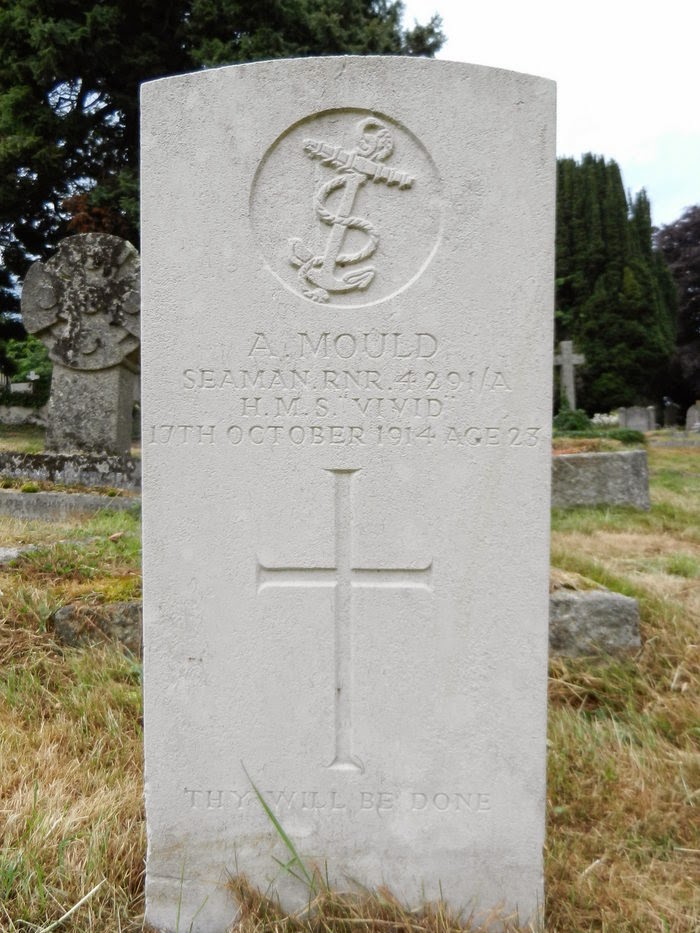
Grave of Arthur Mould, Dawlish Cemetery, Devon
Photo courtesy of julia&keld
http://www.findagrave.com/cgi-bin/fg.cgi?page=gr&GRid=71216363 [Accessed: 19 October 1914]
Saturday 17 October; upon an autumn day,
That began dull along a Devon coastline.
Distant mountainous clouds on a horizon
Line, possibly suggesting later rain fall,
Yet unlikely, being driven on the light wind.
Just an ordinary October autumn day.
From their coastal home, Mother and child
Stepped out looking out to a fine account,
Ideal for a weekend walk into Dawlish town.
The day across South Devon dawned similar,
With travels of civilian people and military
Personnel, beginning their weekend day -
Movements of the navy, resting or training,
Stirred along south coast ports, with ships
At anchor - or on alert in manoeuvres of war.
Amid Naval Reservists taking leave on land,
Was the young 23-year-old Arthur Mould.
The day was good for travel, neither hot
Nor cold – stationed at Plymouth, Navy
Barracks of HMS 'Vivid', Arthur Mould, his
Service Number 4291, had been given leave.
The plan was to travel to see his parents,
Who had moved from Derby after his birth,
In 1891, to live in Birkenhead – the surprise
Was especially planned for his young wife, M.
Larking with other mates on leave, to taunt
Those men left behind, upon the land bound
HMS 'Vivid' – Stoker, Arthur Mould, with other
Naval Reserves, made their way to the train.
The Journey would be long; taking a coastal
Line, before moving inland to his hometown.
In Dawlish, a brighter morning light promised
A fair day, as people emerged onto streets,
Trekking out to gain their weekly provisions.
Among them, the mother and girl walked
Briskly - for the purpose here, we shall call
The child Jane - her mother, Mrs Smith –
In reflection of the real story the girl’s age
Stays a mystery – perhaps 5 or as old as 9?
The train preparing to depart at Plymouth,
Packed for Saturday trips with travellers.
Some bound for local destinations, others
Further afield - possibly reaching London,
Perhaps Scotland, or even for Birkinhead;
As was the aim for Seaman Arthur Mould,
Who with mates, squeezed them aboard.
With a Lack of room, he stood by the door.
Jane and Mrs Smith walked about Dawlish
Market, buying foodstuffs from varied stalls.
Other matter's were on Jane’s mind she
Yearned to escape down to beach and sea.
Seagulls were calling - pulling her mother’s
Hand, asking for them to walk down
To the beach. At first her mother made
No response, Mrs Smith talked with traders.
Finally she met in length, with a neighbour
And friend. Jane’s persistence finally made
Her mother give in – making her promise,
To be careful, Jane might go for twenty
Minutes down to the sea, advising her
To make a route by the coastguard station
Over the railway bridge and down the steps.
To stay there until her mother collected her.
Arthur Mould stood happily upon the train,
Buffeted by mates within the small space.
They talked of jokes, stories and waiting
Women at home. Their rowdy, raised voices
Tolerated by their fellow passengers in such
Respect for Naval uniforms - Arthur Mould
In the need for air, slid open the window.
Cooler air rushed in as the sea rushed by.
Arthur thought of his waiting home and wife.
The train rolled placidly on from the south.
When the first tunnel of five opened up
The engine let out its sharp sigh of steam.
The rhythmic clatter of the rolling train held
Arthur Mould calmly, as they blinked between
Tunnels, the line carrying them onwards close
To the shore cutting thorough the Devon cliffs.
He stared out to sea, knowing where destiny
Of his life was to be taking him to fight aboard
Ship - to encounter German boats and threat
Of submarines - away from safety of training
At Devonport – this would be his last sight of
Home to see before Arthur Mould went to sea.
The rhythm of the train held him his mates,
Still larking about him, guessing how much
They might yet drink, before return to duty
The fourth tunnel passed again the engine
Blew its sound like an excited beast and now
Again the plunge into darkness for the fifth
Time – time, almost gone - came light again
As carriages curved about rocky coastal edge
Feeling almost like the train itself, was at sea.
How the next few fateful moments happened
Remains unclear, to be always so, can only
be imagined here - If the train, being packed,
Might have made a sinister contribution to fate.
With Arthur Mould, among the jostling, laughing
Group of fellow seamen - the train, perhaps
Not scheduled to stop, or slow down through
A Dawlish seaside town, in fate of Arthur Mould.
Somehow he fell - knocking the door handle
Or if the carriage door had not been shut
Maybe his weight was enough to cause
Door fall open – the sailor fell tumbling in air
That brushed his hat away – almost flying
With the speed of the train - the door swung
Too, maybe unnoticed of the missing fellow.
As time that coincides, Jane had reached
A place nearby the Coast Guard Station,
When she saw the man, lying on the ground.
Like her doll, he was strewn upon the track.
With any thought of sea shells gone, she
Looked about but no one else was around.
At speed she ran down - knowing that a train
Had passed, realising he must have fallen.
She saw that he wore a uniform of a sailor,
But he was not awake and saw wound upon
His head. Still no one was about - on hearing
The sound of another train’s whistle, Jane,
With no other thought, pulled on the man arm
He did not move – in fear at enlarging train
She put hands under his shoulders and heaved
With all her strength - The steaming train
Was growing large - she pulled again and again.
Jane felt him bumping off the track as metallic
Wheels skimmed by – she did not stop until
They were at the footway and she sat to take
A breath. Looking upon his closed eyes Jane
Spoke to him but he made no response – not
Knowing what else to do, she sat as he lay there,
Telling him of her growing collection of seashells.
When help came, her mother found her Jane
Nursing the injured sailor and hugged her
Bravery – this reported true story noted a girl’s
Prompt reaction – Jane, as small as she was,
Dragged Alfred Mould, out of further harm.
Sadly the severity of the injury to his head,
Meant that this navy man never recovered.
Today, Alfred remembered, still lies by the sea,
In Dawlish Cemetery, Devon Plot 668.
by Jamie Mann.
Anon.,1914. Girl's Prompt Action. The Daily Telegraph, [online] 19 Oct. p.3. Col.5. Available at: http://www.telegraph.co.uk/news/ww1-archive/11165474/Daily-Telegraph-October-19-1914.html [Accessed: 19 October 2014].
Mann, J., 2014. 100 years Ago - Poems by Jamie Mann. [letter] (Personal communication, 19 October 2014).
#WW1 #WW1centenary #GreatWar #WW1poem #GreatWar #ww1centenary #worldwarone #worldwaroneremembered
