Showing posts with label 1916_02. Show all posts

Sunday, 28 February 2016

Poem ~ Mother's War Ultimatum - Monday, 28 February 1916

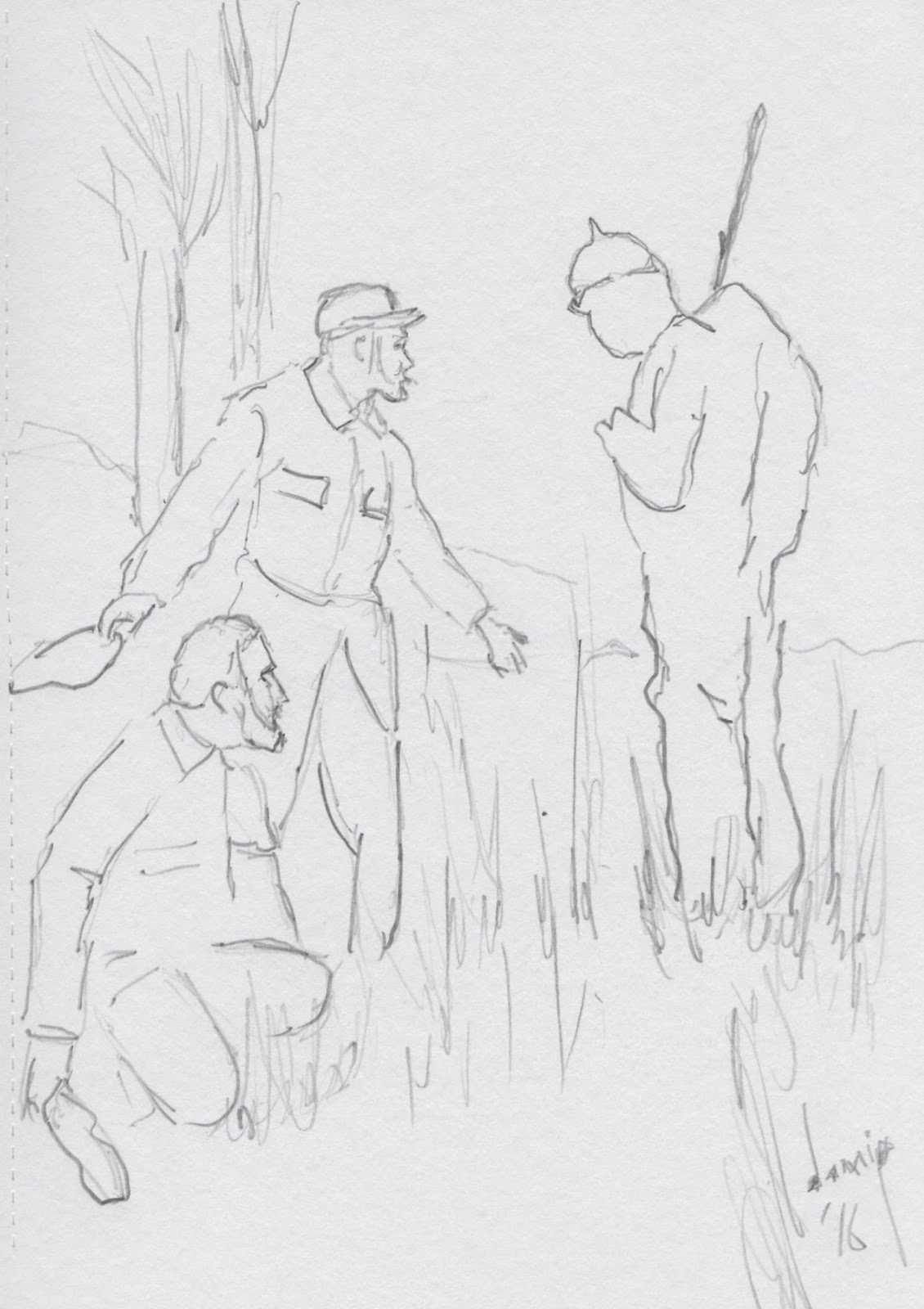
Impression sketch : Mother's War Ultimatum - by Jamie.

From the letter of an Englishman
Came a story of New York.
A French acquaintance had recently
Travelled back from America -
During his time there he had dined
In a New York restaurant.

When ordering his meal he found
The waiter to be French.
Developing a conversation, he asked
The young man of Europe
Why he was not fighting for France -
A reason was forthcoming.

The French waiter told how he would
Soon make his way to fight.
He handed the traveller a letter just
Received from his mother -
The correspondence informed her son
He had lost both brothers.

Her words spelled out her patriotism;
As she declared, while
Being her only remaining son, unless
He did not come back
To France in fighting for their country,
He need never return to her.

by Jamie Mann.

Anon.,1916. French Mothers Patriotism. The Daily Telegraph, [online] 28 February 1916. P.7. Col.3. Available at: http://www.telegraph.co.uk/news/ww1-archive/12175151/Daily-Telegraph-February-28-1916.html [Accessed: 28 February 2016].


#WW1 #WW1centenary #GreatWar #WW1poem #GreatWar #WW1centenary #worldwarone #worldwaroneremembered #WW1France

Saturday, 27 February 2016

Poem ~ Tree Border Guards - Sunday, 27 February 1916


Impression sketch of a German sentry carved from a tree stump - by Jamie. From an original image that can be seen at: <http://www.illustratedfirstworldwar.com/item/a-wooden-soldier-in-real-war-a-pollarded-german-guard-iln0-1916-0226-0007-001/ l> [Accessed: 27 February 2016]

As battles unfold,
By advance or retreat,
Comes luck to escape -
Or poor fortune
In capture.

In such events
Two such soldiers
Of France, found
Themselves
Prisoners.

Amid others
Transportation took
Them to Germany,
For incarceration
Of a camp.

On route these two
Men managed to get
Free - adapting
To events,
They hid.

By stealth, both
Then made their way
To reach border
Of Holland and
Germany.

After time, to feel
They would step freely
Across to Dutch soils,
Despair filled
Them both.

Just ahead they
Saw a sentry, steely
Guarding the passage
To their freedom -
What next?

They prepared
To fight and readied
To die, rather than
Give into that
Waiting sentry.

The German figure
Was on diligent guard;
With a fixed gaze,
Stared unmoved
Into Germany.

The two French
Picked up a rock, along
With a stick, readied
To strike for
Freedom.

From hiding
They rushed the guard,
Who made no move -
A striking rock
Bounced
Off him.

Heightened
By their attack, the two
Men fell, shocked
To their knees
Before the foe.

That alert German
They spied at distance,
Was nothing more
Than wood - sticks
Grew at his feet.

A stump of a tree
Had been cut and carved -
Pollarded into
Shape of a
German.

They had been
Fooled by the duplicity
Of clever crafting -
To admire
The skill.

They stepped past
The inanimate German,
To discover close
By, other such
Sentry trees.

Without any real
Soldier’s, only numbers
Of stumps stood
To resemble a
Frontier guard.

In wonder, the two
French soldiers walked
Into neutrality -
Days later back
In their regiment.

The two escapees,
In telling their story caused
Great amusement,
Regarding stumps
Of wooden sentries.

by Jamie Mann.

Anon.,1916. A Wooden Soldier In Real War: A Pollarded German 'Guard'!. The Illustrated London News, [online] 27 February 1916. 263. Available at: http://www.illustratedfirstworldwar.com/item/a-wooden-soldier-in-real-war-a-pollarded-german-guard-iln0-1916-0226-0007-001/ [Accessed: 27 February 2016].


#WW1 #WW1centenary #GreatWar #WW1poem #GreatWar #WW1centenary #worldwarone #worldwaroneremembered #WW1WesternFront

Thursday, 25 February 2016

Poem ~ Yorkshires Seek Prisoner - Friday, 25 February - Saturday, 26 February 1916


Impression sketch for Yorkshires Seek Prisoner - by Jamie

As rumours go, based on truth,
Was story of Canadian troopers,
Taking up the hobby of dipping
Into trenches - making short
A shift of work returning home,
To convey a prisoner or two.

In liking for a type of such Red Indian
Warfare, there were also others; young
British officers who, being itchy all day
For the night to come, when time allowed
Night patrols in their moving out to wire.

Another rumour in the then
Trenches of Yorkshire lads,
Was their general's pleasure,
To bring a prisoner to him -
A proposal of a sortie was
Soon discussed in dug outs.

One non commissioned officer
In league with an eager sergeant,
Formulated their idea into a plan.
Completed by four lieutenants,
Who set to find their volunteers.

Included was one private
With a waggish humour
And roguish eyes - two
Parties after dark found
Yards equal to miles, with
The dead earth lit by flares.

At intervals of regularity came
A sudden whoosh, as rockets
Flared the dark - with sudden
Stark white lights, the parapets
And wire made stark silhouettes.

Beneath the harsh lit
White, crawling forms
Of Yorkshire men halted -
Pressing exposed selves
Downwards, into the spin
Of earth beneath them.

When darkness held them again,
They crawled on fingers - inch
By inch - following blindly the path
Of leading subalterns, towards
A gap of a curved enemy trench.

Between two bays that
Flashed in white relief,
The Yorkshires paused -
In the loop they listened
Intently, hearing a sentry
Stamping his cold feet.

The sentry paced back and forth,
For warmth he gave a quiet whistle.
His exhale patterning in harsh light
Of white flares where he thought
He was alone, unaware of English.

The Yorkshires lay close
To him, holding breathes,
Clasping revolvers - two
Lieutenants fingered way
To the parapet - behind
Men were left to instinct.

Any orders would alert the sentry;
One man led himself to clamber
Down into trench, only yards from
The sentry - as a wolf he tensed
For his prey, as footsteps came.

Moving in the dank sunk
Was a black form, marked
By glowing cigarette nub;
A German officer on rounds.
The man leapt away, his
Feet hung over the trench.

With legs lying in open air, head
Towards British lines - the officer's
Passing cloak, gently stroked his
Heels - the lad twisted in tension,
To see the German go on his way.

Close by, the lonely
Sentry made a  whistle,
A tune of home to try
And cheer his isolation,
When the alert of a click
Changed everything.

One lieutenant aimed his gun
But the mud filled its mechanism,
So it could not fire - the sentry
Spun, his whistle became a gasp -
Now he was blind with terror.

To fall from the parapet
Was a British sergeant -
Before him the boy sentry
Suddenly shrieked with
A yell - an English hand
About his German throat.

The fingers were trying to strangle
Him - he struggled when a second
Englishman an officer, was before
Him - to hold a cold barrel against his
Neck, to feel thump of a dud revolver.

The first officer sought
To knock him out, while
A trigger squeezed and
Blew away the sentry’s
Life - the same bullet also
Shot the sergeant's hand.

Now all alarm was raised - attempts
To gain any prisoner was lost, with
Thuds of German boots, hurrying 
To a lost rescue of their fellow sentry;
The raiding party scrambled away.

Over the slimy parapet
they fell into a watery ditch -
All attempts were to race
For their home trench -
Under the white flares
And heel snapping bullets.

The split of two parties had found
The other Yorkshire group troubled,
To find their way across a sodden
Ditch - they came against enemy
Wire, slowed down by making a gap.

In breaking through
The leaders split - the
Sergeant to the left
Lieutenants to right -
Their men close behind
To creep forwards.

In the target bay the sergeant soon
Discovered two German sentries,
Whose alert facial status prompted
Him to throw them a grenade -
The noisome result looked to work.

From a dugout two
Germans appeared
Into the smoky hole -
The sergeant sent
Another bomb, when
More soldiers came.

Making for a sharp exit - along
With him the party crouched,
As the enemy flung bombs
Towards them - only to realise
Their lieutenant was missing.

Turning back to find
Him, the sergeant saw
From out of the dark,
A shadow lift  - a flare
Burst revealed a white
Face, a result of wounds.

Despite a bayonet neck injury
And shrapnel hit, the Lieutenant
Lead the party back to safety -
Only one left of their number had
A delay; the grinning eyed man.

Lying in a ditch,
The Yorkshire man
Maintained calm -
Although caught
By the enemy wire,
Expectant of death.

Certain that his bombs had
Killed a number of the Hun,
He tried to get free of the trap.
His boots were caught - only by
Removing them he might get out.

Feeling that they
Were very good
Boots, he could
Not part with them -
Twisting once, then
Again he was free.

Both parties returned in safety,
Despite a lack of any prisoner
There were no regrets in giving
The Germans the jumps - which
Continued over consecutive nights.

Apparently seeing
Shadows, the Hun 
Habitually tossed
Bombs at their  
Own barbed wire; 
To humor the Yorks.

by Jamie Mann.

Anon.,1916. Daring Yorkshires - 'No Man's Land' Exploit. The Daily Telegraph, [online] 25 February 1916. P.9. Col.2. Available at: http://www.telegraph.co.uk/news/ww1-archive/12169037/Daily-Telegraph-February-24-1916.html [Accessed: 25 February 2016].


#WW1 #WW1centenary #GreatWar #WW1poem #GreatWar #WW1centenary #worldwarone #worldwaroneremembered #WW1WesternFront

Wednesday, 24 February 2016

Poem ~ Verdun: A German Success? - Thursday, 24 February 1916

Source: File: Germans helping a French wounded soldier.jpg. [online]  Available at: <http://wereldoorlog1418.nl/battleverdun/kortverdun/index.htm#03> [Accessed: 24 February 2016]

Via the waves of wireless press,
Came a version from the other side -
Two days after an initial German
Push, news finally reached Berlin.

In content of a report from main
Headquarters, told how from east
Of Souchez, their enemy's trenches
Fell, damaged by German mines.

With Souchez success brought
Rewards of three machine guns -
To capture prisoners; 348 soldiers,
Along with 11 French officers.

Meanwhile upon the Meuse Hills,
On the 21 day of February, saw duel
Of artillery along the Meuse's east
River bank, in a plan of strategy.

A French hope had been to hold
Onto that rivers edge - seen to be
Where they had worked to fortify
A hold for over a year and a half.

In that situation the French would
Suffer catastrophe from German
Artillery attack; close to communes  
Of Azannes and Consenvoye.

With fated villages in a fortressed
Area, defences of German held out
North of Woevre - all to add to their
Success by second day of Verdun.

Across a three mile push inwards,
Bois des Caures was taken; troops
Closed in on Flabas village - later
To take the village of Haumont.

German successes in upper Alsace
Lay in eastward attacks of Heidwiler -
Capturing an allied position, half mile
In length and 400 metres in depth.

The victory for Germany had totaled
3000 prisoners and material claims -
To then fail 23 February, by French
Resistance at Bois de l'Herbebois.

by Jamie Mann.

Anon.,1916. The Verdun Battle - German Version. The Daily Telegraph, [online] 24 February 1916. P.9. Col.2. Available at: http://www.telegraph.co.uk/news/ww1-archive/12169037/Daily-Telegraph-February-24-1916.html [Accessed: 24 February 2016].


#WW1 #WW1centenary #GreatWar #WW1poem #GreatWar #WW1centenary #worldwarone #worldwaroneremembered #WW1Verdun

Tuesday, 23 February 2016

Poem ~ Refusal To Kill - Wednesday, 23 February 1916

Impression sketch of a tribunal - by Jamie. From an original image that can be seen at: <http://www.ppu.org.uk/learn/infodocs/cos/st_co_wwone.html> [Accessed: 23 February 2016]

With the Derby Scheme
Leading to compulsory enlistment,
Tribunals were set to hear reasoning
Beyond the medical, for a contingent
Declaring selves 'conscientious objectors'.

Herne Bay Military Tribunal,
Heard a claim for total exemption;
A young male engineer a member
Of Open Brethren - his beliefs were
Ruled by Bible, which was his evidence.

On this Military Tribunal,
Mr G. Blaiklock declared, he knew that
Non-resistance was belief in Society
Of Friends, but unaware of existence
In the religious body of Open Brethren.

As he stood before the panel,
The applicant received questioning
As to his exact reasons for not
Wanting to fight - Mr Beetonson
Highlighted contradictions in the Bible.

An 'eye for an eye' doctrine
Was quoted - the applicant replied
The impossibility of contradictions
As the bible was God's word;
Imagine then the enemy at his door.

Mr Blaiklock then suggested,
What if Germans attacked his mother
And sister, and a rifle was close
By - would he not use this gun
In order to defend his own family?

Accepting he might if they
Were at his door — the chairman added
That their boys over there were
Doing just that, halting the Hun -
The engineer acknowledged the fact.

The Applicant believed
How his country normally appreciated
Any recognition of religious
Convictions - a counter argument
Was Germans might invade England.

Furthermore such a situation 
Would occur, if everyman had the same
Ideals - that was conjecture,
The man replied that God would
Help those that called out to him.

Yet did not god help those
Who helped themselves? The fact
Was for need of sufficient men -
They had to be sent out to halt
German forces landing in Britain.

The engineer applicant
Argued how he could not help to build
Bridges for troops - nor might
He work on a minesweeper,
That would assist war ships.

With these objections
He did not object to work in Army
Pay Corps, or in medical work -
This then the chairman said
Could be arranged - he agreed.

A conclusion of tribunal
Being presented with this the appeal,
For conscientious objection
Was allowed - but appellant was
Referred to Royal Army Medical Corps.

by Jamie Mann.

Anon.,1916. Conscientious Objection - Interesting Exchange of Views. The Daily Telegraph, [online] 23 February 1916. P.7. Col.4. Available at: http://www.telegraph.co.uk/news/ww1-archive/12165487/Daily-Telegraph-February-23-1916.html [Accessed: 23 February 2016].


#WW1 #WW1centenary #GreatWar #WW1poem #GreatWar #WW1centenary #worldwarone #worldwaroneremembered #WW1Recruitment

Monday, 22 February 2016

Poem ~ Australian Trooper 'Bluegum' - Tuesday, 22 February 1916

Impression sketch of Oliver Hogue aka Trooper Bluegum,

- by Jamie. An original image that can be seen at: <http://mosman1914-1918.net/project/blog/oliver-hogue-aka-trooper-bluegum-1880-1919> [Accessed: 22 February 2016]


To download an ebook version of 'Trooper Bluegum at the Dardanelles' by Oliver Hogue book  see: <http://www.gutenberg.org/ebooks/46097>

Born Sydney Australia, Oliver Hogue
Proved he had sporting ability,
To perfect his skill as horseman -
When school ended, young Oliver
Believed himself a born Bushman.

With youth and time Oliver setout
To cycle East coast Australia -
To cover the countless miles to Cairns.
Suiting the outdoors, his career
Involved him as commercial traveler.

Back in Sydney 1907, Oliver Hogue
Turned his talent to journalism,
With the Sydney Morning Herald.
To believe in 1914 he could become
The country’s official war correspondent.

While denied this route he took
Another path as a trooper with
6th Light Horse Regiment - to leave
For the front 21 December 1914,
On SS Suevic of the white Star Line.

By then commissioned as Second
Lieutenant, with a destination
Of Egypt - for the next months
He served Gallipoli as a soldier,
Until enteric fever sent him to England.

Once back in Sinai area Oliver Hogue,
Now Lieutenant, became orderly
Officer to Colonel Ryrie - basically
Still a journalist, Hogue's recorded
Experience in letters to family and Herald.

Despite all Hogue stayed cheerful,
To stick to reporting the truth -
An officer to be known across
Australia for his accounts, under
The pseudonym Trooper Bluegum.

Writing out verbal pictures of Gallipoli
He contributed various articles
To T.P.'s Journal of Great Deeds
With readable, straightforward
Ways to say how he avoided a scratch.

'While blokes like Paddy Ryan
Gained a hole in hat and DCM -
While Billy Sing had a shoulder
Wound - how at total 30,000
Dead came the single word to quit.'

With a chatty style to state his
Hurt at leaving their sleeping pals
At Anzac - the story would
Stick, even in peace between
Campaigns, Bluegum didn't forget.

by Jamie Mann.

Anon.,1916. Trooper 'Bluegum'. The Daily Telegraph, [online] 22 February 1916. P.12. Col.3. Available at http://www.telegraph.co.uk/news/ww1-archive/12165475/Daily-Telegraph-February-22-1916.html [Accessed: 22 February 2016].

Source: Mitchell, E. File: Hogue, Oliver (1880–1919). Australian Dictionary of Biography. Online. Available at: <http://adb.anu.edu.au/biography/hogue-oliver-6700> [Accessed 22 February 2016]

Source: Major Oliver 'Trooper Bluegum' Hogue. Australian War Memorial. Online. Available at: <https://www.awm.gov.au/people/P10675880/> [Accessed 22 February 2016]


#WW1 #WW1centenary #GreatWar #WW1poem #GreatWar #WW1centenary #worldwarone #worldwaroneremembered #WW1Australia