Monday, 26 October 2015

Poem ~ Pointless Targets - Tuesday, 26 October 1915


Impression sketch of A German observation post near La Bassée Canal, 1915 - by Jamie. Taken from original at: http://www.nam.ac.uk/online-collection/detail.php?acc=1993-02-375-114

Within their advances about Loos,
British held positions had seen
Their strength reinforced since
September, which Germans knew.

Within the presence of the Royal
Army Medical corps, a Corporal
Williamson recorded in a letter,
A disastrous attack of the enemy.

The suggestion was desperation
By the German side, then faced
With increased numbers, with days
Or hours delays would give difficulty.

They had a plan which the allies
Knew - to aim and take a chalk pit.
With prior information gathered
By airmen, saw men in thousands.

Not too far away the enemy had
Gathered in woods, sheltered
And confident they believed how
At half a mile, they could succeed.

Positioned south of La Bassee
Canal they emerged - an enemy
Swarm, a solid formation of 900 -
Another block followed behind.

In German grey they moved out
Towards the chalk pit - from
The wood they would reach little
More than a hundred yards.

British rifle and machine gun
Fire started to cut them to bits -
It was said they howled and
Yelled, to fall dead on each other.

Others still came, their path forced
In clambering over the lying dead
Or wounded - only for them to hit
a solid wall of leaden gunnery.

More and more they shouldered
Against a biting wind - the more
Killed, the more that walked
Out to take their death it seemed.

Not one could get to the trenches
As the artillery shook the woods.
Still they piled into thousands
To form a human hill of death.

Demented or determined depended
On a view point of opposition -
Then elsewhere success, as German
Soldiers broke into a British trench.

Defence by bombers halted
The attempt - under this some
Could still crawl, all to surrender,
With prisoners easily taken.

Techniques of those men captured
Included ones who pretended
To be glad to fall into hands -
in thought of improved treatments.

A German Corporal Williamson
Encountered, spoke English well -
Despite caution to hear his 'yarns'
What he said was held in belief.

Advised of their objective, orders
They had been given were to take
The chalk pit at any sacrifice -
This they tried, to fail in heavy cost.

by Jamie Mann.

Anon.,1915. German Defeat At Loos - a Soldier's letter. The Daily Telegraph, [online] 19 October. P.4. Col.3. Available at: http://www.telegraph.co.uk/news/ww1-archive/11928883/Daily-Telegraph-October-19-1915.html [Accessed: 19 October 2015].

Source: File: John Kipling From Wikipedia, the free encyclopedia [online] Available at: <https://en.wikipedia.org/ wiki/John_Kipling> [Accessed: 19 October 2015]

Mann, J., 2015. 100 years Ago - Poems by Jamie Mann. [letter] (Personal communication, 19 October 2015). 


#WW1 #WW1centenary #GreatWar #WW1poem #GreatWar #WW1centenary #worldwarone #worldwaroneremembered #WW1France

Sunday, 25 October 2015

Poem ~ March To Conscription - Monday, 25 October 1915


Source: File: Edward George Villiers Stanley, 17th Earl of Derby, by Sir William Orpen.jpeg [online] see original image at: <https://en.wikipedia.org/wiki/Edward_Stanley,_17th_Earl_of_Derby> [24 October 2015].


With war's necessity in maintenance

Of an army's strength, to gain conclusion
Of a successful end - army recruitment
Once again, was in forefront discussion.

19 October 1915; a Mansion House
Conference heard the speech by Earl
Of Derby, in his role Director General
Of recruitment set out new intentions.

Organised by Chairman of the Urban
District Councils, to include Parliament
Agents of the metropolitan area; a Lord
Mayor of Mayors hosted the speech.

Without any hint of a Christmas end,
The Earl began, to speak of importance
To give Earl Kitchener what he wanted,
For months ahead - by soldier supplies.

Fights conclusion would arrive - yet
Only if all and every man, realised the
Empire's duty lay on his shoulders -
An open secret was for easy numbers.

For this would be forty-six groups
Of men - those first twenty-three
To be unmarried men - these to be
Then set out, according to ages.

The other groups of twenty-three
Would consist of married males
To be called on - only when those
groups of unmarried men depleted.

Thus some were more expendable
Than others - when needed the
Groups would be given two weeks
Notice; with date for each man to join.

Those men deemed to be of special
Classes might appeal - only likely
As a delay  - they would be expected
To join a class later than their own.

An additional rule for men on leave,
Should receive no military pay - only
To be given chance for voluntary
Military drill; such was their fortune.

On the one hand, a chance to request
To join whatever service unit desired
Will be considered - while in reality they
Would be placed where most needed.

In optimism gaining many more numbers
Joining, than the military could train -
Such men were to be allowed home
On 3s per diem and put on 24 hours call.

All groups of men would then be taken
On for General service, with limited men
For non-frontline infantry - oddly,
Requests would be rightly respected.

Powers of discretion would be charged
To recruiting officers on non-starred
Men, in indispensible employment;
Exempt trade lists would be prepared.

The Earl stated intention of an elastic
Scheme, without red tape, in finalist
Preference to married men for service
And medical corps for married men;

An obvious tact then, was for classes
Of men with value and those without
Value - reduced to lists and numbers. 

by Jamie Mann.

Anon.,1915. Lord Derby on his new Scheme - Classifying Recruits - Forty Six Groups - Unmarried Men First. The Daily Telegraph, [online] 20 October. P.9. Col.7. Available at: http://www.telegraph.co.uk/news/ww1-archive/11928898/Daily-Telegraph-October-20-1915.html [Accessed: 20 October 2015].

Mann, J., 2015. 100 years Ago - Poems by Jamie Mann. [letter] (Personal communication, 25 October 2015). 


#WW1 #WW1centenary #GreatWar #WW1poem #GreatWar #WW1centenary #worldwarone #worldwaroneremembered #WW1Britain

Saturday, 24 October 2015

Poem ~ Banned Poets - Sunday, 24 October 1915


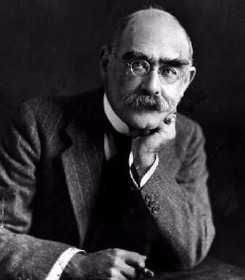
Source: File:  Rudyard Kipling.jpeg [online] see an original image at: <https://www.poeticous.com/kipling> [24 October 2015].


With questions raised

In the House of Commons,
Came one subject discussed,
Which dealt with poets -
Subjected to military censors.

The home secretary
Was asked by Mr McNeill,
About quotes of Mr Kipling
And Mr Browning, being
Deleted from press dispatches.

A reply was given by Sir Simon
To suggest the Press Bureau
Might provide an acceptable
List of British poets  - might
That possibly prove ineffective?

With amusement provided
To the idea that the military
Did not object to poetry,
But to times of an inability
To recognize the art form.

Meanwhile Mr Outhwaite
Quizzed, if the same official
Had censored both Kipling
And Browning - Sir Simon
Replied how he thought not.

The belief was suggested
That the Browning quote,
That appeared in a despatch,

Had come from an accredited
Front line correspondent.

The quip reply by Mr McNeil,
Was asking for reassurance
That two separate people
Were responsible - Afterwards
Mr Simon made a response.

The Home secretary, who 
Had raised this issue,
From then on  prompted
All censors to; 'meditate
The thankless muse.'

by Jamie Mann.

Anon.,1915. Censors and The Poets - 'No Military Objection'. The Daily Telegraph, [online] 22 October. P.6. Col.2. Available at: http://www.telegraph.co.uk/news/ww1-archive/11936818/Daily-Telegraph-October-22-1915.html [Accessed: 24 October 2015].

Mann, J., 2015. 100 years Ago - Poems by Jamie Mann. [letter] (Personal communication, 24 October 2015). 


#WW1 #WW1centenary #GreatWar #WW1poem #GreatWar #WW1centenary #worldwarone #worldwaroneremembered #WW1England

Friday, 23 October 2015

Poem ~ Cavell: Shock in America - Saturday, 23 October 1915


Source: File: Execution of Edith Cavell cartoon.jpeg  [online] see an original image at: <http://www.trenchartofww1.co.uk/edith_cavell_44.html> [23 October 2015].

By way of American media, a new level
Had shifted from indignation at Edith Cavell's
Execution; 'horror and disgust' of brutality
Of German military, in opposition of American
Plea and premeditated murder of a woman.

In a complete report, The New York Herald
Predicted waves of horror about the world;
In a killing of a nurse, in a matter of military
Routine - New York Tribune told of a German
Woman in Britain given a lenient sentence.

Could then German policies or conscience
See mercy towards woman as a weakness?
The British Telegraph sported American unity
Against the island's enemy - who would pay
Dearly for loathing raised in both countries.

For some there was no surprise in atrocities
Carried out in Belgium; 'Zabern military
Despotism’ seemed to have no limitations -
Edith Cavell's unapologetic murder might only
Increase recruiting, as any Zeppelin raid.

Back to an American view came Wall Street
Journal, in asking if it would be too much
To request Germany to promise to halt such
Actions on women and to stop such murders?
Or maybe this was merely for amusement?

German-American viewpoint also expressed
An indignity, via editor of Staats Zietung,
Herman Ridder spoke; Cavell being executed
As an unnecessary shock - while Secretary 
Of State, Mr Lansing, was asked for opinion.

Would there be protests or action taken?
But the deed was made and anything done
After would have no viable effect - an equal
Opinion from Washington President Wilson
Said nothing might improve this situation.

Maybe America was at war,
In everything but taking arms?

by Jamie Mann.

Anon.,1915. America Roused - 'Horror and Disgust.' The Daily Telegraph, [online] 23 October. P.10. Col.1. Available at: http://www.telegraph.co.uk/news/ww1-archive/11936838/Daily-Telegraph-October-23-1915.html [Accessed: 23 October 2015].

Mann, J., 2015. 100 years Ago - Poems by Jamie Mann. [letter] (Personal communication, 23 October 2015). 


#WW1 #WW1centenary #GreatWar #WW1poem #GreatWar #WW1centenary #worldwarone #worldwaroneremembered #WW1America

Thursday, 22 October 2015

Poem ~ Anti-Protestor Lady - Friday, 22 October 1915


Impression sketch of Anti-Protestor Lady  - by Jamie

Wife of a major, Mrs Templar,
Strolled in the company of a friend -
The widow of a Colonel Finch -
The two women were out walking
On Tuesday 19 October.

In Farnborough on Alexandra road,
They encountered the presence
Of a William Hogg who, aged 47, was
Voicing his opinion, by process
Of a speech out in the open.

A few people were already
Gathered, when they both stopped
To watch - Hogg's statement
Was they were, 'sending them out
To murder them!'

In the obvious nature of referring
To troops, Mrs Templar gave
Her reaction, to call Mr Hogg a traitor.
The speaker stopped to ask
Her to come closer and say that.

In doing so Mrs Templar
Said how he was not only a traitor,
But a damned one at that -
The scene led to Mr Hogg's to appear
At Aldershot Police Court.

Mrs Templar said in evidence,
That her language could
Not have any excuse - as that came
To mind in condemnation,
In witness to that terrible thing.

After Mrs Finch confirmed
Events, Mr Hogg's plea was not guilty -
The son of a dean of church
Of Ireland - who had served through
The South African war.

This though seemed to make
No difference to court,
As Mr Hogg was found guilty; given
A choice of either a month
In prison or payment of £5 fine.

by Jamie Mann.

Anon.,1915. Patriotic Lady's Protest. The Daily Telegraph, [online] 22 October. P.12. Col.5. Available at: http://www.telegraph.co.uk/news/ww1-archive/11936818/Daily-Telegraph-October-22-1915.html [Accessed: 22 October 2015].

Mann, J., 2015. 100 years Ago - Poems by Jamie Mann. [letter] (Personal communication, 22 October 2015). 


#WW1 #WW1centenary #GreatWar #WW1poem #GreatWar #WW1centenary #worldwarone #worldwaroneremembered #WW1England

Wednesday, 21 October 2015

Poem ~ Habits of a Turkish Sniper - Thursday, 21 October 1915


Source: File: Gallipoli 1915 a sniping pair.jpeg An observer is looking for targets through a periscope, while the sniper is ready with rifle with periscope sight Photo taken by a soldier of the London Rifle Brigade (1/5th Battalion, The London Regiment) - [online] see an original image at: <https://www.awm.gov.au/collection/A05767/> [21 October 2015].

Back two months to Summer’s August
Date 25th the location Gaba Tepe, Turkey.
In the midst of the Dardanelles Imperial
Force Representative, Captain Bean
Told of the Turkish sniper’s ways.

Another environment; hot open spaces
In which to fight an opposition, whose
Acquaintance of rocks and gorse gave
Challenge for a determined invader.

Not the glutinous mud of Flanders
Nor the altitude of Alpine mountains -
But a long open valley, once silent -
Then filled with concealed fighters,
Those being the Turkish snipers.

Captain Bean's explanations gave
Two likely ways to deal with situations
Of the waiting, watching gunmen -
With ideas out of theoretical manuals.

One way to build across valley's length,
An imperial formation of a sandbagged
Wall - alternatively to put in place
A counter sniper buttress  - this would
Allow a man to stroll in sight of enemy.

The idea was that the Turkish shooter
Would find a score of rifle fire from
Hidden posts, would get bullets home -
Such is theory’s extension of cover fire.

An obvious strategist’s actions that sets
To protect advancing body of troops,
As they set from shelter of one trench
On way to take next - Thus this was
Adoption taken on by Anzac presence.

Assigned by that line’s Australian
Officer, one New Zealander was given
Reign to organise system of protection -
A sport that appealed to all Anzacs.

In tourist’s approach they made out
Lay of the land hillsides and valleys
Came under close scrutiny - in days
They were familiar with each and every
Hole, tunnel or corner of the enemy.

By recognition respect of the bravery
And cleverness of the Turkish sniper,
Realization of the fire he was under set
Him to suggest alternative source of fire.

The brave Turk took to stand breast
High at night, to face flashes shot
From a dozen loopholes - who then
Are countered as that lone gunmen,
A volunteer target draws their fire.

In darkness of the Gaba Tepe valley,
Silence was broken - snaps and cracks
Of flashes - like momentary candles -
Flash and speed in hopeless mockery.

Night firing in Dardanelles lacked
Accuracy - the Turks that lean from
Parapets, to attempt to focus down
On any possible figures in gullies -
Waste their shots over opposition.

Lights like star flashes - night skies
Merge with earth to form harmless
Night snipers - but in daylight’s promise
A periscope of a Turk was dangerous.

Endeavours came in all types and sizes;
Endless mirrors on sticks, in cases
Of metal, with dead and green leaves -
As a sandbag or sacking shreds,
To be part of a torn sandbag in wind.

A small tubular type, believed bullet
Proof, distracted by a larger dummy
Or even waved back and forth briefly;
All the cleverest types being smashed.

Night is when work was carried out
With the Turk no different - in pitch
Dark they left their murky trenches,
To curse as they stumbled amid scrub;
Sound and smell drift out to watchers.

The noise of work; a shovel or carpentry.
Then by light a newly built V, with hole
For a sniper appears, or a new sandbag -
Obvious to Anzac sniper who shoots it.

In one strange experiment one morning,
There appeared a wicker work shape
Over Turkish parapet a weird beast -
Between a pig and alligator - a snout
And openings like eyes, looking out.

Warily, not knowing it’s meaning, this
Thing was watched until one Anzac
Fired at it - paused to reload to see
The beast look directly towards him.

With no hesitation he fired rounds
Into its muzzle and the construction
Broke, being ripped to tiny bits, never
To reappear - Such strange sports
Captain Bean describes never ended.

Only after the British army landed in
Suvla Bay, Anzac snipers assigned
To join them - having lost sportsman
Who had been their first  organizer.

Within that July and August standoff
Another Australian, a polo player
Took over - then recalled to an attack
Turks on 6 August, before his snipers
Were ready, he fell amid the scrub oak.

by Jamie Mann.

Anon.,1915. Epic of Anzac -The Turkish Sniper. The Daily Telegraph, [online] 21 October. P.7. Col.1. Available at: http://www.telegraph.co.uk/news/ww1-archive/11936798/Daily-Telegraph-October-21-1915.html [Accessed: 21 October 2015].

Mann, J., 2015. 100 years Ago - Poems by Jamie Mann. [letter] (Personal communication, 21 October 2015). 


#WW1 #WW1centenary #GreatWar #WW1poem #GreatWar #WW1centenary #worldwarone #worldwaroneremembered #WW1Dardanelles